


China’s rural reform changed not only policy content but also how policy was made. Localities and grassroots actors gained limited room to test and shape policy, while the centre endorsed and promoted successful practices. Yet no complete, institutionalised system of decentralisation emerged, and local experiments often proceeded under ambiguous conditions. Zhao Shukai calls this a “limited opening of policymaking power,” a defining feature of Chinese politics during the reform era.
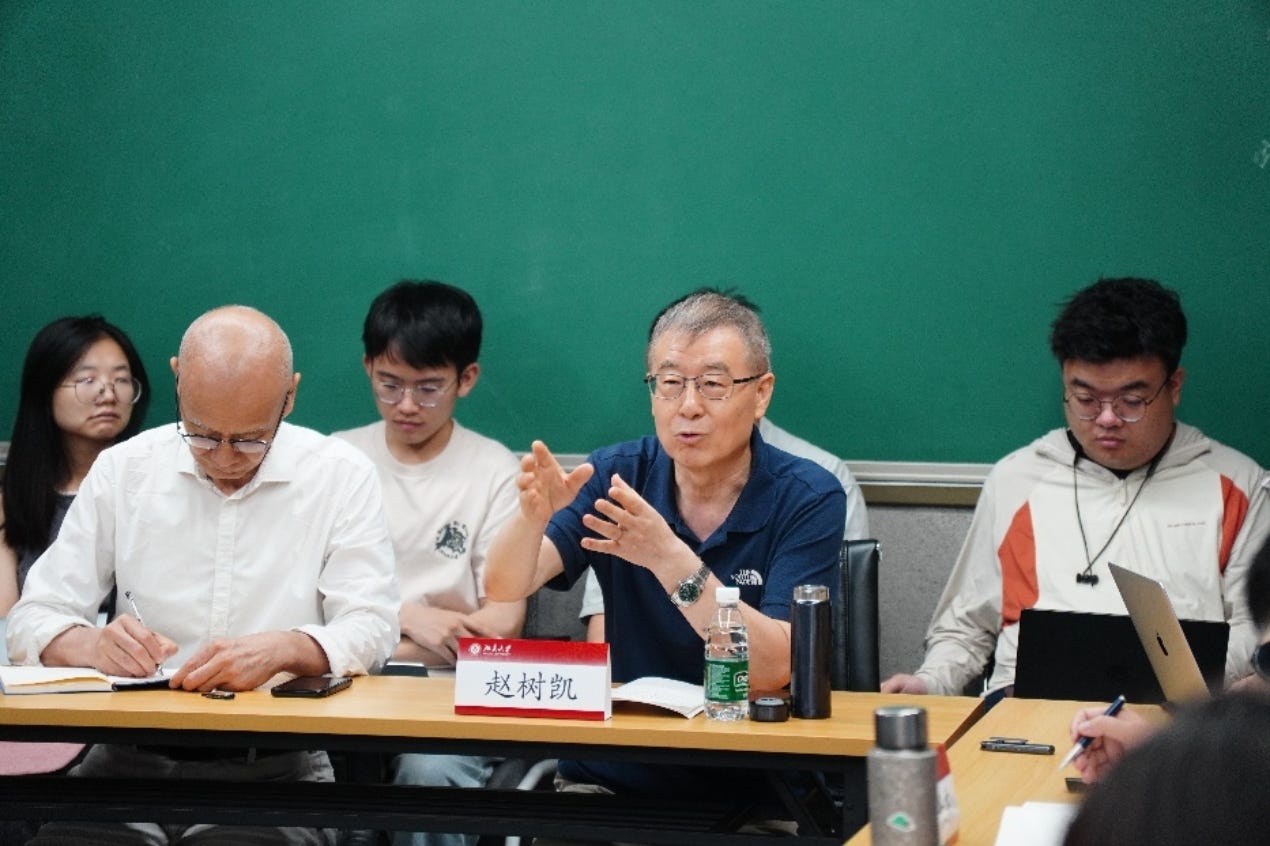
Zhao Shukai (赵树凯; b. 1959) is a Chinese official of rural policy and governance. From 1982 to 1989, he worked at the Rural Policy Research Office of the Communist Party of China Central Committee’s Secretariat (later reorganised as the State Council’s Rural Development Research Centre and subsequently the Research Centre of Rural Economy under the Ministry of Agriculture and Rural Affairs). Starting in 1990, he served at the Development Research Centre of the State Council, China’s government cabinet, holding roles including Director General of the Rural Department’s Organisation Research Office and Director General of the Information Centre.
This is the fourth instalment in Zhao Shukai’s series, Reflections on the History of China’s Rural Reform. The Chinese original is available on the WeChat blog 九号院时刻 (No. 9 Courtyard Moment).
— Yuxuan Jia
赵树凯:农村改革史是”政策权”变迁史
——农村改革史阅读随笔(4)
Zhao Shukai: The History of Rural Reform Is a History of Shifts in “Policymaking Power”
—Reflections on the History of China’s Rural Reform (IV)
June 2026
For years, accounts of China’s rural reform have focused heavily on economic growth, changes in property rights, and institutional innovation, while paying notably less attention to the mechanisms through which reform itself came about.
In my recent essay, “Reflections on the History of China’s Rural Reform (III),” I argued that “the history of rural reform is, first and foremost, a political history.” That essay sought to move beyond a purely economic interpretation, emphasising that rural reform was above all a product of political change, that shifts in policy arose from shifts in politics, and that the course of rural reform reflected an adjustment in political relations between the state and the grassroots. My purpose was to redirect scholarly attention from the outcomes of reform to its causes, and from institutional change to changes in the structure of power.
Yet “political history” remains a fairly broad concept. What, exactly, were the political changes that drove rural reform? How did political power shape policy change? And what powers were reallocated in the process? These questions merit further exploration. In this essay, “Reflections on the History of China’s Rural Reform (IV),” I therefore introduce the analytical concept of “policymaking power.”
By “policymaking power,” I mean the power to determine the substance of policy, alter its direction, define its boundaries, and choose how it is to be implemented. This differs from administrative power in the ordinary sense. Administrative power is primarily the power to carry out policies that have already been established, whereas policymaking power is the power to determine the policies themselves. Rural reform involved more than changes to the economic system or political change in a general sense. More fundamentally, it was a process in which policymaking power, once highly centralised, was gradually opened up to a limited extent and reallocated. In this sense, the history of rural reform is first and foremost a history of shifts in policymaking power.
The emergence of the household responsibility system, the collapse of the people’s communes, and the rapid transformation of long-established institutions all show that rural reform was primarily political rather than economic. More specifically, it involved a redistribution of policymaking power. Rural reform is therefore first and foremost a history of shifts in policymaking power.
During the people’s commune era, power over rural policy was highly centralsed. Higher authorities made uniform decisions about what was to be produced and planted, how output was to be distributed, how labour was to be organised, and how cadres were to be evaluated. They even determined many aspects of farmers’ everyday lives. Grassroots cadres had managerial authority but no genuine power to make policy. Farmers were even more clearly the objects of policy rather than participants in policymaking.
The most serious problem with this highly centralised structure was that higher authorities held the power to make policy but struggled to obtain accurate information about conditions on the ground, while those at the grassroots understood the actual situation but had no power to adjust policy. As a result, the gap between policymaking and practical needs grew ever wider.
It was precisely this structure of policymaking power that the earliest reforms challenged. Household contracting did not initially alter the system of land ownership; instead, it broke through the existing allocation of policymaking power. Without prior approval, farmers chose to adopt a new way of organising production. Although this was not officially permitted at the time, it helped address practical production problems. The significance of household contracting therefore lay not only in the new system itself, but also in the fact that, for the first time, people at the grassroots exercised some of the policymaking power previously held by higher authorities.
Policy breakthroughs in Sichuan, Anhui, and elsewhere followed the same pattern. The early reforms were not based on a unified plan from the central government. Instead, local cadres and farmers experimented in response to practical pressures, giving local areas limited room to test new policies. Reform thus developed from the bottom up. From this perspective, rural reform was a process of reallocating policymaking power between the central and local governments, and between higher authorities and the grassroots.
Many of the major changes that occurred during the early years of reform and opening up can be understood from the perspective of policymaking power. The central government, for example, began allowing localities to “experiment,” different regions to adopt different approaches, the grassroots to explore new institutional arrangements, and some areas to move ahead before their experience was reviewed and assessed. What truly changed was not any single policy, but the process through which policy was made.
Under the previous model, the centre formulated policy and the localities implemented it. After reform began, the logic gradually shifted: localities explored new policies, and the centre subsequently endorsed them.
This may appear to have been merely a procedural adjustment, but it represented an important change in the structure of power. The household contract responsibility system was able to spread rapidly not simply because it produced good economic results, but, more importantly, because a new mechanism for exercising policymaking power took shape during the reform process. The grassroots gained some room to experiment, localities gained some room to innovate, while the centre endorsed and promoted successful approaches.
This shift had far-reaching significance for political development. Reform had long been understood mainly as a change in policy content — for example, the shift from collective to household farming, or from unified state purchasing and distribution to market exchange. More important, however, was the change in the policymaking process itself. Changes in policy content were the result; changes in the distribution of policymaking power were the cause.
The various reform breakthroughs would not have been possible had policymaking power remained highly concentrated rather than becoming somewhat more widely distributed. The nationwide wave of reform that followed could not have emerged without giving the grassroots limited room for policy innovation. The deepest significance of rural reform therefore lies not in the transformation of agricultural production, but in the transformation of how policy was made.
This shift, however, was not a simple, straightforward process of decentralisation, as the reform era did not establish a fully institutionalised system of devolving power. Local policy breakthroughs generally occurred under ambiguous circumstances. The central government neither explicitly authorised them nor firmly prohibited them. Instead, it observed and tolerated these experiments before reviewing the experience and promoting successful practices. This condition can be described as a “limited opening of policymaking power.” Such limited openness was a defining feature of the way Chinese politics operated during the reform era.
Looking more closely, the success of China’s rural reform may lie not merely in the household contract responsibility system itself, but in the creation of a new mechanism for policymaking — one that allowed the grassroots to identify problems, localities to propose solutions, and the central government to draw lessons from their experience. In other words, the most important institutional innovation of the reform era may have been not the contracting system itself, but a new way of exercising policymaking power. If rural reform is understood as political history, this idea can be taken a step further: it is a “history of policymaking power.”
The most important aspect of political change is neither a change in leadership nor simply an adjustment to organisational structures, but a change in how policymaking power is allocated. Reform was defined not only by changes in policy, but, more fundamentally, by changes in who decided policy, how it was decided, and how it took shape.
In this sense, the history of China’s rural reform is not only a history of agricultural development, economic reform, or political change. It is first and foremost a history of the continual adjustment, reallocation, and reopening of policymaking power. This may be the key to understanding how rural reform came about.

Zhao Shukai: the policy failures that enabled China's rural reform

In the following essay, Zhao Shukai (赵树凯; b. 1959) argues that rural reform was not the result of far-sighted planning or the guidance of some enlightened “thought” or “theory”, but was driven largely by farmers’ own innovations, which policymakers gradually accepted after failing to suppress them.
Zhao Shukai: China’s Rural Reform Began with Political Change

China’s rural reform is commonly recounted as a series of policy breakthroughs, above all the shift from collective to household farming. Zhao Shukai, however, argues that the political changes that preceded — and made possible — policy shifts should not be overlooked. A less monolithic distribution of power at the top, together with growing disagreemen…
Zhao Shukai: From National Policy to Local Politics

Regional stereotypes are a staple of Chinese humour: Shandong is associated with bureaucracy and protocol, Sichuan and Chongqing with bluntness, Beijing with political savvy and grand talk, and Shanghai with commercial pragmatism.
The Politics of Policy Research in China

In China, the boundary between politics and policy is often extraordinarily blurred. Yet very few people — especially those who have worked inside the system — are able to explain, with the benefit of deep experience in China’s Party-state apparatus, how the two relate to each other, where they should be distinguished, and why that distinction matters.
Zhao Shukai: Ghostwriters of Reform

Behind China’s big policy documents and set-piece speeches stands an anonymous guild of wordsmiths whose drafts have nudged the course of reform as surely as any the leaders who sign them. One of them, veteran rural-policy insider Zhao Shukai, looks back on four decades in the engine room of official document writing to reflect on what it means to “danc…
Zhao Shukai: How China Allowed Private Employment

China’s removal of restrictions on private employment was gradual and contested. It unfolded through local experiments involving farmers, fishponds, and small workshops, amid conflicting instructions from senior leaders and repeated decisions to defer a definitive answer.
Zhao Shukai: where Ezra Vogel got it wrong

Zhao Shukai (赵树凯; b. 1959) is a Chinese official of rural policy and governance. From 1982 to 1989, he worked at the Rural Policy Research Office of the Communist Party of China Central Committee’s Secretariat (later reorganised as the State Council’s Rural Development Research Centre and subsequently the