


China has no shortage of assets, but too few are worth owning. Li Xunlei, chief economist at Zhongtai Financial International Limited, an investment bank, explains that years of investment-led expansion have increased productive capacity faster than final demand, depressing prices, profits and corporate returns. Meanwhile, China’s vast money supply leaves abundant capital competing for the few high-quality assets available, driving funds into government bonds and a narrow group of highly valued technology companies.
Where, then, do the investment opportunities lie? Li sees AI and silicon-based technologies as the defining long-term investment theme, although better entry points may emerge only after the current bubble deflates. He also identifies opportunities in M&A, as Chinese companies seek to build scale; strategic resources, whose scarcity value will increase as global supply chains fragment; undervalued large-cap and traditional companies, which may benefit from a valuation re-rating as China’s equity market matures; consumer stocks, where policies to raise household incomes could create scope for recovery; and property in major cities that continue to attract population inflows.
Li has kindly reviewed this translation.
—Yuxuan Jia

Li Xunlei delivered this speech on 28 May 2026 as part of TAIXUE, a TED-style programme produced by the New Economist think tank. This article was prepared from a recording of the event and published on 11 August on the think tank’s official WeChat blog.
李迅雷:“资产荒”的背面
Li Xunlei: The Other Side of the Asset Shortage
Hello, everyone. I’m Li Xunlei, and the title of my talk today is “The Other Side of the Asset Shortage.”
Many countries, including China and the United States, are experiencing asset shortages to varying degrees. What is causing these shortages? What are the underlying factors?
Truth Behind Asset Shortage: A Scarcity of High-Quality Assets
Let me start with China. Before 2000, China had a shortage economy. In 1994, CPI inflation reached 23%; inflation was high and goods were in short supply. As the market economy developed and prospered, the supply of goods steadily increased. By the early 2000s, goods were already in relative surplus.
The Shanghai and Shenzhen stock exchanges were established in 1990, and stocks, as equity assets, gave ordinary people another investment option. Because the supply of stocks was limited at the time, share prices were bid up. This was a period of capital scarcity, which lasted until around 2015, when supply and demand in the capital market reached a balance and share prices fell markedly. Any market economy will go through a transition from a shortage of goods to a surplus, and from capital scarcity to a relative surplus of capital.
Yet even when capital is abundant, particular types of assets can remain in short supply. In 2006, I wrote an article titled “Buy What You Cannot Afford,” [use leverage if necessary to buy valuable assets before they become even less affordable] which captured expectations of rising asset prices at the time. In 2018, I wrote another article titled “Buy What You Cannot Get” [invest in genuinely scarce assets that money alone may not be enough to secure]. The point was that while assets were abundant overall, attractive, high-quality assets remained in short supply: even if you wanted them, you could not necessarily obtain them. Today, we face a shortage of silicon-based assets, especially chips. That is why the share prices of some listed chip and AI companies have been bid up so sharply.
Every economy follows a similar pattern as it develops.
I would now like to discuss whether there is a bubble in the U.S. stock market. Judging from this chart, I believe there is.
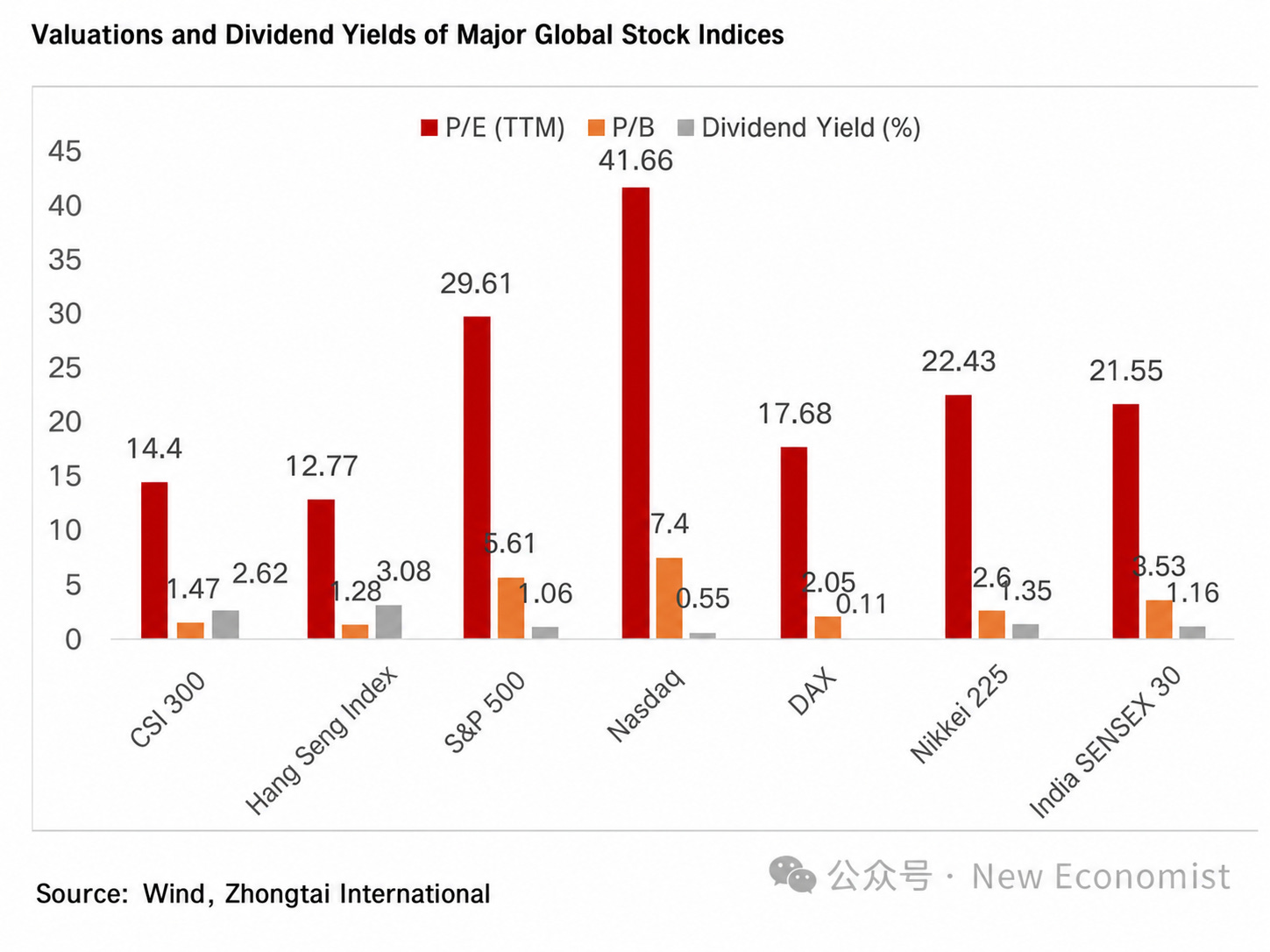
For example, the Nasdaq’s average price-to-earnings (P/E) ratio has risen above 40, while the S&P 500’s has reached 30. The United States is once again facing inflationary pressure. Against this backdrop, P/E ratios should not be so high; in my view, they should come down. A 2% risk-free rate, for example, corresponds to a P/E ratio of 50, while a 5% rate corresponds to a P/E ratio of 20. With the yield on the 10-year U.S. Treasury now at 4.7%, current P/E ratios are clearly on the high side.
However, the U.S. stock market has also become highly polarised: a small number of companies have created most of the value, while the majority have created little or none. According to my calculations, since 2010, just 6.3% of U.S.-listed companies have generated all of the net increase in market capitalisation across a universe of roughly 10,000 companies. More than 5,000 of those companies have since been delisted.
This polarisation is severe: both trading activity and profits are increasingly concentrated among the market leaders. That is also a defining feature of the AI era.
Although China’s A-share indices have delivered impressive gains this year, the rise has been concentrated mainly in ChiNext and the STAR Market. According to the latest figures, the STAR 50’s P/E ratio has exceeded 170, while the median P/E ratio is approaching 100 — significantly higher than the Nasdaq’s.

The shortage of attractive investable assets is now clearly visible. The prices of already highly valued assets continue to rise, while the 10-year government bond yield remains low. Generally speaking, the 10-year government bond yield should move broadly in line with nominal GDP growth. U.S. nominal GDP grew by 5% last year, for example, and the 10-year Treasury yield is now 4.7%. China’s nominal GDP growth is around 4%, yet the yield on its 10-year government bond is only 1.7%. Clearly, this shortage has driven large amounts of capital into the government bond market as well.
But do high P/E ratios necessarily imply strong growth? I compared corporate returns in China and the United States. In China, the average ROE of A-share companies was 7.5% in the first quarter. By contrast, the average ROE was more than 18% for companies in the U.S. S&P 500 and more than 20% for those in the Nasdaq. Moreover, the ROE of Chinese A-share companies has been gradually declining over the past decade, which helps explain China’s emphasis on high-quality development.
Judging from the performance of listed companies, growth remains lacklustre and returns are not particularly satisfactory. The current A-share rally has therefore not been characterised by a clear improvement in earnings or fundamentals; it has benefited more from the AI wave.
At the same time, China’s money supply is enormous. The country’s M2 balance has reached RMB 353 trillion, equivalent to roughly US$50 trillion. That is larger than the combined total for the United States and the euro area.
So why is China experiencing an asset shortage? Because too much money is chasing too few high-quality assets. That is the background I wanted to set out.
Global Polarisation Is a Mathematical Phenomenon
Once an economy reaches a certain stage of development, disparities inevitably emerge. This appears to be almost a mathematical phenomenon. In 1896, the economist Vilfredo Pareto observed that 20% of Italy’s population owned 80% of its land, an observation that later gave rise to the 80/20 rule. To illustrate the point, imagine 200 strangers entering this theatre, with each person given 100 coins. In every round, everyone gives one coin to another participant chosen at random. The rules are fair and transparent.
Everyone starts with the same 100 coins. But what happens after 20,000 rounds? Twenty percent of the participants end up holding 50% of all the coins. In other words, even when the rules are fair, open, and impartial, and everyone starts from the same position, the outcome can still be unequal.
It has been 81 years since the end of World War II. During that period, the rules have not been fair, nor have the starting points been equal. This has given rise to widespread structural and cyclical problems, as well as rising debt across society. The Pareto distribution also suggests that if the rules remain unchanged and the game continues, disparities will grow increasingly pronounced.
How have governments around the world responded to the many problems we face? By borrowing.
U.S. debt now stands at around 125% of GDP. Federal government debt has reached US$39 trillion, and annual interest payments exceed US$1 trillion. The debt burden is considerable.
This brings me to another concept: the macro leverage ratio. Governments borrow; so do households and businesses. Economic growth across society has therefore become debt-driven. In the past, growth was powered by gains in labour productivity and industrial development. At this stage, however, economies around the world are under strain.
This is the “paradox of peace.” Everyone longs for peace, and peace has indeed brought enormous benefits: longer life expectancy, greater accumulated wealth and better infrastructure. These are all positive developments. On the other hand, the widening gap between rich and poor has intensified social tensions. Friction between individuals has increased, as has conflict between countries. Tensions between humanity and nature have also intensified; the three years of the pandemic, for example, reflected such a conflict.
In this day and age, society continues to advance and develop. At the same time, prolonged peace has meant that there has been no large-scale “reset.” Historically, major population declines have often resulted from war and disease. The world’s population has grown from 2.5 billion at the end of World War II to 8.1 billion today, and that expansion has intensified conflict between humanity and nature, among other problems.
Polarisation is an inevitable consequence of development, while the widening wealth gap is one of its negative by-products. We have to recognise this. In the U.S. stock market, for example, the top 1% own about 50% of stock-market wealth, while the bottom 50% of investors own only around 1%. Income and wealth disparities have become common worldwide. The top 1% generally own 10%–20% of total wealth, while the top 10% own more than 60%. As markets fluctuate and evolve, only a minority consistently make money; most people do not. This is a global phenomenon.
Structural Problems in China’s Economy
Every country faces a different set of circumstances. The United States is under inflationary pressure because it has shifted a large share of its manufacturing overseas. China, as a late-comer, has steadily increased its share of global manufacturing and now accounts for nearly one-third of global manufacturing value added. China therefore needs strong exports; otherwise, it will face pressure from overcapacity.
China accounts for 17% of the world’s population but around 30% of global manufacturing capacity, so it is bound to be a major exporter. When external demand weakens, the pressure on China becomes considerable. This helps explain why prices in China have remained subdued over the past 15 years.
According to my calculations, China’s producer price index (PPI) recorded virtually no cumulative increase from 2010 to 2025. The PPI was essentially flat over those 15 years, while the CPI rose only modestly. This is clearly related to China’s production capacity. Chinese exports have remained strong, but much of that strength has come from exchanging lower prices for higher volumes. According to our estimates, China’s export price index fell by 19% between 2023 and 2025.
China’s exports have, of course, shifted from the traditional “old trio” of clothing, furniture and household appliances to the “new trio” of electric vehicles, lithium batteries and solar cells. This is a positive development. But whether this model of exchanging lower prices for higher volumes is sustainable remains an open question. On the one hand, China faces a shortage of attractive investable assets; on the other, prices remain weak.
The Central Economic Work Conference therefore called for reasonable price rebounds, which will also require a more balanced economic structure. The problem is that these structural issues have become more pronounced since China’s property market entered a downturn in 2021.
We therefore need to respect economic cycles. This cyclical downturn is closely connected with China’s demographic structure, its shrinking population, and its accelerating population ageing.
Against this backdrop, China clearly needs to boost domestic consumption. External demand depends on the rest of the world’s appetite for Chinese goods, while domestic demand remains weak. In the past, China relied heavily on investment to support domestic demand. But while investment generates demand in the short term, it adds to supply in the medium term and leads to overcapacity in the long term.
Investment can therefore stabilise growth in the short term, but not over the long term; in the longer run, it may distort the economic structure. Consumption is a slow-moving variable, whereas investment is a fast-moving one.
Nor can we ignore the income issues China now faces. According to the National Bureau of Statistics, households are divided into five income quintiles: low income, lower-middle income, middle income, upper-middle income, and high income. The distribution among these five groups has changed little, with the top 40% receiving around 70% of total income. This resembles the Pareto-type distribution I mentioned earlier and suggests that disparities in income distribution have become entrenched.
At the same time, as the population ages more rapidly and mobility declines, fewer migrant workers are moving to cities. The population is increasingly flowing towards a small number of more developed regions. In 2025, only eight provincial-level regions recorded net population inflows: Guangdong, Zhejiang, Jiangsu, Shanghai, Hubei, Xinjiang, Tibet, and Ningxia. More than two-thirds of provincial-level regions experienced net population declines. Major cities such as Shanghai, Beijing, Guangzhou, Shenzhen, Hangzhou, and Chengdu remain attractive because they offer more employment opportunities. China is therefore experiencing population decline, ageing, and polarisation. This process of metropolitanisation has significant implications for the economic structure.
Risks and Key Investment Themes in the AI Era
Having discussed the many opportunities and challenges in today’s economy, where do the investment opportunities lie in the AI era?
I mentioned the AI bubble earlier. It represents both risk and opportunity. AI marks the beginning of a new technological revolution, which will reorganise and reshuffle the global economy, industrial chains, and supply chains.
Most of the advances in human society have occurred over the past two centuries. For much of the preceding two thousand years, societies were primarily agrarian or nomadic, and annual GDP growth averaged only around 0.1%. The invention and application of the steam engine and textile machinery during the First Industrial Revolution then brought a major increase in labour productivity.
The Second Industrial Revolution was defined by the internal combustion engine and electricity. The Third was defined by computer and information technology and advances in genetics. The Fourth Industrial Revolution, now underway, is being driven by artificial intelligence. AI has the potential to reduce labour costs substantially and deliver a major boost to productivity, although those gains will need to be realised through “AI Plus” applications. It will have far-reaching effects on society, industrial and supply chains, and employment. We must seize this rare and transformative opportunity.
Naturally, people have seen the opportunity and begun pursuing it. The question is how to assess the opportunities and the risks. First, I believe AI currently carries risks. In both the U.S. stock market and other markets, valuations are elevated and bubbles may continue to expand.
When might these risks materialise? Several indicators warrant close attention, including free cash flow. As AI companies sharply increase capital expenditure, the key question is whether their free cash flow is keeping pace. The ratio of market capitalisation to free cash flow could therefore serve as an important gauge of risk. Capital expenditure by US AI companies has risen sharply in 2026, with spending by the Magnificent Seven up 70%–80% from 2025.

The second indicator is the unemployment rate. Although the Magnificent Seven now account for around one-third of total U.S. stock-market capitalisation, together they employ only about 2.5 million people, nearly half of them at Amazon. Nvidia is the largest U.S.-listed company by market capitalisation, yet it employs only about 35,000 people. That is why I believe unemployment is another important indicator to watch.
The third is inflation. If inflation remains high, the Federal Reserve will be unable to cut interest rates, and that could prick the bubble. A bursting bubble is a risk, but it is also an opportunity: it reshuffles the market, weeds out weaker players, and brings valuations back to more reasonable levels. Whether today’s Magnificent Seven eventually become eight or nine giants, or shrink to four or five, remains uncertain. The strongest will survive.
I therefore believe that the bursting of the bubble would create a major opportunity. The silicon era is already under way, making it essential to identify the market’s defining theme. In my view, AI and silicon-based technologies represent a major long-term investment theme. Computing power, data, and algorithms form the foundations of AI, and investors should actively pursue the opportunities they create.
The second opportunity, in my view, lies in positioning portfolios for de-dollarisation. The United States faces a range of problems: its debt is growing too quickly, and the dollar’s international standing is weakening. The era in which the dollar stood alone as the dominant currency is over. The future will bring a more diversified monetary system, as reflected, for example, in the recent appreciation of currencies in some resource-rich countries.
The third opportunity stems from deglobalisation. Intensifying conflict between countries is reshaping industrial and supply chains and creating strains in energy and food markets. If supply chains snap, commodities and strategically critical resources, such as rare earths, will offer the best investment opportunities.
The fourth opportunity lies in undervalued traditional industries. The very fact that they are currently out of favour may present an opportunity.
In the AI era, China must invest more heavily in computing power if it is to narrow the gap with the United States. Another arena for future competition may be commercial spaceflight. Aerospace offers substantial opportunities and advantages in both peacetime and wartime.
China still faces considerable pressure, but this could also provide impetus for future growth. The 15th Five-Year Plan therefore calls for the development of a new RMB 10 trillion smart economy. Substantial public investment and policy support for data, computing power, and algorithms can be expected, drawing on China’s capacity to mobilise resources nationwide.
These areas still account for a relatively small share of the economy, but they should become pillar industries driving future growth. Data from the first four months of this year show relatively rapid investment growth in new quality productive forces and equipment upgrades, which is also closely connected with the AI era.
Resource-related assets also deserve attention. Trading in the A-share market still shows a pronounced retail-investor bias: low- and mid-cap stocks account for a disproportionately large share of turnover. Companies with market capitalisations below RMB 30 billion generate around 60% of total market turnover but only about 10% of profits. I therefore believe that once the current rally undergoes a correction, large-cap companies may have an opportunity for a valuation re-rating.
At present, the CSI 300 trades at a P/E ratio of around 14 and offers a dividend yield of 2.6%, well above the yield on 10-year Chinese government bonds. That may also present an opportunity.
In the U.S. market, around 80% of turnover is concentrated in companies with market capitalisations above US$100 billion. China’s market will gradually evolve from an emerging market into a mature one. The process will take a long time, but the broad direction should be the same.
I would also encourage investors to pay close attention to mergers and acquisitions. Why have US companies become so large? No A-share company has yet reached a market capitalisation of US$1 trillion, and that milestone remains some way off. US companies have largely built scale and strengthened their market positions through M&A. Each of the Magnificent Seven has completed hundreds of acquisitions. China does not yet have its own Magnificent Seven, while even comparable Chinese companies have made only dozens of acquisitions. Investment opportunities may therefore emerge as Chinese companies use M&A to expand and strengthen their competitive positions.
Finally, consumption has remained weak so far this year. Total retail sales of consumer goods grew by just 1.9% year on year in the first four months of 2026. Yet when sentiment towards consumer stocks is this depressed, it may be precisely the right time to gain exposure, as markets often reverse at extremes. Portfolio positioning for 2027 should also take into account further progress towards common prosperity. Last December’s Central Economic Work Conference explicitly called for the formulation and implementation of a plan to raise the incomes of urban and rural households. I believe this policy direction could also create attractive investment opportunities.
Looking ahead, as China’s population ages, the government is likely to increase spending on people’s livelihoods, including fiscal support to help close social security funding gaps. I estimate that such spending could reach RMB 4 trillion by 2030, which could also create significant investment opportunities.
Investors need to take a contrarian approach and identify the right entry points. I also believe there are opportunities in the property market, though they will be primarily structural. As I mentioned earlier, property is an important component of household asset allocation in China. But China is now undergoing metropolitanisation, with people increasingly concentrating in major cities, provincial capitals, and cities specifically designated in the state plan [Dalian, Ningbo, Xiamen, Qingdao, and Shenzhen].
Against this backdrop, the property market may continue to adjust for some time. Investment, however, should follow the flows of people, capital, goods, and information. Investment strategies should therefore be aligned with these flows. In my view, greater concentration in major cities is a clear trend.
Overall, China’s economy is undergoing a profound adjustment, amid structural, cyclical, and institutional challenges that must all be acknowledged and addressed. At the same time, AI is likely to remain a major long-term investment theme.
I hope everyone will take a calm and objective view of China’s current economic conditions and structure, and look for investment opportunities in this rapidly changing world. That concludes my speech. Thank you.

Li Xunlei: a data-driven analysis of China’s economy challenges conventional wisdom

Li Xunlei is Chief Economist at Zhongtai Financial International Limited. Li has worked extensively at other Chinese securities banks, including Junan Securities, Guotai Junan Securities, and Haitong Securities. He is one of the most renowned chief economists among major domestic securities firms in China.
Li Xunlei: bull market boosting consumption is bearly grounded

In mainland China’s financial discourse, there’s a widely shared but largely untested belief that a rising stock market can stimulate consumption and help boost domestic demand. The logic is simple: rising stock prices fatten investor portfolios, leading to higher consumer spending, which in turn could reinvigorate economic recovery.
Li Xunlei: China Is Growing Older — and Less Mobile

A new report on China’s births, ageing, and internal migration finds that even a substantial recovery in fertility would do little to slow ageing before 2050.
Li Xunlei: one billion people in China have never been on a plane

“One billion people in China have never been on a plane” has become a minor meme to be wheeled out whenever the conversation turns to weak consumption and an economy short of effective demand. It was first put forward in early 2019 by Li Xunlei, one of the most renowned chief economists among major domestic securities firms in China, as a warning that “…
Li Xunlei warns against excessive industrial investment amid declining demand and population

Li Xunlei is Chief Economist at Zhongtai Financial International Limited and has worked extensively at other Chinese securities companies, including Junan Securities, Guotai Junan Securities, and Haitong Securities. He is one of the most renowned chief economists among major domestic securities firms in China.
Li Xunlei: Why China’s debt keeps climbing while others’ have eased

Li Xunlei, Chief Economist at Zhongtai Financial International Limited. Li has worked extensively at other Chinese securities banks, including Junan Securities, Guotai Junan Securities, and Haitong Securities. He is one of the most renowned chief economists among major domestic securities firms in China.