


The East is Read has previously published extensively on China’s domestic-demand debate, which centres on a basic question: when demand is weak, should policy focus primarily on boosting consumption, or should investment take the lead in raising employment, incomes, and ultimately consumption?
Economists including Liu Shijin, Cai Fang, and Xu Gao have argued, from different perspectives, for shifting more income and resources towards households, improving income distribution, and giving consumption a greater role in driving domestic demand.
We have also featured Yu Yongding’s contrasting view, including his rejection of a “consumption-driven” growth model and his call for greater reliance on infrastructure investment and more expansionary macroeconomic policy.
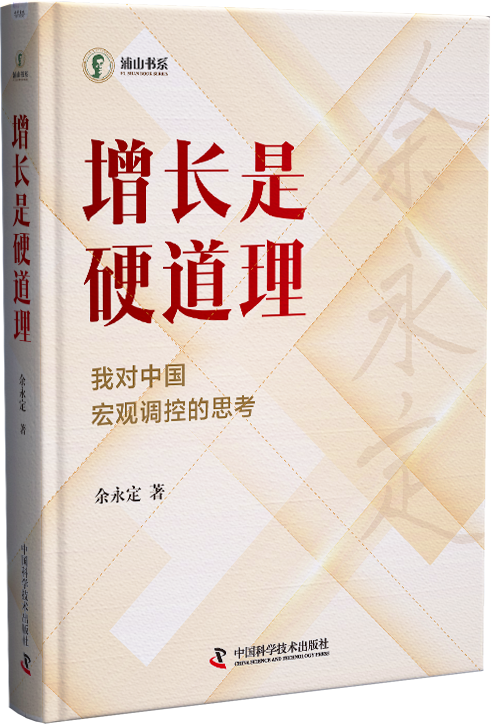
Zhang Bin, Deputy Director and Senior Fellow at the Institute of World Economics and Politics, Chinese Academy of Social Sciences (CASS), comes down firmly on Yu’s side of the debate. In the following article, he examines Yu’s recent book 增长是硬道理 Growth Is the Hard Truth and the reasoning behind its central argument.
Zhang argues that the appeal of income redistribution, social welfare, and structural reform can obscure the necessity of the traditional, textbook approach: countercyclical fiscal and monetary policy, particularly public investment.
In his view, China still needs more public investment to tackle insufficient domestic demand, with considerable room for further infrastructure spending in urban renewal, underground utility networks, public-service infrastructure, and the maintenance of existing facilities. Such spending, Zhang says, can directly expand demand and employment while raising incomes and corporate profits, which in turn supports consumption.

The article was published on 28 August 2026 in the China Economic Times, a newspaper run by the Development Research Centre of the State Council, an in-house think tank of China’s cabinet. It is also available on the official WeChat blog of the China Economic Times.
Zhang has kindly reviewed and authorised the translation.
— Yuxuan Jia
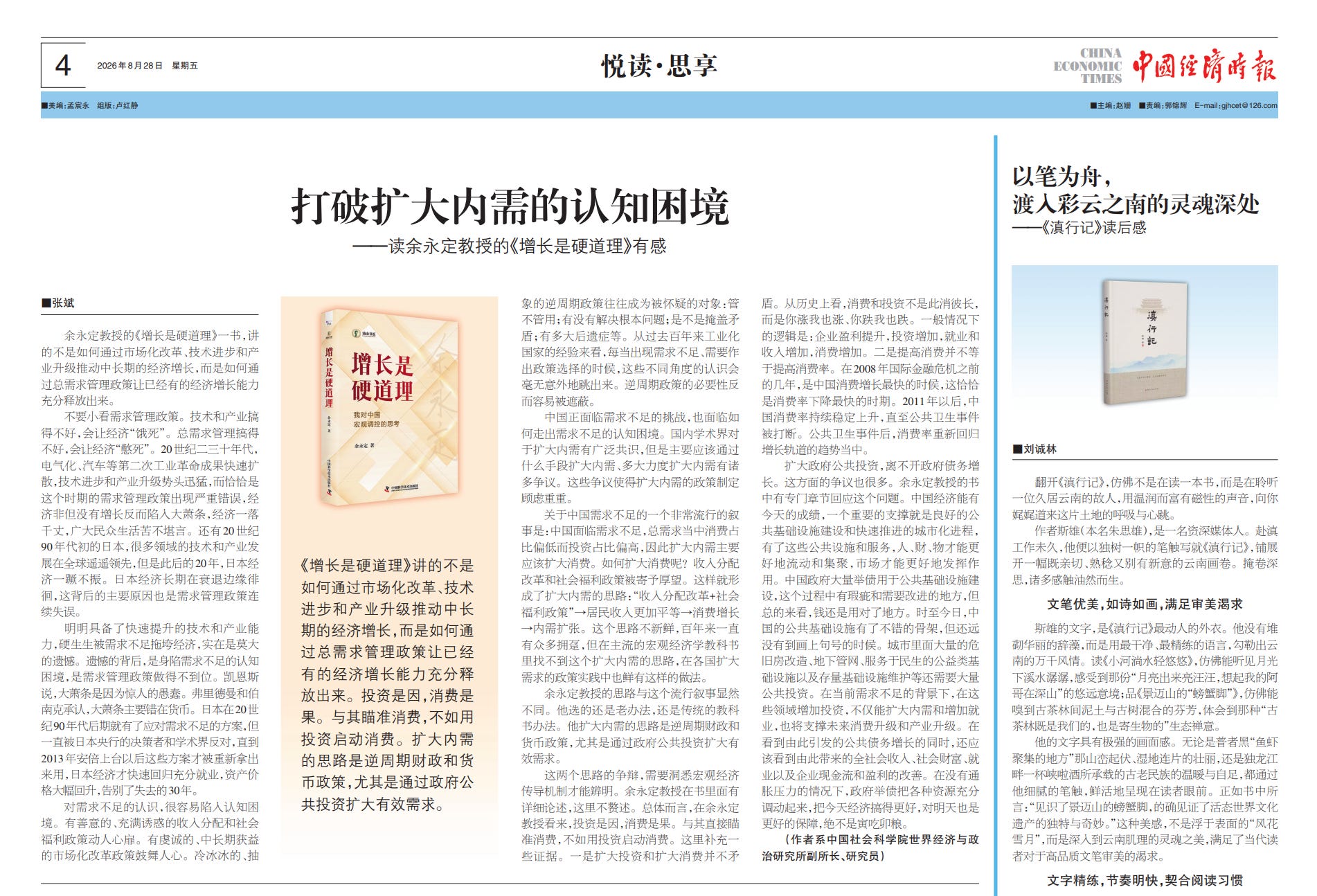
打破扩大内需的认知困境
Breaking the Conceptual Trap in Expanding Domestic Demand
Professor Yu Yongding’s book Growth Is the Hard Truth is not about how market-oriented reforms, technological progress, and industrial upgrading can drive medium- and long-term economic growth. Rather, it explains how aggregate demand management can allow an economy to fully realise the existing growth potential.
The importance of demand-management policy should not be underestimated. Weak technological and industrial development can cause an economy to “starve”; poor aggregate demand management can cause it to “suffocate.” In the 1920s and 1930s, the achievements of the Second Industrial Revolution, including electrification and the automobile, spread rapidly, while technological progress and industrial upgrading gathered momentum. Yet it was precisely during this period that serious mistakes in demand management plunged economies into the Great Depression instead of allowing these advances to translate into economic growth. Economic activity collapsed, and ordinary people suffered enormously.
Japan in the early 1990s offers another example. Its technological and industrial capabilities were among the world’s most advanced in many fields, yet the economy remained weak for the following two decades. A major reason Japan hovered on the brink of recession for so long was a succession of mistakes in demand management.
It is deeply regrettable for an economy with rapidly advancing technological and industrial capabilities to be dragged down by insufficient demand. Such an outcome reflects both a failure to properly understand insufficient demand and an inadequate policy response. John Maynard Keynes attributed the Great Depression to “extraordinary imbecility.” Milton Friedman and Ben Bernanke argued that monetary policy was largely to blame for the Great Depression. Proposals for tackling Japan’s insufficient demand had already emerged by the late 1990s, but they met persistent opposition from policymakers at the Bank of Japan and from much of the academic community. It was not until Shinzo Abe returned to office and a new policy framework was introduced in 2013 that Japan rapidly returned to full employment, asset prices rose sharply, and the country finally began to leave its “lost three decades” behind.
Discussions of insufficient demand can easily become a conceptual trap. Well-intentioned and appealing proposals for income redistribution and social welfare are naturally compelling. Market-oriented reforms, embraced for their promised medium- and long-term gains, can be equally inspiring. By contrast, cold and abstract countercyclical policies often invite suspicion: Do they work? Do they address the root problem? Do they merely paper over deeper contradictions? What lasting side effects might they leave behind?
Over the past century, whenever industrialised countries have faced insufficient demand and had to choose a policy response, these competing views have invariably resurfaced, often obscuring the need for countercyclical policy.
China is now grappling with both insufficient demand and the conceptual trap surrounding it. Although Chinese academics broadly agree on the need to expand domestic demand, they remain divided over which tools to use and how aggressively to deploy them. These disagreements have left policymakers with considerable reservations about how to expand domestic demand.
One widely held view of China’s demand problem goes as follows: China suffers from insufficient demand; consumption accounts for too small a share of aggregate demand, while investment accounts for too large a share; therefore, expanding domestic demand should focus primarily on boosting consumption.
How, then, should consumption be increased? Much hope is placed on income-distribution reform and social-welfare policies. This gives rise to the following policy logic: income-distribution reform + social-welfare policies → a more equal distribution of household income → higher consumption → stronger domestic demand.
This is hardly a new idea and has attracted many supporters over the past century. Yet this is not the standard approach to expanding demand found in mainstream macroeconomics textbooks, nor is it commonly seen in countries’ actual policy practice.
Professor Yu Yongding takes a clearly different view. He favours the established approach — the traditional textbook approach. His prescription for expanding domestic demand is to use countercyclical fiscal and monetary policies, particularly government investment in public projects, to boost effective demand.
Assessing these two approaches — one centred on consumption and the other on investment — requires a clear understanding of macroeconomic transmission mechanisms. Professor Yu discusses these mechanisms in detail in the book, so I will not repeat the argument here. Broadly speaking, in his view, investment is the cause and consumption the effect. Rather than targeting consumption directly, it is better to use investment to get consumption going.
A few additional points help illustrate the argument. First, expanding investment and expanding consumption are not mutually exclusive. Historically, consumption and investment have tended to move in the same direction rather than one rising at the expense of the other. The usual chain is: higher corporate profits lead to more investment; greater investment creates jobs and raises incomes; higher employment and incomes then support stronger consumption.
Second, increasing consumption is not the same thing as increasing the consumption share of GDP. In the years immediately before the 2008 global financial crisis, China experienced some of its fastest consumption growth, even as the consumption share of GDP was falling most rapidly. From 2011 onward, China’s consumption share rose steadily until the trend was interrupted by the COVID-19 pandemic. After the pandemic, the share returned to an upward trajectory.
Expanding government investment in public projects inevitably involves an increase in government debt, another highly contested issue. Professor Yu devotes a separate chapter of the book to this question.
One important foundation of China’s economic achievements has been its strong public infrastructure and rapid urbanisation. Public facilities and services allow people, capital, and goods to move and concentrate more efficiently, enabling the market to function more effectively. The Chinese government has borrowed heavily to finance public infrastructure. There have certainly been shortcomings in this process and areas that need improvement, but overall, the money has largely been spent where it was needed.
Today, China has built a solid basic framework of public infrastructure, but the job is far from finished. Cities still require substantial public investment to renovate unsafe and dilapidated housing, upgrade underground utility networks, build public-interest infrastructure that serves people’s everyday needs, and maintain existing infrastructure.
Against the current backdrop of insufficient demand, greater investment in these areas would not only expand domestic demand and create jobs, but also support future consumption and industrial upgrading. While such investment would increase public debt, it is equally important to recognise the gains it can bring in overall income, social wealth, employment, corporate cash flow, and profitability.
In the absence of inflationary pressure, government borrowing that mobilises underused resources and strengthens the economy today also creates a stronger foundation for tomorrow. It is by no means simply a case of borrowing from the future to pay for the present.
Yu Yongding: There Is No “Consumption-Driven” Growth Model, and China’s Infrastructure Investment Is Far From Saturated

For a growing number of economists, both outside China and increasingly within it, the central question facing the world’s second-largest economy is its exceptionally weak domestic demand. Beijing, at least rhetorically, has moved in the same direction. Over the past two years, “
Yu Yongding on the Economic Priorities of the 15th Five-Year Plan

In this latest discussion of the 15th Five-Year Plan, Yu Yongding, one of the most influential economists in China, argues that the country should treat development and security as equally central in a far harsher external environment; set a specific GDP growth target rather than a vague range; avoid treating total factor productivity as a rigid policy …
China’s consumption problem is an income distribution problem

Last month, Cai Fang, former Vice President—meaning Vice Minister—of the Chinese Academy of Social Sciences (CASS), wrote in the Communist Party of China (CPC)’s flagship journal Qiushi that China should optimise its income distribution structure through institutional development.
Part I of Xu Gao: corporate gains fail to boost household income, leading to over-investment & excessive savings in China

On March 13, 2024, the National School of Development (NSD), Peking University, in collaboration with Baidu Economic & Financial News, held the 68th session of the China Economic Observation Report event and launched the 30th-anniversary celebration of the NSD.
Liu Shijin’s Proposals to Turn Excess Saving into Domestic Demand

The Chinese economy has once again reached an important turning point, said liu Shijin, making reducing excessive saving and expanding final demand increasingly urgent.

It is clear that the correct debate is happening in China. I appreciate reading about the various viewpoints that are in the mainstream. Would it be so in the US, where neo-classical economics reigns supreme, where only the brave few question its outdated and erroneous models.
It is clear that Bin is argueing from a Keynesian/Post-Keynesianism perspective that is just shy of MMT. The only thing missing is explicitly addressing why China's government, as the issuer of the renminbi, is not financially constrained from making these investments.