


The Chinese economy has once again reached an important turning point, said liu Shijin, making reducing excessive saving and expanding final demand increasingly urgent.
Among his proposals are transferring RMB 20 trillion in publicly traded state-owned capital to social security funds, using more than half of macroeconomic stimulus spending to support consumption, substantially raising pensions under the basic scheme for urban and rural residents, addressing the urban–rural housing mismatch faced by migrant workers, and encouraging higher dividend payouts by both state-owned and private companies.
He argues that China’s excessive saving is closely linked to income inequality and calls for higher personal income and property taxes on high-income groups, with the aim of reducing the Gini coefficient to below 0.4.
Liu also challenges several widely held assumptions: that China’s investment-led growth model can continue largely unchanged, that raising the incomes of low- and middle-income groups is merely a social welfare issue, and that short-term stimulus can substitute for structural reform.
Liu Shijin is a former Vice President (Vice Minister) of the Development Research Centre (DRC), a comprehensive policy research and consulting institution directly under the State Council, the central government of the People’s Republic of China. He was also Deputy Director of the Economic Committee of the 13th National Committee of the Chinese People’s Political Consultative Conference (2018-2023).
— Yuxuan Jia
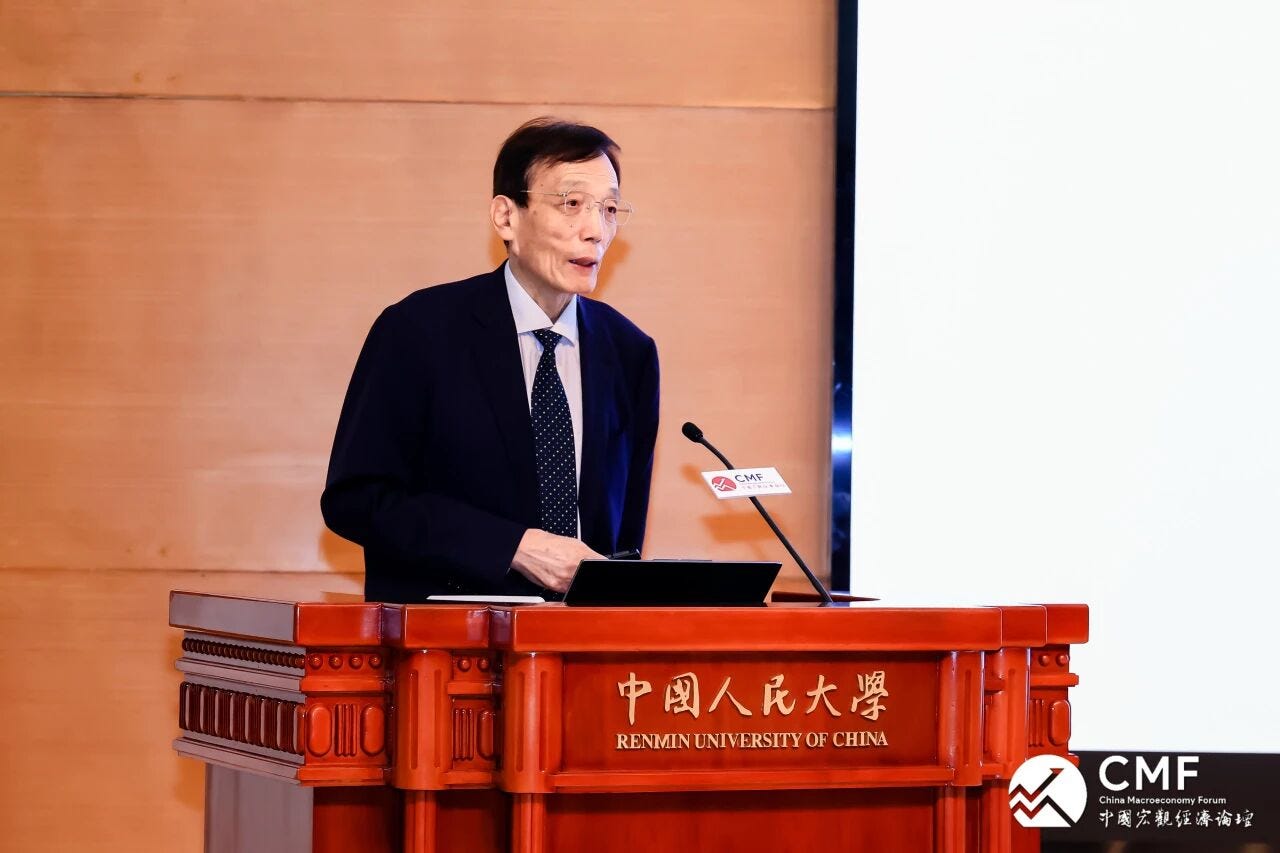
Liu made the speech on 27 June 2026 at a quarterly forum of China Macroeconomy Forum (CMF), a think tank affiliated with the Renmin Univerisity of China. A consolidated transcript was published on CMF’s official WeChat blog on 6 July.
刘世锦:深化储蓄-消费形成机制改革,尽快扭转供强需弱的不平衡状态
Liu Shijin: Deepen Reform of the Mechanisms Governing Saving and Consumption and Reverse the Imbalance Between Strong Supply and Weak Demand as Soon as Possible
At present, the imbalance between strong supply and weak demand poses a major challenge to maintaining stable growth in China. The 2025 Central Economic Work Conference clearly identified the pronounced imbalance between strong domestic supply and weak demand, as well as the shortage of effective demand, as prominent problems facing the economy.
This imbalance stems from a distorted growth model underpinned by a range of institutional and structural factors. Reversing it requires policy to focus on reforming the mechanisms governing saving and consumption, substantially reducing the saving rate, and correspondingly expanding final demand.
I. The Manifestations and Underlying Causes of Strong Supply and Weak Demand
The term “strong supply and weak demand” describes several seemingly contradictory phenomena frequently observed in the economy, sometimes referred to collectively as K-shaped development.
On the one hand, China is experiencing a surge in innovation, with significant advances in artificial intelligence, robotics, and green technology. On the other hand, economic growth remains under sustained pressure, with nominal growth falling below real growth.
Exports have expanded at an exceptional pace, and China’s merchandise trade surplus reached a record of nearly US$1.2 trillion last year. At the same time, the weakness of domestic demand has continued to intensify. Investment contracted over the whole of last year. In the first five months of this year, cumulative investment fell by 4.1 percent year-on-year, while total retail sales of consumer goods declined by 0.6 percent year-on-year in May.
China’s manufacturing sector and industrial chains are globally competitive, yet many industries face serious overcapacity, while the needs of certain social groups remain unmet.
Strong supply and weak demand are not the result of short-term economic fluctuations. They arise from a series of institutional and structural factors. These include GDP-oriented competition among local governments; the dominant role of state-owned enterprises (SOEs) and the relatively high share of state-owned capital in foundational and strategic industries; a macroeconomic policy that has sought to stabilise growth primarily through investment, particularly infrastructure investment; and an economic structure centred on manufacturing and exports.
Together, these factors have created a tilted growth model characterised by high saving, high investment, and high exports — a model that emphasises production while paying insufficient attention to consumption.
At the beginning of reform and opening up, China was a shortage economy. For a long period, when supply remained insufficient, this growth model was well suited to the country’s circumstances and offered clear advantages. Even after the economy shifted from high-speed to medium-speed growth and from supply constraints to demand constraints, the model remained highly persistent and resilient, continuing to function as long as there was still scope to expand investment.
Nevertheless, this growth model has limits. Those limits are reached when investment can no longer be expanded and begins to contract. China has now reached this point.
II. Insufficient Final Demand Has for Some Time Been the Direct Cause of Subdued Prices and Slower Growth
The relationship between strong supply, weak demand, and economic growth can be examined through the concepts of the “height” and “breadth” of growth.
The “height” of growth refers to the expansion of an economy’s growth potential through productivity gains driven by technological innovation, improved management, institutional reform, greater openness, and other factors.
The “breadth” of growth refers to the extent to which effective demand for existing productive capacity is generated across different segments of society — for example, across ten population deciles.
The height determines the potential rate of growth, while the breadth determines the rate an economy actually achieves.
Strong supply raises the height of growth, while weak demand means that its breadth has failed to expand in step. Raising the height of growth cannot substitute for broadening it and may, in some cases, even undermine that breadth. Artificial intelligence, for example, may displace existing jobs and widen income inequality.
This helps explain an apparent puzzle: why can innovation-driven development and emerging industries perform well while the overall economy remains under considerable pressure?
At this point, it is necessary to introduce the concept of final demand.
Final demand refers to the portion of GDP that does not enter another production process. It includes all consumption, together with non-productive or consumption-oriented investment, principally investment in housing, infrastructure, and other livelihood-related service sectors.
Final demand represents the true end product of economic activities. It is the part of GDP that directly serves the ultimate purpose of economic activity: meeting people’s aspirations for a better life.
GDP minus final demand consists of productive investment and net exports. Both are instrumental and ultimately serve the expansion of final demand.
For many years, consumption as a share of China’s GDP has remained approximately 20 percentage points below the international average, reflecting a structural distortion. However, the prolonged rapid expansion of real estate and infrastructure investment effectively concealed this distortion.
After 2022, the property sector contracted sharply and infrastructure investment also lost momentum, exposing the long-concealed weakness in consumption and making it a major constraint on final demand.
In recent years, final demand has slowed markedly and declined as a share of the economy. This has pushed down the GDP deflator, causing nominal growth to fall below real growth. Together, weak final demand and excessive investment — particularly excessive productive investment — have reduced capacity utilisation. When capacity utilisation falls too low, returns on investment weaken, discouraging investors from committing additional capital. This is the principal reason for the current decline in investment.
The growth of industrial value added has remained relatively solid, primarily supported by exports and, more recently, by rising capital expenditure on artificial intelligence.
In the national accounts, net exports are counted as part of national saving and correspond to lower domestic consumption. Strong exports are therefore one cause of weak domestic consumption, yet this relationship has not received sufficient attention.
III. Focus Reform on the Mechanisms Governing Saving and Consumption
Behind the imbalance between strong supply and weak demand lies a pattern of national income allocation marked by high saving and low consumption.
China’s saving rate is exceptionally high by international standards. Over the past decade or so, it at one point peaked at over 50 per cent and, despite declining somewhat in recent years, still stands above 42 per cent — far higher than the global average of around 25 per cent.
National saving in China comes mainly from the corporate and household sectors. Government saving has gradually declined and has been negative in recent years.
According to China’s flow-of-funds accounts, GDP in 2022 was approximately RMB 120 trillion and total saving stood at RMB 55 trillion, implying a national saving rate of 46 per cent and a corresponding consumption rate of about 54 per cent. Among those, corporate saving amounted to RMB 27 trillion and household saving to RMB 27.6 trillion, with each accounting for roughly half of the total.
At 22.5 per cent of GDP, corporate saving was notably high by international standards. This largely reflects the relatively small share of corporate returns on capital paid out as dividends. In 2022, corporate dividends accounted for only 10.2 per cent of Chinese households’ property income, compared with a global average of 55.7 per cent.
Historically, periods of rapid growth generated strong demand for investment funds. With external financing difficult and expensive to obtain, companies tended to rely on internal financing and retain a larger share of their earnings.
More importantly, state-owned capital accounts for a substantial proportion of total corporate capital in China, and state-owned enterprises for many years paid either no dividends or only limited dividends.
The establishment of the state-owned capital operating-budget system in 2007 changed this situation to some extent. As SOE reform deepened and the governance system for state-owned capital improved, dividend payments by state-owned capital in publicly traded companies increased. Nevertheless, many SOEs that are not publicly traded continue to pay relatively few dividends.
The corporate sector receives an excessively large share of society’s disposable income, much of which is retained as corporate saving. This produces a high corporate saving rate for society as a whole. Corporate saving ultimately has only one use: investment.
The household saving rate is also high. But a closer look at the income distribution shows that this is driven largely by the substantial savings of high-income households.
According to China Merchants Bank’s 2024 annual report, its Golden Sunflower customers — those with average daily total assets of RMB 500,000 or more — accounted for only 2.49 percent of its retail customers but held 81.90 per cent of customer assets.
Compared with 2023, Golden Sunflower customers accounted for 87.48 per cent of the net increase in customer assets. This indicates that a small group of high-net-worth customers hold the overwhelming majority of bank savings assets and that this concentration is continuing to increase. Data from other banks show similar patterns.
Some people argue that because China adds more than RMB 10 trillion in new savings each year, it should be sufficient simply to encourage households to convert some of these savings into consumption.
This view considers only the aggregate amount and ignores its distribution. It fails to recognise that high saving and low consumption are directly related to excessive income inequality within the household sector. It is therefore highly misleading, both theoretically and as a basis for policy.
IV. How to Reform the Saving–Consumption Mechanism and Reorient Policy
Investment has been contracting for more than a year, and in May total retail sales of consumer goods also fell year-on-year. This combination has not occurred since the start of reform and opening up and warrants the utmost attention.
The operation and development of the Chinese economy have once again reached an important turning point.
The most urgent task is to revive investment and restore positive investment growth. The way to achieve this is to substantially reduce the saving rate and correspondingly increase final demand.
This differs from the views of some observers, but it is crucial to understanding how the Chinese economy currently operates.
National income is divided between saving and consumption. If a high saving rate cannot be reduced, a low consumption rate cannot be increased. This is a simple but binding constraint.
Only by lowering the saving rate and expanding final demand can capacity utilisation be increased. Once capacity utilisation reaches a sufficiently high level, genuine investment demand will emerge. This is precisely the kind of investment repeatedly emphasised by the central authorities: investment backed by real demand and capable of generating returns.
If the saving rate is not reduced and final demand is not expanded — or is instead allowed to contract — while investment is forcibly increased through traditional methods, the imbalance between strong supply and weak demand will become even more severe, pushing the Chinese economy further in the wrong direction.
The key to correcting this imbalance lies in reforming the mechanisms through which saving and consumption are generated and converting excessive saving into effective consumption. Several priority areas for reform and corresponding quantitative policy objectives can be proposed.
First, reduce the overall social saving rate to below 40 per cent within a relatively short period, such as three years, and lower the corporate saving rate to below 20 per cent. Part of corporate saving should be converted into consumption, raising the overall social consumption rate to above 60 per cent. This would also be a concrete step toward achieving the 15th Five-Year Plan’s objective of increasing the household consumption rate.
A direct approach is to increase corporate dividend payout rates. Transferring a substantial proportion of state-owned capital to social security funds would, in effect, constitute a specific form of dividend distribution by state-owned capital.
Some have raised concerns about transferring state-owned capital. They argue that relatively few state-owned assets are sufficiently profitable to generate dividends; that state-owned capital in certain sectors carry heavy debt burdens, making their net asset value difficult to assess; and that state-owned capital is controlled by different departments and institutions, which may resist transferring it to social security funds.
These problems are not, in fact, difficult to resolve.
Put simply, transfers could begin with state-owned capital that is already publicly traded. The total market capitalisation of China’s A-share market is currently approximately RMB 120 trillion. A preliminary estimate suggests that state-owned capital accounts for approximately 40 per cent of this amount. A specified amount, such as RMB 20 trillion, could be transferred to social security funds.
The transfer would not alter the existing departmental or institutional affiliation of the state-owned capital. Instead, new pension funds could be established under the relevant departments and institutions to manage the transferred state-owned capital, thereby creating new operational functions and objectives.
From the perspective of the capital market, this would simply convert part of the state-owned capital into pension assets and increase the supply of long-term, patient capital.
Private enterprises should also be encouraged to increase dividend payments. Measures such as improving corporate governance, strengthening the protection of minority investors, and promoting long-term value investing should encourage companies to return more profits to shareholders through dividends, which shareholders could then convert into consumption expenditure.
Second, steadily advance tax reform, contain increases in the Gini coefficient, and gradually reduce the coefficient to 0.4 or below. This would increase society’s average propensity to consume and reduce the household saving rate accordingly.
International experience shows that economies that successfully moved from middle-income to high-income status generally had Gini coefficients of between 0.3 and 0.4, with some recording even lower levels.
A relatively balanced distribution of income allows a larger share of national income to be converted into final-demand expenditure and eases the pressure created by the release of large amounts of productive capacity accumulated during periods of rapid growth.
China’s tax system remains dominated by indirect taxes, while direct taxes such as personal income tax and property tax account for a relatively small share of total taxation.
To reform the saving–consumption mechanism, China should appropriately increase taxes on high-income groups, particularly through personal income and property taxation, thereby raising government revenue.
Some are concerned that moderately increasing taxes on high-income groups would undermine the confidence and expectations of those groups. In reality, the negative effect would be limited. It will instead strengthen the government’s incentive to protect property rights.
One argument holds that “the boundary of the capacity to tax” determines “the boundary of the protection of property rights,” because protecting property rights also means protecting the tax base.
Third, shift the focus of macroeconomic regulation and government functions at all levels from the supply side to the consumption side.
More than 50 per cent of macroeconomic stimulus expenditure should be used to address the imbalance between strong supply and weak demand, with a particular focus on building a stronger social security system for low- and middle-income groups.
There remains some confusion in society about how consumption drives economic growth.
Reforming the saving–consumption mechanism and increasing the income and consumption of low- and middle-income groups would first create new space in the consumer market. Excess capacity would then cease to be excessive and might even give way to capacity shortages, thereby stimulating new and effective investment.
Second, and more importantly, expanding consumption would allow more people, especially low- and middle-income groups, to share in the benefits of reform, opening up, and development. It would also strengthen their sense that their aspirations for a better life are being fulfilled.
Equally important, the additional consumption generated by these groups would be concentrated in developmental consumption. In effect, this is investment in human capital and a concrete expression of “investing in people.” It would provide the most important form of human-capital support for innovation-driven development.
Subsidies for the purchase of consumer goods have only a limited effect on the income and consumption of low- and middle-income groups. Policy should instead focus on two particularly prominent weaknesses: housing and social security.
A migrant worker may own a two-storey, 200-square-metre house in the countryside but return to it for only a few days each year, while spending the rest of the year crowded into a ten-square-metre basement room in a city.
According to statistical measures, this worker would have access to 210 square metres of housing. In reality, however, the worker’s living conditions are extremely difficult. Migrant workers and similar groups face a major structural mismatch between their housing resources in rural and urban areas.
Housing-support policies, together with a reorganisation and reallocation of urban and rural resources, should be used to accelerate efforts to address the housing difficulties faced by migrant workers and other new urban residents. This would also generate genuine demand, helping to stabilise the property sector and restore normal growth.
Through the transfer of state-owned assets to social security funds, fiscal subsidies, short-term stimulus funding, and improvements to social security contribution arrangements, China should seek, during the 15th Five-Year Plan period, to achieve a substantial increase in the per capita pension benefits provided by the basic pension scheme for urban and rural residents.
This scheme covers the largest number of low- and middle-income people. The increase in benefits should be aligned with the current need to expand final demand and stabilise macroeconomic growth.
Among the many consumption-stimulus policies, this reform would rank among the most effective in promoting economic growth and would play an irreplaceable role in stabilising growth.
Some people argue that increasing the pension income of elderly rural residents would have little effect on consumption. This may appear plausible at first, but it is fundamentally mistaken.
In reality, the excessively low level of pension benefits under the basic pension-insurance scheme for urban and rural residents constrains the release of society’s consumption potential in several ways.
First, it directly limits the consumption capacity of 170 million pension recipients.
Second, inadequate pensions of rural parents require their children to make larger intergenerational transfers, thereby crowding out their own consumption.
Third, it makes the 370 million people currently contributing to the scheme less secure about their future, prompting them to increase precautionary saving out of necessity.
The basic pension-insurance scheme for urban and rural residents covers 550 million people, 95 per cent of whom are rural residents. This represents approximately half of all participants in China’s pension system. They constitute both the lowest-income and the largest segment of the national pension system, while also having the highest propensity to consume.
From this perspective, the shortfall in pension income among those covered by the scheme constrains consumption growth among approximately half of China’s population. Its broad economic impact should not be overlooked.
V. Several Misunderstandings That Must Be Clarified to Reverse Strong Supply and Weak Demand as Soon as Possible
One view holds that China’s growth model, which emphasises production while giving insufficient attention to consumption, has existed for a long time. Although China has often described its development as unbalanced, uncoordinated, and unsustainable, the country has nevertheless continued to grow for many years, suggesting that this model may be able to continue in the future.
In the past, however, China remained a shortage economy for a long period. Even after the economy became constrained by demand rather than supply, there was still some room to expand investment.
Those conditions no longer exist. Investment has been contracting for an extended period, indicating that it is becoming increasingly difficult for the existing growth model to continue.
Another view holds that expanding consumption and increasing the income of low- and middle-income groups are livelihood issues that should be pursued only within available means and should not be rushed. This view had some validity for a considerable period in the past.
Under current conditions, however, unless the income of low- and middle-income groups is increased and final demand expanded, capacity utilisation cannot rise, investment growth will be difficult to restore, and actual economic growth will fall significantly below potential growth.
Increasing the income and consumption of low- and middle-income groups is therefore not merely a livelihood issue. More importantly, it is a matter of stabilsing macroeconomic growth.
In the past, when growth weakened, China focused on investment. At the present stage, it must focus on consumption. The underlying logic is the same, but circumstances have changed, and the areas in which growth potential can be found are now different.
Another view holds that although structural and institutional reform is important, “distant water cannot extinguish an immediate fire,” and short-term policy should therefore continue to rely on macroeconomic stimulus.
Structural reform and macroeconomic policy each have their own role. There is no need to choose one while excluding the other. Combining the two will often produce better results. In fact, some structural reforms, such as transferring state-owned assets to social security funds, can produce results in the short term.
Other reforms, such as reducing the Gini coefficient, may appear slow in the short term once policy goals have been set and implementation has begun, but can prove relatively fast over a longer time horizon.
Using short-term stimulus to replace or avoid structural reforms that could in fact be advanced will only prolong the problem and raise the eventual cost.
Japan was the first country to introduce quantitative easing, zero interest rates, and negative interest rates. More than two decades later, however, it has yet to decisively break free from deflation or restore economic vitality.
Japan’s experience has been widely studied in recent years. China should draw lessons from it rather than repeat the same mistakes.
The central authorities have made a clear assessment of the imbalance between strong supply and weak demand, and the path toward resolving the problem is also clear.
International experience shows that economies that fall into the “middle-income trap” generally suffer from weak innovation and insufficient industrial competitiveness. China’s present weakness, by contrast, lies in strong supply and weak demand.
In logical terms, demand-side problems should be relatively easier to solve than supply-side problems. That does not mean, however, that resolving them will be easy.
Strong supply and weak demand are deeply intertwined with a series of institutional and structural factors. Moving beyond the existing growth framework, shifting from a model driven primarily by investment and exports to one driven primarily by innovation and consumption, and accelerating the establishment of a new growth framework will require a new round of emancipation of the mind and the building of a new social consensus.
China must overcome path dependence and address the challenges of changing mindsets, interest relations, policy tools, and working methods. Only in this way can strong supply help generate strong demand, creating a new cycle of dynamic mutual reinforcement between supply and demand, stabilising the overall macroeconomic environment, and generating sustained momentum for long-term and stable development.
Liu Shijin Makes a Forceful Case for Raising Rural Pensions

Liu Shijin is a former Vice President (Vice Minister) of the Development Research Centre (DRC), a comprehensive policy research and consulting institution directly under the State Council, the central government of the People’s Republic of China. In recent years, he has been one of the most senior voices urging Beijing to raise the meagre pensions paid …
Part I of Liu Shijin: search for growth potentials

Liu Shijin is a Former Vice President (Vice Minister) of the Development Research Centre (DRC), a comprehensive policy research and consulting institution directly under the State Council, the central government of the People's Republic of China.
Part II of Liu Shijin: charting a new wave of structural reform

Liu Shijin is a Former Vice President (Vice Minister) of the Development Research Centre (DRC), a comprehensive policy research and consulting institution directly under the State Council, the central government of the People's Republic of China.
Xu Gao: why SOE stocks should be distributed among all citizens

Xu Gao is the Chief Economist of Bank of China International (China) Co., Ltd., an adjunct professor of National School of Development in Peking University, and a member of the China Chief Economist Forum. Xu has also published two best selling textbooks in China -- "Lectures on Macroeconomics from a Chinese Perspective" and "Lectures on Financial Econo…
Xu Gao: Why curbing investment can backfire in China

Xu Gao, the Chief Economist and Assistant President of Bank of China International Co. Ltd., and an adjunct professor of the National School of Development (NSD) at Peking University, has been featured on The East is Read several times.
Meng Xiaosu: China’s state capital has a rural debt to pay

For decades, China’s modernisation has been underwritten by the countryside: cheap grain, cheap labour, and cheap land. Yet the welfare state built alongside that growth remains split down the middle.