


Last month, Cai Fang, former Vice President—meaning Vice Minister—of the Chinese Academy of Social Sciences (CASS), wrote in the Communist Party of China (CPC)’s flagship journal Qiushi that China should optimise its income distribution structure through institutional development.
On 18 December, speaking at the CAIJING Annual Conference 2026 in Beijing, Cai returned to the same theme in more accessible terms, arguing that improving income distribution is a practical breakthrough for easing constraints on consumption and sustaining growth.
Cai Fang is currently a member of the Academic Committee at Tsinghua University’s Center for Industrial Development and Environmental Governance (CIDEG). He also holds the title Academician 学部委员 of CASS, reserved only for the highest echelon of its scholars.
The speech was reposted by CIDEG on its official WeChat account on 20 December. Cai has kindly authorised the translation but has not reviewed it.
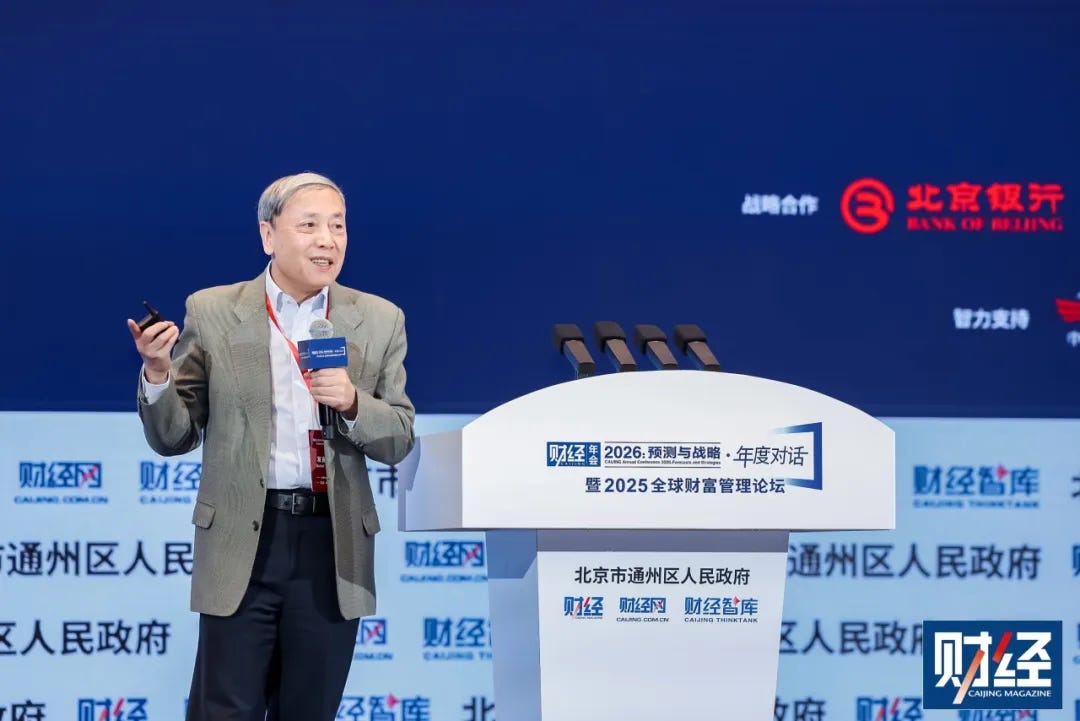
蔡昉:改善收入分配是解决消费制约的突破点
Cai Fang: Improving Income Distribution is a Breakthrough for Easing Constraints on Consumption
Introductory Note
On December 18, the CAIJING Annual Conference 2026: Forecasts and Strategies was held in Beijing. Cai Fang, Chief Expert on national high-end think tanks at the CASS and a member of Tsinghua University CIDEG’s Academic Committee, said at the forum that improving income distribution is key to easing current constraints on consumer demand and sustaining economic growth.
“Sharing the pie well” helps “make the pie bigger,” Cai said. He argued that safeguarding and improving people’s wellbeing as development advances first rests on making the pie bigger. But the point of making the pie bigger is to raise living standards and improve well-being, so policy should also focus on sharing the pie well.
Tsinghua University CIDEG is reposting the full text of the speech below for readers.
01 China Faces a Pivotal Leap in the Consumption Share
At the forum, Cai Fang noted that consumer demand is increasingly acting as a bottleneck for economic growth. To break through this constraint, the state must focus on two critical levers: raising household incomes and improving income distribution.
Global experience shows that the trajectory of household consumption as a share of GDP varies across different stages of development. During the transition from a low-income to a middle-income economy, a nation’s consumption rate typically dips. At this stage, growth is swift, investment levels are high, and the returns on capital are relatively robust.
However, the shift from upper-middle-income to high-income status typically coincides with a sharp rebound in consumption’s share of GDP, often by around 20 percentage points. Cai argues that as per-capita incomes rise and development deepens, the consumption share must increase accordingly. At this stage, living standards need to step up materially; without stronger domestic demand, growth eventually runs out of steam.
China is now facing such a constraint. Cai said that only by raising incomes and improving income distribution can this constraint be removed.
Cai said that between now and 2035, China will cross the high-income threshold and enter a high-income stage, with per-capita income above US$14,000. Under the plan set out at the Fourth Plenary Session of the 20th CPC Central Committee, China aims to become a moderately developed country by 2035, with per-capita income exceeding US$20,000.
Catching up in per-capita GDP needs to be matched by a higher consumption share. At around 39 per cent, China’s consumption share still lags upper-middle-income economies, and the gap is wider still versus high-income peers. Cai argues that moving through this phase of a pronounced rise in consumption is both a risky leap and a decisive one.
02 Calling For Income Distribution Targets in The 15th Five-Year Plan
The Fourth Plenary Session of the 20th CPC Central Committee offered new explanations and made major arrangements on income distribution. It specifically called for an income growth plan for both urban and rural residents, and for efforts to foster an oval-shaped structure of distribution.
Based on China’s current income distribution, Cai said that there is still a gap between where China is and the income distribution goals required for modernisation.
Income inequality is commonly measured by the Gini coefficient, which ranges from 0 to 1. A higher value indicates a larger income gap. Overall, China’s Gini coefficient has trended down since around 2009, suggesting some improvement in income distribution. The decline was relatively rapid before 2015, but has not fallen markedly since then. China’s current Gini coefficient is 0.465, which still leaves a large gap compared with many countries.
Cai also called for setting income distribution targets for 2035 during the 15th Five-Year Plan period, aiming to bring the Gini coefficient as close as possible to 0.4, or to reduce it below 0.4.
Starting in 2008, the income gap between urban and rural residents narrowed rapidly. Poverty alleviation efforts and policies on agriculture, rural areas, and farmers helped reduce the gap. Cai said that this narrowing also contributed to the decline in the overall Gini coefficient.
At present, China’s urban-rural income ratio has fallen to 2.3, but it is still relatively high compared with other countries. According to Cai’s research, a ratio of 2 is a relatively reasonable benchmark. He also hopes that during the 15th Five-Year Plan period, and at least by 2035, China can meet the target of bringing the ratio down to 2.
Cai said that in many advanced economies, taxation now plays a smaller role, with redistribution relying more on transfer payments. In China, however, the taxes with the strongest redistributive impact, including personal income tax, corporate income tax, and capital gains tax, make up a notably small share of total revenue, lower than in almost every OECD country. He argues that China still has significant untapped scope to use the tax system to adjust income distribution.
03 Eliminating Age-Based Employment Discrimination
What are the main bottlenecks in improving income distribution? From a labour economist’s perspective, Cai argues that inequality within rural areas has improved relatively quickly, and the urban–rural gap has narrowed even faster. Yet overall progress on the Gini coefficient has been slow because inequality within cities has barely improved and may even be rising. In his view, this points to deeper structural strains in urban employment.
Cai said that as technology advances and industries restructure, machines are replacing labour, displacing some workers and leading to job losses. He argues that the pace of job destruction in China is accelerating. Since 2012, cities have created roughly 170 million jobs in total, but a large share did not translate into net employment gains: more than 50 million positions disappeared along the way. Some were automated away, while others were cut as struggling firms downsized or closed.
Cai said another feature of structural employment tensions is polarisation among key groups, particularly by age. One group is young workers, and the other is older workers.
Employment rates among young people are relatively low. Despite high levels of education, many lack work experience and struggle to secure jobs. As artificial intelligence and tools such as ChatGPT spread, some entry-level tasks and skills are being automated, potentially raising the bar for new graduates and early-career workers.
Older workers, by contrast, tend to have fewer years of schooling and may also be in poorer physical condition, making it harder to keep up with industrial restructuring and technological change. Cai argues that gaps in skills, digital capabilities, and an “intelligence divide” can leave older workers in more precarious employment.
China’s 2020 Seventh National Population Census shows that older workers, including those close to retirement, make up a growing share of the employed working-age population. China has an Employment Promotion Law that emphasises eliminating discrimination in the labour market, but it does not explicitly include age as a protected category.
Cai called for age-based employment discrimination to be explicitly included in the Employment Promotion Law as China advances its strategy for actively responding to population ageing. He said training and policy support should be used to close older workers’ skills gaps and help them prepare for the jobs of the future.
Cai said new forms of employment are increasingly becoming the norm, with flexible employment taking a larger share. Among urban workers, self-employment, private-sector jobs, and work outside the state sector already account for more than 60 per cent of total employment, and the share is still rising. He argues that artificial intelligence will only reinforce this shift, rather than pulling workers back into state sector employment.
On efforts to improve employment income and income distribution, Cai said distribution is closely tied to social mobility. Both fairer distribution and higher mobility, he argues, depend on strengthening human capital. Education should be the starting point: extending years of schooling and building clearer pathways from schooling into later vocational training across the life cycle.
Cai Fang on Beijing's income equality playbook

Beijing has long framed its fight against inequality in a vocabulary of its own, built around a three-stage taxonomy of income allocation: primary distribution, meaning wages and returns to capital; secondary distribution, where the tax and welfare systems reallocate income via social security, public services, and transfer payments; and a third, “terti…
Li Xunlei: one billion people in China have never been on a plane

“One billion people in China have never been on a plane” has become a minor meme to be wheeled out whenever the conversation turns to weak consumption and an economy short of effective demand. It was first put forward in early 2019 by Li Xunlei, one of the most renowned chief economists among major domestic securities firms in China, as a warning that “…
Xu Gao: why SOE stocks should be distributed among all citizens

Xu Gao is the Chief Economist of Bank of China International (China) Co., Ltd., an adjunct professor of National School of Development in Peking University, and a member of the China Chief Economist Forum. Xu has also published two best selling textbooks in China -- "Lectures on Macroeconomics from a Chinese Perspective" and "Lectures on Financial Econo…
China’s economy is red hot and its labor force is declining along with its Gini coefficient. There’s no urgent need for more consumption.
He urges to "adjust income distribution." In this country ruled by a so-called Communist party, the vision of proceeding to communism has obviously been lost.