


Liu Shijin is a former Vice President (Vice Minister) of the Development Research Centre (DRC), a comprehensive policy research and consulting institution directly under the State Council, the central government of the People’s Republic of China. In recent years, he has been one of the most senior voices urging Beijing to raise the meagre pensions paid to rural residents.
In his latest interview, Liu placed this argument within a broader critique of overreliance on investment-led stimulus. The transcript of the interview was published on the official WeChat blog of Tencent Finance on 8 May 2026.
Liu has agreed to this translation and publication.
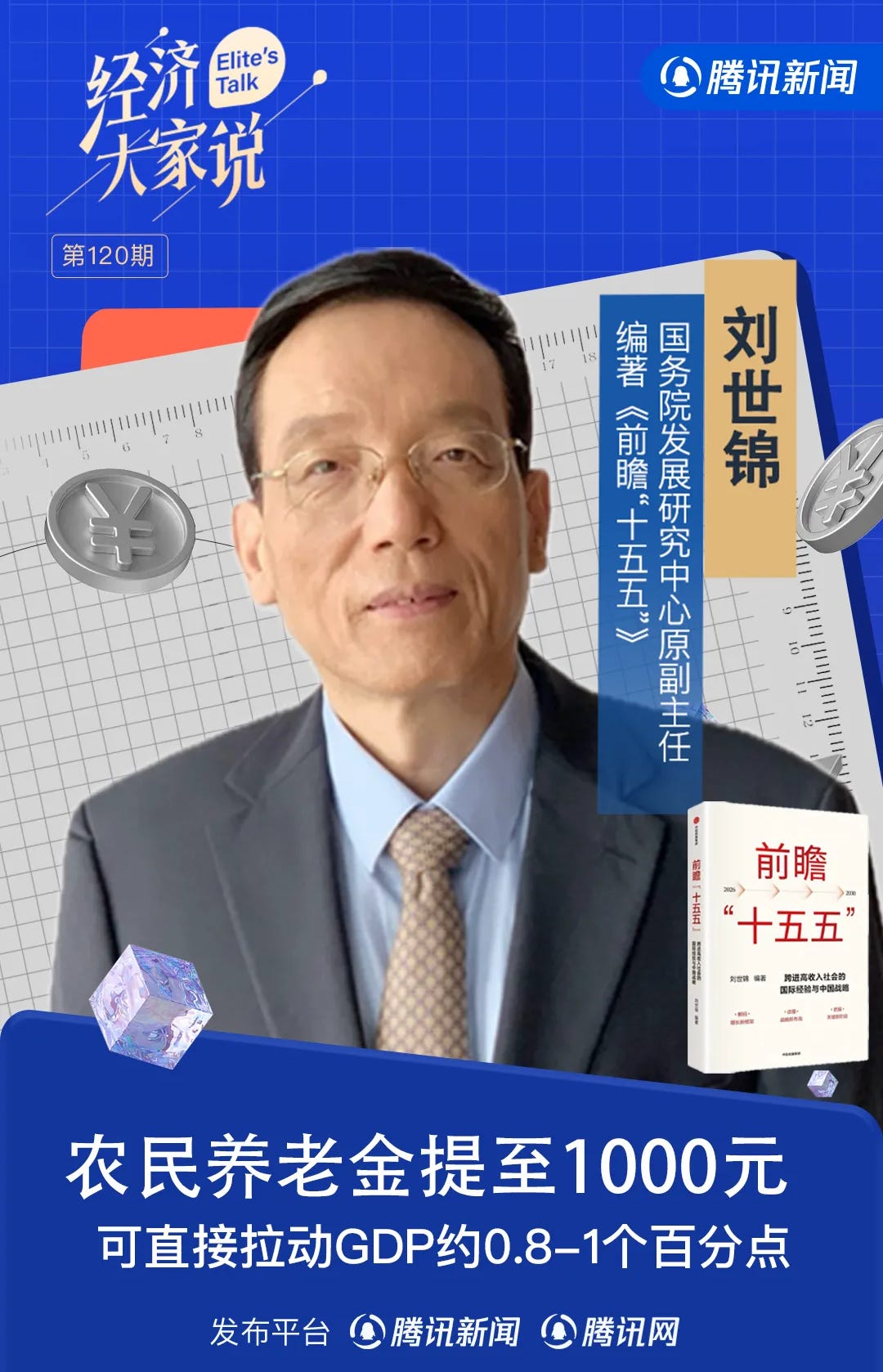
经济学家刘世锦:给1.8亿农民涨养老金 比大搞投资管用
Economist Liu Shijin: Raising Pensions for 180 Million Rural Residents Would Be More Effective Than Investment-Led Stimulus
“To address weak final demand, policy must start from a first principle: resources should be concentrated, and both policy priorities and funding should be directed squarely at boosting final demand,” Liu Shijin said.
Liu also cautioned against the view that China can rely on ever-larger macroeconomic stimulus to lift growth, calling it a misunderstanding of what policy can achieve. “If growth could be restored simply by making macro policy loose enough, and if it were really that straightforward, then the whole economic problem would be very easy to solve,” he said.
On 16 April, the National Bureau of Statistics released China’s Q1 economic data. GDP reached 33.42 trillion yuan, up 5.0 per cent year on year, a clear improvement from the 4.5 per cent recorded in Q4 last year. Stronger-than-expected exports, robust industrial data, and the early rollout of macroeconomic policy support were among the main factors behind the better Q1 performance.
But behind the 5.0 per cent growth figure, the structural imbalance of “strong supply and weak demand” has not been fundamentally resolved. Where, then, should China’s growth momentum come from? And where should macro stimulus funds be directed?
In an interview with Tencent Finance’s Elite’s Talk, Liu Shijin, former Vice President of the Development Research Centre of the State Council, said that any assessment of the current economy must be based on “a holistic or systemic perspective”. It is essential, he said, to distinguish “which problems are derivative and which are root causes”.
In his view, problems such as nominal growth falling below real growth and persistently weak prices are all “secondary effects”. There is only one true root cause: insufficient final demand.
What is the key to breaking this deadlock? Liu’s answer is clear: raise the incomes of middle- and low-income groups, especially rural residents.
He cited one set of estimates. China’s basic old-age insurance scheme for urban and rural residents currently covers 550 million people, more than 95 per cent of whom are rural residents. Among its 180 million recipients, the average monthly pension is only 249 yuan. That is far below the “more than 6,000 to 7,000 yuan [887-1,034 U.S. dollars]” received by retirees from urban Party and government organs and public institutions, and the “more than 3,000 yuan [443 U.S. dollars]” received by retired urban enterprise employees.
“If the pension could first be raised to 600 yuan, which is roughly the current level of the Rural Minimum Living Standard Guarantee (Rural Dibao), and then to 1,000 yuan, the demand generated would lift GDP growth that year by about 0.8 to 1 percentage point,” he said.
Liu suggested accelerating the transfer of part of state-owned capital into social security funds, or allocating a relatively large share of the annual fiscal stimulus package to raising the incomes of low-income groups.
For Liu, social welfare is never merely a welfare issue. Raising the incomes of middle- and low-income groups, he said, is both a long-term social policy issue and a short-term macroeconomic growth issue. If progress is too slow, short-term growth will be affected.
On macroeconomic policy, Liu stressed that money must be “put in the right place”. “The effectiveness of stimulus policy will vary greatly,” he said, depending on whether it is used at the end of the chain, in intermediate links, or at the source—namely, final demand.
For this reason, Liu remains cautious about calls for investment-led stimulus. The precondition for expanding effective investment, he argued, is first to raise the level of final demand.
The following are highlights from Liu Shijin’s interview.
I. Insufficient Final Demand Is the Root Cause
Elite’s Talk: China’s economy grew by 5.0 per cent year on year in the first quarter, marking a solid start to the year. But Mao Shengyong, Deputy Commissioner of the National Bureau of Statistics, also said frankly that “the domestic imbalance of strong supply and weak demand remains pronounced.” How do you assess the current economic situation?
Liu Shijin: To analyse the current economic situation, we need a holistic or systemic perspective. We must be clear about which problems are derivative and which are root causes.
In my research over the past few years, I have put forward the concept of “final demand”. What does final demand mean? GDP, or gross domestic product, refers to the sum of value added across the economy over the course of a year. It is also known as final output.
Strictly speaking, however, it is not truly final, because part of it consists of productive investment, which then re-enters the production process. This portion therefore needs to be excluded. What remains after that is goods consumption, services consumption, and another category of non-productive investment, which we may call consumption-oriented investment. Together, these make up final demand.
There are many links in the operation of the national economy, but final demand is the most important outlet. It is both the starting point and the destination of economic activity.
In previous years, China’s non-productive investment, or consumption-oriented investment, mainly consisted of livelihood-related real estate, infrastructure, and parts of the services sector. For a long time, as is well known, China’s real estate sector expanded rapidly, as did infrastructure investment. Over the past couple of years, however, the picture has changed. The property sector has slowed sharply, and infrastructure investment is also struggling to maintain its previous pace of growth.
Against this backdrop, the gap between China’s consumption share of GDP and the international average—about 20 percentage points—has become much more apparent. In the past, this gap was not easy to see. In a sense, it was masked by the expansion of the property sector. Once real estate slowed, however, the gap was inevitably exposed. Once exposed, the growth of final demand in the national economy slowed markedly. In effect, this amounts to a relative contraction.
A series of phenomena and problems in the current economy—nominal growth falling below real growth, persistently weak prices, overcapacity in some sectors, rising debt burdens, and consumption downgrading among urban white-collar groups—are all secondary effects. Insufficient final demand is the root cause. Many other problems are derived from it.
II. Raising Rural Pensions to 1,000 Yuan Could Lift GDP Growth by Around 0.8 to 1 Percentage Point
Elite’s Talk: You said that insufficient final demand is a “root cause”. Where, then, is the key breakthrough point?
Liu Shijin: To address weak final demand, policy must start from a first principle. What does that mean? It means resources should be concentrated, and both policy priorities and funding should be directed squarely at boosting final demand.
A large part of the problem lies with China’s middle- and low-income groups, especially rural residents, whose incomes remain relatively low. Weak consumption ultimately reflects weak income growth. Raising their incomes, therefore, requires measures to strengthen social protection, including one issue that has attracted considerable discussion: rural pensions.
China has a basic old-age insurance scheme for urban and rural residents, covering 550 million people, more than 95 per cent of whom are rural residents. At present, around 170 million to 180 million people are receiving pensions under that scheme. How much do they receive each month? The figure is 249 yuan [36.8 U.S. dollars].
By comparison, retirees from urban Party and government organs and public institutions receive more than 6,000 to 7,000 yuan [887-1,034 U.S. dollars] per person on average, while retired urban enterprise employees receive more than 3,000 yuan [443 U.S. dollars] per person on average. The gap between farmers and these groups is very large.
The low level of the basic old-age insurance scheme for urban and rural residents affects not only the living standards of pension recipients. It also directly and indirectly constrains the consumption of more than 300 million employed people who are still working. According to preliminary estimates, it affects the consumption level of roughly half of China’s population.
If this pension level were raised, the boost to economic growth would be very significant. We have done some research and estimates. For example, if the current level of just over 200 yuan were raised in two steps—first to 600 yuan, which is roughly the current level of the Rural Minimum Living Standard Guarantee (Rural Dibao), and then to 1,000 yuan, the demand generated would lift GDP growth that year by about 0.8 to 1 percentage point.
Several proposals are already being discussed. One option is to transfer part of state-owned capital into social security funds. Another is to use a portion of the annual fiscal stimulus package for this purpose. For example, allocating 1 trillion yuan would raise rural residents’ monthly pensions from just over 200 yuan to more than 400 yuan. That would provide a clear boost to domestic demand and, in effect, raise the level of final demand.
III. Social Welfare Is Also a Short-Term Growth Issue
Elite’s Talk: Some people argue that farmers’ pensions cannot be raised too quickly. How would you respond?
Liu Shijin: There are indeed different views on this issue. But it is important to recognise that this is both a social welfare issue and an urgent question of economic growth.
On one level, the government and society should care for vulnerable groups, help low-income people raise their incomes, and improve their access to basic public services.
On another level, it is also an immediate growth issue. Last year, China’s real GDP growth was 5 per cent, yet nominal growth was only 4 per cent—1 percentage point lower. Why? Because demand was insufficient. And where did that shortfall in demand come from? From the insufficient final demand I just discussed.
Improving social welfare and raising the incomes of low-income groups will, at the macro level, translate into higher aggregate demand. Once aggregate demand rises, it can help achieve the planned growth target. On the one hand, economic growth needs to reach 5 per cent. On the other hand, nominal growth should be equal to, or even higher than, real growth.
IV. Bigger Stimulus Is Not Necessarily Better; Money Must Be Put in the Right Place
Elite’s Talk: When it comes to macroeconomic policy, there is a great deal of discussion in the market about the size of stimulus measures and where the money should go. How do you view the role and limits of macro stimulus?
Liu Shijin: Macroeconomic stimulus is meant to address short-term economic balance and stability. It cannot solve the problem of growth momentum.
At the current stage, China’s relatively low consumption rate has much to do with the structure of household demand. If households are grouped into ten income deciles, the gaps between those deciles are quite large. That is what is usually meant by a high Gini coefficient. In such circumstances, both the overall marginal propensity to consume and the average propensity to consume tend to be low.
Solving this problem requires reform of the income distribution system. But it is difficult to make major progress in the short term. That is why macroeconomic policy should be used, at least in the short term, to ease or partially address the problem of insufficient consumption.
Given a certain amount of stimulus funding, where exactly should it go? Should it be used at the end of the chain, in intermediate links, or at the source—namely, final demand? The effectiveness of stimulus policy will vary greatly depending on this choice.
There are two points here.
First, when it comes to stimulus, bigger is not necessarily better. If growth could be restored simply by making macro policy loose enough, and if it were really that straightforward, then the whole economic problem would be very easy to solve.
Macroeconomic policy, whether monetary or fiscal, can boost overall economic activity by injecting additional stimulus. But that only helps stabilise the economy and restore short-term balance. It does not create the ultimate drivers of long-term growth.
Second, when the size of the stimulus is fixed, the key question is where the money should go. The same first-principles logic still applies: funds should be directed towards final demand. That is where they can generate the strongest demand effect and deliver relatively high efficiency.
This, I think, is the issue we need to focus on now.
V. Avoid Ineffective Investment and Invest Where There Are Returns
Elite’s Talk: Another widely debated view is that investment-led growth remains more effective in the short term. How do you see the relationship between investment and consumption?
Liu Shijin: The central authorities have repeatedly stressed the need to prevent ineffective investment. What we need is investment backed by demand and capable of generating returns.
Investment does play a major role in supporting overall economic growth. But the precondition is that there must be demand.
Where does that demand come from? As I said earlier, final demand must first be raised. Only after that can investment truly expand. Much of the current debate still shows a strong bias towards investment, driven by the belief that it produces quick results. But if final demand does not rise and consumption remains weak, further investment will only worsen overcapacity and increase the associated debt burden.
So, to truly expand investment, the first step must be to raise final demand. Once final demand rises, capacity utilisation will improve as well. In some sectors, capacity may then become insufficient, creating a need for additional investment. Only then will investment be backed by genuine demand and capable of generating returns.
From the perspective of the national economic cycle, this is the basic logic behind expanding effective investment. This point must be made clear. In practice, the relationship between investment, consumption, and growth must be managed properly, and China’s various sources of growth potential should be better identified and put to use.

Part I of Liu Shijin: search for growth potentials

Liu Shijin is a Former Vice President (Vice Minister) of the Development Research Centre (DRC), a comprehensive policy research and consulting institution directly under the State Council, the central government of the People's Republic of China.
Part II of Liu Shijin: charting a new wave of structural reform

Liu Shijin is a Former Vice President (Vice Minister) of the Development Research Centre (DRC), a comprehensive policy research and consulting institution directly under the State Council, the central government of the People's Republic of China.
David Daokui Li calls for 1.25 trillion yuan pension increase for Chinese farmers
David Daokui Li is a Professor of Economics and Director of the Academic Center for Chinese Economic Practice and Thinking (ACCEPT) at Tsinghua University. He has been very active on Chinese social media, including opening a video channel on WeChat, China’s top messaging app, releasing a short video of him talking daily. He posts the same videos on his …
Why a Legal Clarification on Social Security Shook China’s Public Debate

When China’s Supreme People’s Court (SPC) issued a judicial interpretation in early August clarifying that employer–employee agreements to forgo social-insurance contributions are invalid, the text itself seemed straightforward. Yet the announcement set off a wave of online debate, forcing official newspapers such as
Three types of hidden debt unaccounted for in China's official stats

The debts accumulated by Local Government Financing Vehicles (LGFVs), often referred to as China's hidden debts due to their association with government liability, are widely known among observers of China's economy. However, in a recent speech and Q&A
Absolutely. Add a steady increase in rural pensions (to 1000 RMB monthly) to the new Hukou relaxations and the domestic element of the dual circulation economy will be boosted. A lot of migrants consume less, as they remit sums back to their elderly parents in the village home. If their parents were to receive higher pensions then migrants in cities could spend more. Thus, domestic consumption would rise.