

ByteDance is reorganising its AI and enterprise software businesses as it seeks to turn its lead in China’s consumer AI market into corporate revenue. The TikTok’s Chinese parent will bring workplace collaboration platform Feishu closer to Doubao, its flagship AI assistant, and Volcano Engine, its cloud and AI services arm.
Under the changes, Feishu’s product team will join a newly consolidated Doubao product group, according to Chinese media reports citing a leaked internal letter.
Feishu’s marketing, sales, and customer service operations — collectively known as its go-to-market team — will be merged with those of Volcano Engine to form a new division called the Creativity Service Platform.
ByteDance told Chinese media that existing Feishu products and services would remain unchanged, while Feishu and Doubao would work more closely on workplace productivity tools. An enterprise version of Doubao, developed with the involvement of Feishu’s product team, is already being tested by selected Feishu customers.
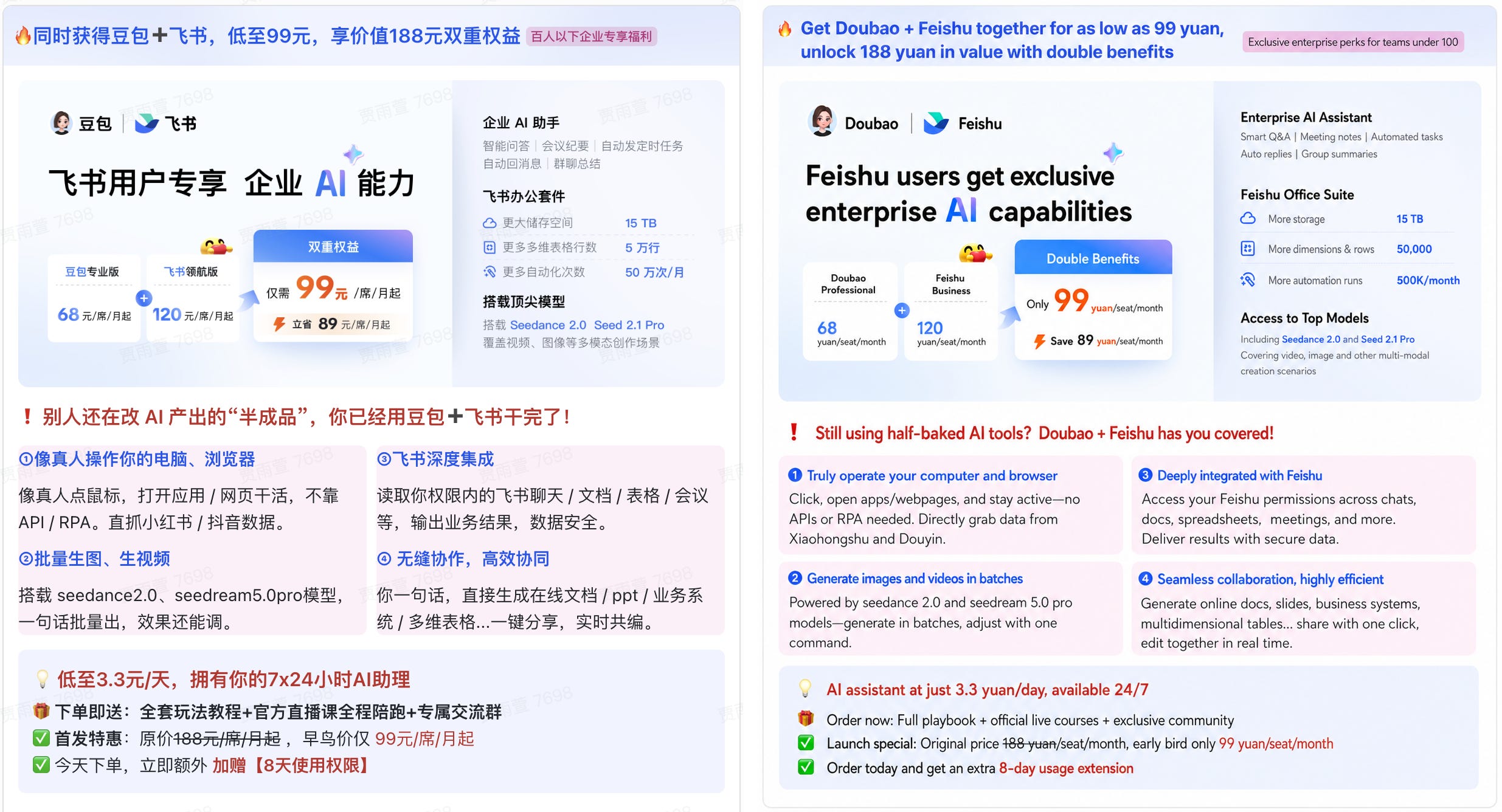
The restructuring brings together three complementary parts of ByteDance’s AI business: a mass-market assistant, a workplace platform, and a cloud-services operation.
Doubao, whose name means “bean bun” in Chinese, is ByteDance’s proprietary general-purpose AI assistant, launched in August 2023. It had 382 million monthly active users in June, more than double the 167 million recorded by second-ranked Alibaba’s Qwen app, according to mobile analytics company QuestMobile. This makes Doubao by far China’s most widely used standalone AI application.
Feishu, known as Lark outside China, provides the workplace layer through which ByteDance can bring those AI capabilities into companies. The platform combines messaging, video meetings, cloud documents, databases, and workflow tools, and counts Chinese technology and electric-vehicle groups including Xiaomi, Li Auto, Nio, and Xpeng among its customers. Feishu said in July 2025 that its Base database product was approaching 10 million monthly active users.
Volcano Engine provides the computing and commercial backbone for ByteDance’s enterprise AI push, giving corporate customers cloud-based access to Doubao models through model-as-a-service (MaaS). Launched in 2020, the cloud unit accounted for 49.5% of token usage in China’s enterprise public-cloud MaaS market in 2025, ahead of Alibaba Cloud and Baidu AI Cloud, according to research firm IDC.

Enterprise AI push
The restructuring follows a broader shift in ByteDance’s priorities. ByteDance Chief Executive said at a Volcano Engine conference in June that advancing AI was the company’s most important task, adding that the cloud unit’s MaaS business was becoming a foundational part of ByteDance.
The overhaul gives that strategy a more direct route to revenue by embedding Doubao’s AI capabilities in Feishu’s workplace tools and selling the resulting model access, computing capacity and enterprise services through Volcano Engine.
It also formalises an integration that had been taking shape for several years. Feishu unveiled its Smart Partner, an AI assistant, in November 2023. It followed in August 2024 with a major upgrade to Aily, an enterprise platform for building customised AI agents and applications using a company’s own knowledge, data, and business processes. By June 2026, more than 90% of the new customers Feishu had signed since the start of the year had also purchased its AI capabilities, Chinese media reported, citing people familiar with the matter.
ByteDance is not alone in seeking to connect AI models, cloud-based capabilities and workplace software. In early July, Alibaba began consolidating several previously separate workplace-agent tools into QwenWork, which combines its Qwen AI models with cloud-based data and task-management functions and deep integration with DingTalk, its workplace collaboration platform.
Tencent is building a similar product, but taking a different, and potentially more formidable, route. Tencent already operates WeChat, China’s near-ubiquitous messaging and social platform, giving it a consumer distribution channel that neither company can easily replicate.
The company launched WorkBuddy, its desktop AI agent for workplace tasks, in March. It subsequently connected the service to WeChat and, at the end of that month, launched a WeChat mini-program that allows users either to run tasks in the cloud or remotely direct WorkBuddy on their computers.
On 5 June, Tencent Cloud unveiled WorkBuddy Enterprise and a broader suite of productivity agent tools designed for corporate users. On 18 July, Tencent launched WorkBuddy as a standalone mobile app.
According to Analysys’s report on China’s office-agent market in Q2 2026, WorkBuddy recorded 20.97 million visits on personal computers in June, more than the second- and third-ranked services combined. Tencent said in its first-quarter results that WorkBuddy had become China’s most widely used productivity AI agent service by daily active accounts.

Louis Vuitton’s Legal Win Turns Into a Reputation Crisis in China

Louis Vuitton’s trademark victory has triggered an unruly backlash in China that now extends far beyond far beyond Molly Tea, the fast-growing Chinese tea chain it sued.
Xiaomi: a hater's taunt, a fan revolt

Xiaomi Corp. issued rare sanctions against senior executives to atone for paying a longtime hater, a move that sparked a loyalist revolt.
The Caffeine Crisis: CHAGEE and China’s Anti-Drug Nerve

Can a 20-yuan ($2.80) cup of milk tea be a “legal drug”? For CHAGEE, a Chinese tea chain that has expanded to more than 7,000 stores worldwide, the question triggered a full-scale reputational crisis just six months after its Nasdaq debut.
What China’s tech giants wanted buried in 2025

In China, WeChat is not merely a messaging app. It is also the country’s dominant public-account publishing platform, where individuals, companies, and media outlets alike run blog- or newsletter-like feeds in a role somewhat akin to Substack, but with far greater reach and something close to monopoly status in the domestic information space.
Founder of Temu parent company envisioned wealth redistribution through reverse insurance

Born in 1980, 黄峥 Colin Huang studied computer science at Zhejiang University and earned a master's degree from the University of Wisconsin in 2004. He founded Pinduoduo, an e-commerce platform company in 2015. In 2018, when Pinduoduo became publicly traded in the U.S., Huang