


In China, WeChat is not merely a messaging app. It is also the country’s dominant public-account publishing platform, where individuals, companies, and media outlets alike run blog- or newsletter-like feeds in a role somewhat akin to Substack, but with far greater reach and something close to monopoly status in the domestic information space.
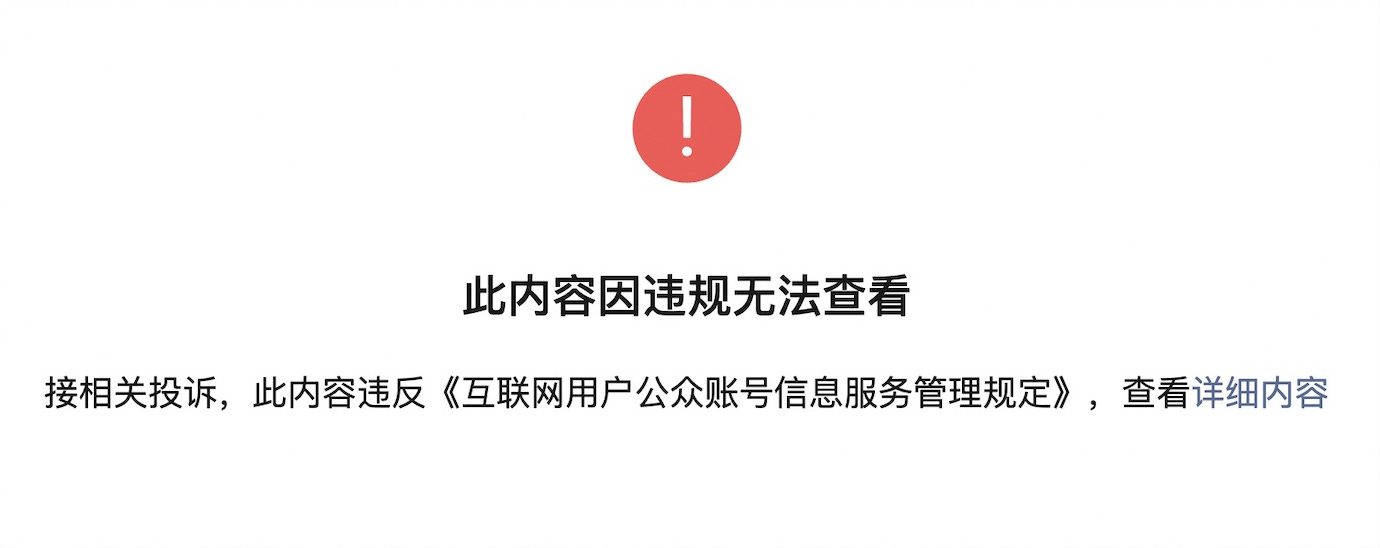
In that ecosystem, articles do not disappear neatly. Often, the original link remains active, but the page is replaced by a stock notice saying the content is unavailable “due to a violation”. When an article is quietly revised instead, however, there is usually no sign that anything has changed, unless an earlier version has been archived elsewhere.
That makes reporting on WeChat particularly difficult to track, especially business coverage. Companies involved often pursue takedowns by filing complaints through WeChat’s public-account system or by approaching publishers directly to seek deletions and revisions. Without systematic archiving, it is hard to know what was changed, what disappeared, and what kind of intervention lay behind it.
Cheng Chunxiao 程春晓, who writes the personal WeChat blog Bottom Observer 底层观察家, has kept a running record of such changes. His compilation, drawn from four highly influential, market-oriented, non-state-run outlets known for their reporting on China’s internet economy, technology companies, and AI sector in 2025, offers a revealing archive of what was changed or removed: sometimes straightforward factual corrections (and rightly so), but often reporting on executive reshuffles, unannounced products, tax and regulatory manoeuvres, and signs of strategic uncertainty. Some stories disappeared. Others remained, but in a cleaner and more carefully managed form.
This should not be read as a complete record. These outlets published far more than the items listed here, and the true number of deletions and revisions was almost certainly higher.
Nonetheless, the list points to a more structural weakness in China’s commercial media market. Business outlets often depend heavily on the very companies they cover, through advertising, paid partnerships, and other commercial ties. That leaves them with limited leverage to resist when a company asks for softer wording or the removal of awkward details, and, in some cases, with a clear financial incentive to accept such requests.
The following article was written and published on 31 December 2025 by Cheng Chunxiao on his personal WeChat blog Bottom Observer. Strikethrough indicates deleted text, while italic and bold indicate text added later. All hyperlinks were added by The East is Read.
Cheng has been working for ByteDance since 2020. The tagline of his personal WeChat blog describes him, tongue in cheek, as “the most educated person at the bottom of society”.
—Yuxuan Jia

2025大厂最在意什么?看头部商业媒体的删文与改文清单
What mattered most to China’s tech giants in 2025? A Look at Removed and Revised Articles from Leading Business Media Outlets
There are two kinds of truth in this world: historical truth and narrative truth. Historical truth may forever be beyond reach, but narrative truth can still reveal both the storyteller and the times in which they lived.
This article brings together records of edited and deleted pieces from four leading business media outlets—LatePoint 晚点, 36Kr 36氪, leiphone.com 雷锋网, and DeepWeb 深网—in 2025. As noted earlier in “Humanity’s Path in the AI Era: Doing What AI Won’t Bother With,” it is intended purely as a factual archive, without commentary.
1. Deleted Articles
LatePost
The sole survivor in the crack: Tesla and CATL’s “American factory,” 24 April 2025. “This content has been deleted by the publisher.”
The beginning of the end | TikTok’s five-year struggle reaches its conclusion, office quiet as usual, 26 Sept 2025. “This content is unavailable due to a violation.”
Exclusive | AITO M6 expected to launch in Q2 next year, will not replace M5, 24 Nov 2025. “This content has been deleted by the publisher.”
Exclusive | Wey CEO Feng Fuzhi takes “leave of absence,” 12 Feb 2025. “This content has been deleted by the publisher.”
36kr
At Baidu Cloud’s all-hands meeting, Shen Dou discusses performance, model competition, and DeepSeek | Exclusive by Intelligent Emergence, 13 Feb 2025. “This content has been deleted by the publisher.”
[Note: Intelligent Emergence is an AI-focused WeChat blog under 36Kr.]
JD takeout is just three steps away from the battlefield | DeepKr Lite, 5 Mar 2025. “This content has been deleted by the publisher.”
Baidu Cloud launches new round of restructuring: key executive roles shuffle | Exclusive by Intelligent Emergence, 4 Jun 2025. “This content has been deleted by the publisher.”
Alibaba leads largest single funding round in AI video generation sector | Exclusive by Intelligent Emergence, 10 Sept 2025. “This content has been deleted by the publisher.”
TikTok reaches a fateful turning point, 20 Sept 2025. “This content is unavailable due to a violation.”
Trump signs new executive order, details of TikTok sale in U.S. revealed, 26 Sept 2025. “This content is unavailable due to a violation.”
leiphone.com
NetEase shuts down strategic investment department: overseas investment setbacks trigger shakeup, over 100 employees affected, 17 Jan 2025. “This content has been deleted by the publisher.”
Exclusive | Leading domestic outbound platform lowers annual growth forecast, may open warehouses in Vietnam to avoid taxes, 18 Feb 2025. “This content has been deleted by the publisher.”
Exclusive | Pinduoduo has formed multiple large model teams that compete internally, 24 Feb 2025. “This content has been deleted by the publisher.”
News of large-scale layoffs a false alarm? Several mysteries surrounding Cainiao, 27 Feb 2025. “This content has been deleted by the publisher.”
Days spent with the Xiaomi robot, 19 Mar 2025. “This content has been deleted by the publisher.”
DeepWeb
Behind Seres Auto’s Hong Kong IPO push: as Huawei’s halo fades, what “new story” will it tell? | DeepWeb, 9 Apr 2025. “This content has been deleted by the publisher.”
2. Modified Articles
LatePost
LatePost Exclusive丨ByteDance’s Seedance explores DeepSeek support; new mobile head Cao Dapeng assumes role, 25 Feb 2025
ByteDance is increasingly prioritising model research and development. In January this year, it established the AGI Research Institute Project “Seed Edge” In February, ByteDance recruited top talent Wu Yonghui from Google to take overall responsibility of join Seed.
Internationalisation refers to the overseas expansion of businesses like food delivery, including Keeta, which has already entered the Middle East market, and drone services. Meituan aims for its Keeta’s food delivery market to reach a scale of $100 billion, which means its food delivery business cannot be confined solely to the Chinese market.
ByteDance’s AI reboot: an independent organisation and a full-chain offensive, 31 Mar 2025
Leveraging its formidable talent pool, ByteDance has also marshalled resources to its AI division that are far beyond the reach of start-ups. This enables the company to harness Douyin’s reach: starting last April, other AI products were no longer allowed were once barred from advertising on Douyin and other ByteDance platforms, but later gained access to ad placements.
Within three months of launching its food delivery service, it secured 25 million orders through billions in subsidies, disrupting the stable market landscape that had persisted for years. It then shifted focus to instant retail, building its own fulfilment centres to sell fresh produce, beverages, and cosmetics under its own brand. Next, JD plans to expand into the wine and travel sectors.
Meituan acquired Maiyatian at a low price earlier this year, further strengthening its delivery capacity moat. At the time, frontline employees and even senior executives in the food delivery business at Meituan, Alibaba, and JD did not anticipate a head-to-head clash this year.
During the weekend subsidy war, some merchants noticed that when using Maiyatian and Qingyun to place orders, they had to wait longer than usual, sometimes even one or two hours before a rider picked up the order. This caused significant fulfilment delays, further slowing down order processing speeds on other platforms. Sources close to Meituan informed us that the surge in orders overloaded the servers of Maitian and Qingyun, leaving some merchants temporarily unable to place orders through aggregator delivery platforms. Meituan’s own merchant-side settlement system ran into similar problems.
Richard Qiangdong Liu said their food delivery service only aims for a 5% profit margin. Bro...no one has ever managed to turn a 5% profit in the food delivery business. When Zhang Xuhao sold Ele.me to Alibaba in 2018, he openly stated that the food delivery model would never be profitable, which is precisely why he sold it.
Taobao Flash Sale’s Double 11 battle plan: the new beginning of the retail war of attrition, 7 Nov 2025
At the end of August, during Alibaba’s second-quarter earnings call, Jiang Fan, CEO of Alibaba E-commerce Business Group, stated that instant retail would generate an incremental market of 1 trillion yuan for Taobao and Tmall over the next three years, referring solely to merchandise transactions, excluding food delivery. This primarily includes non-food retail orders from Taobao Flash Sale, orders delivered via Flash Sale from brand flagship stores on the Taobao app, and Alibaba-operated half-day delivery services like Freshippo and Tmall Supermarket.
LatePost Exclusive丨Another key member has left ByteDance Seed, bringing this year’s total departures to seven, 17 Nov 2025
ByteDance continues to maintain an exceptionally high density of talent. LatePost learnt that within each research area prioritised by Seed, at least three several teams are simultaneously advancing their work, exploring different technical directions while also competing with one another.
“Jingren doesn’t really manage us much,” said a Tongyi Labs insider. But They’ve all set ambitious goals for themselves—like Lin Junyang aiming to make the Qwen model rival Gemini and gain greater international influence.
Chinese tech giants’ AI battle boils down to Alibaba versus ByteDance, 16 Dec 2025
ByteDance’s applications focus more on content generation and emotional companionship universal assistants. By encroaching on users’ time across the board with dozens of products like Doubao (conversation), Maoxiang (social companionship), and Xinghui (AI camera), it has transplanted the “app factory” model into the AI era.
If Alibaba aims to help users “save time,” then ByteDance is helping users “kill time.” Alibaba and ByteDance broadly represent two distinct visions for AI: the super assistant (tool-oriented) and the super companion (partner-oriented universal assistant).
Yet within ByteDance’s domain of emotional AI social interactions and content creation, challenges around privacy, ethics, and psychology remain equally complex. As tens of thousands of young people grow accustomed to confiding in AI, even forming deep, intimate bonds with it, where does authentic social interaction fit into this landscape?
Reinventing offline business on Douyin, 26 Dec 2025
To address this need, Douyin Life Services will roll out a one-stop managed-service tool, internally codenamed “One Sum”. In future, merchants will only need to commit a single budget, which the platform will allocate through intelligent management across advertising, coupon distribution, influencers, commissions, and other channels, with the ultimate goal of maximising merchants’ redeemed GMV.
36kr
Exclusive | Meituan Select exits loss-making cities as Meituan moves beyond cut-throat competition, 23 Jun 2025
36Kr has learned from multiple independent sources that Meituan Select has announced the closure of will withdraw from certain regional operations cities experiencing losses, while retaining business in places such as Guangdong and Hangzhou. This decision was discussed internally last week and finalised today. Many members of the Meituan Select team have been reassigned to the newly launched offline business of Little Elephant Supermarket, “Project N”, where they will be responsible for brick-and-mortar store operations. The project is led by Gao Yulong. The rest are seeking internal transfers.
The organisation was clearly moving towards a more middle-office-driven structure. A source close to Meituan Select told 36Kr that in September 2024, the company initiated an internal restructuring, consolidating its original 17 provincial divisions into 9. The goal was to “reduce costs and improve efficiency.” In addition, the operations and commercial analysis lines were merged, with Li Pengju in charge strengthening coordination. The idea was to use real business data to inform strategy, a longstanding hallmark of how Meituan runs its businesses.
Against this backdrop, traffic-driving products, unbranded goods, and subsidies were all scaled back sharply. In addition to phasing out unbranded products on a broad basis, the platform also required higher profit margins across all categories. A person close to Meituan Select gave 36Kr one example: “Whether online or offline, eggs are the classic traffic-driving item in retail. But during the period when the profit mandate was at its most extreme, even eggs were treated as a profit-making product. That was clearly the wrong approach.”
A Meituan Select insider told 36Kr that “Pinduoduo runs a platform model, with multiple revenue streams including merchant commissions and marketing income.” That is also consistent with Pinduoduo’s platform DNA. For Meituan, which grew out of food delivery, the features of Meituan Select, such as its focus on lower-tier markets and low average order values, were unfamiliar terrain. “The business was positioned differently from the start. Meituan approached it in a more self-operated way. Without sustained subsidies and traffic support, it was hard to beat Pinduoduo on market share.”
leiphone.com
ByteDance Games: 365 days of reboot, 24 Apr 2025
Reporting to Zhang Yunfan is a “think tank” “core team” of around five people. This core team coordinates key strategies for ByteDance Games around Zhang, overseeing metrics such as revenue, data, and costs, as well as adjustments to product strategy. When Zhang is in the United States, this group manages the business on his behalf from China. According to Luna, members of this think tank are ranked no lower than the GMs of the various studios.
After months of intense competition in food delivery, Douyin Life Services had so far kept a relatively low profile. Now, it appears ready to make a serious push of its own.
In response, a person in charge of Douyin Life Services said that August 16 marks the platform’s “Food, Drink and Fun Day”. Through premium content supply and related traffic support, the platform aims to boost the summer culture-and-tourism economy, encourage more in-store spending, and get users to experience the atmosphere of offline life through dine-in and other forms of consumption.
DeepWeb
Former ByteDance Volcano Engine AI solutions head Luo Yihang joins Shengshu Technology as CEO | DeepWeb, 12 Mar 2025
It is understood that Luo Yihang, a former senior AI executive at ByteDance and head of the AI application product line at Volcano Engine, recently joined Shengshu Technology as CEO, taking full charge of the company’s R&D, products, commercialisation, and team management.
Kayou’s core audience is elementary school students the post-2000s generation. In recent years, the company’s trading cards based on popular IPs such as Ultraman, My Little Pony, and Harry Potter have swept school campuses across China.
Challenges and concerns: Alibaba’s “two-front gamble” for 2025 | DeepWeb, 26 Dec 2025
Its market capitalisation has climbed steadily from the trough, driven by the new leadership’s mix of “blitzkrieg” and “war of attrition”: pouring over 36 a hundred billion yuan to prise open a gap in the seemingly locked-in food delivery market; and committing over 380 billion yuan over the next three years to stake its future on AI as the fuel for tomorrow.
“Burning capital blindly is the easiest yet hardest decision to make,” said Zhou Jun, an Alibaba insider. Data from the three companies’ financial reports shows that in just six months from Q2 to Q3 of 2025 (calendar year), Meituan invested over 20 billion yuan 56.786 billion yuan in marketing expenses, JD invested 14 48.063 billion yuan in marketing expenses, and Taobao Flash Sale, a later entrant, invested more than the combined total of the first two, reaching 36 billion yuan 119.674 billion yuan in marketing expenses.
Xiao Hong: This thinking grew out of what we observed while building Monica. I remember speaking with an entrepreneur at the time, who broke down the cost structure of AI products today, using Monica as an example: in 2024, roughly one-third of costs went to employee salaries, another third is token fees (for large model calls), and the remaining third to user acquisition spending on internet advertising platforms. We’re competitive in part because of our cost-effective talent pool of Chinese engineers. Silicon Valley engineers command higher salaries, making it difficult for them to compete with our cost structure.
Xiaomi: a hater's taunt, a fan revolt

Xiaomi Corp. issued rare sanctions against senior executives to atone for paying a longtime hater, a move that sparked a loyalist revolt.
THE 2028 CHINESE INTELLIGENCE CRISIS

The 2028 Global Intelligence Crisis, a speculative macro memo published on 22 February 2026 by U.S. research firm Citrini Research on its Substack platform, has caused major tech and financial firms’ share prices to tumble, sparking heated debate among economists and strategists over the realism of its scenario.
Ma Dugong: glad that we are all clowns in different makeup

Ren Chonghao, known by his pen name Ma Qianzu (foot soldier) or Ma Dugong (foreman), is a popular Chinese commentator on military and geopolitical affairs. He engages a substantial audience through various media platforms, with over two million followers on
Three decades, three paradigm shifts: how the internet transformed China

The Internet's arrival in China in 1994 coincided with pivotal economic reforms that catalyzed the country's marketization. This confluence of digital progress and economic restructuring spurred the transformation of a primarily agrarian society that had previously missed the industrial revolutions.