

Louis Vuitton’s trademark victory has triggered an unruly backlash in China that now extends far beyond far beyond Molly Tea, the fast-growing Chinese tea chain it sued.
Between July 2 and July 13, material related to the ruling appeared in an estimated 220,000 posts, reposts, and comments on the Chinese internet, according to a Chinese media-monitoring analysis. Topic pages on Weibo, China’s equivalent of Twitter, recorded more than 400 million aggregate views.
As criticism mounted, the stories surrounding Louis Vuitton became much more dramatic — and more bizarre. Widely shared posts claimed that the company had sued a Chinese noodle shop over its décor and a residential compound for its building design. Both accounts were later shown to be false.
More recently, social-media accounts claimed that celebrities had boycotted a Louis Vuitton fashion show in Shanghai. That story is also reportedly under question.
Louis Vuitton, meanwhile, has remained conspicuously silent throughout the controversy, leaving one of the world’s most recognisable luxury brands with little visible role in shaping the narrative around its conduct in a crucial market. The world’s second largest economy remains a “cornerstone of luxury market growth” this year, according to Bain.
A Trademark Dispute Turned into Cultural Ownership Debate
At the centre of the case was Molly Tea’s use of a black four-petal emblem across its shopfronts, drinks packaging, online accounts, and promotional materials.
On 19 June, a court in Suzhou found that Molly Tea had infringed seven registered flower-device trademarks owned by Louis Vuitton. It ordered the chain to pay 10 million yuan in damages and a further 300,000 yuan in enforcement costs, and to publish statements on six online platforms. Molly Tea has said it will appeal.
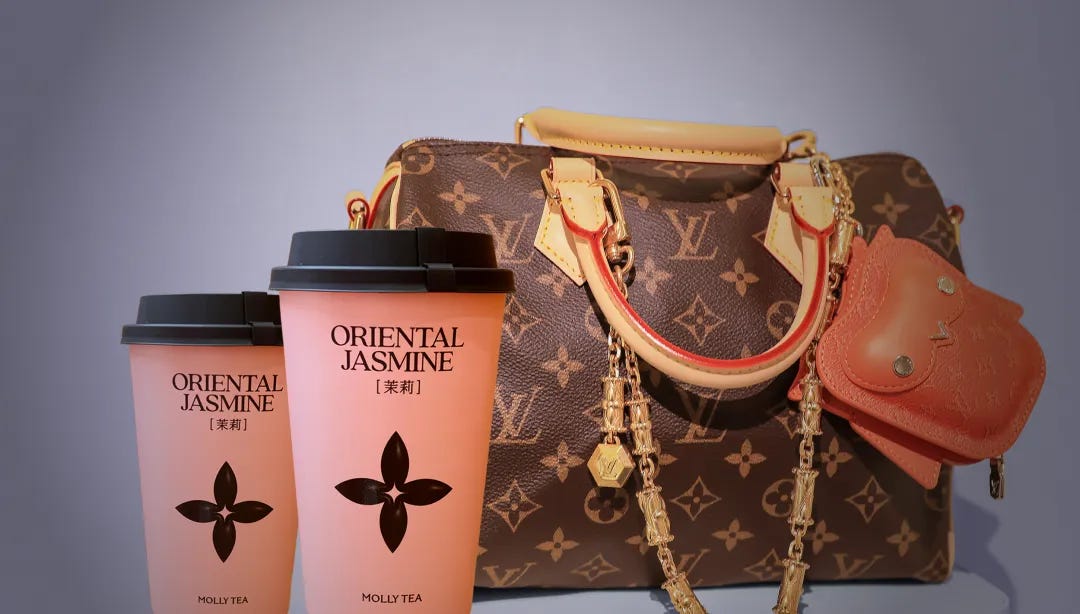
The court said it considered whether the resemblance between Louis Vuitton’s classic four-petal motif and Molly Tea’s emblem could lead consumers to believe that the two companies had entered into a licensing agreement, collaboration, or other commercial relationship.
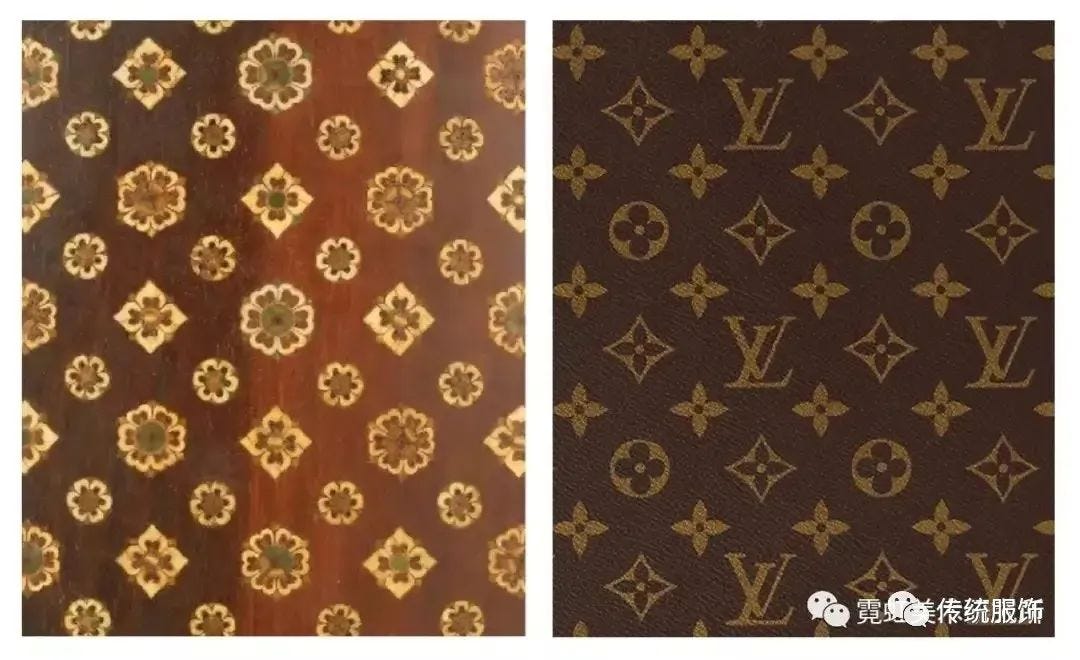
Much of the online response, however, focused on whether Louis Vuitton was using trademark law to claim control over motifs from China’s visual heritage. Users circulated side-by-side comparisons of its flower designs with baoxianghua, a Buddhist floral motif, as well as traditional Chinese patterns, ancient musical instruments, garden windows, and temple decorations.
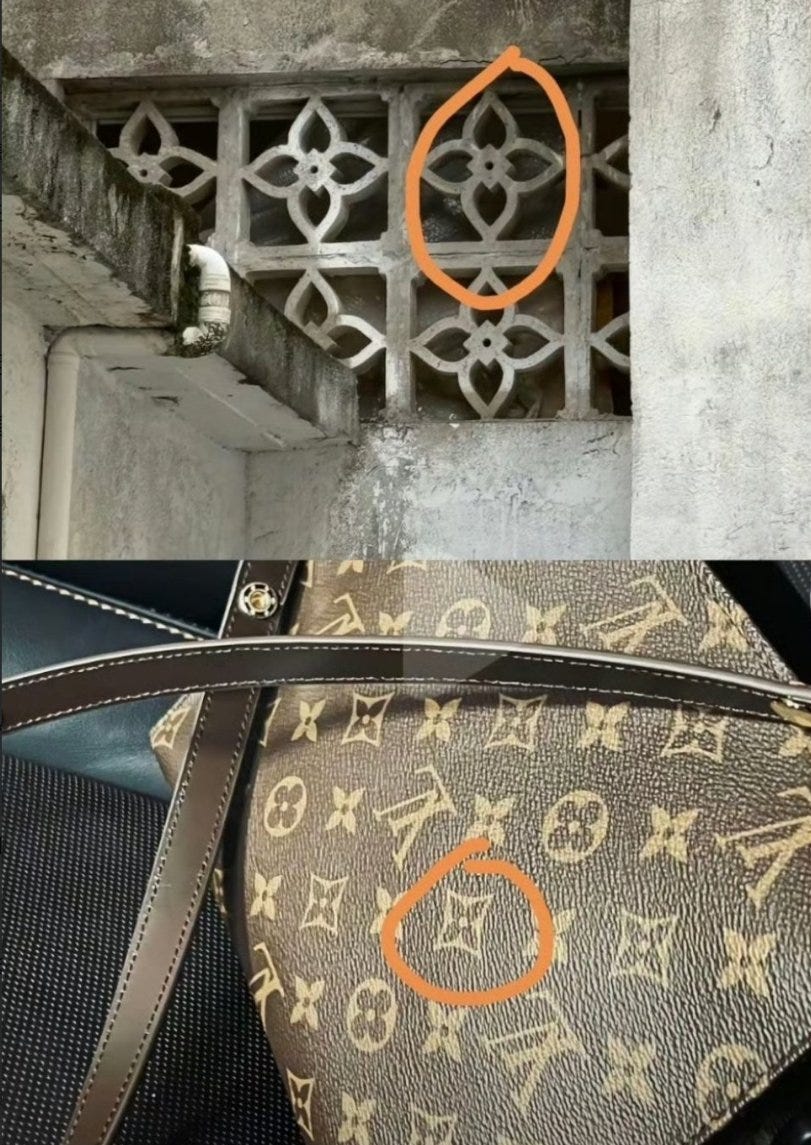
The comparisons also became a source of ridicule. Images circulated online comparing Louis Vuitton’s Monogram flowers with ventilation grilles and tiles found in older public toilets, giving rise to the nickname “toilet bag”. A separate video purported to show the letters “LV” on a public toilet in Henan, suggesting that they stood for “lavatory”. Local authorities later said the footage had been digitally altered, and that the person responsible was given an administrative penalty.
The reaction reflected a broader shift in Chinese public sentiment in recent years, as growing cultural confidence has increasingly been accompanied by a more assertive sense of national identity. In disputes involving foreign brands and traditional symbols, questions of trademark ownership can quickly become entangled with concerns over cultural appropriation, national dignity, and the right to define China’s own heritage.
Many users accused Louis Vuitton of “claiming Chinese traditional motifs as its own, then suing a domestic brand.” Others said that it was “bullying Chinese ancients for failing to register trademarks.”
In a commentary, the People’s Daily took a more moderate position. It argued that companies may build trademarks from traditional motifs, but that such rights should have clear limits, and called for more precise boundaries on commercial claims to traditional Chinese patterns and aesthetic elements.
Rumours fill the information gap
The controversy soon spread to businesses and disputes with little or no connection to the Molly Tea case.
Reports that Louis Vuitton had filed for judicial review of a separate decision by China’s intellectual-property regulator were recast online as the company “suing the Chinese government” and challenging China’s authority over its own cultural symbols. Such court challenges, however, are a standard legal procedure for companies seeking to overturn administrative trademark decisions in China.
In Nanjing, a lawsuit over another restaurant’s use of four-petal motifs in its decorations and plate design was misreported as action against a seller of duck-blood noodles, a popular local staple.
In Xiamen, a pending case against a shop accused of selling counterfeit Louis Vuitton goods — and against property managers accused of failing to supervise it — became a claim that the company had sued a residential developer over four-petal carvings on its buildings.
A Louis Vuitton event in Shanghai on 25 July, described online as a major runway show, was similarly said to have been shunned by Chinese celebrities seeking to avoid association with the brand. However, the Chinese edition of Fashion Network, citing an industry source, said there had been no major public show, only a routine private presentation for clients.
Louis Vuitton has made no public statement on the Molly Tea case or the wider backlash. Its official accounts on Weibo and Xiaohongshu — the latter a popular lifestyle app — had previously been updated regularly but have posted nothing since 1 July. The prolonged silence has further raised questions about the brand’s handling of the controversy.
The backlash in China comes as LVMH and its controlling family face scrutiny at home. In France, Le Monde has published a six-part investigation into founder Bernard Arnault’s political and media influence, as well as the unresolved question of succession within the group.
For Molly Tea, though, the episode appears to have provided an unexpected marketing windfall.
Chinese media reported that the company’s Douyin [TikTok’s Chinese sister app] account gained about 350,000 followers in the days after the ruling and that some branches experienced a surge in orders.

Xiaomi: a hater's taunt, a fan revolt

Xiaomi Corp. issued rare sanctions against senior executives to atone for paying a longtime hater, a move that sparked a loyalist revolt.
The Caffeine Crisis: CHAGEE and China’s Anti-Drug Nerve

Can a 20-yuan ($2.80) cup of milk tea be a “legal drug”? For CHAGEE, a Chinese tea chain that has expanded to more than 7,000 stores worldwide, the question triggered a full-scale reputational crisis just six months after its Nasdaq debut.
JD.com chickens out to masculinist "boy"cotts

JD.com, the world's second-largest online store and China's largest retailer, canceled its partnership with female comedian Yang Li just four days after announcing her as a brand ambassador, chickening out to hopping mad male netizens offended by her stand-up comedy four years ago.
One additional thought came to mind after reading your article.
Ironically, Molly Tea may have gained something that no advertising campaign could easily buy: nationwide attention, public curiosity, and perhaps even a great deal of public goodwill.
Before this lawsuit, many people had never heard of the brand. Today, millions have. Some consumers may even decide to try a cup simply because the controversy introduced the brand to them. From a branding perspective, that kind of exposure could ultimately prove more valuable than the financial damages awarded by the court.
This is why I see the case as more than a trademark dispute. To me, it reflects a broader feedback mechanism in the evolution of businesses—and even civilizations. Every significant challenge, whether friendly or unfriendly, generates feedback. That feedback forces adaptation, and adaptation is often what ultimately creates stronger organizations.
The court delivered its verdict today. The market will deliver its verdict over the coming year.
I will be very interested to see where Molly Tea stands twelve months from now. If this company can transform today’s legal setback into a stronger and more independent brand, the long-term value of what it learned may far exceed the cost of losing the case.
Perhaps this is one of the fundamental ways civilizations evolve—not by avoiding conflict, but by learning, adapting, and becoming stronger through feedback.
Thank you for an insightful article.
What I found most valuable is that it goes far beyond a trademark dispute. It illustrates how legal decisions, culture, history, and market psychology can interact in unexpected ways.
It also reinforced one thought I’ve had for a long time: companies don’t compete on a single scale. Winning in court does not necessarily mean winning the market.
Thank you for sharing your perspective.