


Zhou Yongmei, Professor of Practice in Institutional Development at the Institute of South–South Cooperation and Development (ISSCAD) and the National School of Development (NSD), Peking University, said the main challenge facing multilateral development cooperation is not only a shortage of financing, but a weakening of trust, coordination, and collective action.
Speaking at the 2026 Conference on EU-China relations on 12 May 2026, Zhou said Europe and China have different but potentially complementary strengths in development cooperation. Europe can contribute institutional frameworks, standards, financing structures, and long-term policy support, while China brings capabilities in infrastructure delivery, renewable energy deployment, manufacturing, engineering implementation, and South-South cooperation.
Zhou received her PhD in economics from the University of California, Berkeley, in 1999, specialising in new institutional and development economics. From 1999 to 2020, she worked at the World Bank, advising leaders in Africa and South Asia, managing the Fragility, Conflict and Violence Group, and co-directing the 2017 World Development Report.
Zhou has kindly provided the transcript of her remarks.
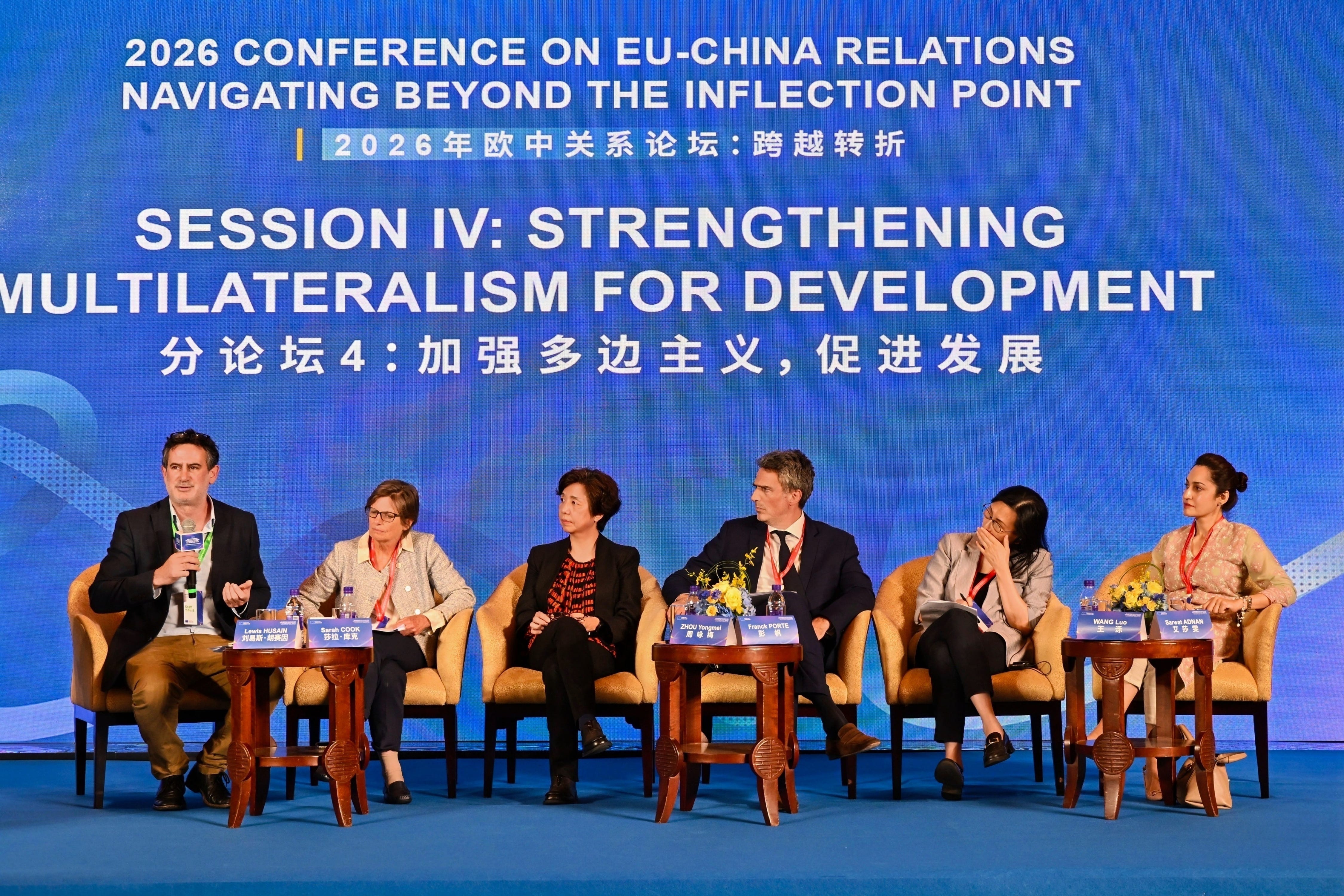
Rebuilding Multilateralism for Development: Rebuilding Trust, Coordination, and Collective Action in a Fragmented World
The global development community often frames today’s challenge as a financing gap. Indeed, development financing pressures are real. Many countries face rising debt burdens, slowing aid flows, increasing climate costs, and widening infrastructure and energy deficits.
But the deeper challenge facing multilateralism today is not merely a funding issue.
It is whether the international system can still mobilize trust, coordination, and collective action to address increasingly complex global challenges such as climate change, pandemics, fragility, energy transition, and industrial transformation.
Many countries — particularly in the Global South — increasingly question whether existing multilateral arrangements adequately reflect their priorities, distribute development opportunities fairly, or give them meaningful voice in shaping global rules. At the same time, geopolitical tensions and inward-looking policies are making international cooperation more difficult precisely when cooperation is most needed.
Yet despite growing strategic competition, Europe and China remain indispensable actors in addressing many global development challenges because of their respective technological, financial, institutional, and industrial capabilities.
The future of multilateralism may therefore depend less on defending institutional architectures in the abstract and more on whether different actors can combine complementary capabilities around practical development challenges defined by developing countries themselves.
Energy Access and the Coordination Challenge
Energy access provides one important example.
For the past two decades, global energy governance attempted to balance four goals simultaneously: energy security, development, sustainability, and equity. Today, that balance is increasingly under strain.
The United States has signaled that climate commitments can shift with domestic political cycles. Europe, after the Ukraine war, understandably placed greater emphasis on energy security and industrial competitiveness. Meanwhile, AI and the digital economy are rapidly increasing demand for electricity and data-center infrastructure.
Yet globally, around 730 million people still lack access to electricity, most of them in Sub-Saharan Africa.
As a result, global energy governance increasingly operates through two parallel conversations. One focuses on AI, strategic industries, data infrastructure, and technological competition. The other focuses on whether rural clinics, schools, and small businesses have reliable electricity at all.
Many developing countries increasingly worry that global energy governance discussions are becoming less connected to the immediate development realities they still face, particularly energy access, affordability, and industrialization needs.
Recalibrating global energy governance therefore requires re-establishing energy access as a central development issue while strengthening multilateral coordination around this agenda.
The World Bank’s “Mission 300” initiative, which aims to help provide electricity access to 300 million additional people in Africa by 2030, is important not only because of the scale of its ambition, but also because it creates a platform for coordinating governments, private developers, concessional finance, and development institutions around a shared objective.
At a time when parts of the international system are becoming more fragmented and some traditional multilateral commitments less predictable, European actors have remained important anchors within many multilateral institutions — sustaining support for climate cooperation, development finance, technical standards, blended finance mechanisms, and rules-based coordination frameworks.
China, meanwhile, has become increasingly important through its strengths in infrastructure delivery, renewable energy deployment, manufacturing ecosystems, engineering implementation, and South-South cooperation.
The central question for multilateralism is therefore not whether one model replaces another, but whether these different capabilities can be mobilized in complementary rather than fragmented ways.
DARES and the Logic of Complementary Capabilities
Nigeria’s Distributed Access through Renewable Energy Scale-Up project, or DARES, supported by the World Bank, illustrates how such complementary cooperation architectures could potentially work in practice.
DARES is helping expand decentralized electricity access through mini-grids and Solar Plus models that combine decentralized solar with battery storage, digital payment systems, or energy-as-a-service models for clinics, schools, and small businesses.
These Solar Plus models are attractive because they can sometimes bypass weak legacy systems and expand access more quickly and flexibly.
What makes DARES particularly interesting is not the technology alone, but the way it creates a coordination platform linking governments, multilateral development banks, concessional finance, private developers, and local implementation actors around a shared development objective.
From a financing perspective, DARES also illustrates the growing importance of blended finance approaches.
In simple terms, blended finance means using public or concessional financing to reduce risks that private investors often cannot absorb on their own in difficult markets. The goal is not to replace private investment, but to mobilize it toward development objectives that markets alone may underprovide.
In this sense, blended finance is fundamentally a coordination tool — using public resources strategically to mobilize broader pools of private capital and implementation capacity toward development objectives.
Chinese firms have developed strong capabilities relevant to Solar Plus ecosystems, ranging from solar manufacturing and installation to battery systems, smart system management, and technical training.
At the same time, European institutions and multilateral organizations often contribute strengths in regulatory frameworks, safeguards, standards-setting, financing structures, and long-term institutional support.
The challenge to the multilateral system today is whether it can make such cooperation platforms work — allowing complementary capabilities to reinforce one another around priorities defined by developing countries themselves.
Vocational Education and Industrial Capability
Similar coordination challenges arise in vocational education and workforce development.
Many developing countries aspire to industrial upgrading, green transition, and digital transformation, but often lack sufficiently skilled technical workforces. This is not simply an education problem. It is fundamentally an ecosystem problem linking firms, institutions, incentives, financing systems, and industrial strategy.
Chinese firms and financing institutions often have strong practical capabilities connected to real production ecosystems — including industrial parks, manufacturing supply chains, factory-linked training, and apprenticeship systems closely tied to operational demand.
Multilateral institutions, meanwhile, often bring strengths in teacher development systems, qualification frameworks, certification portability, monitoring systems, financing sustainability, and long-term institutional capacity building.
Many of these functions also have strong public goods characteristics. Firms alone may underinvest in them because the benefits extend far beyond any single company and contribute to broader national capability and long-term productivity growth.
This is precisely where governments and multilateral institutions can play an important role — through co-financing, incentive structures, and institutional partnerships that help align private sector participation with broader public development objectives.
In this context, parallel financing arrangements may prove more realistic than fully integrated financing models in a geopolitically fragmented environment.
The real challenge is not simply coordinating financing flows. It is coordinating different institutional logics, implementation cultures, and time horizons.
Rebuilding Practical Multilateralism
The future of multilateral development governance will depend less on abstract declarations and more on whether institutions can rebuild trust, coordination, and collective action around concrete shared challenges.
This is particularly important in a more fragmented and multipolar world, where no single actor possesses all the capabilities needed to address complex development problems at scale.
Europe, China, multilateral institutions, private firms, and developing-country governments each bring different but potentially complementary strengths. Some contribute institutional frameworks, financing systems, technical standards, and long-term policy support. Others contribute industrial capabilities, implementation experience, manufacturing ecosystems, technological innovation, or deep local knowledge of development priorities and political realities. The challenge is whether these diverse capabilities can be organized in ways that reinforce rather than fragment one another.
Practical cooperation around issues such as energy access, green transition, and long-term capability building may therefore matter not only for development outcomes themselves, but also for rebuilding confidence in multilateral cooperation more broadly.
In this sense, effective multilateralism today is not simply about preserving existing institutions. It is about creating workable coordination mechanisms in a world of increasingly diverse actors, interests, and development pathways.
China’s contribution may matter not only because of its financing or technology, but because it can help push global governance toward a more development-centered and inclusive logic—one in which developing countries’ priorities, constraints, and voices are taken seriously.

Zhou Yongmei: Containing violent conflict is the foremost priority of state governance

Ethiopia’s rapid rise under a tightly managed “developmental state” has given way to protracted internal armed conflicts—a reminder, argues Zhou Yongmei, that in ethnically diverse countries, cohesion is the first order of business.
Transcript: Zhou Yongmei on why “good governance” may not be a prerequisite for development

Zhou Yongmei is Professor of Practice in Institutional Development at the Institute of South–South Cooperation and Development (ISSCAD) and the National School of Development (NSD), Peking University, a role she has held since 2020. She received her PhD in economics from the University of California, Berkeley, in 1999, specialising in new institutional …