


Ethiopia’s rapid rise under a tightly managed “developmental state” has given way to protracted internal armed conflicts—a reminder, argues Zhou Yongmei, that in ethnically diverse countries, cohesion is the first order of business.
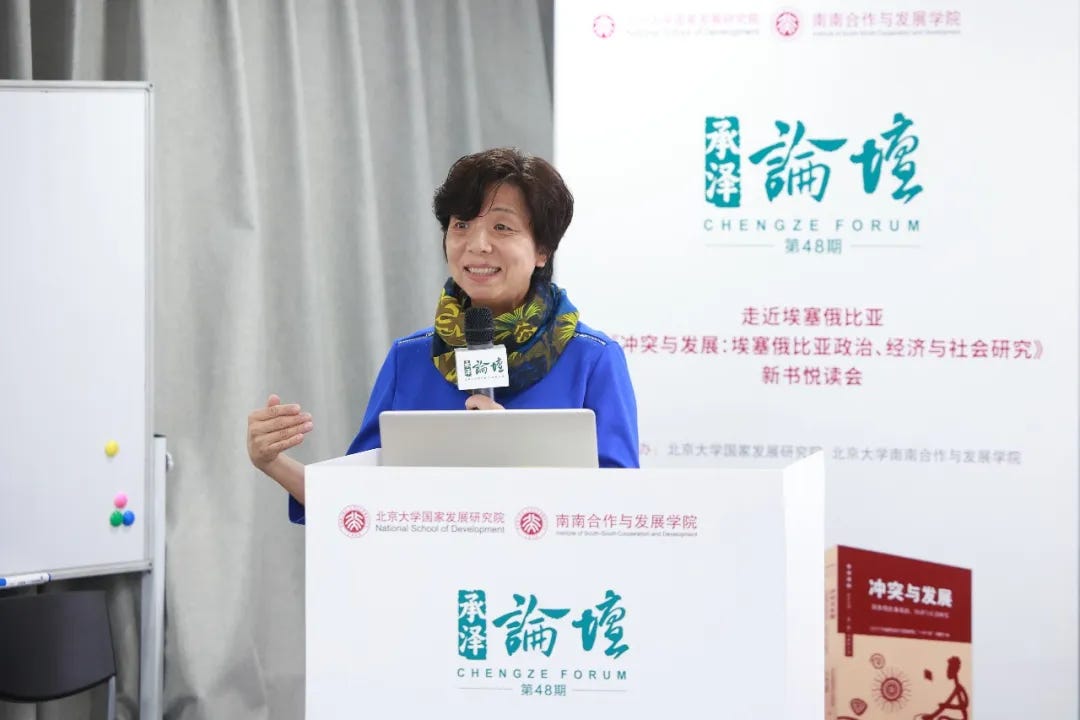
Zhou Yongmei is Professor of Practice in Institutional Development at the Institute of South–South Cooperation and Development (ISSCAD) and the National School of Development (NSD), Peking University, a role she has held since 2020. She received her PhD in economics from the University of California, Berkeley, in 1999, specialising in new institutional and development economics. From 1999 to 2020, she worked at the World Bank, advising leaders in Africa and South Asia, managing the Fragility, Conflict and Violence Group, and co-directing the 2017 World Development Report.
Zhou made the speech on December 5, 2025, at a seminar jointly hosted by the NSD, ISSCAD, and the China Center for Economic Research (CCER). The seminar was dedicated to Conflict and Development: Studies on Ethiopia’s Politics, Economy and Society 冲突与发展:埃塞俄比亚政治、经济与社会研究, a new book published by Xinhua Publishing House and compiled by ISSCAD Belt and Road research group.

The article was published on 26 February 2026 on the NSD’s official WeChat blog.
周咏梅:控制暴力冲突是国家治理的第一要务
Zhou Yongmei: Containing violent conflict is the foremost priority of state governance.
From 2000 to 2007, I was seconded by the World Bank to work in West Africa. Over that period, Ethiopia was growing fast. The country’s then Prime Minister, Meles Zenawi, was an exceptional leader whose policies were shaped by East Asia’s developmental-state experience, including China’s. For Chinese readers, many of Ethiopia’s policy choices will sound familiar.
Economically, Meles emphasised strong government intervention in industrial policy, infrastructure development, and agricultural modernisation. The growth model was agriculture-led industrialisation, underpinned by large public investment. Scarce state resources were then channelled into priority areas to raise productivity and drive structural transformation, in the sense often used by Professor Justin Yifu Lin. Ethiopia’s land tenure system also echoed China’s: land remained in public ownership and served as a key instrument of state-led development, an arrangement that is unusual globally.
Politically, power was highly centralised, which made long-term planning and sustained reform easier. The ruling Ethiopian People’s Revolutionary Democratic Front (EPRDF) also built a dense organisation down to the grassroots, strengthening the state’s ability to implement development plans.
How Should Ethiopia’s Internal Armed Conflicts Be Understood?
Ethiopia enjoyed nearly two decades of relative peace and rapid growth. But on my first field visit in 2023, I could not travel to the north due to ongoing hostilities.
The north, often described as the cradle of Ethiopian civilisation, was meant to be the centrepiece of my research. That became impossible after tensions between the Tigray authorities and the federal government erupted in November 2020 and quickly spread across the country. What began as a confrontation in Tigray turned into a protracted crisis, with multiple armed actors and recurring flare-ups, and it triggered a major humanitarian emergency. Several international organisations have estimated that between 2020 and 2022, civilian deaths linked to the Tigray War ranged from roughly 300,000 to 800,000, while millions were displaced. In 2021, the World Bank classified Ethiopia as a “fragile and conflict-affected situation” for the first time.
What are the deeper causes of Ethiopia’s internal armed conflicts? At their core lies an unfinished nation-building project. Ethiopia’s ethnic federal system has struggled to forge a shared political community across its diverse groups.
Ethiopia is home to more than 80 ethnic groups. The Tigrayans make up around 8 per cent of the population, yet they have long carried significant political weight, rooted in the region’s status as the birthplace of Ethiopian civilisation. The Amhara, roughly 30 per cent, have traditionally dominated national governance. The Oromo, the largest group at about 40 per cent, have long been politically under-represented. Abiy Ahmed’s rise to the premiership in 2018—the first Oromo to hold the post—greatly enhanced the political standing of the group. Other communities include the Somali population and a wide range of southern minorities.
Some macroeconomists use an “ethnic fractionalisation index”, which captures the likelihood that two randomly selected citizens come from different ethnic groups. A score of 0 implies near homogeneity, as in Japan or South Korea; a score closer to 1 signals extreme diversity. China is put at about 0.15; Ethiopia at around 0.72.
A high ethnic fractionalization index points to structural governance challenges. When ethnic groups are weakly integrated and a shared national identity is thin, economic stress or external shocks can sharpen grievances, potentially escalating into violence. Different groups were incorporated into the modern state at different times. That legacy left uneven political status across communities and persistent imbalances in power and resources—fault lines that have remained unresolved to this day.
One might ask: Ethiopia has always been ethnically diverse—why did violence intensify only in recent years? The answer is that, at different historical moments, Ethiopia relied on different sources of cohesion. For a long time, the Ethiopian Orthodox Church played that role, anchoring state legitimacy and a shared identity. As the state expanded and incorporated predominantly Muslim areas in the southeast, that religious anchor could no longer serve as the single organising principle for national cohesion.
Ethiopia is also one of Africa’s oldest state traditions, with an early civilisation and a durable monarchy. For a long time, political legitimacy rested on two pillars rooted in the northern highlands: the Ethiopian Orthodox tradition and the Solomonic line. From the mid-nineteenth century, rulers of the Solomonic dynasty unified rival polities by force and resisted European encroachment, preserving independence. That process forged the territorial outline of the modern Ethiopian state and produced a “unity in diversity” structure. But it also entrenched a strong centre and left a legacy of strained interethnic relations, making questions of ethnic identity and political rights central to Ethiopia’s nation-building.
After the Second World War, ethnic tensions sharpened. Separatist currents, rural uprisings, and elite mobilisation for political inclusion became defining features of Ethiopian politics. In the 1970s, the military regime that followed Mengistu’s coup doubled down on centralisation and Amhara’s primacy. The result was a further rise in ethnic nationalism and secessionist pressures, and Ethiopia slid into a civil war.
The 1995 constitution introduced ethnic federalism, drawing regional boundaries largely along ethnic settlement patterns. The idea was to create relatively cohesive subnational units capable of accommodating internal interests, reduce inter-communal conflict, and in doing so, secure peace and development. It was an ambitious institutional experiment.
At its core, ethnic federalism was a bargain: autonomy in exchange for staying within a single Ethiopian state, thereby averting fragmentation. It did weaken Amhara’s primacy, but implementation fell short. Under the EPRDF, power and resources were not distributed equitably, widening tensions both among ethnic groups and between the federal centre and the regions. The Oromo, around 40 per cent of the population, were particularly aggrieved by limited access to national decision-making.
The “developmental state” model under Meles rested on centralised authority and unified control over resource allocation, which made it possible to push through infrastructure building and industrialisation. But that logic sits uneasily with a federal system built around regional autonomy. In practice, the two pulled in opposite directions, creating constant strain. Ethnic federalism also carried its own trade-off: it strengthened ethnic identification, while a shared national identity became harder to sustain.
When Abiy Ahmed took office in 2018 as Ethiopia’s first Oromo prime minister, the Oromo’s political standing rose. He entered office with a reform agenda and moved quickly on several fronts. Economically, he pushed privatisation and opened sectors long dominated by state monopolies to foreign investment. Externally, he struck a peace deal with long-standing adversary Eritrea, which later earned him the Nobel Peace Prize. At home, he relaxed political controls, allowing many exiled opposition figures and former political prisoners under Meles to return.
Abiy then moved to dissolve the EPRDF and replace it with the Prosperity Party, intended as a single national vehicle that could bring disparate political forces under one roof. However, the Tigray, representing roughly 8 per cent of the population, opposed the move, fearing that a dominant national party would weaken regional autonomy. Their refusal to join became a key trigger for conflict. During the pandemic, arguments over postponing national elections deepened disputes and, in the end, tipped the country into large-scale armed conflict.
In the longer view, Ethiopia, a state marked by profound ethnic diversity, has often lived in a precarious balance. Successive leaders have tried to manage economic distribution, power-sharing, and the control of violence. In textbook definitions, the state monopolises the legitimate use of force. In many settings, however, this condition has not fully prevailed. Ethnic communities in Ethiopia have their own political structures and armed organisations. When multiple actors have coercive capacity but feel deprived of proportional economic and political status, instability becomes endemic.
Diversity as a Structural Fact; Governance as an Institutional Achievement
Ethnic diversity is a structural fact of Ethiopia. It is also a serious test of state governance: how can communities divided by ethnicity, identity, language, and faith live within a single political system? The answer is institutional design and practice. This is the core claim of my talk: in ethnically diverse states, preventing and containing violent conflict is the first order of business.
Many countries have experimented with institutional arrangements to manage violence and create the conditions for peace and development. From 2012 to 2014, I led the World Bank’s Fragile States Group. Drawing on that experience, I outline several approaches and policy tools that may be useful for multi-ethnic states.
First, building a shared political identity.
Tanzania offers a notable example. It is highly diverse, with an ethnic fractionalisation index as high as 0.93. However, Julius Nyerere, the first president after independence, prioritised building a civic “Tanzanian” identity through language and education, rather than entrenching ethnic affiliation. Two tools were central: the nationwide promotion of Swahili and investment in public schooling to embed a shared national identity over time. That long, systematic effort at nation-building helped Tanzania avoid the kind of large-scale ethnic violence seen in Ethiopia.
Second, establishing power-sharing mechanisms.
Many multi-ethnic states manage diversity through institutionalised power-sharing. Ethiopia’s ethnic federalism is one such attempt.
India’s linguistic fractionalisation index reaches 0.86. There is no single nationwide language; banknotes carry 16 official languages, which gives a sense of the governance challenge. India’s response blends accommodation with integration. Ethnic groups and states are free to use their own languages and protect local cultures. At the same time, a federal elite civil service serves as national “glue.” Each year, about 100 officials are selected from hundreds of thousands of applicants. They are posted across the country, often to states with languages and cultures far from their own, and expected to serve for life. Over time, this cadre becomes an elite force that reinforces national unity.
Canada practices asymmetrical federalism. Quebec, predominantly French-speaking, has greater autonomy than the English-speaking provinces. The arrangement also carries risk—Quebec’s 1995 independence referendum came close to succeeding. Even so, asymmetry remains a common institutional device in ethically diverse states.
Bosnia and Herzegovina is another case. After Yugoslavia’s breakup, power-sharing among the three main communities became deeply contested. One telling arrangement is at the central bank: the governor has been required to be a foreign national, reflecting the depth of mutual distrust. The compromise was to give each community a deputy governor, while the governor is appointed through an IMF process as a neutrality guarantee.
Electoral design is another key part of power-sharing. In ethnically diverse states, simple majority rule often doesn’t work as it locks minorities out of representation. Proportional representation is therefore widely used, with parliamentary seats allocated in line with population shares. It is widely seen as a fairer way to share power.
Some countries also use cabinet formation as a power-sharing tool. In parts of Africa, cabinets can include 80 or more ministerial and deputy-ministerial posts, with portfolios distributed to balance ethnic and political representation. In countries such as Indonesia and Afghanistan, a winning presidential candidate may also bring a rival into government as vice president or defence minister. From a textbook view of government, this can look unusual. In practice, it is often a pragmatic bargain for stability. As a former Indonesian president put it, cross-party cooperation can be essential to getting legislation through; without it, politics can slide into gridlock, as seen in the United States.
Decentralisation between the centre and local governments is another common mechanism, and it is not limited to federal states. Unitary systems such as China and Indonesia also use fiscal decentralisation and cadre management to balance authority. These tools can also serve the governance needs of ethnically diverse states.
Third, refining resource distribution mechanisms.
Resource allocation is just as important. Nigeria is a case in point: it is ethnically and religiously diverse, yet much of its oil wealth is concentrated in a small number of states. To manage the tensions that can follow, Nigeria uses a clear, rules-based revenue-sharing formula, setting out how oil revenues are divided among the federal government, the states, and local governments, with allocations made every quarter. Such allocation rules are a common tool for governing diverse states.
Ethiopia’s Governance Model and Economic Outlook
Looking ahead, Ethiopia faces no shortage of governance challenges. The core issue of managing ethnic diversity persists. Ethnic federalism, for all its originality, is best understood as a workable compromise in the absence of a clearly better option. Its results have been limited, but no superior alternative has yet emerged.
From the perspective of an external observer, that compromise may simply be the reality for now. Over the longer term, the hope is that Ethiopian leaders can demonstrate the kind of statecraft shown by Julius Nyerere: using measures such as education and fairer resource-sharing to grow a shared national identity. But this is not a quick fix. It is undoubtedly a long, systemic project.
What does this mean for Chinese companies already operating in Ethiopia, or considering entry? In recent years, many Chinese firms have pulled out of conflict-affected areas. Security is one reason. Another is the strain on public finances: war has pushed up fiscal pressures, and the government has sought to raise revenue through higher taxes and fees, significantly worsening the business environment. In that sense, Ethiopia is competing with neighbours such as Kenya, Tanzania, Rwanda, and Uganda to retain investors.
Chinese investors should therefore reset expectations. The “Great Leap Forward” mindset of a decade ago no longer fits. A more cautious approach—strong risk management, serious security planning—is now essential.
Chinese firms should also plan for the federal–regional coordination problems that come with a federal system. Fieldwork in the Eastern Industrial Zone and in Hawassa suggests that some regional governments do not fully endorse, and may not even implement, federal investment policies. Policy frictions also exist within the federal government itself. For example, coordination is weak between investment promotion agencies and fiscal or tax authorities. Chinese companies should factor this into their strategy and do the groundwork upfront.
Conflict and fragile equilibrium are the norm in many ethnically diverse states. Chinese firms going global need a clear read on the underlying drivers of local conflict and should set realistic expectations accordingly.
Transcript: Zhou Yongmei on why “good governance” may not be a prerequisite for development

Zhou Yongmei is Professor of Practice in Institutional Development at the Institute of South–South Cooperation and Development (ISSCAD) and the National School of Development (NSD), Peking University, a role she has held since 2020. She received her PhD in economics from the University of California, Berkeley, in 1999, specialising in new institutional …


Small Chinese company empowers Sub-Saharan African women to reclaim reproductive rights

Since the 1990s, the production of subdermal contraceptive implants, a form of long-acting reversible contraception, has been dominated by two pharmaceutical giants—MSD and Bayer—plus a small player, Shanghai Dahua Pharmaceutical Co., Ltd, a Chinese firm with just over 100 employees. Established in 1996, Dahua developed its own Sino-implant (II), also k…