


On 7 August 2026, the 12th Cross-Strait Think Tank Academic Forum, themed “Changing Times and the Future of Cross-Strait Relations,” was held in Wuxi, Jiangsu Province. The forum was jointly hosted by the Institute of Taiwan Studies at the Chinese Academy of Social Sciences (CASS), the National Society of Taiwan Studies, the Graduate Institute for Taiwan Studies at Xiamen University, and the 21st Century Foundation in Taiwan.
According to the Institute of Taiwan Studies, CASS, More than 50 scholars from both sides of the Taiwan Strait exchanged views on developments in cross-Strait relations.
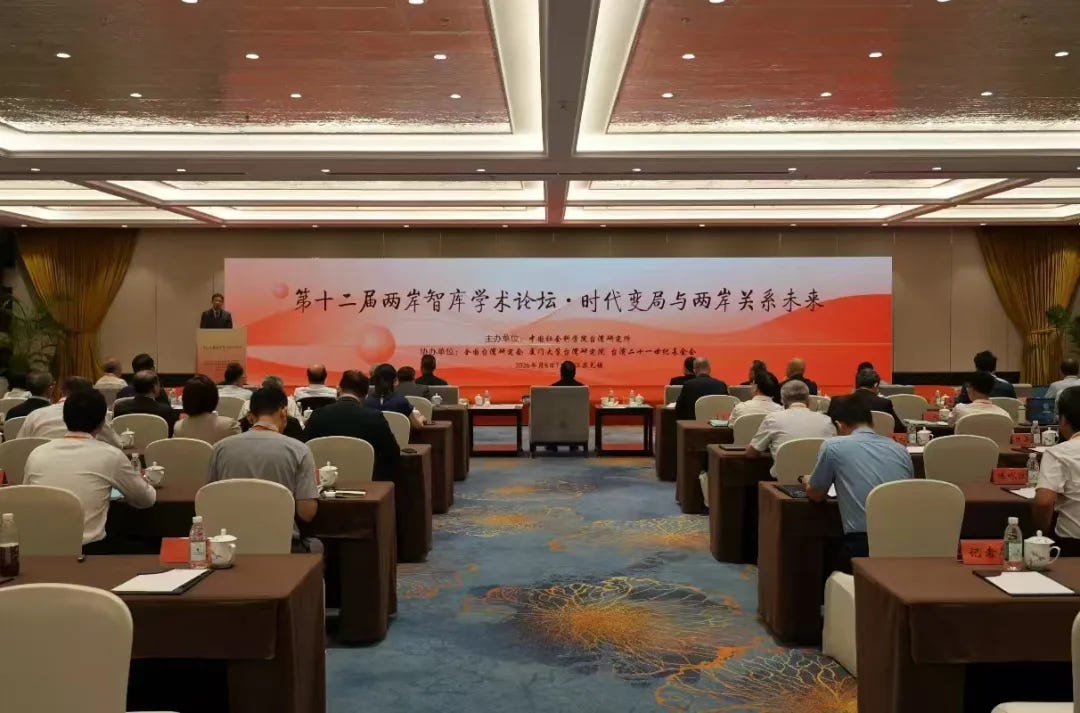
In his keynote address, Peng Weixue, Deputy Director and Research Fellow at the Institute of Taiwan Studies at CASS, presented a mixed assessment of the situation in the Taiwan Strait.
He argued that the mainland holds the strategic initiative and that momentum toward reunification is growing. At the same time, however, he warned that any easing in China-U.S. relations would not prevent Washington from continuing to support Taiwan. He also noted that Lai Ching-te had recovered from the setback of the failed recall campaign, tightened his control over the DPP, and expanded his political base. Public attitudes favouring reliance on the United States and resistance to reunification, as well as the erosion of Chinese identity and the rise of an increasingly Taiwan-centred identity, could become further entrenched.
The text of the speech was published on 17 August on Taiwan Studies (台湾研究), the official WeChat blog of the Institute of Taiwan Studies at CASS.
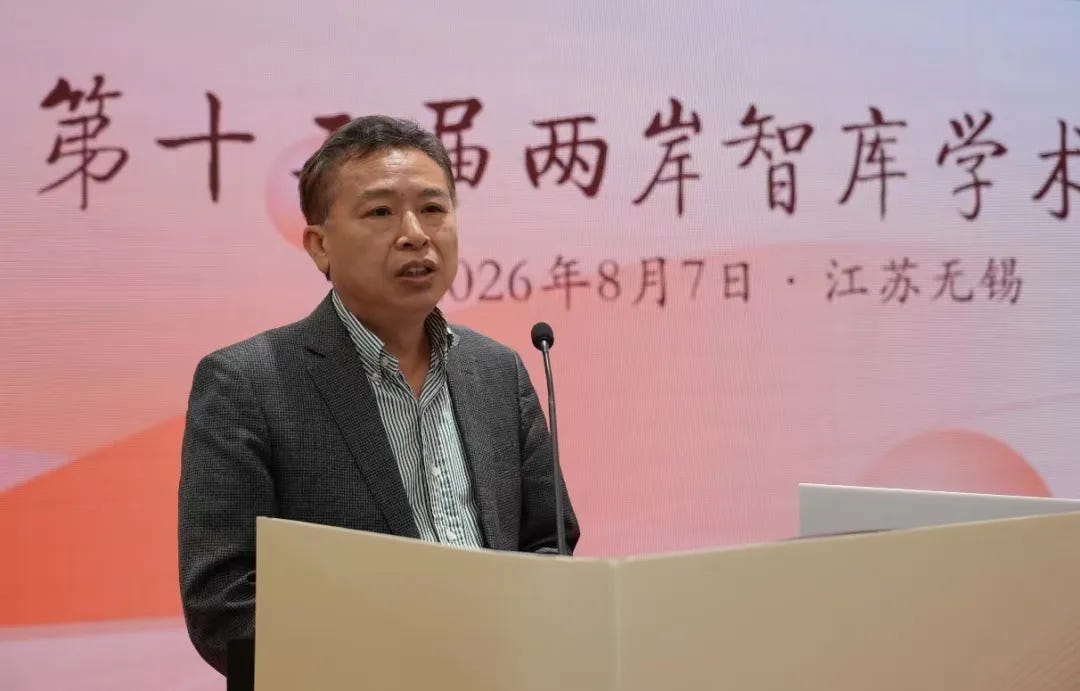
彭维学:台海新局的机遇与挑战
Peng Weixue: Opportunities and Challenges amid the Evolving Situation in the Taiwan Strait
The situation in the Taiwan Strait has entered a new stage characterised by the mainland’s firm grasp of the strategic initiative, a recalibration of the U.S. approach, significantly stronger momentum among pro-reunification forces, growing constraints on pro-independence forces, and generally manageable risks and challenges. The strategic inertia behind U.S. and Western efforts to “contain China while exploiting Taiwan,” the Lai authorities’ persistent reliance on the United States to resist the mainland, infighting and fragmentation within the KMT camp, and, in particular, uncertainty surrounding the 2028 elections in both the United States and Taiwan will make it more challenging for the mainland to manage the situation in the Taiwan Strait. None of these factors, however, can alter the broader trend toward China’s reunification.
I. Five Major Changes in the Taiwan Strait Strengthen the Strategic Foundation for National Reunification
Over the three decades from 1996 to 2026, external actors and “Taiwan independence” forces repeatedly engaged in provocations, reinforced the island-chain strategy, and sought to create a strategic trap in the Taiwan Strait. This led to persistent turbulence in cross-Strait relations and, at times, serious crises. In particular, Nancy Pelosi’s visit to Taiwan in 2022 crossed China’s red line, while Lai Ching-te has aggressively advanced a “new two-state theory” since taking office in 2024, pushing the situation in the Taiwan Strait to the brink of crisis. The mainland, however, has remained resolute in opposing “Taiwan independence” and external interference, contributing to five significant changes in the situation.
First, the mainland has further consolidated its leading role and strategic initiative in cross-Strait relations. Its strategic strength, confidence, initiative, and ability to manage the overall situation in opposing independence and promoting reunification are unprecedented. Drawing on its comprehensive national strength, responding to developments in proportion to their seriousness, and moving forward at its own pace, the mainland has continued to strengthen a framework for constraining “Taiwan independence,” maintaining the initiative in cross-Strait affairs, and countering U.S. interference, while steadily advancing the reunification process.
Second, it has become increasingly clear that external actors have fewer options for intervening in the Taiwan Strait and that such intervention is becoming less effective and more costly. The United States has significantly reassessed the risks involved in the Taiwan Strait, while its attempt to “use Taiwan to contain China” has been effectively curbed. The Trump administration has consequently been compelled to move away from the traditional policy of “strategic ambiguity” and towards restraining “Taiwan independence” forces, pursuing transactional bargaining, and managing risks. Most countries are unwilling to bear the considerable risks of relying on the United States to support “Taiwan independence.” Countries including Lithuania and the Czech Republic have recently been compelled to recalibrate their approaches to China on Taiwan-related issues.
Third, “Taiwan independence” forces are facing mounting difficulties, with increasing infighting and scapegoating. The mainland’s campaign against “Taiwan independence” has entered a new stage. Its measures are now more routine, systematic, and targeted, with operations increasingly conducted around the island. The space for “Taiwan independence” advocacy, public support, and international activity has been curtailed to an unprecedented degree, forcing “Taiwan independence” forces from aggressive expansion to a period of internal consolidation and low-profile activity.
Fourth, the trends toward “inevitable reunification” and “accelerated reunification” have become clearer. The mainland has established a stronger foundation for opposing “Taiwan independence” and promoting reunification, while its efforts to shape and manage cross-Strait developments are producing increasingly visible results. The international one-China framework has become firmer, and a preliminary system of law enforcement and governance has taken shape in the waters around Taiwan. The mainland has also continued to strengthen its assertion of jurisdiction over Taiwan. “Never before have we been so close to, confident in, and capable of achieving the goal of national rejuvenation.”
Fifth, Taiwan’s bargaining leverage in discussions on a “One Country, Two Systems” solution is clearly diminishing. As Taiwan becomes more deeply entrenched in its fixation on “aligning with the United States, relying on Japan, and resisting the mainland”, as the disparity in overall strength between the two sides continues to widen, and as cross-Strait political negotiations drag on, Taiwan will have less room for manoeuvre in those negotiations and will be able to secure fewer gains.
These five major changes are the combined result of three trends: China’s rise and U.S. decline in the strategic competition between the two countries; the growing disparity in overall strength between the mainland and Taiwan; and political and social cohesion on the mainland in contrast to division in Taiwan. These trends help the mainland maintain stable control of the situation in the Taiwan Strait, safeguard sovereignty and security, and protect the well-being and development interests of compatriots on both sides.
II. Four Sources of Momentum and Opportunity Usher in a New Stage in the Mainland’s Efforts to Constrain “Taiwan Independence” and Shape Conditions for Reunification
Chinese modernisation continues to advance; the mainland is seeking progress while maintaining stability in its Taiwan policy; and cross-Strait integrated development is deepening. Together, these developments are providing strong momentum for stability in the Taiwan Strait and for national reunification.
Under the guidance of the four principles for cross-Strait relations set out by General Secretary Xi Jinping and the 15th Five-Year Plan, the mainland will continue to leverage its strategic advantages, maintain the strategic initiative, enhance the quality and effectiveness of its efforts to constrain “Taiwan independence” and shape conditions for reunification, and strengthen the exercise of jurisdiction over Taiwan at multiple levels.
The development of “a constructive China-U.S. relationship of strategic stability” is bringing greater certainty to China’s management of the situation in the Taiwan Strait. General Secretary Xi has promoted substantive common understandings between China and the United States that will guide bilateral relations in the period ahead. Trump has set out a “Four Noes” policy on the Taiwan question, clearly signalling that he is unwilling to become involved in a conflict in the Taiwan Strait and that he opposes reckless moves toward “Taiwan independence.” China and the United States have developed overlapping interests in opposing “Taiwan independence” and maintaining peace in the Taiwan Strait. This has encouraged Trump to exercise restraint in his Taiwan policy, placed limits on arbitrary U.S. arms sales to Taiwan and official interactions with the region, reduced the risk of a China-U.S. conflict in the Taiwan Strait, and greatly narrowed the space available to the Democratic Progressive Party (DPP) to “rely on the United States to pursue independence” and advance “Taiwan independence.”
The United States and other Western countries remain deeply embroiled in the Russia–Ukraine conflict and conflicts in the Middle East, diverting their strategic attention and resources. Meanwhile, growing global distrust of the United States and apprehension about Trump are weakening cohesion within the U.S. alliance system. These developments have, objectively, eased some of the strategic pressure on China in the Taiwan Strait. With U.S. soft power and global leadership declining markedly, strategic fatigue deepening across the United States and the West, and China, Russia, and Iran strengthening their strategic coordination, the Chinese mainland has significantly strengthened its strategic initiative in resolving the Taiwan question.
The Communist Party of China (CPC) and the Kuomintang (KMT) have established a new model of dialogue suited to a new era and a new generation. The stark contrast between Cheng Li-wun’s approach of building friendly ties with the mainland to promote Taiwan’s prosperity and Lai Ching-te’s approach of subservience to the United States at Taiwan’s expense is encouraging public opinion in Taiwan to become more pragmatic and rational. Perceptions in Taiwan that China is rising while the United States is declining have grown stronger, as has public scepticism toward both the United States and “Taiwan independence.” Calls for communication and dialogue, avoiding war and pursuing peace, promoting mutually beneficial exchanges, and proactively discussing reunification have also increased. These developments will help curb the Lai authorities’ reckless pursuit of “Taiwan independence” and weaken the effectiveness of their policy of relying on the United States to resist the mainland. Polls conducted by the My Formosa and Global Views Monthly, among others, show that more than half of Taiwan’s residents are unwilling to “sacrifice their lives to avoid reunification.” Nearly 60 per cent believe that resuming cross-Strait negotiations and easing restrictions on people-to-people exchanges would do the most to safeguard Taiwan’s security, while 54.2 per cent do not believe Lai Ching-te’s claims about a “mainland attack on Taiwan in 2027.”
III. Four Overlapping Risks Increase the Challenges Facing the Mainland in Managing the Situation in the Taiwan Strait
First, the United States is becoming increasingly calculating in its efforts both to contain China and exploit Taiwan. Washington’s deep-seated anxiety over maintaining its hegemony and its long-standing wariness of China mean that a tactical easing of China–U.S. tensions cannot fundamentally alleviate the structural and strategic tensions between the two countries. Both U.S. parties, Congress, parts of the strategic community, and anti-China hawks in particular remain committed to a hard line against China. Seeking to gain leverage in its competition with China and maintain its strategic credibility — and especially as the 2028 election cycle approaches — Trump and politicians in both the Democratic and Republican parties may further amplify the so-called “China threat,” step up the so-called “Operation Causeway” and “drone-hive strategy,” and seek to fully exploit Taiwan’s strategic, economic, and technological value within the island chain.
In the long term, while remaining within the framework of the three principles — severance of diplomatic relations, withdrawal of troops, and abrogation of the Mutual Defense Treaty with Taiwan — the United States will continue to support Taiwan through legislation, shore up Taiwan diplomatically, back it militarily, draw on its technology, and mobilise allies to intervene in Taiwan-related affairs. It will seek to deepen Taiwan’s decoupling from China and integration with the United States and its strategic dependence on Washington.
At the same time, it will seek to shape the KMT’s leadership, political direction, and alliances; disrupt KMT-TPP cooperation; manipulate elections; and prop up a pro-independence regime. In addition, the United States is stepping up military deployments and provocations along the first island chain, while Japan, the Philippines, and Europe are joining forces to intervene in Taiwan-related affairs. This is strengthening the linkage among the Taiwan Strait, the South China Sea, and the East China Sea, and increasing the risks and costs China faces in opposing independence, promoting reunification, and managing the situation in the Taiwan Strait.
Second, the Lai authorities may soften their rhetoric and repackage their agenda, but their “Taiwan independence” nature remains unchanged. Although the easing of China–U.S. relations has constrained Lai Ching-te’s separatist activities, he continues to play up the “mainland threat” while invoking “democratic peace” and “maintaining the status quo,” as well as the defence of “national sovereignty and dignity” and the strengthening of “societal resilience.” In reality, he is seeking to align closely with the needs and pace of the Trump administration’s competition with China. His softer rhetoric and repackaged agenda are intended to test the mainland’s bottom line, ease pressure at home and abroad, and win votes by misleading the public.
Over the medium and long term, Lai will further develop his “new two-state theory,” press ahead with decoupling from China and integrating with the United States, strengthen “asymmetric capabilities,” erect an iron curtain against cross-Strait integration and reunification, intensify the suppression of forces favouring closer ties with the mainland, and reinforce the “anti-peace, anti-exchange, anti-democracy, and anti-humanity” narrative. He will also seek to generate support for “relying on the United States to resist the mainland” and broaden the DPP’s political base.
Third, Lai Ching-te’s tricks to tighten his political grip are heightening political risks. Due to firm pushback from the mainland, warnings from Trump, and checks from KMT-TPP cooperation, the DPP has little to show for its time in office. Yet Lai has resorted to ruthless tactics and expanded his political clout. He has recovered from the crushing defeat of the recall campaign and further consolidated his position within the party. Externally, he has used trade agreements and US arms purchases to bind Taiwan more closely to Washington. Internally, he has used the judicial system to target rivals such as Cheng Wen-tsan and Ko Wen-je, continued to drive wedges between the KMT-TPP alliance, and capitalised on favourable economic conditions and used policy giveaways to shore up his base and expand his influence.
Cheng Li-wun has demonstrated an unconventional leadership style, strengthening her approach of building friendly ties with the mainland to promote Taiwan’s prosperity, enhancing KMT-TPP cooperation, and broadening engagement with society. However, the KMT has yet to overcome its strategic passivity, while prominent disputes over power and political direction have seriously undermined the authority of the party’s central leadership and its momentum ahead of local elections.
The DPP currently enjoys greater overall support than the KMT and TPP combined. In the year-end local elections, it aims to retain control of the five cities and counties it currently governs while winning five additional contests, consolidating its existing position while making further gains. It then hopes to carry that momentum into the 2028 election. The KMT and TPP face a severe test in preventing Taiwan’s political landscape from evolving toward the kind of long-term one-party dominance of Japan’s Liberal Democratic Party.
Fourth, the structures that favour the green camp and impede reunification will be difficult to reverse in the short term. The party structure of a “strong DPP camp and weak KMT camp,” public sentiment structure favouring “reliance on the United States and rejection of reunification,” and a social structure increasingly detached from China and centred on Taiwan may, under certain conditions, become further entrenched. This would make it more difficult for the mainland to promote integration and reunification. In the period ahead, the DPP will use these trends to stoke reliance on the United States against China, mislead people in Taiwan, and sharply restrict the political space available to forces that do not support “Taiwan independence,” particularly patriotic pro-reunification forces.
Overall, the mainland firmly holds the strategic initiative in the Taiwan Strait and continues to build momentum and shape favourable conditions for constraining “Taiwan independence” and advancing reunification. However, the entrenched strategic logic behind U.S. efforts to exploit Taiwan to contain China, together with negative factors such as Lai Ching-te’s attempts to repackage his “Taiwan independence” agenda, will make the situation more difficult for the mainland to manage. In particular, worst-case outcomes in the 2028 elections in both the United States and Taiwan would seriously undermine efforts by China and the United States to build a constructive relationship of strategic stability and would destabilise the Taiwan Strait.
It is therefore essential to recognise the protracted and complex nature of China-US strategic rivalry, as well as the difficulties and setbacks that may arise in the reunification process. With both the strategic goal of national rejuvenation and profound changes unseen in a century in view, the Party’s overall policy for resolving the Taiwan question in the new era must be implemented, and the process of national reunification resolutely advanced.

Full text: Cheng Li-wun’s speech at Nanjing welcome banquet

Cheng Li-wun, chair of Taiwan’s opposition Kuomintang (KMT), arrived in the Chinese mainland on Tuesday, leading a party delegation after accepting an invitation from Xi Jinping, general secretary of the Communist Party of China (CPC) Central Committee, in the first visit by a sitting KMT chair to the mainland in a
Full text: Cheng Li-wun's speech at the Sun Yat-sen Mausoleum in Nanjing

Cheng Li-wun, chair of Taiwan’s opposition Kuomintang (KMT), visited the Sun Yat-sen Mausoleum in Nanjing on Wednesday, retracing a stop made on Lien Chan’s landmark 2005 “Journey of Peace” and using the occasion to pledge cross-strait reconciliation and peace as part of Sun Yat-sen’s unfinished mission.
Full Transcript of Xi Jinping and Cheng Li-wun's Remarks and Cheng's Press Conference

Xi Jinping, general secretary of the Communist Party of China (CPC) Central Committee, met Kuomintang Chair Cheng Li-wun in Beijing on Friday, the first meeting in a decade between the leaders of the two parties, with both sides centring their public message on peace across the Taiwan Strait.
Key Taiwan poll on identity is misleading, mainland researcher says

Today we have an excerpt from an article from Issue 5, 2024, of the Reunification Forum, published by the China Council for the Promotion of Peaceful National Reunification. The author is Guo Shanwen, then Research Fellow at the Institute for Taiwan Studies
Two Mainland analysts on "Lai Ching-te Administration's Foreign Policy Direction and Its Countermeasures"

Below is an article from Issue 3, 2024, of the Reunification Forum, published by the China Council for the Promotion of Peaceful National Reunification. The authors are Chen Ye, School of Politics and Administration, Tianjin Normal University, and Yu Jingting, PhD student at the Center for Taiwan Studies of Xiamen University.