

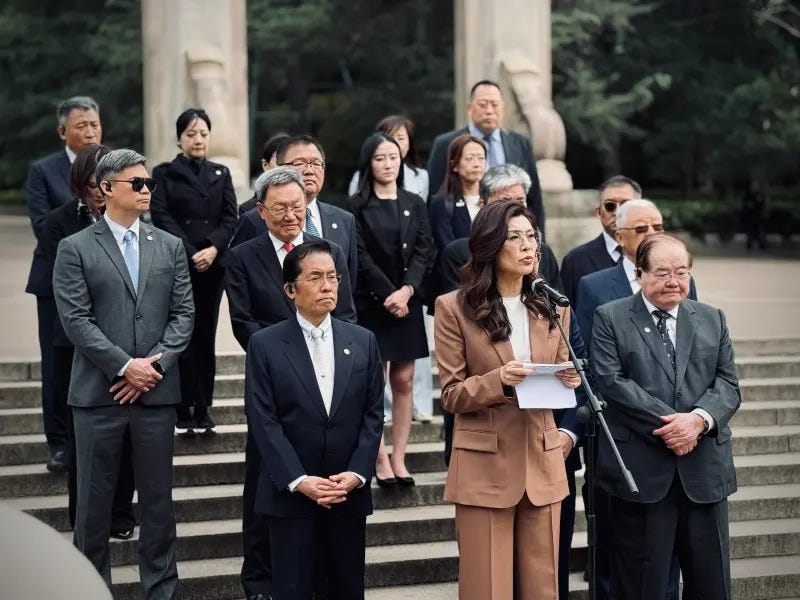
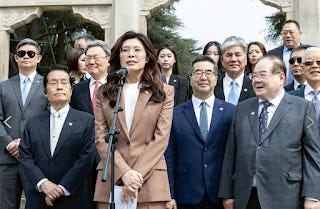
Cheng Li-wun, chair of Taiwan’s opposition Kuomintang (KMT), visited the Sun Yat-sen Mausoleum in Nanjing on Wednesday, retracing a stop made on Lien Chan’s landmark 2005 “Journey of Peace” and using the occasion to pledge cross-strait reconciliation and peace as part of Sun Yat-sen’s unfinished mission.
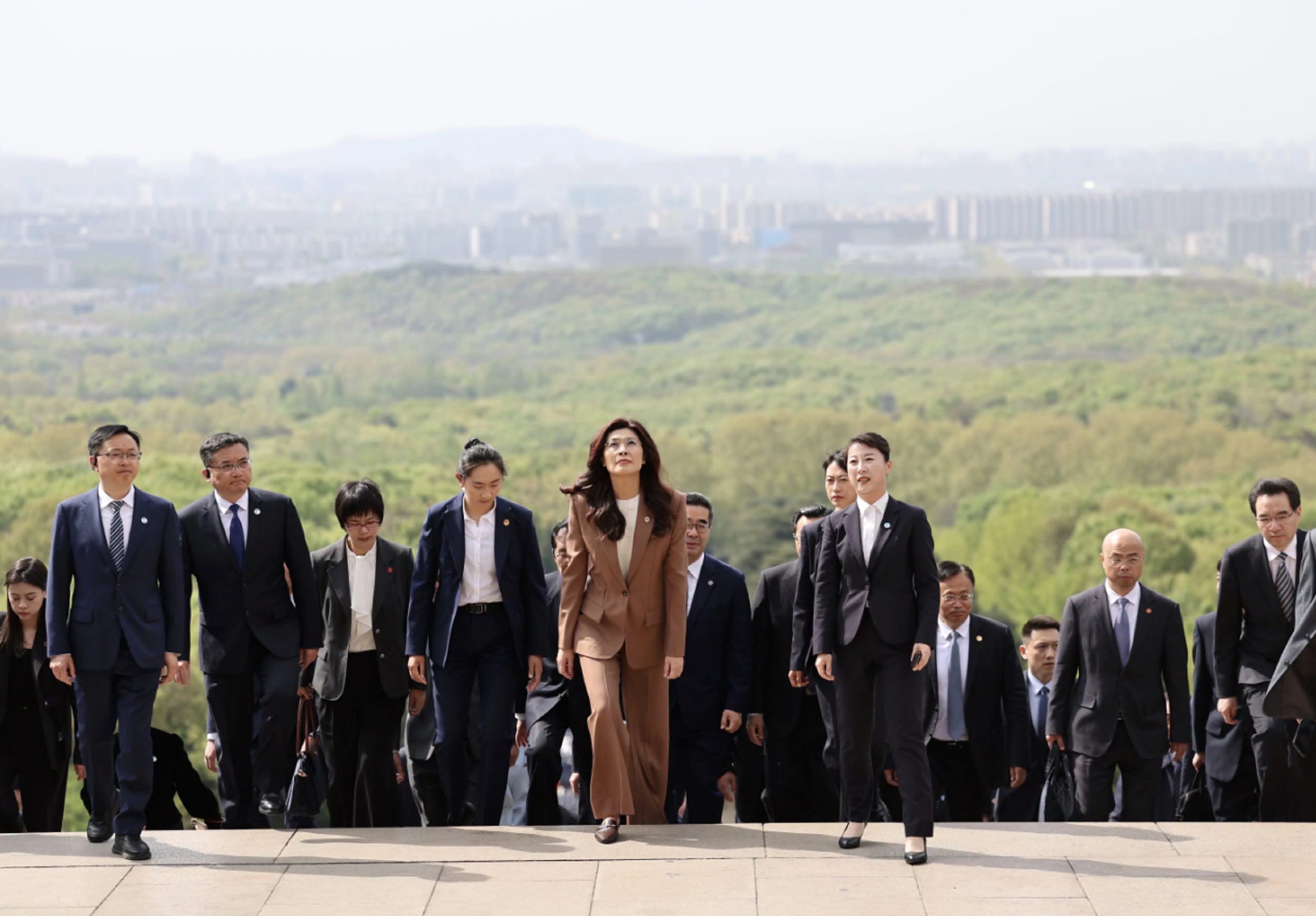
After paying tribute at the mausoleum, Cheng delivered a speech that invoked Taiwan’s history under Japanese colonial rule, the founding of the Republic of China, and the Chinese Civil War, as she called for renewed dialogue and exchanges under the “1992 Consensus” and said she hoped to “plant the seeds of peace” for both sides of the Taiwan Strait.
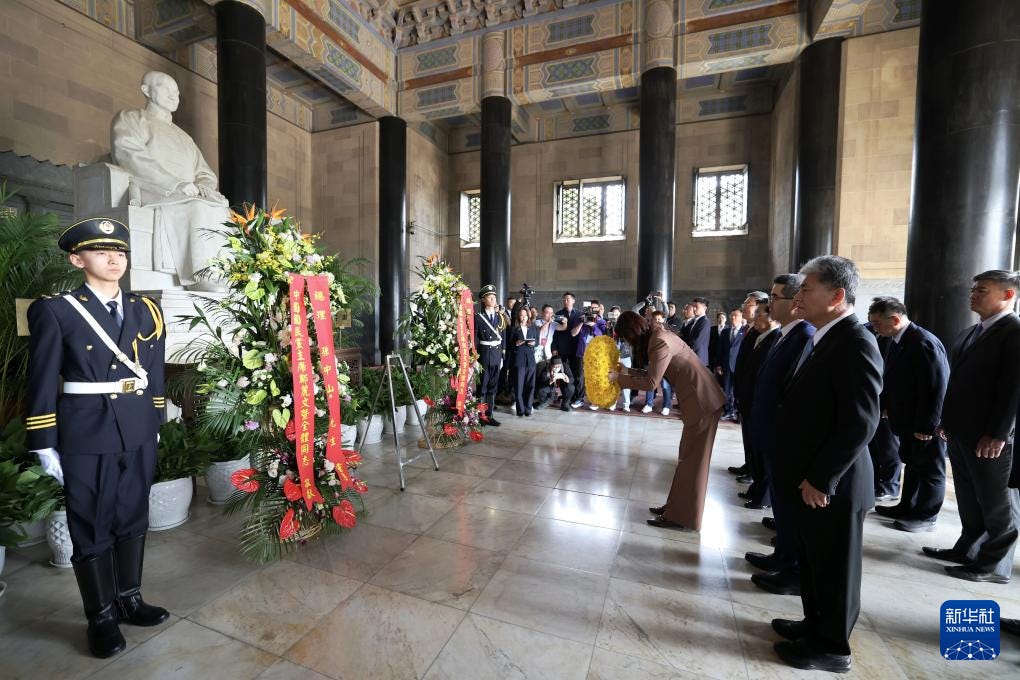
This translation is based on the official transcript published on the KMT official website. A livestream clip of the speech is also available below.
Today, after 21 years, I have returned once again to the Sun Yat-sen Mausoleum. My heart is filled with emotion.
On 12 March 1925, Dr Sun Yat-sen, Father of the Nation, passed away. At the time, the international press devoted extensive coverage to his death. Some 300,000 people flooded the streets to see him off, shouting, “Down with imperialism! Down with the warlords!” By then, Taiwan had already been under Japanese colonial rule for 30 years. The Taiwanese people faced an awkward identity and a harsh predicament. Unlike the Chinese on the mainland, they had no way to openly give voice to their grief over Dr Sun’s passing. Yet even under Japanese repression and suppression, memorial services were held across Taiwan on an unprecedented scale. Elegies and memorial writings, however, were banned and censored by the Japanese authorities.
When news of the Father of the Nation’s death reached Taiwan, people from all walks of life were overcome with grief. Mr Chiang Wei-shui [founding member of the Taiwanese Cultural Association and the Taiwanese People’s Party] personally wrote an editorial for the Taiwan Minpao titled “Crying Toward the Horizon in Mourning for a Great Man: On the Death of Mr Sun.” At the very beginning, the article gave voice to disbelief that such a towering figure could really have fallen. It said: “At this moment, four hundred million of our compatriots must be in mourning and anguish. Gazing towards the Central Plain from afar, we too cannot restrain the torrent of tears.” Those words fully captured the grief and sorrow felt by the Taiwanese people at the time.
Likewise, Mr Zhang Wojun [Taiwanese-born writer and educator] wrote in another essay, “The Hero’s Tears Forever Soak His Robe”: “Mr Sun, do you know that on this lonely island overseas, there is also an unknown young man whose robe is drenched in tears of sorrow?” In that single sentence, he laid bare the anguish felt by the Taiwanese under colonial rule. Perhaps it was also because the Japanese authorities forbade Taiwanese from mourning Sun Yat-sen as “Father of the Nation,” he instead referred to him as “the father of the weak and oppressed peoples”.
On the mainland, mourning Sun Yat-sen’s death was only natural, open, and honourable. In Taiwan, mourning his death meant having to do so by stealth, with great caution, and by every possible device. Taiwan had become a colony only because China had grown weak and declined, and was defeated in the First Sino-Japanese War. For that reason, Taiwan’s intellectual elite and patriots followed Sun Yat-sen’s revolutionary cause of overthrowing the Manchu dynasty of Qing with deep concern, great expectation, and heartfelt admiration. Some actively devoted themselves to it, took part in it, supported it, emulated it, and learned from it.
After the success of the Xinhai Revolution, the people of Taiwan were filled with excitement. In Dadaocheng in Taipei, merchants collectively hung banners celebrating the restoration of Han Chinese rule, only for the Governor-General’s Office to immediately dispatch military police to tear them down by force. In Tainan, the Bao Mei Lou opera troupe adapted the story of Huanghuagang into a Taiwanese opera, The Seventy-Two Martyrs, only for the Governor-General’s Office to promptly ban it on the grounds that it endangered public order. In March 1912, members of the Lin family of Wufeng in Taichung collectively cut off their queues, burned their queue ornaments, and declared that they would follow Mr Sun’s revolutionary spirit. At the time, Taiwanese intellectuals hoped that, after the revolution succeeded, China would strive to strengthen itself, recover Taiwan at an early date, and bring Japanese colonial rule to an end.
Of course, it was not only Taiwan. China’s neighbouring countries, indeed Asia as a whole, especially those then under semi-colonial or colonial domination, were inspired by the Xinhai Revolution and the Three Principles of the People. After his death, Sun Yat-sen rose onto the international stage and entered the ranks of the world’s great figures not only because he overthrew the Manchu dynasty of Qing dynasty and founded the Republic of China, the first democratic republic in Asia, but also because throughout his life he laboured tirelessly for the weak and oppressed peoples of the world who shared a common fate. It was for this reason that Sun Yat-sen won such special reverence among the Taiwanese and became a guiding figure in the Taiwanese people’s liberation.
Four months before his death, Sun Yat-sen set out his vision of Pan-Asianism. Unlike the “Greater Asianism” propagated by Japan to disguise its ambitions of expansion and aggression, Dr Sun called for an alliance of Asian peoples that would raise the standing of Asia’s weaker and oppressed nations. He also urged Japan not to continue acting as the running dog of Western hegemonic culture, but instead to treat the weak and oppressed peoples in its colonies with decency. These ideas immediately won a warm response and active support among the Taiwanese.
Sun Yat-sen contrasted the Eastern culture of the humane authority (王道) with the Western culture of hegemony (霸道). He argued that we should take our own civilisational inheritance as our foundation, that we should speak of morality, and that we should speak of benevolence. Benevolence, righteousness, morality, and ethics, he said, formed the sound basis of our Pan-Asianism. With that sound basis in place, we must also learn from Europe’s science, revive industry, and improve our weaponry. But we are not learning from Europe to destroy other nations. We are learning to defend ourselves.
In the Father of the Nation’s last testament, he also placed special emphasis on this: “To achieve freedom and equality for China, we must unite in common struggle with all those nations of the world that treat us on a basis of equality.” Therefore, in China’s own pursuit of freedom and equality, we must not forget to extend what we seek for ourselves to others, to join hands with all weak and oppressed peoples of the world, to treat one another as equals, to pursue common ideals, and to bring imperialism to a complete end. China must never become like Japan once was, thinking only of its own rise, only to replicate Western imperialism after becoming strong.
After the success of the Xinhai Revolution came Yuan Shikai’s restoration of the monarchy, the fragmentation of China under warlords, and the pressure of the great powers on every side. Dr Sun’s ideals continued to move forward, step by step, through brambles and rubble. In Taiwan, anti-Japanese resistance also shifted from an earlier phase of armed struggle and bloodshed to one of cultural resistance. In 1921, the Taiwanese Cultural Association was founded. Chiang Wei-shui and other Taiwanese intellectual elites sought, through a cultural movement, to preserve the subjecthood of their national culture while also advancing the petition movement for the establishment of a Taiwanese parliament to demand self-government from Japan.
After Sun Yat-sen’s death, Chiang Wei-shui, following the organisational model of the Kuomintang, founded the Taiwanese People’s Party in 1927. Taking Sunism and the Three Principles of the People as its foundation, he drew up the party platform and completed both the discourse and the programme of action for the Taiwanese people’s liberation. China itself, however, was in such suffering that it could scarcely look after its own survival. After Generalissimo Chiang Kai-shek finally succeeded in the Northern Expedition, he was immediately confronted by the step-by-step advance of Japan’s invasion of China. The eight-year War of Resistance Against Japanese Aggression was marked by blood and tears. Only after Japan’s defeat did Taiwan finally emerge from the calamity of 50 years of colonial rule.
After the war, China, scarred and shattered, fell into civil war between the Kuomintang and the Communist Party. At the same time, Chen Yi was placed in charge of taking over Taiwan, and the February 28 Incident broke out. Two years later, the Kuomintang’s million-strong forces withdrew to Taiwan, Penghu, Kinmen, and Matsu. Thereafter, under the shadow of the conflict between the Kuomintang and the Communist Party, not only were the Rural Pacification Campaign and the White Terror launched inside Taiwan, but Taiwan also endured 38 long years of martial law.
To this day, because of the First Sino-Japanese War 130 years ago, the wound carved along the Taiwan Strait by the blade of Japanese imperialism still has not healed. China’s disasters have never come only from imperialist forces abroad. Many have also arisen from internal conflicts and divisions that led to fratricidal bloodshed. Yet those who truly suffer are always the innocent, the ordinary people, and those at the bottom.
Twenty-one years ago, at the beginning of 2005, cross-Strait relations were extremely tense. Chairman Lien Chan hoped to break the ice across the Strait on behalf of Taiwan’s latest mainstream public opinion. Deeply moved, I accepted Chairman Lien’s invitation, formally joined the Kuomintang, became a party member, and served as its spokesperson. Soon afterwards, in pursuit of the historic mission of breaking the ice across the Strait and promoting reconciliation between the Kuomintang and the Communist Party, I deliberately chose the eve of that year’s commemoration of the February 28 Incident to invite Mr Chen Ming-chung, the last death-row prisoner under the White Terror, to speak at the Kuomintang’s Central Party Headquarters.
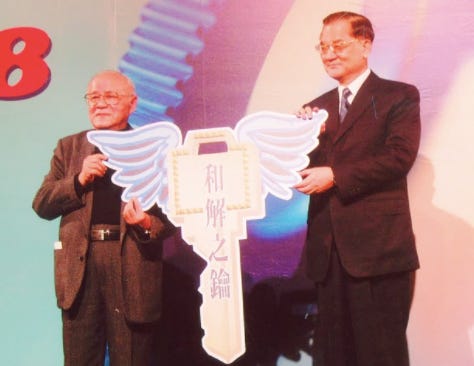
Standing before the huge portrait of Dr Sun Yat-sen and the full text of his testament, Mr Chen delivered a speech on the distorted collective memory of the February 28 Incident. Mr Chen said: “My family and my wife were both political victims, among the most grievous victims of the February 28 Incident and the White Terror. I have come to the Central Headquarters of the Kuomintang today not to demand justice, but in the hope that the same suffering will never again befall any Taiwanese person. The root of this historical tragedy lies in the Chinese Civil War. Therefore, ending the state of hostility across the Strait and concluding peace is a historical responsibility and duty that the Kuomintang cannot shirk.”
He then handed Chairman Lien a key symbolising reconciliation. Chairman Lien immediately announced that Vice Chairman Chiang Pin-kung would first lead a delegation to the mainland to pave the way for the Journey of Peace. In April that same year, Chairman Lien led a delegation, including myself, to Nanjing and embarked on that historic Journey of Peace, becoming the first Kuomintang chairman to return to the former capital, Nanjing, since 1949.
Today, 21 years later, I have once again come to the Sun Yat-sen Mausoleum. I have climbed its 392 steps and seen the three great terraces symbolising the Three Principles of the People, the five great terraces symbolising the Five-Power Constitution, the 392 steps, and the 1992 Consensus, which made it possible for the two sides of the Strait to begin reconciliation, exchange, and dialogue. I have thought of the unfinished mission of Dr Sun and of the wound across the Strait that still has not healed. Here, I would also like to report to the founder of our party that, under the guidance of the Three Principles of the People, the Kuomintang successfully built Taiwan, Penghu, Kinmen, and Matsu into a fine society marked by democracy, freedom, the rule of law, and shared prosperity.
Likewise, on the mainland, we too have seen and witnessed progress and development that have exceeded everyone’s expectations and imagination. Our guide just mentioned that on 12 March this year, I also led the Kuomintang in a mourning and commemorative ceremony at the National Dr Sun Yat-sen Memorial Hall in Taiwan. On that occasion, a descendant of Dr Sun specially brought to Taiwan seeds from the tamarind tree that Dr Sun had once taken from Honolulu back to his native home, and gave them to me.
Today, 21 years later, I too hope to plant the seeds of peace. Throughout his life, Dr Sun loved nature, valued ecology, and encouraged tree planting. I was just told, and this is also something to which I have long paid close attention, that General Secretary Xi Jinping also places great importance on ecological conservation and advocates tree planting every year. Let us hope that today we may plant seeds of peace not only for the Chinese people on both sides of the Strait, but for all humanity. Let every one of us, every single day, diligently water and nourish this tree, so that it may spread its branches and leaves and grow into a towering giant. Forebears plant the tree so that later generations may enjoy the shade. May all our descendants, under the shelter of this great tree, pursue the dreams of their own lives without fear or hesitation.
So in closing, let us not forget the charge our leader left us before his death: “The revolution has not yet succeeded; comrades must still strive.” At the heart of Sun Yat-sen’s ideal that “all under heaven is for the public (天下为公)” have always been the values of equality, inclusion, and unity. We should work together to promote reconciliation and unity across the Strait, and to create regional prosperity and peace.
Here today, I hope that all of us, as comrades, may offer ourselves as fuel, carrying forward the Father of the Nation’s revolutionary spirit, his broad-hearted benevolence, and his ideal of Great Harmony (大同). May the flame be passed on as the fuel is consumed, so that the torch lit by the revolutionary pioneers a century ago may continue, like stars in the dark night, to guide those comrades who press on one after another along the revolutionary road, and may it become the Blue Sky with a White Sun [青天白日, the revolutionary emblem later adopted as the national emblem of the Republic of China and the Kuomintang party emblem], warming and nourishing every inch of land and every living being. Let us encourage one another together. Thank you all.
Full text: Cheng Li-wun’s speech at Nanjing welcome banquet

Cheng Li-wun, chair of Taiwan’s opposition Kuomintang (KMT), arrived in the Chinese mainland on Tuesday, leading a party delegation after accepting an invitation from Xi Jinping, general secretary of the Communist Party of China (CPC) Central Committee, in the first visit by a sitting KMT chair to the mainland in a
Transcript: Cheng Li-wun embraces Beijing trip

Beijing announced this morning that Xi Jinping had invited Cheng Li-wun, leader of Taiwan’s opposition Kuomintang (KMT), to visit the Chinese mainland with a party delegation from April 7 to 12.
Meet Cheng Li-wun, the new Chair of KMT

The election for the Chair of the Kuomintang (KMT), the opposition party in Taiwan, was concluded on October 18. Cheng Li-wun was elected as the new party chair.
