


What can developing countries learn from China’s economic transformation? How can international development cooperation better support their industrialisation and long-term growth? And could artificial intelligence offer latecomers a new opportunity to narrow the development gap with advanced economies?
In an interview with Economic Daily, a Chinese newspaper, following the 18th BRICS Summit in New Delhi, Justin Yifu Lin addresses these questions through the lens of New Structural Economics, the development economics framework he has championed for much of his academic career.
For Lin, the most transferable lesson from China’s development experience is not a particular set of policies or institutions, but the importance of identifying and building on each country’s own comparative advantages. He argues that international development cooperation should place greater emphasis on building productive capacity, creating employment, and facilitating structural transformation, alongside meeting immediate humanitarian and social needs.
Of particular interest is Lin’s assessment of artificial intelligence. He sees affordable, open-weights AI, including that emerging from China, as a source of latecomer advantage for developing economies. Countries building new industries may be able to integrate the latest technologies from the outset, rather than incur the costs of retrofitting existing industrial systems. Realising that potential, however, will require investment in local talent, access to data, and the adaptation of technology to local economic conditions.
The interview also explores the role of BRICS in facilitating mutual learning among developing countries, the scope for economic cooperation between China and India, and how reforming international institutions and maintaining an open global trading system could serve the development interests of both the Global South and the Global North.
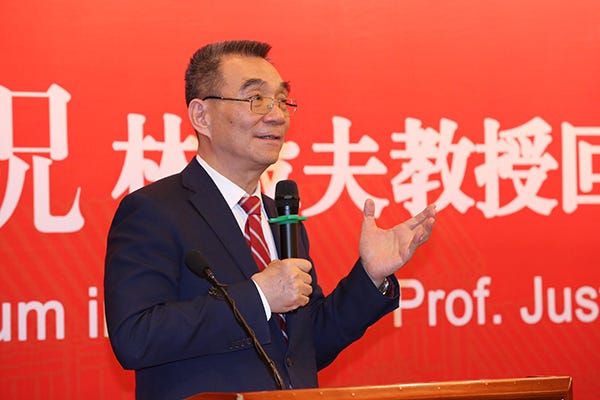
Justin Yifu Lin is Dean of the Institute of New Structural Economics, Dean of the Institute of South-South Cooperation and Development, and Professor and Honorary Dean of the National School of Development, Peking University. He also served as Senior Vice President and Chief Economist of the World Bank, 2008-2012.
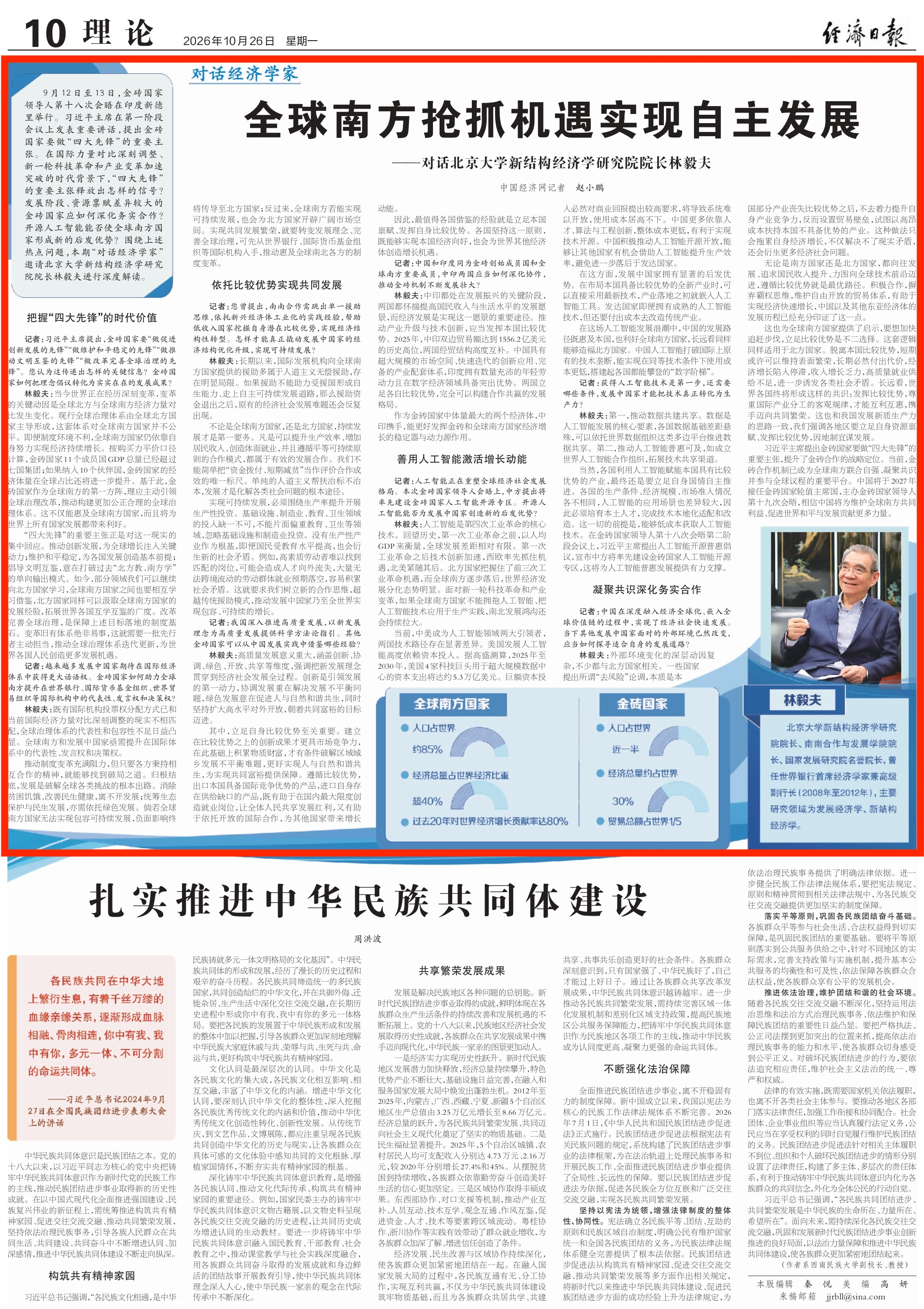
The interview was published in the 26 October issue of Economic Daily. It is also available on the newspaper’s official WeChat blog.
Lin reviewed the following translation before publication.
全球南方抢抓机遇实现自主发展
——对话北京大学新结构经济学研究院院长林毅夫
The Global South Seizes Opportunities to Achieve Autonomous Development
An Interview with Justin Yifu Lin, Dean of the Institute of New Structural Economics at Peking University
Zhao Xiaopeng, China Economic Net
The 18th BRICS Summit was held in New Delhi, India, on 12–13 September. President Xi Jinping delivered an important speech at the first session, calling on BRICS countries to assume four pioneering roles: a pioneer in advancing innovation-driven development; a pioneer in upholding peace and stability; a pioneer in facilitating mutual learning between civilisations; and a pioneer in reforming and improving global governance.
Against a backdrop of profound shifts in the global balance of power, a new wave of technological revolution, and accelerating industrial transformation, what signals does this proposal send? How can BRICS countries, which differ considerably in their stages of development and resource endowments, deepen practical cooperation? Can open-source artificial intelligence create new latecomer advantages for countries of the Global South?
To explore these questions, this edition of “Dialogue with Economists” invited Justin Yifu Lin, Dean of the Institute of New Structural Economics at Peking University, to offer an in-depth analysis.
Understanding the Contemporary Significance of the “Four Pioneering Roles”
Reporter: President Xi Jinping proposed that BRICS be “a pioneer in advancing innovation-driven development,” “a pioneer in upholding peace and stability,” “a pioneer in facilitating mutual learning between civilisations,” and “a pioneer in reforming and improving global governance.” What key messages do you think this conveys? How can BRICS countries translate these ideas and initiatives into tangible development outcomes?
Justin Yifu Lin: The world today is undergoing profound changes, driven primarily by shifts in the balance of economic power between the Global North and the Global South.
The existing global governance system was shaped under the leadership of Northern countries, and it is unfair to countries of the Global South. Despite this unfavourable institutional environment, countries of the Global South have continued to achieve economic growth through their own efforts. Measured at purchasing power parity, the combined GDP of the 11 BRICS member countries has already surpassed that of the G7. Including the 10 partner countries would further increase the BRICS share of the global economy.
As the leading group within the Global South, BRICS countries should therefore take the initiative in driving global governance reform and promoting a more just and equitable global governance system. This would benefit not only countries of the Global South but also every country in the world.
The proposal for “four pioneering roles” is a direct response to this reality. Advancing innovation-driven development provides a crucial impetus for global growth; upholding peace and stability creates the basic conditions for countries to develop; and facilitating mutual learning between civilisations seeks to break away from the old model of one-way knowledge transfer, in which “the North teaches, and the South learns.” Today, countries of the Global South can continue to learn from the North in certain areas, but they should also learn from one another. Northern countries, in turn, can draw on the development experience of the Global South. This will broaden opportunities for mutual learning among all countries.
Reforming and improving global governance provides the institutional foundation for achieving these objectives. Transforming the existing system is by no means easy. It requires a group of pioneers to take the initiative and drive the renewal of global governance, creating more development opportunities for people around the world.
Reporter: More and more developing countries want a greater voice in the international economic system. How can BRICS help the Global South strengthen its representation, voice, and decision-making power in international institutions such as the World Bank, the International Monetary Fund, and the World Trade Organization?
Justin Yifu Lin: The allocation of voting power in existing international institutions no longer reflects the profound changes in the global balance of economic power. The lack of representation and inclusiveness in the global governance system is becoming increasingly apparent. Countries of the Global South and other developing countries urgently need greater representation, a stronger voice, and more decision-making power within the international system.
Institutional reform faces considerable resistance, but a way forward can be found as long as all parties approach the process in a spirit of cooperation. Ultimately, development is the fundamental solution to the various challenges in the world. Eliminating poverty and hunger and improving people’s livelihoods and health all depend on development. Reconciling environmental protection with improvements in people’s livelihoods likewise requires green development. If countries of the Global South cannot achieve inclusive and sustainable development, the negative consequences will eventually spread to Northern countries. Conversely, sustainable development in the Global South would open up vast market opportunities for the North.
Achieving shared development and prosperity requires a change in development thinking and improvements to global governance. Reform could begin with international institutions such as the World Bank and the International Monetary Fund to bring about institutional changes that benefit both the Global North and the Global South.
Achieving Shared Development Through Comparative Advantage
Reporter: You have argued that South-South cooperation needs to move beyond a narrow focus on aid, draw on the practical experience of industrialisation in emerging economies, and help low-income countries identify their potential comparative advantages and achieve structural economic transformation. What would genuinely help developing countries upgrade their economic structures and achieve sustainable development?
Justin Yifu Lin: For a long time, much of the assistance provided by international development institutions to countries of the Global South has taken the form of humanitarian aid. This approach has clear limitations. If aid does not help recipient countries develop the capacity to sustain their own growth and embark on a path of autonomous and sustainable development, the same economic and social problems will recur once the funding is withdrawn.
Whether in the Global South or the Global North, sustained development must be the foremost priority. Any form of cooperation that improves production efficiency, raises household incomes, creates decent jobs, and adheres to the principles of equality and sustainability constitutes effective development cooperation. The disbursement of funds and short-term poverty reduction cannot serve as the sole criteria for evaluating the success of cooperation. Humanitarian assistance alone addresses symptoms rather than root causes. Development is the fundamental way to resolve social problems.
Sustainable development requires productive investment aimed at raising productivity. Investment in infrastructure, manufacturing, education, and healthcare is indispensable. Too much emphasis should not be placed on education and healthcare at the expense of infrastructure and manufacturing. Without productive industries as a foundation, even improvements in educational attainment can give rise to new social tensions. For example, highly skilled workers may struggle to find suitable jobs, leading to an outflow of talent. Large numbers of workers who cannot move abroad may find their employment expectations unmet, fuelling more social tension. A new approach to cooperation is therefore needed, one that moves beyond traditional aid models and promotes inclusive and sustainable growth in developing countries and, indeed, throughout the world.
Reporter: China is advancing high-quality development, guided by the new development philosophy. What lessons can other BRICS countries draw from China’s development experience?
Justin Yifu Lin: High-quality development is of great significance. It encompasses innovative, coordinated, green, open, and shared growth, and emphasises applying the new development philosophy throughout the process of economic and social development: Innovation is the primary driver of development. Coordinated development focuses on addressing imbalances, while green development seeks to promote harmony between humanity and nature. At the same time, continued efforts are needed to expand high-standard opening up and move towards the goal of common prosperity.
Crucially, development must be grounded in a country’s own comparative advantages. Only innovations that build on these advantages can be competitive in the market. The wealth generated in this way can, in turn, help address development disparities between regions and between urban and rural areas, promote greater harmony between humanity and nature, and lay the foundation for common prosperity. Following the principle of comparative advantage—exporting products in which a country has an international competitive edge and importing those for which domestic supply is insufficient—helps maximise job creation at home and ensures that the benefits of development are shared by the entire population. Open international cooperation also allows countries to generate growth momentum for one another.
The most valuable lesson for other countries, therefore, is to build on their own resource endowments and make full use of their comparative advantages. By following this principle, countries can improve their own economic performance while creating growth opportunities for other economies.
Reporter: China and India are both founding BRICS members and important members of the Global South. How should the two countries deepen their cooperation and help the BRICS mechanism continue to grow?
Justin Yifu Lin: China and India are both at critical stages of development and national rejuvenation. Both aspire to raise their people’s incomes and living standards, and economic development is an important means of achieving these goals.
Industrial upgrading and technological innovation should be pursued in line with each country’s comparative advantages. In 2025, bilateral trade between China and India reached a record US$155.62 billion, and the two countries’ economic and trade structures are highly complementary. China has an enormous market, rapidly evolving innovative applications, and a comprehensive industrial support system. India has an abundant supply of young labour and particular strengths in the digital economy. By building on their respective comparative advantages, the two countries are fully capable of building a pattern of mutually beneficial and win-win cooperation.
As the two largest economies in BRICS, China and India can work together to play a greater role in stabilising and driving economic growth across BRICS and the Global South.
Harnessing Artificial Intelligence to Generate Growth Momentum
Reporter: Artificial intelligence is reshaping global economic and social development. At this BRICS Summit, China proposed taking the lead in establishing a BRICS AI open source community. Can open-weights AI create new latecomer advantages for developing countries?
Justin Yifu Lin: Artificial intelligence is the core technology of the Fourth Industrial Revolution. Looking back, before the First Industrial Revolution, global disparities in development, as measured by GDP per capita, were relatively small. Technological innovation accelerated after the First Industrial Revolution. Western Europe was the first to seize the opportunities it brought, followed by North America. Countries of the Global North capitalised on the opportunities presented by the first three industrial revolutions, while the Global South gradually fell behind, leading to an increasingly pronounced divergence in global economic development. Against the backdrop of a new wave of technological revolution and industrial transformation, if countries of the Global South fail to embrace AI and put it to use in production, the development gap between North and South will continue to widen.
China and the United States have now emerged as the two leading countries in AI, but their technological approaches differ significantly. AI development in the United States relies heavily on capital investment. According to Goldman Sachs estimates, four US technology giants will spend approximately US$5.3 trillion on hyperscale data centres between 2025 and 2030. Such massive investment inevitably creates pressure to deliver high commercial returns, making companies less willing to open up their systems and keeping the cost of using them high. China’s approach relies more on talent, algorithms, and engineering innovation, resulting in lower overall costs and making it easier to open-source the technology. By actively promoting open-weights AI, China can offer other countries the opportunity to use AI to improve production efficiency and avoid falling further behind developed countries.
Developing countries have significant latecomer advantages in this respect. When developing entirely new industries in sectors where they have comparative advantages, they can adopt the latest technologies directly and integrate AI tools from the outset. Developed countries, even with mature AI technologies at their disposal, still have to invest in adapting their existing industries.
China’s approach to AI development benefits not only China and countries of the Global South but also, in the long run, countries of the Global North. By breaking existing international technology monopolies, Chinese AI makes it possible for countries to access technology at a lower cost without compromising on technical capabilities, creating a “digital ladder” that every country can climb.
Reporter: Gaining access to AI technology is the first step. What other conditions are needed for developing countries to turn that technology into productive capacity?
Justin Yifu Lin: First, data needs to be jointly developed and shared. Data is a core input for AI development, but countries differ enormously in their data infrastructure. Multilateral platforms such as the World Data Organization can help promote data sharing. Second, AI needs to be made accessible and beneficial to all. The establishment of the World Artificial Intelligence Cooperation Organization (WAICO), for example, provides a new platform for technology sharing.
Ultimately, however, each country must take its own approach to using AI to strengthen industries in which it has comparative advantages, based on its national circumstances. Production conditions, economic scale, and market access vary from country to country, as do the application scenarios of AI. It is therefore essential to develop local talent and adapt the technology to local needs.
The prerequisite for all this is affordable access to AI technology. At the second session of the 18th BRICS Summit, President Xi Jinping proposed the open source and inclusive AI initiative and announced that China would take the lead in establishing a BRICS AI open source community. This will provide strong support for making AI more widely accessible and beneficial.
Building Consensus and Deepening Practical Cooperation
Reporter: China achieved rapid economic and social development as it became deeply integrated into economic globalisation and global value chains. Other developing countries now face a very different external environment. How should they identify development paths suited to their own circumstances?
Justin Yifu Lin: The reasons behind changes in the external environment are complex, and many are linked to countries of the Global North. Some countries have promoted the so-called “de-risking” narrative. In essence, rather than focusing on improving the competitiveness of industries in which they have lost their comparative advantage, they have resorted to trade barriers and costly subsidies to support industries in which they are no longer competitive. Such measures will only undermine their own economic growth. Far from resolving existing problems, they will create further economic and social difficulties.
Countries in both the South and the North aspire to develop, raise national incomes, and move towards the global technological frontier. Following the principle of comparative advantage is the best path. Active cooperation, the rejection of hegemonic thinking, and the maintenance of a free and open trading system can help achieve rapid economic growth. The development experience of China and other East Asian economies has amply demonstrated this.
This also offers an important lesson for countries of the Global South: building on comparative advantage is the only way to accelerate their catch-up. The same logic applies to countries of the Global North. Moving away from a country’s comparative advantages may create an appearance of prosperity in the short term, but it will inevitably come at a cost in the long run: economic stagnation, sluggish income growth, a shortage of high-quality jobs, and further social tensions.
In time, countries around the world will come to recognise that only by making full use of their comparative advantages and respecting the realities of the international division of labour can they achieve mutual benefits and move towards shared prosperity. This is also in line with China’s approach to developing new quality productive forces, which emphasises that each region should build on its own resource endowments, make full use of its comparative advantages, and pursue development suited to local conditions.
President Xi Jinping’s proposal that BRICS countries assume “four pioneering roles” has elevated the strategic importance of BRICS cooperation. The BRICS mechanism has now become an important platform for the Global South to strengthen its collective position, build consensus, and participate in shaping the global agenda. China will assume the rotating BRICS chairmanship in 2027 and host the 19th BRICS Summit. China is expected to make further contributions to safeguarding the shared interests of the Global South and promoting world peace and development.

Justin Yifu LIN: Developing countries, unite!

Today's post is short, featuring a speech delivered at the "Confronting Fragmentation in Global Trade" sub-forum during the Boao Forum 2024 on March 26. The speaker, Professor Justin Yifu LIN, is Dean of the Institute of New Structural Economics, Dean of the
Justin Yifu Lin explains “The Great Change in the World and China’s Rejuvenation”

We are pleased to share Professor Justin Yifu Lin’s speech and the subsequent Q&A session held on September 30, 2025, at the Education University of Hong Kong (EdUHK).
Justin Yifu Lin: the Coming “Structural Revolution” in Modern Mainstream Economics

Justin Yifu Lin has spent much of his career arguing that China cannot be fully understood through economic theories built elsewhere. His answer is New Structural Economics, which he presents as part of a broader effort to build an autonomous Chinese knowledge system in economics. Its basic argument is that countries should not be judged against a singl…