


We are pleased to share Professor Justin Yifu Lin’s speech and the subsequent Q&A session held on September 30, 2025, at the Education University of Hong Kong (EdUHK).
It was originally published on EduHK’s Faculty of Liberal Arts and Social Sciences (FLASS) Newsletter, November 2025 issue, which has kindly authorized us to reproduce it here at The East is Read.
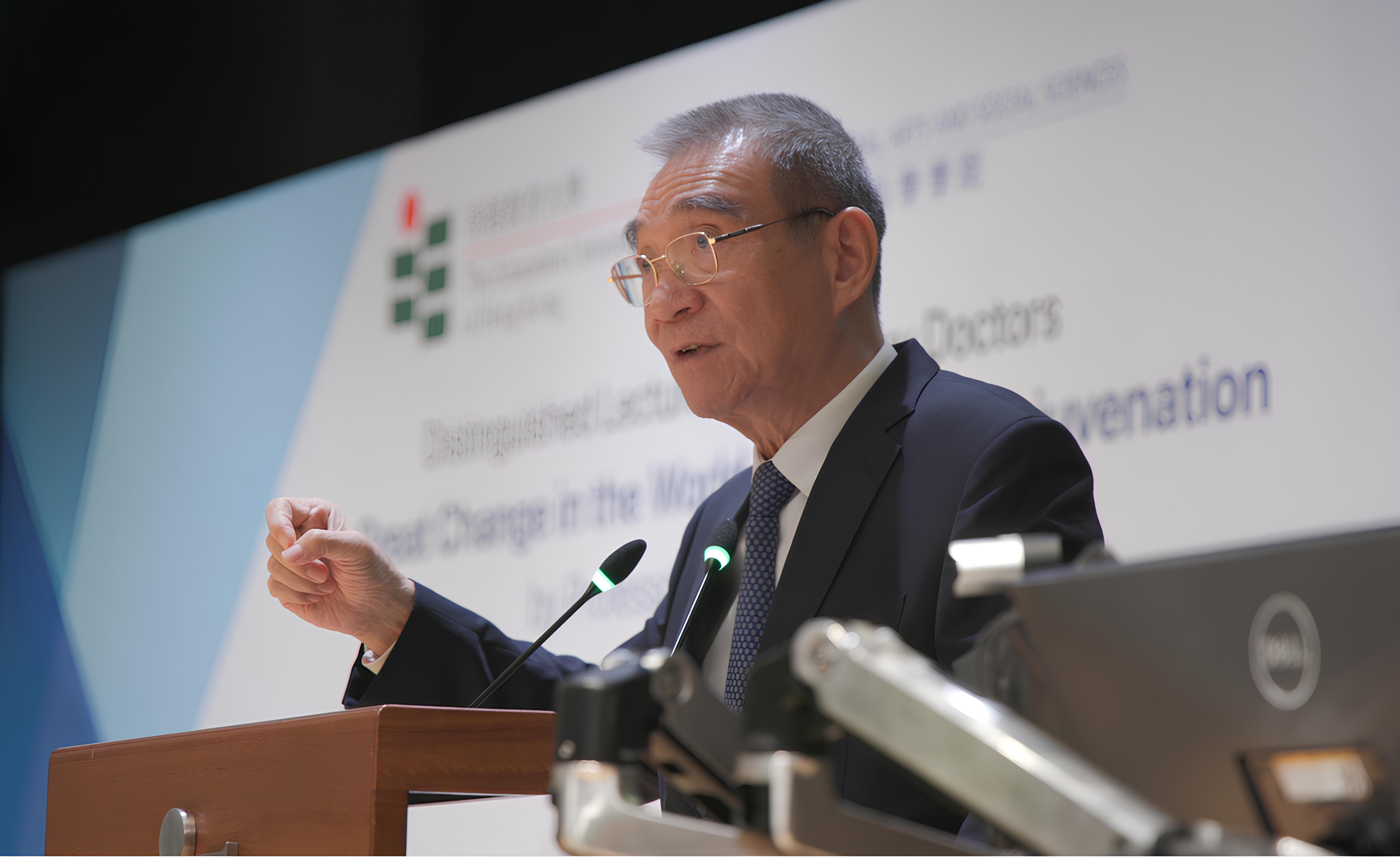
Professor Justin Yifu Lin delivers a speech at the “The Great Change in the World and China’s Rejuvenation”
Professor Justin Yifu Lin currently serves as a Standing Committee member of the Chinese People’s Political Consultative Conference (CPPCC) National Committee, Vice Chairman of the Committee on Economic Affairs of the CPPCC National Committee, Dean of the Institute of New Structural Economics at Peking University, Honorary Dean of the National School of Development at Peking University, and Honorary Dean of the Institute of South-South Cooperation and Development. He was previously Chief Economist and Senior Vice President for Development Economics at the World Bank, and is highly regarded in the international economics community as an authoritative scholar on Chinese issues.
Born in Taiwan, China, Professor Lin initially enrolled at the College of Agriculture at National Taiwan University. He later joined the army and attended the Army Academy. After graduation, he pursued further studies at the Graduate Institute of Business Administration at National Chengchi University in Taiwan. During the era of China’s reform and opening-up, driven by his passion for the country, Professor Lin went to Peking University to study for a master’s degree in economics. He then completed his PhD in economics at the University of Chicago, USA. In 1987, he returned to China to serve as Deputy Director of the Development Research Institute at the State Council’s Rural Development Research Centre, conducting research in China’s rural reform policies.
In 1994, he founded the China Center for Economic Research at Peking University and participated in the formulation of the country’s economic reform policies, including telecommunications reform, accession to the World Trade Organisation, financial reform and rural development. In 2008, Professor Lin was appointed as Chief Economist and Senior Vice President of the World Bank, becoming the first person from a developing country to hold this key position. After stepping down, he returned to Peking University to continue his research and teaching work.
Professor Lin has a prolific academic output, having published over 300 papers in domestic and international academic journals and received numerous academic honours. His book Institutions, Technology, and China’s Agricultural Development won the Sun Yefang Economic Science Award, while Re-examining Institutions, Technology, and China’s Agricultural Development won First Prize in the Third Humanities and Social Sciences Outstanding Achievement Awards for Chinese Universities from the Ministry of Education of China. In 1993, he received the Best Policy Paper Award from the International Food and Agricultural Policy Research Center at the University of Minnesota, USA. In 1997, he was awarded the Sir John Crawford Award from the Australian Agricultural and Resource Economics Society, and in 2000, he won the Classic Citation Award from the Social Sciences Citation Index in the USA.
In recent years, Professor Lin has been involved in planning the development of the Greater Bay Area, including Hong Kong’s economic direction, offering strategies for Hong Kong to leverage its advantages and integrate into the development of the Area. Thanks to his outstanding academic achievements, Professor Lin has been elected as a Fellow of the World Academy of Sciences and a Foreign Member of the British Academy. He has also received honorary doctorates from more than ten universities worldwide, including institutions in Hong Kong.
Professor Lin was awarded an honorary doctorate by EdUHK on 26 September.
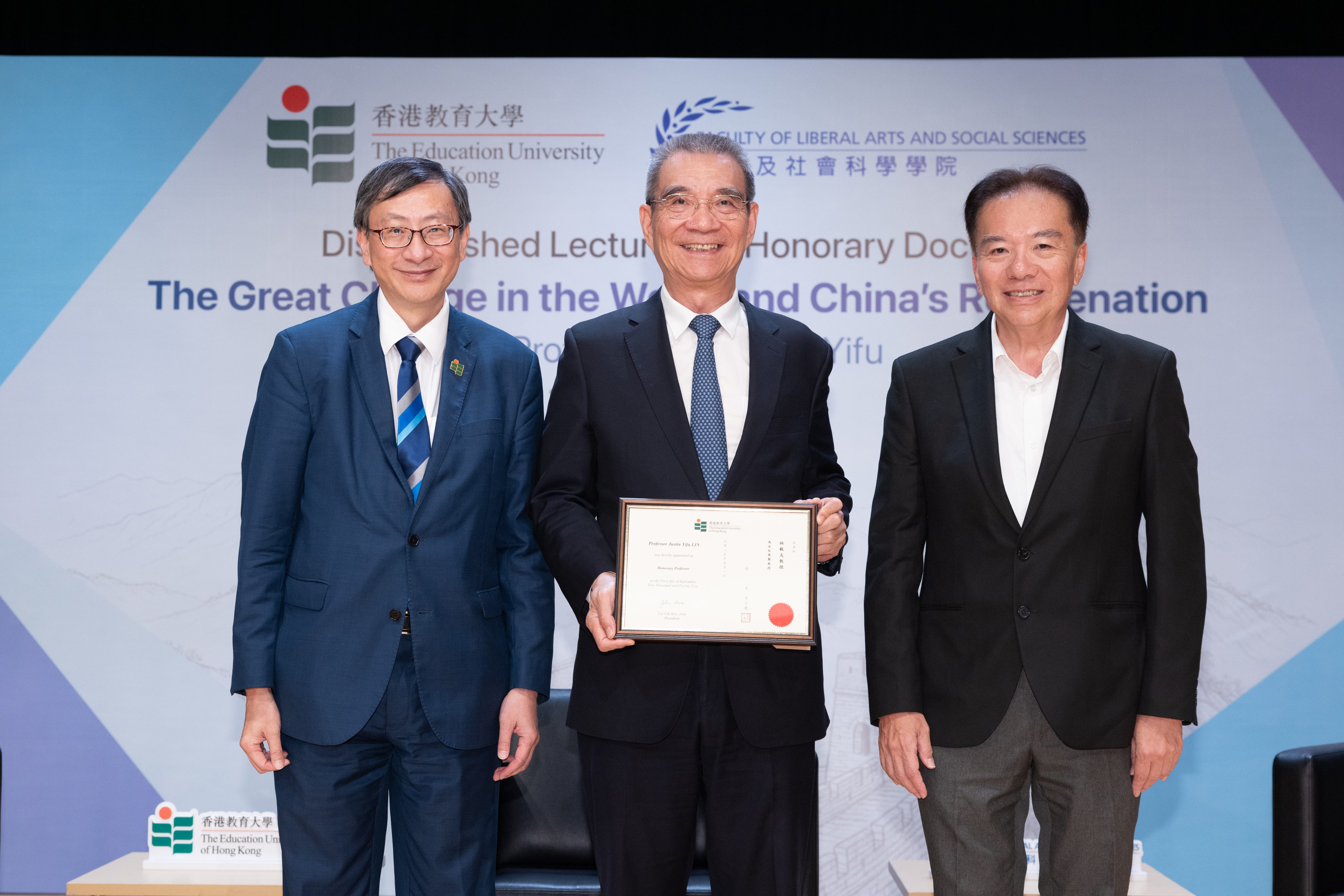
On 30 September, Professor Lin gave a lecture organised by FLASS, titled “The Great Change in the World and China’s Rejuvenation”.
EdUHK President Professor John Lee Chi-Kin delivered a welcoming address at the lecture. Professor Lee and Professor Li Wai-keung, Dean of FLASS, moderated a Q&A session afterwards.
The newsletter thanks Professor Lin for allowing us to share his speech and the Q&A session in this article. Sub-headings have been added for easier reading.
The world order under the domination by the Eight-Nation Alliance and the G8
If I had to describe the current world situation in one word, I would use the title of the famous film by Akira Kurosawa—“Ran”, which means chaos.
In 2018, Chinese President Xi Jinping stated at the Central Conference on Work Relating to Foreign Affairs that the world is currently undergoing great changes unseen in the past century. I would like to discuss what these profound changes are, the factors driving these changes, and how we can navigate them to achieve the great rejuvenation of the Chinese nation. As an economist, I believe economic development is fundamental and determines many aspects of society. I will explore these changes by reflecting on how the global economic landscape has shifted over the past 100 years.
A major historical event that occurred at the beginning of the 20th century was the invasion of China by the Eight-Nation Alliance. In 1900, eight nations—Great Britain, the United States, France, Germany, Italy, Russia, Japan, and the Austro-Hungarian Empire—invaded Beijing. These eight countries were the most advanced industrialised nations at the time; they were the Great Powers. Whenever these powers found something unacceptable, they would resolve it by force. The combined economic output of these eight nations, measured by purchasing power parity (PPP), accounted for 50.4% of the world’s total at the time. In other words, these eight countries controlled half of the world’s economy.
At the start of the 21st century, there was an organisation called the Group of Eight (G8), made up of the United States, Canada, the United Kingdom, France, Germany, Italy, Japan, and Russia. These eight countries were the most advanced industrialised nations at the time, accounting for roughly half, 47% to be precise, of the world’s total economic output.
The members of the G8 were almost identical to those of the Eight-Nation Alliance. Over the one hundred years from the early 20th to early 21st century, the development of these eight countries and the relationships between them dominated the changing world order.
Let’s look back at history. Germany and the Austro-Hungarian Empire formed the Central Powers. For geopolitical and economic reasons, they clashed with the Allies (also known as the Entente Powers), which consisted of other nations. At first, these two blocs attempted to settle conflicts through negotiation, but negotiations failed, which led to the outbreak of the First World War. Twenty years after the end of the First World War, the Axis Powers—Germany, Italy and Japan (members of the present-day G8)—found themselves at war with the Allies, including China, Britain, the United States, France and the Soviet Union, due to ongoing political and economic conflicts that could not be resolved peacefully. This resulted in the Second World War.
Why did President Xi Jinping say in 2018 that the world is undergoing great changes unseen in a century?
G8 countries held 34.7%, just one-third, of the global economy in 2018, a noticeable drop from 47% in 2000. This was a significant development in the first two decades of the 21st century. As economics is fundamental, the fall in the G8’s share of world output reflects a decline in its ability to regulate global affairs.
For example, during the 2008 global financial crisis, G8 leaders found they could not formulate a response at their summit as they had done previously. As a result, United States convened a meeting in Washington in 2008, bringing together the world’s 20 largest industrialised nations, the G20, to discuss countermeasures.
The shift from G8 to G20 meant that the power shaping world development moved from eight countries to twenty—which now include China, India, Brazil, and South Africa.
Since 2008, the G8 has lost its status as host of the most important annual global conferences, which have shifted to the G20. The shift from G8 to G20 meant that the power shaping world development moved from eight countries to twenty—which now include China, India, Brazil, and South Africa. This marks an unprecedented change not seen in a century.
A world no longer led by the United States
When the combined economic output of the G8 countries declined, China’s share of the global economy increased from 6.9% in 2000 to 16.8% in 2018. In other words, China’s economic growth accounted for 80% of the G8’s reduction in share.
The United States was most affected by these changes. Since 1875, and throughout the entire 20th century, the United States remained the largest economy in the world by purchasing power parity. The US joined both World Wars midway, and as the largest economy, defeated its opponents through overwhelming material resources and steel production. For the whole of the last century, the United States was the world’s dominant power.
According to International Monetary Fund figures calculated by purchasing power parity, China’s total economic output surpassed that of the United States in 2014. This was the first time in 140 years since 1875, that the US was overtaken by another country. The US realised the world had changed, and it could no longer resolve issues by acting alone.
Another example is the Paris Agreement, which was adopted by 195 United Nations member states at the UN Climate Summit in December 2015. This legally binding international treaty aims to control global warming by reducing greenhouse gases (GHG), such as carbon dioxide (CO2).
Most of the CO2 in the atmosphere was emitted by these eight countries during their industrialisation. Since these developed countries have shifted to mainly service-based economies, reducing carbon emissions will not significantly impact their growth. However, developing nations in Africa and South Asia are only beginning industrialisation, so they still require a lot of energy for ongoing development. Imposing emission limits restricts their energy use and hinders their growth. Facing the common crisis of global warming, developed and developing countries have struggled to agree due to their differing positions.
In 2009, Chinese President Hu Jintao and US President Obama agreed to formulate climate change measures under the principle of common but differentiated responsibilities, based on each country’s capacity. This laid the foundation for developed and developing countries to reach the later Paris Agreement.
This example shows how the power that shapes world development has shifted. In the past, important global matters were decided by the G8, mostly led by the US; now, consultation with China is necessary.
Response from the United States
Although China has surpassed the United States in terms of purchasing power parity, it is still behind when measured by nominal GDP and GDP per capita. GDP per capita reflects a country’s productivity and technological level; a lower per capita GDP shows that China has not reached the overall level of development seen in the United States. In terms of financial system’s maturity, influence on international discourse, and leadership in social science theory, China also still lags behind the US.
Facing China’s rise, the United States is likely to feel a sense of loss and tries to use its current advantages to restrain China’s development. In 2011, former President Obama introduced the “Pivot to Asia” strategy, redeploying US military resources to the Asia-Pacific to contain China. This approach clearly reflected US thinking on strategic containment.
Afterwards, Donald Trump launched a new round of trade and technology wars against China. When Joe Biden became president, he suggested forming an Alliance of Values with other Western democracies to isolate China. When Trump was re-elected, he revived the “Make America Great Again” (MAGA) campaign, once more aiming to contain and suppress China through economic and technological means.
US policy towards China now is similar to how it treated Japan in the past. In the 1980s, after Japan’s rapid economic rise, the US reached the Plaza Accord in 1985 with Japan, Britain, France, and Germany, forcing a dramatic appreciation of the yen, from 260 yen per dollar in 1985 to 120 yen in 1988, to address persistent trade deficits. The US also made Japan share chip manufacturing technologies and spread production lines to Taiwan, South Korea, and America.
For many years, by market exchange rates, Japan was the world’s second-largest economy, once reaching 70% the size of the US economy. By 2024, however, Japan’s economy was only 16% of the US’s. This stagnation, which lasted 30 years, is widely attributed to American pressure and suppression.
By any measure, China is a major economic power and plays a critical role on the global stage.
By nominal GDP, the United States still leads and China is second. By purchasing power parity, however, China is already number one, with the US in second place. By any measure, China is a major economic power and plays a critical role on the global stage.
China is now the world’s largest trading nation and the biggest trading partner for over 140 countries. Trade is mutually beneficial, and smaller economies often gain even more. When China and the US trade, not only do those two countries benefit, but so does the whole world. Any friction between China and the US affects not just China, but the entire globe, sometimes the indirect consequences elsewhere are even greater than those within China. It’s like two elephants fighting; the grass beneath gets trampled as well.
When will the world reach a state of peace and stability?
So, when will the world achieve peace and stability? I believe that when China’s per capita GDP reaches half that of the United States, the US will finally acknowledge and accept China’s rise. When that day comes and if the two countries can manage their relationship well, the world will become stable.
I will explain my view from several angles.
Currently, China’s population is four times that of the United States, and this ratio is unlikely to change significantly in the coming decades. If China’s per capita GDP reaches half that of the US, China’s total economic output would be about double that of the United States. If conflict were to break out at that point, China would be able to mobilise more resources than the US, giving it greater strategic confidence.
The population of China’s most advanced regions — including Hong Kong, Beijing, Tianjin, Shanghai, and the coastal provinces of Shandong, Fujian, Zhejiang, Jiangsu, and Guangdong — exceeds 400 million, slightly more than that of the United States. When China’s per capita GDP reaches half that of the US, the per capita GDP of these regions will be roughly comparable to that of the United States. The productivity, industrial capacity, and technological level reflected in their GDP will also be similar, making it difficult for the US to rely on technological bottlenecks to constrain China.
China is a major trading nation, conducting trade with nearly 200 countries. If China’s economy grows to twice the size of the United States’, it would become the world’s largest and an irreplaceable market. High-tech companies worldwide, including those in the US, would rely on the Chinese market to earn the profits needed to fund innovation and sustain development. At that point, access to the Chinese market would determine whether many companies survive. The US would then accept China as a larger economy and maintain good relations with China for its own interests, bringing greater global stability.
How can China raise its per capita GDP to half that of the United States?
I began examining this question in 2019, when China’s per capita GDP was 22.6% that of the United States. To reach 50%, China’s economic growth needs to outpace that of the US.
Economic theory tells us that, in both developed and developing countries, only with continuous technological innovation and ongoing industrial upgrading can productivity improve and economic growth occur. Developed countries have the highest living standards and productivity levels worldwide, representing the frontier of industrial technology. These nations must rely on their own continual innovation to maintain growth. Over the past 100 years, the annual economic growth rate of developed countries such as those in the G8 has been about 3%.
As a catch-up developing country, China, in addition to original innovation, can learn from the technologies and experiences of advanced countries, making breakthroughs through “introduction, digestion, absorption, and re-innovation”. This is known as the “latecomer advantage”, allowing developing countries to innovate and upgrade industries at lower cost and risk, hence growing faster than developed countries. By taking advantage of this, China’s GDP grew an average of 8.9% per year from 1978 to 2024, with per capita GDP rising an average of 8% per year.
In 2019, China’s per capita GDP was 22.6% of the level of the United States—a gap similar to the one between Germany and the US in 1946, Japan and the US in 1956, and South Korea and the US in 1985. Germany since 1962, Japan since 1972, and South Korea since 2001 all maintained average per capita GDP growth of more than 8% for 16 years. If these economies could do this, it means that there’s also potential for China to sustain an average per capita GDP growth rate of 8% per year between 2019 and 2035.
China’s advantages in the fourth industrial revolution
In this new era, China is not only starting on an equal footing with other nations, but also has distinct advantages in three main areas.
The world is currently undergoing the Fourth Industrial Revolution, giving China an additional edge compared to Germany, Japan, and South Korea in earlier times. In this new era, China is not only starting on an equal footing with other nations, but also has distinct advantages in three main areas.
First, seizing the opportunities of the Fourth Industrial Revolution requires excellent talent. With a population of 1.4 billion, China has a vast pool of talent. In recent years, China has invested heavily in higher education, building a strong network of universities nationwide. For example, EdUHK has many scholars listed among the “Top 2% of the World’s Scientists”, showing China’s strength in education and talent.
Second, China is now the world’s largest economy, measured by purchasing power parity (PPP), giving it the largest integrated market globally. New ideas emerge in the Chinese market every day, and investors are quick to turn them into products. The sheer size of the market enables new products and technologies to achieve economies of scale, while the competitive environment promotes ongoing optimisation. This helps explain why four out of the five most downloaded mobile apps in the US come from China.
Thirdly, China has the most complete industrial support infrastructure in the world. If a concept requires hardware to become a product, China’s industrial chain can produce it quickly and at low cost. Tesla, for example, produced only 20,000 to 30,000 electric cars annually in the US for over a decade and faced bankruptcy. After recognising the advantages of China’s industrial system, Tesla set up a production line in Shanghai in 2019 and managed to produce 480,000 vehicles the following year, completely reversing its financial troubles.
Tesla’s current market value is US$1 trillion, while the combined value of the traditional car manufacturers—General Motors, Chrysler, and Ford—is just US$150 billion, only one-seventh of Tesla’s. It’s fair to say that the decision to set up production in China helped Tesla become the world’s most valuable automobile company.
China’s per capita GDP is projected to reach half that of the United States by the 100th anniversary of its founding
Because of these advantages, I estimate that China’s per capita GDP has the potential to grow at an annual rate of 8% from 2019 to 2035. Even taking into account challenges such as China–US tensions, climate change adaptation, and the urban–rural gap, China should still be able to maintain real growth above 5% each year during this period; from 2036 to 2050, the potential growth rate is about 6%, with realistic outcomes of 3% to 4% growth. In other words, over the 30 years between 2019 and 2049, China could maintain an average growth rate of around 4.5% per year.
If these growth rates can be achieved, China’s per capita GDP will reach half that of the United States by the 100th anniversary of the nation’s founding.
Why is it so important to keep up a 4.5% growth rate? Over the past 60 to 70 years, the US’s average annual per capita GDP growth rate has been 1.8%, and this is projected to continue up to the middle of the 21st century. For China’s per capita GDP to reach half of the US’s within 30 years, the Chinese economy must grow 2.7 percentage points faster per year than the US, that is, at 4.5% annually.
If these growth rates can be achieved, China’s per capita GDP will reach half that of the United States by the 100th anniversary of the nation’s founding. At that point, the US is likely to acknowledge China as the largest economic power, helping smooth China–US relations and bring greater global stability.
At that stage, China will become a modern socialist powerhouse and realise the great rejuvenation of the Chinese nation. China’s rise as the world’s largest economy will also be a positive for other countries. During the 20th century, the gap in economic development between most developing and developed nations widened. If China can catch up by the middle of the 21st century, it will inspire other developing countries and show them that, with the right approaches, any country can achieve the dream of modernisation and industrialisation, with a true seat at the global stage.
Q&A
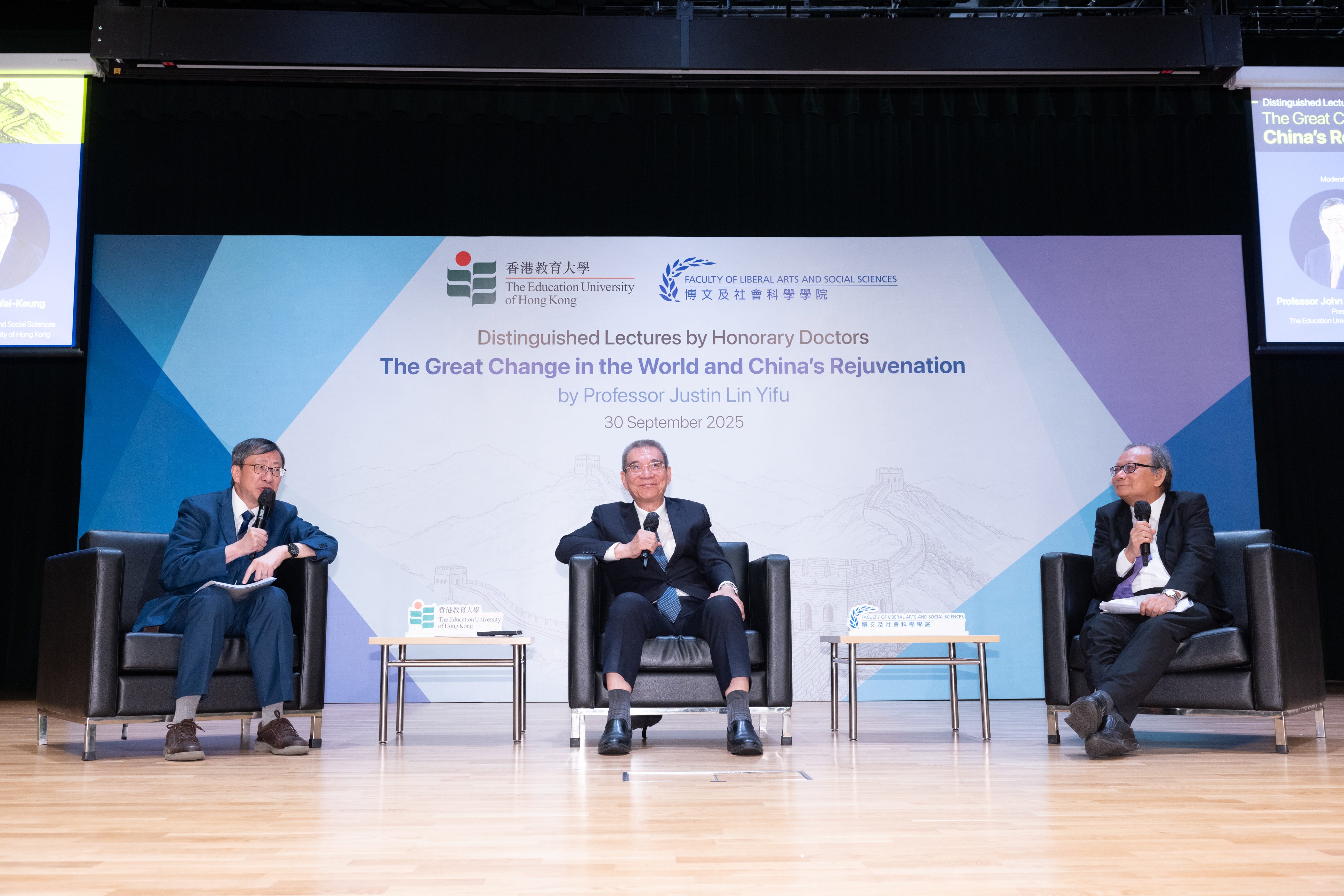
Professor Li Wai-keung: The Four Asian Tigers have developed rapidly, and these economies have been deeply influenced by Confucianism. What role does culture play in economic development?
Professor Lin: In my view, culture is not a decisive factor in driving economic development. When I was young, whether in Chinese Mainland or Taiwan, people blamed Confucianism for economic underperformance. When I visited South Korea, I heard the same view: people said Confucian culture had hindered the country’s development before the 1970s. Yet today, many claim that Confucian values have helped fuel the economic growth of the Four Asian Tigers. If the same factor is used to explain both success and failure, I find the argument unconvincing.
For a country to develop, it must enhance its economic competitiveness by making good use of its comparative advantages. When labour is plentiful, labour-intensive industries should be developed; when sufficient capital has been accumulated, the focus can shift to capital-intensive sectors. By leveraging these advantages, a country can produce goods or services more efficiently and maximise its productivity.
Another key factor in economic development is the reduction of transaction costs, which helps trade in goods and services. Good infrastructure, an efficient financial system, and a sound legal framework reduce transaction costs, enabling enterprises to operate more smoothly.
While the market is vital for resource allocation and driving innovation, the development of infrastructure, financial and legal systems depends on government intervention. Therefore, economic development relies not only on market forces for efficiency and innovation, but also on government efforts to improve infrastructure and establish financial and legal frameworks. As long as these two aspects are well managed, countries with any political system can make the most of their comparative advantages to achieve growth—this is the focus of my “New Structural Economics”.
President Professor John Lee Chi-Kin: Some reports say China’s population might begin to decline from 2030. Will this have a negative long-term impact on China’s economic growth? What does this mean for higher education?
Professor Lin: Currently, there are 57 countries worldwide that have entered an ageing stage. These countries fall into two groups: in 28 countries, per capita GDP had already reached or exceeded half of the US’s level before they became aged societies, while in the other 29, ageing set in before reaching that standard. In other words, some countries became wealthy before growing old, while others aged before becoming wealthy.
I compared the economic performance of these countries for the decade before and after entering an ageing phase. I found that in countries which were wealthy before ageing, the per capita GDP growth rate remained stable after entering the ageing phase, while overall GDP growth slowed slightly. However, in those that became aged before becoming wealthy, overall GDP growth actually accelerated, and per capita GDP continued to rise as well.
Labour force comprises two aspects: total hours worked (quantity) and quality of the workforce. Added together, this is the effective labour force. My research shows that a nation’s economic growth rate is determined primarily by its effective labour force, rather than by the total labour population.
Currently, the average education level of China’s workforce stands at 10.4 years; for retirees it’s about 6 to 7 years, and for new workforce entrants it’s about 14 years on average. This shows that the quality of China’s workforce is improving and effective labour supply is rising. Even if the working-age population declines, increasing educational levels can help sustain China’s economic growth momentum. Higher education institutions in China, including universities in Hong Kong, can contribute significantly in this regard.
Miss Wang Zeying, a student from FLASS’ Master of Arts in Personal Financial Education programme: The issue of youth employment has garnered significant attention across various sectors. I would like to ask Professor Lin, which industries possess both comparative advantages and the capacity to absorb young workers, and should therefore be prioritised for government support? Additionally, what policies should be used to assist these industries?
Professor Lin: Recently, President Xi Jinping introduced the concept of “new quality productive forces”, which emphasises driving economic growth through innovation, with industries serving as the main vehicle. A key principle behind this approach is development tailored to local conditions. Given China’s vast geography and the differing comparative advantages of each region, local governments should develop industries that align with their unique strengths and resources. When they do so, these industries can build competitiveness, grow rapidly, and create new employment opportunities.
The majority of industries in central and western China still belong to the traditional economy. Overall, around 80% of China’s industries are associated with the Third Industrial Revolution or earlier phases of industrial development. While China is often said to have an advantage in the Fourth Industrial Revolution, it is crucial to make full use of the strengths of advanced economies such as Hong Kong and Shenzhen, particularly in finance and logistics. By seizing the opportunities brought by the Fourth Industrial Revolution — including artificial intelligence, big data, robotics, and the low-altitude economy — we can improve the productivity and quality of traditional industries. Through intelligent technologies, digital transformation, and sustainable practices, traditional sectors can be upgraded and developed into emerging industries.
The Chinese government can offer incentives to new enterprises, such as multi-year tax concessions. Government agencies should also focus on strengthening infrastructure and ensuring stronger protection of property rights.
Mr Yao Angran, a student from the Executive Master of Public Administration and Leadership programme, Academy for Applied Policy Studies and Education Futures: Some reports suggest that China’s population may drop below 1.4 billion after 2035, and could fall below 1 billion by 2049. At the same time, many natural villages across China are rapidly disappearing. I would like to hear Professor Lin’s views on these issues.
Professor Lin: China is indeed facing the challenges of an ageing population and a declining birth rate. However, these demographic shifts were anticipated early on, and the Chinese government has introduced various policies to encourage childbirth, which are expected to help raise the birth rate. Based on current projections, I believe China’s population will remain above 1 billion by 2050.
As the proportion of farmers within the population continues to decline, more cultivated land will be freed up for other purposes. Alongside the shrinking agricultural workforce, robotics will increasingly take the place of manual labour. In fact, in parts of central China, some farmland is already largely cultivated using machinery rather than human labour. I am confident that China will remain self-sufficient in key agricultural products and continue to uphold food security.

Part I of NSD Q&A: challenges confronting the 5% growth ambition

On March 13, 2024, the National School of Development (NSD), Peking University, in collaboration with Baidu Economic & Financial News, held the 68th session of the China Economic Observation event and launched the 30th-anniversary celebration of the NSD.
Professor Lin outlines the Beijing‘s Political Ambition. As an Industrial Strategist, I look at the Physical Law.
On G8 Decline: Let's be objective. The G8 wasn't 'defeated'; it abdicated. By prioritizing Financial Assets over Industrial Output, the West voluntarily outsourced the 'heavy lifting' of civilization. Lin's data simply reflects the opportunity cost of that financialization.
The 'Tesla Reality': Lin uses Tesla as a success story. I see it as a Constraint. Innovation (US) is now physically tethered to Capacity (China). It proves that Ideas are mobile, but Supply Chains are sticky. This isn't about 'friendship'; it's about 'gravity'.
The 4.5% Target: This is not a 'destiny' as the speech suggests; it is a Stress Test. To hit 50% of US per capita GDP, the R.I.C.E. system must run at near-perfect efficiency despite demographic headwinds.
The Takeaway: You don't have to agree with the ideology to respect the Law & Math. The pivot from G8 to G20 is simply the accounting catching up with the real physics.