


Justin Yifu Lin has spent much of his career arguing that China cannot be fully understood through economic theories built elsewhere. His answer is New Structural Economics, which he presents as part of a broader effort to build an autonomous Chinese knowledge system in economics. Its basic argument is that countries should not be judged against a single model drawn from advanced economies. Instead, economists should begin with the actual conditions each country faces—its labour force, capital stock, technology, and natural resources—and ask what kinds of industries, infrastructure, and institutions are best suited to that stage of development.
In Lin’s view, this amounts to a “structural revolution” in modern economics. By taking seriously the differences among countries’ economic structures and the ways those structures evolve, New Structural Economics seeks to challenge the universalising assumptions of mainstream theory and offer a framework better suited to China and other developing countries.
Lin also issued a challenge to younger scholars. If Chinese economists merely use Chinese data to test Western theories, he warned, they may publish papers but miss the larger historical opportunity. As China’s economic weight grows, he argued, the centre of global economic research and theoretical innovation will also shift towards China. But that shift will require original theory, not simply the adaptation of imported frameworks.
Professor Justin Yifu LIN is Dean of the Institute of New Structural Economics, Dean of the Institute of South-South Cooperation and Development, and Professor and Honorary Dean of the National School of Development, Peking University. He also served as Senior Vice President and Chief Economist of the World Bank, 2008-2012.
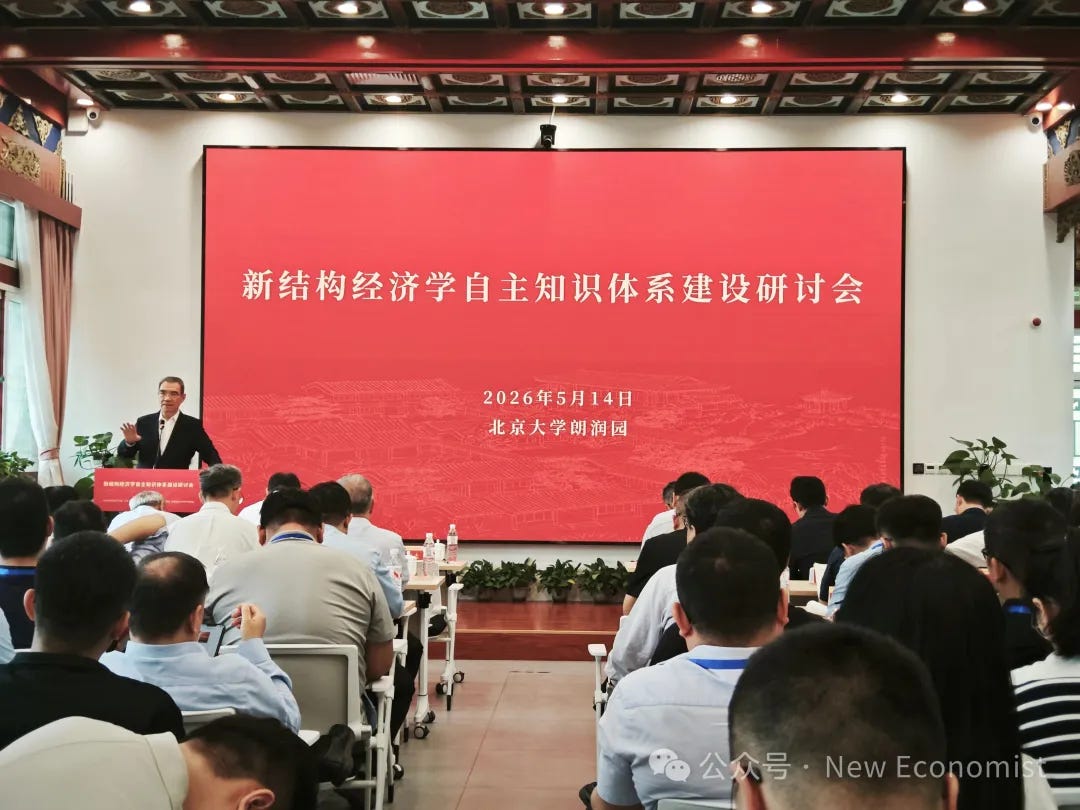
Lin delivered the following speech at Peking University on 14 May 2026. It is titled “Building an Autonomous Knowledge System for New Structural Economics and Expectations for Young Scholars”, lightly edited for clarity by New Economist Think Tank. The Chinese original was published on the New Economist Think Tank’s WeChat blog on 14 May.
—Yuxuan Jia
林毅夫最新主题演讲实录:新结构经济学将掀起对现代主流经济学的“结构革命”
Transcript of Justin Yifu Lin’s Latest Keynote Speech: New Structural Economics Will Launch a “Structural Revolution” in Modern Mainstream Economics
Welcome to this morning’s Seminar on Building an Autonomous Knowledge System for New Structural Economics. I would like to thank the previous speakers for recognising the efforts of the Institute of New Structural Economics in advancing autonomous theoretical innovation and building the knowledge system of New Structural Economics.
As we know, autonomous theoretical innovation is the core of an autonomous knowledge system, and an autonomous knowledge system is the systematic integration of such innovation. As someone who has promotes autonomous theoretical innovation in New Structural Economics and advocates the construction of its autonomous knowledge system, I would like to use today’s opportunity to explain why I have pursued this endeavour since 1988. I will also discuss how to further deepen theoretical innovation in New Structural Economics, build its autonomous knowledge system, and share a few expectations with the young friends present today.
Why promote autonomous theoretical innovation in New Structural Economics?
As we know, the function of theory is to help us understand the world and transform it. From the perspective of economics, mainstream economics has developed a highly sophisticated body of knowledge. Yet whether any theory is applicable depends on whether its premises and assumptions match the context in which it is applied.
Since Adam Smith, Western economics has largely been built on the experience of developed countries such as the United Kingdom and the United States. These theories therefore take, as their implicit premises, the economic, social, political, and other conditions of the developed countries in which they were produced. As a developing country, China differs markedly from those countries in both economic structure and level of development. Applying these theories directly to China therefore creates the problem captured by the Chinese saying: “An orange grown south of the Huai River is sweet, but when grown north of it, it turns bitter.” This is something we must clearly recognise. I came to this understanding in 1988.
In 1988, China experienced inflation of 18.5 per cent, the first such high inflation since the founding of the People’s Republic of China. According to mainstream Western theory at the time, inflation should be tackled by raising interest rates. This would reduce investment demand, lower consumption demand, bring down aggregate demand, and thereby affect inflation expectations. It was also seen as an efficient approach: once interest rates rose, only highly profitable projects would survive, and low-return projects would be eliminated. In theory, this would both curb inflation and improve the efficiency of resource allocation. The logic seemed highly persuasive.
Yet in 1988, China adopted a policy of “governance and rectification”, using administrative measures to cut back investment projects. From the standpoint of mainstream Western theory, this was highly irrational and inefficient. But then I faced a contradiction: if the Chinese government was truly as irrational as mainstream Western theory suggested, how had China maintained an average annual growth rate of 9.9 per cent from 1978 to 1987, with only limited fluctuations?
For a developing country, even several percentage points of growth in a single year is no easy achievement. China at the time was not only a developing country, but also an economy in transition. Sustaining 9.9 per cent growth for nine consecutive years showed precisely that the Chinese government was highly rational and had a deep understanding of the country’s conditions.
It was this intellectual conflict that led me to reflect on the so-called mainstream theories we had studied and applied. Theories from developed countries take their own development stage and conditions as implicit premises. This made me realise that every theory, in a sense, carries the risk of fighting the last war, for it starts from the specific conditions under which it was first developed.
When those premises do not fit developing countries, those of us who wish to contribute our knowledge and wisdom to national progress must develop a deep understanding of our own national conditions and put forward new theories. I am particularly pleased that New Structural Economics began to take shape in 1988, using factor endowments and their structure, which reflect the characteristics of China’s development stage, as the starting point for analysing China’s development. The first article that emerged from this line of thinking was written with Li Zhou and examined the institutional causes of China’s 1988 inflation. Since then, we have developed a distinctive perspective on China’s transition and development based on factor endowments and their structure, which gradually evolved into the analytical framework of New Structural Economics.
In 1994, Cai Fang, Li Zhou, and I published The China Miracle. In that book, the analytical perspective and framework of New Structural Economics were already largely in place. The analytical paradigm was: factor endowments determine industrial structure, which in turn requires corresponding infrastructure and compatible institutional arrangements.
Because our perspective and analytical approach differed from mainstream theory, many of our judgements and arguments were controversial. But the vitality of a theory lies in whether the inferences it produces can be borne out by later practice.
For example, as discussed in The China Miracle, the dominant international view at the time held that because China had not followed mainstream shock therapy or the “Washington Consensus”, its collapse was inevitable despite its strong performance. The “China collapse” thesis was then highly fashionable. In response, we predicted that if China continued with its pragmatic, gradual, dual-track transition, its economy would surpass that of the United States in purchasing power parity terms by 2015, and in market exchange-rate terms by 2030.
This was an extremely bold judgment at the time, but practice confirmed it: China surpassed the United States in purchasing power parity terms in 2014. As for market exchange rates, I believe China is very likely to surpass the United States by 2030.
Later, in 2007, I was invited to give a lecture at the University of Cambridge. I applied this analytical framework, derived from China’s experience, to examine the successes and failures of developing economies around the world after the Second World War. This allowed me to identify the fundamental reasons why a small number succeeded while the overwhelming majority failed, and to develop a fuller analytical framework and set of theoretical propositions.
As China’s economy continued to grow, I had the opportunity in 2008 to serve as Chief Economist and Senior Vice President of the World Bank, becoming the first economist from a developing country to hold that position. My colleagues at the World Bank, as well as the economic research team I led, which comprised more than 1,000 outstanding professionals from both developing and developed countries, were all deeply committed to promoting development in developing countries. The World Bank also had extensive project resources and should have been the world’s most influential development institution. Yet the reality was that, despite the World Bank’s ambitious goal of building a world free of poverty, and despite the fact that China’s reform and opening-up had lifted more than 800 million people out of poverty, the number of poor people in the rest of the world had not fallen, but risen.
These World Bank elites had mastered the most advanced theories and had development projects designed to put those theories into practice. Yet they failed to achieve the expected results. The reason was exactly what I had realised in 1988: they were applying mainstream theories derived from developed countries to developing countries with very different conditions. Their intentions were good, but the outcomes diverged sharply from what the theories predicted.
That is why, on the first anniversary of my appointment as Chief Economist at the World Bank, I proposed the term “New Structural Economics”. The central point was this: countries at different stages of development have different material conditions, and therefore different industrial and institutional structures. We must incorporate the heterogeneity and endogeneity of structures across countries at different development levels into our theoretical thinking, and develop new theories to guide development practice. Only then can we achieve the noble goal of helping developing countries escape poverty.
In 2011, I was invited to deliver the Kuznets Lecture at Yale University, one of the world’s most important economics lecture series. There, I spoke for the first time on “New Structural Economics: A Framework for Rethinking Development”. I later turned the lecture into an article published in The World Bank Economic Review, formally announcing the birth of New Structural Economics to the economics community.
I am also honoured that, as Director Zhao Chuandong, Deputy Director of the National Office for Philosophy and Social Sciences under the Publicity Department of the Communist Party of China Central Committee, mentioned earlier, I was invited to speak at the 2016 Symposium on Philosophy and Social Sciences Work. Nearly ten years have passed since then. Autonomous theoretical innovation has taken on new vitality, and I, like many colleagues here today, have been greatly encouraged by this development.
Next, I would like to discuss how to deepen autonomous theoretical innovation in New Structural Economics and build its autonomous knowledge system.
Any economic phenomenon can be explained by multiple theories. Western economics, in the nearly 250 years since Adam Smith, has built a highly comprehensive body of knowledge. For almost any phenomenon in China, one can find ready-made theories to explain it, and those explanations often appear quite convincing.
Take state-owned enterprise (SOE) reform during China’s transition, for example. It became a major issue because state-owned enterprises were widely seen as inefficient. At the time, the most influential framework was the property-rights theory of new institutional economics, which holds that the most efficient corporate arrangement is one in which ownership and management are unified—that is, where property rights belong to the operator. Otherwise, a divergence of interests between owners and managers will inevitably produce inefficiency. Managers, as employees rather than owners, have no residual claim on operating returns. On this basis, the theory concludes that SOEs are inherently inefficient. If firms are simply divided into state-owned and private enterprises in a regression analysis, private firms appear more efficient by almost any statistical measure. This argument was, therefore, particularly intuitive within the American economics discourse.
For those of us engaged in autonomous theoretical innovation, the first requirement is to adopt a mindset of “changwu” [constant non-presupposition]. When faced with any phenomenon, we should not immediately ask what existing theory says about it. We must first examine the phenomenon itself in depth and on its own terms.
As I noted earlier, many theories can be brought to bear on the same phenomenon. In the case of SOEs, mainstream property-rights theory appears rigorous, and it has been embraced by many leading Chinese scholars in related fields. Yet closer observation shows that state-owned and private enterprises differ in more than ownership. SOEs are often concentrated in capital-intensive sectors linked to national security and the commanding heights of the economy. They also help prevent private capital from using control over scarce resources to extract excessive profits. Private enterprises, by contrast, are mostly found in competitive sectors. Only by observing these differences can we see that mainstream theory is inadequate in distinguishing between industries with different characteristics, or between enterprises that serve different objectives.
Therefore, if we wish to seize the opportunities of our time and engage in genuine theoretical innovation, we must approach reality with a mindset of “changwu”. Every economic phenomenon contains implicit premises, and every theory is produced in a specific context. This means that any theory, if applied mechanically, carries the risk of fighting the last war. Only with such a mindset of “changwu” can we discern the essence of a phenomenon and the factors that truly shape it.
This is a point I have consistently emphasised in advocating autonomous theoretical innovation in New Structural Economics. I also published a book titled Benti and Changwu: Dialogues on Methodology in Economics, [the ontological object of inquiry and a mindset of non-presupposition]. In my exchanges with teachers and students, I have encouraged them to free themselves from the constraints of existing theories and look at the world again with their own eyes, like newborn infants. Only in this way can we understand the essence of phenomena and their determining factors. In the language of traditional Chinese philosophy, looking at the world through existing theories is a “second-order” mode of observation. What we need is a “first-order” mode of observation: to observe the essence and determining factors of phenomena directly, without theoretical prejudice or presupposition. This is what it means to view phenomena through “changwu”.
But if we are to maintain this mindset and directly observe the essence and determining factors of real-world phenomena, how should we observe them? Broadly speaking, there are two worldviews for analysing the essence of phenomena and their determining factors: idealism and materialism.
Since I began exploring the construction of my own theoretical system in 1988, I have fully endorsed and consistently upheld historical materialism. This position also accords with the spirit of the General Secretary’s speech at the Symposium on Philosophy and Social Sciences Work: Marxism reveals the essence, internal connections, and laws of development of things. It is a great tool of cognition and a powerful intellectual weapon for observing the world and analysing problems.
The views that New Structural Economics has gradually developed since 1988, often in departure from mainstream theory, are grounded in a materialist standpoint. They take factor endowments—a material condition—as the starting point for observing development and transition in China and elsewhere in the world. Why insist on historical materialism? Both my own practice and my reading of philosophy have shown me that historical materialism can reveal the essence of phenomena. Factor endowments offer an especially useful entry point.
As is well known, historical materialism holds that the economic base determines the superstructure, while the superstructure in turn acts upon the economic base. The economic base consists of the productive forces and the relations of production shaped by those productive forces. Relations of production are important, but they are ultimately conditioned by the productive forces. It is therefore the productive forces that play the primary role in driving social progress.
When proposing “new quality productive forces”, the General Secretary also emphasised that industries are an important carrier of these forces. New Structural Economics recognised relatively early how industries are determined: the industries of each country and society are determined by the comparative advantages arising from their factor endowments and their structure.
Thus, if the economic base determines the superstructure, and the economic base is primary; if productive forces determine the relations of production, and productive forces are primary; if productive forces are carried by industries, and industries are in turn determined by factor endowments, then within the entire Marxist chain of analysis, factor endowments and their structure are the primary factor.
New Structural Economics further concretises the primacy of material conditions. It holds that factor endowments and their structure are the primary existence and the primary determining force. Its theoretical innovation begins from factor endowments and their structure as the primary material condition, and uses them to observe the country, society, and development. From this come a series of propositions: production structure is endogenous to factor-endowment structure; infrastructure must be compatible with production structure; and the institutional arrangements within the superstructure should also be compatible with production structure. This is the first basic standpoint of New Structural Economics.
In the process of economic development, however, different structures change at different speeds and with different degrees of difficulty, creating time lags. Because of the internal frictions of structural change, institutional structures and production structures are often not fully aligned. This is normal. At times, the state may also pursue goals other than efficiency, such as security, and therefore promote production structures that differ from those determined by comparative advantage. This creates distortions. Structures are endogenous, distortions are endogenous, and the operation of the economy reveals this endogeneity. This is the perspective of New Structural Economics: “one centre, three basic points”.
If New Structural Economics is to pursue theoretical innovation, it should begin from this perspective, observe the phenomena of development and transition in China and other developing countries, and develop theory on that basis. If we have a consistent perspective to guide theoretical innovation, the theories we develop can be linked together through a coherent logical chain and integrated into an autonomous knowledge system.
New Structural Economics was first proposed as the third generation of development economics. Later, we realised that every branch of modern mainstream economics—macroeconomics, monetary economics, public finance, business cycles, industrial organisation, spatial layout, international trade, and so on—takes the structures of developed countries as its implicit premise. Yet countries at different stages of development have different structures.
If we introduce the structural heterogeneity and endogeneity of countries at different levels of development into the various fields of modern mainstream economics, we can in effect launch a “structural revolution” in each of those fields. Therefore, although New Structural Economics was first proposed as the third generation of development economics, this realisation has made our understanding clearer: it is in fact a “structural revolution” in modern economics. Introducing the endogeneity of material structures into modern mainstream economics is, in essence, a Marxist transformation of modern mainstream economics.
Modern mainstream economics takes the structures of developed countries as its implicit premise and neglects the differences in structure, institutions, and economic operation that arise from different material conditions across countries at different stages of development. From a Marxist perspective, since the economic base determines the superstructure, and the superstructure acts back upon the economic base, we must start from the primary determining role of the economic base. This is, in effect, a Marxist revolution in modern economics.
Finally, I would like to share a few expectations with young friends. As mentioned earlier, modern economics began with Adam Smith’s The Wealth of Nations in 1776. Nearly 250 years have passed since then. If we count 25 years as one generation, it has taken the efforts of ten generations to build such a complete system.
Frankly, it is difficult to find a phenomenon that modern mainstream theory cannot explain. These explanations may not always grasp the essence of the problem, but the knowledge system is highly complete, the logical chain is clear, and the arguments are extremely persuasive. New Structural Economics, by contrast, has existed for only 38 years since its beginnings in 1988. If we count from the 2011 Yale lecture, when it was formally introduced to the academic community, it has existed for only 15 years. Compared with the powerful and well-established mainstream theoretical system, the autonomous theoretical innovation represented by New Structural Economics remains at an early and fragile stage. It urgently needs the young scholars here today to devote themselves to it, generation after generation, just as scholars in the Western mainstream academic community have done. Only through sustained collective effort and deeper theoretical innovation can we ultimately build an autonomous knowledge system of New Structural Economics originating in China. This is a task that will require the joint efforts of several generations.
We often say that young people are the hope of the country. Likewise, young people are the hope of building an autonomous knowledge system for New Structural Economics.
I am particularly pleased to see so many young friends participating today, both in person and online. If you can truly start from the materialist perspective of New Structural Economics and summarise the experience of development and transition in China and other countries, this will be a once-in-a-lifetime opportunity.
As I boldly predicted in 1995, at the 40th anniversary of the Economic Research Journal, the 21st century will belong to Chinese economists. It will be an era in which China produces, in significant numbers, leading scholars capable of shaping the theoretical direction of global economics. Since Adam Smith, the centre of the world economy has also been the centre of economic research, theoretical innovation, and the emergence of great economists.
In purchasing power parity terms, China’s economy surpassed that of the United States in 2014. Looking ahead to 2049, I believe China’s economy could reach twice the size of the U.S. economy or even more. The centre of the world economy is shifting towards China, and the research centre of world economics will inevitably shift towards China as well. If you wish to seize this historic opportunity, you must first adopt a mindset of “changwu”: you must not simply use Chinese data to verify Western mainstream theories. If you apply Western mainstream theory whenever you encounter a Chinese phenomenon, you may well be able to publish papers, but you will not grasp the opportunity of this era. Worse still, you may mislead society, because you will have failed to identify the real problem behind the Chinese phenomenon. Would that not make you like the economists I saw at the World Bank, who were sincerely committed to helping developing countries, but who, armed with inappropriate theories, spent large sums of money on many projects with very little effect?
The purpose of economic research is to understand the world and, more importantly, to transform it. Taking the transformation of the world for the better as the goal of research is the only way to seize this opportunity and advance theoretical innovation.
The opportunity of the times is right before us, but whether we can seize it depends on having the right worldview. We can no longer mechanically apply theories that largely belong to the superstructure and fall within the category of idealism. Instead, we must begin from materialism and from the material foundations of each country. We must uphold the Marxist perspective, namely the perspective of New Structural Economics: “one centre, three basic points”.
At the same time, researchers must have the right outlook on life. The purpose of research is to understand the world and, through that understanding, help people transform the world for the better and promote social progress. This is the most important goal, perhaps even the only goal. Whether a paper can be published is not the main concern.
I emphasise this because, while it is undeniable that the nearly ten years since the General Secretary’s speech at the Symposium on Philosophy and Social Sciences Work have given fresh momentum to autonomous theoretical innovation, such innovation remains, overall, at an early stage. New Structural Economics started relatively early, but it has existed for only 38 years. If you search the literature today, there is still not much related research. Moreover, the editors and reviewers of current journals still largely adhere to the mainstream paradigm, making it difficult to publish articles that put forward original theoretical innovations.
If what you are aiming for is publication, you are very likely to give up on autonomous innovation. And if that is your starting point, it will be difficult for you to seize the theoretical opportunities created by China’s rise as one of the world’s major centres of economic research.
Therefore, to meet the demands of this era, you must have both the right worldview and the right outlook on life. You must be clear about the purpose of research: to understand the world yourself, and then to help others change it for the better and advance social progress. This is the most important goal—perhaps even the only one.
I believe that, as China’s national strength continues to grow through reform and opening up, and as the centre of the world economy shifts towards China, the research centre and direction of innovation in world economics will inevitably shift towards China as well. The great masters who lead the development of world economic theory will also gather in China. We live in an extremely fortunate era. The General Secretary’s call for autonomous innovation ten years ago has created a favourable external environment for us.
I am also particularly pleased that the journal New Structural Economics has been approved for formal publication. This channel will provide all colleagues and young friends committed to autonomous theoretical innovation in New Structural Economics with a platform to publish their work, exchange ideas, and learn from one another.
Finally, allow me to conclude with the General Secretary’s words at the Symposium on Philosophy and Social Sciences Work: “This is an era that needs theory and will certainly produce theory; this is an era that needs thought and will certainly produce thought. We must not fail this era.”
Let us take this as mutual encouragement. Thank you.

Justin Yifu Lin explains “The Great Change in the World and China’s Rejuvenation”

We are pleased to share Professor Justin Yifu Lin’s speech and the subsequent Q&A session held on September 30, 2025, at the Education University of Hong Kong (EdUHK).
Reminds me of a Development Economics class I took in the middle '80s. The teacher was having a panic attack over his chosen field as things were going so poorly in South America. He always asked us if we thought the whole field of Development Economics was a bad idea and it should be "just get prices right."
If you don't have free markets, and they obviously are not easy to develop, distortions result. This is not rocket science. China corralled savings, imposed labor restrictions, attracted a tsunami of Western investment/technology, and had very hard-working/competent people, combined with open export markets. Of course, growth would be the result. It isn't the first time it has happened either.
There are many better things to discuss. I've been wondering whether it is feasible for the West to maintain generally freer markets by decoupling. I know I want to maintain the system that has generated so much innovation and high living standards worldwide, outside of a few pockets, while still preserving freedoms. That said,I am not entirely convinced it is feasible without some kind of wall, and I'm not convinced it is possible to build that wall if we wanted to.
Then again, maybe it is just a matter of RMB appreciating a great deal in which case, it just comes back to IP protection and dealing with restructuring of Chinese businesses.
Glad I don't have to make the decisions.
Re Justin Yifu LIN and Structural Economics. Yes, whether any theory is applicable depends on whether its premises and assumptions match the context in which it is applied. Basic stuff is too often ignored. Example: back radiation from a thermally sub zero atmosphere is said to drive surface temperature in spite of the determinative countervailing influences of evaporation, conduction and convection seen in its most extreme instance in desert environments by comparison with coastal or oceanic environments.
Increasing interest rates stokes inflation directly by inflating the need for profits. If the inflation is due to an increase in the cost of fuel the impact is particularly widespread. The increase in interest rates that governments pay increases deficits enhancing demand by the public sector and its employees who tend to be sheltered via wage adjustments. Inflation requires that wages in the private sector are increased to maintain purchasing power parity. Home building costs are driven up as lending for building contracts. An underclass that can not afford housing is squeezed, enhancing the need for social services. There is an excellent argument that interest rates on housing loans for first home buyers should be capped at 2%, and that there should be a limit on home ownership to two homes at the most, one in an urban area and one in the countryside or in a coastal area. Changing the structure will change the dynamics.
It's essential for any nation to ensure that the state prevents private capital from using control over scarce resources to extract monopoly profits but very difficult to ensure that this happens...hence the need for SOE, even though there may be a cost in terms of reduced efficiency.
I agree wholeheartedly that 'the purpose of research is to understand the world and, through that understanding, help people transform the world for the better and promote social progress. This is the most important goal, perhaps even the only goal. Whether a paper can be published is not the main concern'. A case in point relates to the impossibility attached to publishing a paper on 'climate' that contradicts the current orthodoxy.