


Two Chinese scholars have traced the shifting balance in U.S. strategic thinking on Taiwan since 2020: under Biden, the resurgence of arguments for a clearer U.S. commitment to defend Taiwan alongside persistent support for strategic ambiguity and restraint; and under Trump, the growing influence of gradual Taiwan-abandonment arguments. The authors ultimately argue that Trump 2.0’s Taiwan policy combines “maximum extraction” with “de-risking”: extracting as many economic and strategic concessions as possible from Taiwan while reducing the costs and risks of defending it. That policy is “undoubtedly a prelude to eventual U.S. abandonment of Taiwan,” they conclude.
The following article is written by Guan Chenglong, PhD candidate, School of Global and Regional Studies, University of Chinese Academy of Social Sciences; and Yuan Zheng, Deputy Director and Research Fellow, Institute of American Studies, Chinese Academy of Social Sciences (CASS).

The article was published on 20 April in Issue 2, 2026 of 台湾研究 Taiwan Studies, a journal run by the Institute of Taiwan Studies at CASS. It is also available on the official WeChat blog of the Institute of Taiwan Studies.

美国战略界的台海政策辩论:阵营分化与共识离散——兼论特朗普第二任期的台海政策
The Debate on U.S. Taiwan Policy: Camp Divisions and the Disintegration of Consensus
— A Discussion of Taiwan Policy during Trump’s Second Term
Guan Chenglong and Yuan Zheng
Abstract. Since 2020, the U.S. strategic community has conducted several rounds of intense debate over Taiwan policy, marked by sharp divisions among different camps and disintegration of consensus.
Drawing on the positions of the various parties to the debate, this article uses an “ends–means” dimension to divide the field into five camps: the Taiwan-defence camp, the deterrence-rebalancing camp, the traditional status-quo camp, the gradual Taiwan-abandonment camp, and the radical Taiwan-abandonment camp.
It then examines how the evolution of strategic consensus has shaped the way these debates influence decision-making. As the debate continues into Trump’s second term, it is likely to shape the administration’s Taiwan policy in two ways. On one hand, Trump’s Taiwan policy is subordinate to deal-making with China, and it will continue to advance the U.S. strategic community’s minimum consensus — the buildup of Taiwan’s asymmetric defence capabilities and the porcupine strategy. On the other hand, it pursues a strategy of maximum extraction and de-risking aimed at making Taiwan serve the America First agenda across the board, a logic closely linked to the rise of the gradual Taiwan-abandonment camp in recent years.
Keywords: China–U.S. Relations; U.S. Taiwan Policy; Policy Debate; Strategic Consensus; Taiwan Abandonment
Disagreement within the U.S. strategic community over Taiwan policy is long-standing, surfacing periodically in policy debates with a discernible cyclical pattern. These debates are closely intertwined with actual government policy: they may foreshadow policy adjustments, but may also be triggered by shifts in policy itself. Taken together, the successive rounds of debate reflect not only the diversity of views within the U.S. strategic community, but also sharp differences among various camps and factions in how they assess and balance competing interests, with lobbying and personal factors adding further complexity.
Since the Biden administration, debate has become more intense than ever. The long-standing U.S. approach to the Taiwan Strait — grounded in the “one-China policy” and aimed at maintaining the status quo — has faced sustained challenges from multiple directions, while Biden’s efforts to adjust policy in response to these pressures have been less than satisfactory. U.S. Taiwan policy has therefore, on the whole, entered a difficult period of transition. It is thus worth examining these debates from a broader range of perspectives and considering how they shape the government’s decision-making process.
I. Factional Divisions on Taiwan Policy within the U.S. Strategic Community
After the Kuomintang retreated to Taiwan in 1949, Taiwan policy became an increasingly prominent subject of debate within the U.S. strategic community. The outbreak of the Korean War and the signing of the U.S.–Taiwan Mutual Defence Treaty enabled the Taiwan-defence camp to dominate both the government and the strategic community, with Taiwan regarded as an integral part of U.S. Cold War strategy in East Asia.
By the late 1960s, as Sino-Soviet relations deteriorated, the U.S. strategic community began to rethink China policy. Within the U.S.–China–Soviet strategic triangle, the argument for aligning with China to counter the Soviet Union gained ground, and it was on this basis that the Nixon administration initiated the normalisation process. With the establishment of diplomatic relations with China and the signing of the three joint communiqués, the U.S. government gradually consolidated a Taiwan policy framework grounded in the “one-China policy”. In parallel, debate within the strategic community came to be dominated by the status-quo camp, further reinforcing the legitimacy of this policy framework.
For a long time, the positions taken on Taiwan policy within the U.S. strategic community could be sorted roughly into three camps: the Taiwan-defence camp, the Taiwan-abandonment camp, and the status-quo camp.1 Building on the opposition between the abandonment and Taiwan-defence camps, some scholars have subdivided the former into immediate and gradual variants and the latter into a strengthening defence camp and a maintaining status-quo camp.2
Tao Wenzhao, for his part, divides the debate into three camps: a minority calling for a rethinking of Taiwan policy, a mainstream camp favouring the maintenance of the status quo, and a conservative faction that links the “China threat” thesis to U.S. Taiwan policy and continues to emphasise Taiwan’s strategic value to the United States.3 Lin Gang sorts these debates into three camps: a status-quo camp advocating neither unification nor independence across the Taiwan Strait, a Cold War camp that sees Taiwan as an important means of containing the mainland’s peaceful rise, and a Taiwan-abandonment camp that favours ending the U.S. security commitment to Taiwan.4 Zhong Houtao holds that the core question in the debates is how to assess Taiwan’s strategic value to the United States — in essence an argument over whether Taiwan is an asset or a liability.5 Other scholars, drawing on the distinction between Taiwan as a strategic liability and as a strategic asset, divide the debate into three positions: the abandonment thesis, the Taiwan card thesis, and the status quo thesis.6
As the U.S.–China balance of power has shifted more rapidly in recent years, some scholars have argued that Taiwan is becoming a high-risk strategic asset for the United States and that the risks of continuing to play the Taiwan card are mounting.7 Wang Shushen observes that the two major U.S. parties are largely of one mind on using Taiwan to check China, but that Republican “strategic hawks” hold more provocative views of Taiwan and advocate more dangerous policies than the Democratic establishment.8
James B. Steinberg, who served as deputy secretary of state under Obama, groups current views within Washington’s strategic community into three camps. The first calls on the U.S. government to make an explicit commitment to defend Taiwan and to state publicly that it does not recognise Taiwan as part of China. The second emphasises strengthening Taiwan’s defence capabilities, pursuing a porcupine strategy, and creating a so-called “boiling moat.” The third advocates abandoning Taiwan and seeking an accommodation with Beijing.
Taken together, these frameworks are based on sustained observation and analysis of the U.S. debate. They offer valuable insights into the complex range of positions and the principal lines of division, providing clear examples of the diversity of views within the U.S. strategic community. Yet as the debate has evolved, two problems in the existing scholarship warrant further discussion.
First, any such classification should begin with a clearly defined research question and avoid conflating ends with means. Steinberg’s typology clearly blurs this distinction by placing measures — such as support for higher Taiwanese defence spending and the porcupine strategy — alongside strategic positions on whether to defend or abandon Taiwan. In fact, there are now few voices within the U.S. strategic community that oppose the porcupine strategy. A more nuanced distinction among the positions of leading strategic thinkers is therefore needed.
Consider the debate over strategic clarity initiated in 2020 by Richard Haass, president of the Council on Foreign Relations (CFR), and David Sacks, a CFR research fellow. The two viewed strategic clarity as a means of rebalancing deterrence in the Taiwan Strait and preserving the status quo. If classified according to their strategic objectives rather than the means they advocated, both would belong to the status-quo camp.
Second, as the debate has evolved, the conventional dividing lines have become increasingly blurred, and any classification must adapt accordingly. Views and camps in the U.S. strategic community are constantly shifting, and the landscape has changed markedly since Biden took office. The long-dominant status-quo camp has become internally divided, while both the Taiwan-defence and Taiwan-abandonment camps have gained ground rapidly. The relative influence of the three camps has shifted noticeably, and after Biden himself made four successive statements that appeared to move towards greater strategic clarity, the debate became more complicated still.
II. Camp Divisions in the New Round of Taiwan Policy Debate
Since the establishment of China-U.S. diplomatic relations, the “one-China policy” has been the cornerstone of U.S. Taiwan policy. Strategic ambiguity has served as the principal means of implementing that policy. Its core objective is to maintain the status quo, ideally through dual deterrence: deterring the mainland from changing the status quo by force while also deterring pro-independence forces on Taiwan from disrupting it.
Under the Biden administration, the U.S. strategic community engaged in several substantial and highly contentious rounds of debate over Taiwan policy. These debates exposed a structural tension in U.S. policy: it has become increasingly difficult to preserve the status quo by maintaining an ambiguous and broadly defined posture. For decades, this posture gave the U.S. government considerable room for manoeuvre, allowing it to remain deeply involved in cross-Strait affairs while avoiding, to some extent, excessive commitments. Yet the policy rested on a rough balance of power across the Strait.
As the cross-Strait power gap has widened in recent years, and as the strategic gap between the United States and China along the first island chain has narrowed, U.S. policy has come under growing pressure. A consensus has emerged within the strategic community that time is no longer on the U.S. side.
(1) The Taiwan Debate Within U.S. Strategic Community Since 2020
Since 2020, the U.S. strategic community has gone through successive rounds of debate over questions such as: Is a mainland “attack” on Taiwan imminent? Should the United States explicitly commit to defending Taiwan? Does Taiwan implicate vital U.S. strategic interests?
During this period, the “Davidson window,” an argument underpinning the view that a mainland “attack” could be imminent, was repeatedly invoked, while the thesis of Taiwan’s undetermined status was revived on multiple occasions and became an important basis for the government’s increasingly unconstrained use of the Taiwan card. The Biden administration, meanwhile, repeatedly tested the limits of strategic ambiguity9, while using a democracy-versus-autocracy narrative to further “internationalise” the Taiwan question. House Speaker Nancy Pelosi’s 2022 visit to Taiwan brought domestic calls to defend Taiwan to a peak.
As support for defending Taiwan intensified, some within the strategic community began to pay closer attention to the risks of strategic miscalculation and escalating crisis dynamics between the United States and China, and to guard against them. They strongly criticised the Taiwan-defence camp and the case for strategic clarity. Some offered a series of more objective reflections: Is a mainland “attack” really so imminent? Does Taiwan genuinely implicate vital U.S. strategic interests? Has the U.S. public accepted the prospect of war with China?
At the same time, the rapid rise of New Right political forces emphasising strategic retrenchment and domestic priorities, together with Trump’s return to office, provided the Taiwan-abandonment camp with new intellectual support and a more favourable political environment, creating greater space for its growth within the U.S. strategic community.
In 2020, a group of strategic thinkers led by CFR president Richard Haass and research fellow David Sacks called into question the long-standing policy of strategic ambiguity. As the China-U.S. power gap narrowed and the balance of forces across the Taiwan Strait shifted, they argued, the United States should move towards strategic clarity to restore the balance of deterrence. At the same time, they continued to support the “one-China policy”, maintaining that a shift towards strategic clarity would not alter Washington’s long-standing “one-China policy” or its position of not supporting Taiwan independence.
The argument immediately sparked fierce debate between supporters and critics upon publication. Raymond Kuo, director of RAND’s Taiwan Policy Initiative, argued that, given the prevailing balance of forces, the United States should strengthen the credibility of its deterrence against China and that Washington’s long-standing policy of strategic ambiguity had already lost its effectiveness. In Deterrence Gap: Avoiding War in the Taiwan Strait, Jared M. McKinney and Peter Harris likewise contended that the material basis for continued ambiguity had been badly eroded, that U.S. deterrent capability in the Strait would reach its nadir within a decade, and that a shift to strategic clarity was urgently required.
On the other side of the debate, mainstream voices within the status-quo camp joined parts of the Taiwan-abandonment camp in resisting this line. Bonnie Glaser and Michael J. Mazarr, among others, argued in turn that a turn to strategic clarity would fail to remedy declining U.S. deterrence and would instead invite greater danger. Michael Glennon warned that such a turn would contravene both the Taiwan Relations Act and the U.S. Constitution, carrying serious legal and political risk.
In 2021, an article by Oriana Skylar Mastro, a fellow at Stanford’s Freeman Spogli Institute for International Studies, touched off heated argument over the imminence of a mainland “attack”. Mastro claimed that the mainland’s growing military capabilities were being matched by a greater willingness to use force, and that the United States urgently needed to strengthen military deterrence to convince Beijing that it could not achieve its objectives. The argument echoed the contemporaneous “Davidson window” and the congressional testimony of Ely Ratner, then Assistant Secretary of Defence for Indo-Pacific Security Affairs, and quickly triggered widespread discussion.
Rachel E. Odell, Research Fellow at the Quincy Institute, Eric Heginbotham, principal research scientist at MIT’s Center for International Studies, and Bonny Lin, senior fellow at the Center for Strategic and International Studies (CSIS), subsequently published an article arguing that such alarmism was in fact harmful to the interests of both the United States and Taiwan, and that there had been no major shift in the mainland’s policy towards Taiwan. Interestingly, an argument intended to push U.S. policy choices towards a “moment of truth” ultimately created space for both the Taiwan-defence and Taiwan-abandonment camps to sharpen their respective positions, while also drawing forceful rebuttals from the mainstream status-quo camp.
In 2024, Andrew S. Erickson, professor at the U.S. Naval War College, Gabriel Collins, fellow at Rice University’s Baker Institute for Public Policy, and former deputy national security adviser Matthew Pottinger co-authored a piece likening Taiwan to the West Berlin of a U.S.–China new cold war, warning of catastrophic consequences for the United States and the world if the Chinese mainland were to “take” Taiwan. The piece brought the case for defending Taiwan back to the centre of the debate and prompted widespread discussion. In fact, the abandonment thesis and the defence thesis represent two opposing strands of the same broader debate over Taiwan: whenever arguments for defending Taiwan gain momentum, the case for abandonment tends to mount a strong counterreaction.
Indeed, since 2024, the abandonment thesis has shown clear signs of resurgence. Michael D. Swaine, a senior research fellow at the Quincy Institute, offered a sober reassessment of Taiwan’s strategic value to the United States, stressing that Taiwan does not constitute a vital U.S. interest. Jennifer Kavanagh, senior fellow and director of military analysis at Defence Priorities, and Stephen Wertheim, senior fellow at the Carnegie Endowment for International Peace, wrote that “the United States should insulate its regional strategy from developments in Taiwan. That way, Washington can minimise the fallout in case Beijing succeeds in taking the island.” Michael Mazarr and colleagues at RAND went further, proposing that the United States create maximum incentives for Beijing to pursue peaceful unification by gradual means. With the New Right ascendant in U.S. politics and Trump back in office, the resurgence of the abandonment thesis marks only the beginning of a new round of debate, one that is likely to continue evolving.
The foregoing sketches only some of the key developments since 2020 and cannot capture the debate in its entirety. Even so, the evolution of the debate and the shifting balance of the Taiwan-defence, Taiwan-abandonment, and status-quo camps make clear that discussion of Taiwan policy in the U.S. has remained highly intense and frequent in recent years. This reflects both deep U.S. anxiety over China’s rapidly growing military power and the changing strategic landscape in East Asia, and a growing reassessment of — and wariness about — the increasingly radicalised trajectory of strategic competition with China and Taiwan’s potential role as a conflict flashpoint. The rise of the abandonment thesis represents, to some extent, a return to more restrained thinking within the U.S. strategic community. As the debate evolved, the long-standing U.S. consensus on the Taiwan Strait has come under increasing pressure, and the status quo camp’s mainstream position has been shaken.
(2) Camp Division and the Disintegration of Consensus
For a long time, the U.S. debate was dominated by the status-quo camp, with the Taiwan-defence and Taiwan-abandonment camps occupying opposing ends of the spectrum. The clashes between the two, in fact, continually reinforced the status-quo camp’s dominant position, while the consensus it represented — strategic ambiguity and maintenance of the status quo — provided the principal source of legitimacy for the U.S. government’s “one-China policy”. As the structure of the debate has shifted in recent years, that mainstream consensus has begun to loosen.
On one side, the Taiwan-defence camp has gained momentum rapidly, while figures within the status-quo camp, represented by Haass and Sacks, have placed greater emphasis on deterrence and turned to endorse strategic clarity that would explicitly commit the United States to defending Taiwan. This has given rise to a deterrence-rebalancing camp emerging from within the status-quo camp. On the other side, the Taiwan-abandonment camp has steadily gained ground, and the gradualist approach advocated by some within it has attracted considerable support.
The simultaneous growth of both wings has put increasing pressure on the status-quo camp’s dominant position, while developments in the Taiwan Strait have made it increasingly difficult to restore the earlier order favoured by the mainstream status-quo camp.
Working along an end–means dimension, and setting out three objectives — defending Taiwan, maintaining the status quo, and abandoning Taiwan — against three instruments — strategic clarity, strategic ambiguity, and non-intervention — this article attempts to clarify the most recent state of the debate, dividing the field into five camps: the Taiwan-defense camp, the deterrence-rebalancing camp, the traditional status-quo camp, the gradual Taiwan-abandonment camp, and the radical Taiwan-abandonment camp.
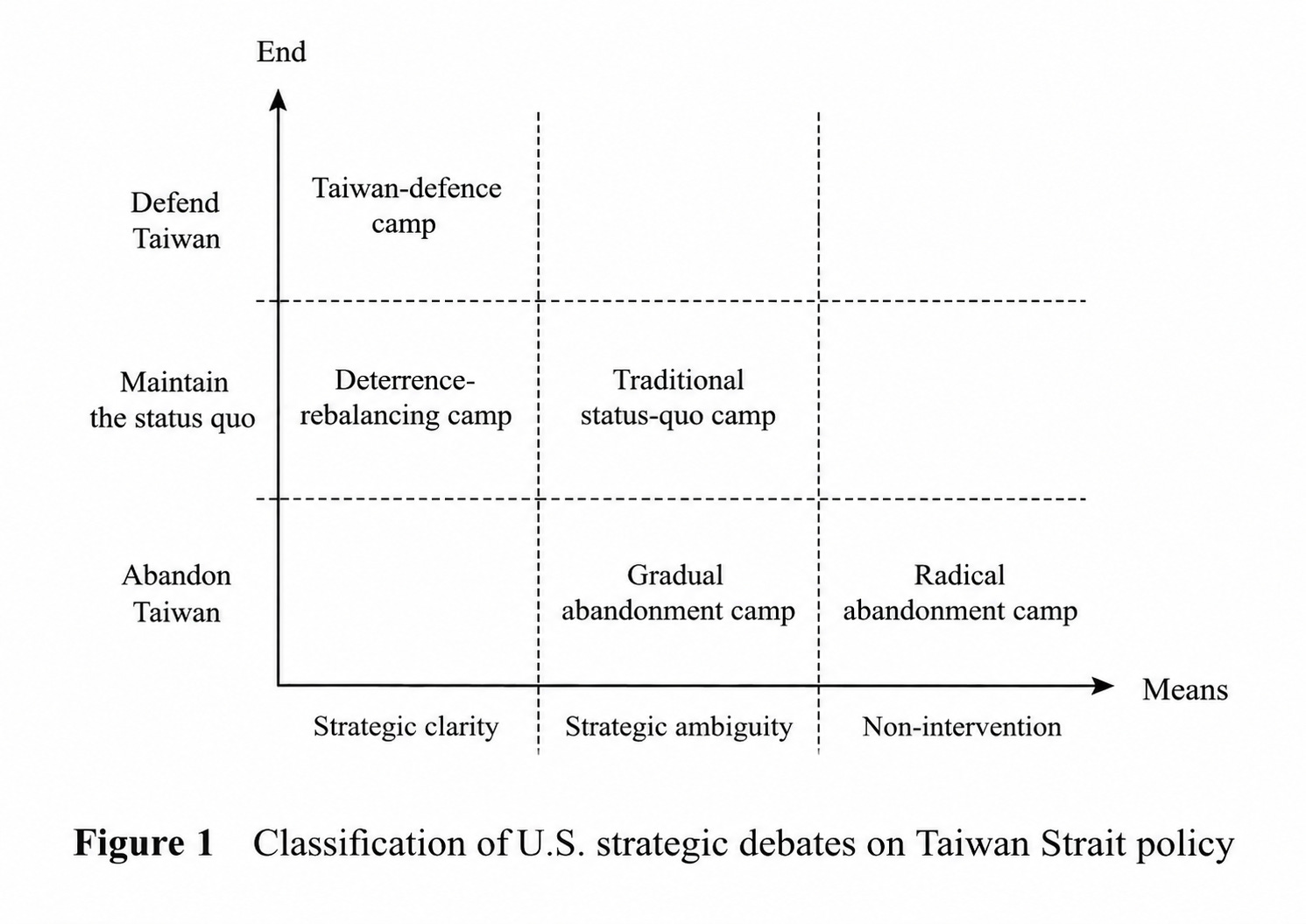
More specifically, the Taiwan-defence camp is represented by former national security adviser John Bolton, Matt Pottinger, and former chairman of the House Select Committee on the CCP, Mike Gallagher. It views Taiwan as a forward bastion in U.S. strategic competition with China and in efforts to contain and undermine Beijing, and argues that the United States should actively defend the island. Those who hold this view are generally among the “extreme China hawks” in the U.S. strategic community.
The deterrence-rebalancing camp and the traditional status-quo camp both regard maintenance of the status quo as their principal objective, but differ over how best to achieve it. The deterrence-rebalancing camp argues that the United States should shift towards strategic clarity by making an explicit commitment to defend Taiwan. Its members generally hold that long-standing strategic ambiguity no longer fits the changing strategic situation in the Strait. The traditional status-quo camp, represented by Bonnie Glaser and Ryan Hass, maintains that strategic ambiguity remains effective and is still the best available option. Its members have criticised Biden’s repeated attempts towards greater strategic clarity.
The Taiwan-abandonment camp, meanwhile, has evolved in new directions, giving rise to a group of gradual Taiwan-abandonment advocates who view abandonment as the ultimate objective but argue that, for the time being, the United States should maintain strategic ambiguity and the “one-China policy”, postponing further steps until conditions are more favourable. On some issues, this group aligns with the mainstream traditional status-quo camp, and in several rounds of debate the two have jointly pushed back against the Taiwan-defence and deterrence-rebalancing camps. Jennifer Kavanagh, Michael Mazarr, and Michael Swaine are its principal representatives.
Jennifer Kavanagh has repeatedly defended strategic ambiguity and proposed concrete steps to reinforce the “one-China policy”. She argues that Taiwan does not require direct U.S. military defence and that even losing Taiwan would not fundamentally affect the U.S. strategic position in the Indo-Pacific. She also places hope in Trump’s ability to break the current impasse and dangerous spiral in the Taiwan Strait, arguing that the administration’s best path to avoiding conflict is to pursue a bold new agreement with China.
In a 2025 report, Michael Swaine likewise argued that the United States should maintain strategic ambiguity while carrying out necessary preparations for a noninterventionist policy shift. Once those preparations were complete, he argued, strategic ambiguity should be replaced by a policy of strategic clarity that excludes the possibility of a Sino–American war over Taiwan.
The radical Taiwan-abandonment camp, by contrast, neither believes that strategic ambiguity remains effective nor considers the long-standing “one-China policy” sustainable. In its view, the United States should abandon Taiwan as soon as possible. Doug Bandow, for example, argues that Taiwan is not vital to U.S. security, that Washington’s policy of strategic ambiguity should be brought to an end, and that honest dialogue is required for a peaceful resolution of the Taiwan question. Charles L. Glaser, Professor at George Washington University, a long-standing advocate of abandoning Taiwan, also argues that maintaining the status quo has become an increasingly dangerous choice for the United States, that the time for a grand bargain with China has passed, and that Washington’s only remaining option is to explicitly end its so-called commitment to Taiwan.
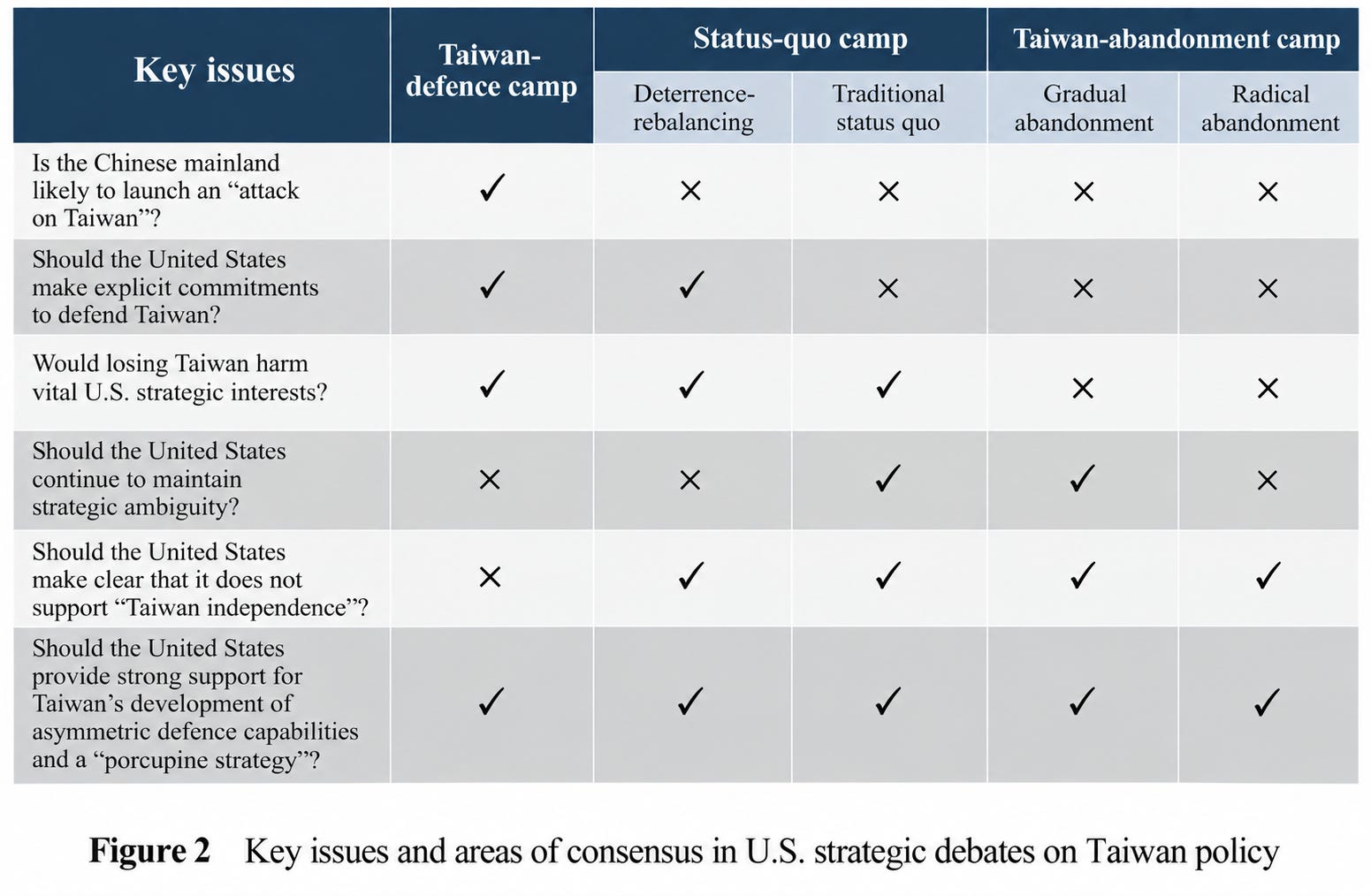
The debate has thus fragmented into five camps. All ultimately seek to safeguard U.S. national interests, but they differ markedly over intermediate objectives and policy instruments, while still sharing common ground on certain issues. The gradual and radical Taiwan-abandonment camps share abandonment as their strategic objective; the Taiwan-defence and deterrence-rebalancing camps both support strategic clarity in the form of an explicit commitment to defend Taiwan; and the deterrence-rebalancing and traditional status-quo camps are both committed to maintaining the status quo.
Overall, consensus within the U.S. strategic community has visibly eroded, and the long-standing core positions of maintaining the status quo, upholding the “one-China policy”, and preserving strategic ambiguity no longer command the broad support they once did. As support for these positions has weakened, the so-called minimum consensus has been repeatedly narrowed, until little remains beyond support for strengthening Taiwan’s asymmetric defence capabilities and pursuing a porcupine strategy. The division of camps and disintegration of consensus pose a new challenge to the coherence of U.S. Taiwan policy.
III. How Do Policy Debates Influence U.S. Taiwan Policy? An Explanation Based on “Strategic Consensus”
How debates within the U.S. strategic community over Taiwan policy shape U.S. government policy remains a question that warrants further investigation. As a regular feature of the U.S. political system, policy debate helps shape the broader environment in which government decisions are made. Following the logic of “policy debate➔strategic consensus➔decision-making constraints,” and taking into account the Biden administration’s repeated attempts to clarify strategic ambiguity, this section seeks to explain both the phenomenon itself and the mechanism through which it operates.
(1) A Preliminary Exploration of How “Strategic Consensus” Influences Decision-Making
As a relatively autonomous and intellectually diverse expert community, the U.S. strategic community plays an important role in shaping government policy, particularly in complex and highly specialised areas such as Taiwan policy. Its members can influence policy through several channels. Through the “revolving door,” they may move between expert and government positions, bringing their policy views directly into the decision-making process. They can also shape government policy through journal articles, reports, media commentary, and testimony before Congress.
Policy debates within the U.S. strategic community typically generate a wide range of strategic perspectives and policy proposals. Together, these views continually reshape the community’s dynamic “strategic consensus,” which generally reflects changes in how it perceives external threats and weighs competing interests.
Robert Sutter, a veteran specialist who worked for many years at the Congressional Research Service, has offered a preliminary explanation of U.S. policy debates over the Taiwan Strait: “The domestic debate/domestic interests have sometimes been a ‘driver’ of the direction of U.S. policy towards mainland China/Taiwan. More often, they have been a ‘brake’ slowing the momentum of U.S. policy.” Policy debate both reflects changes in official Taiwan policy and, in turn, can help bring about policy adjustments to varying degrees.
By the same logic, strategic consensus plays a key role in shaping the decision-making environment for U.S. policy towards Taiwan, while debates within the U.S. strategic community influence government decisions by continually reshaping that consensus. When strategic consensus is relatively stable and broad, government decision-making tends to favour continuity and leaves less room for policy change. When that consensus becomes significantly divided or weakened, the government may become more inclined to adjust policy, particularly amid rapid and major changes in the external environment.
More specifically, strategic consensus within the U.S. strategic community on Taiwan policy has two main components. The first is the community’s overall “minimum consensus” — the “greatest common denominator” shared by all camps and factions on Taiwan Strait issues. The second is the “mainstream consensus” upheld by the dominant status-quo camp, grounded in the “one-China policy” and aimed at maintaining the status quo.
(2) The “Mainstream Consensus” on Taiwan Policy within the U.S. Strategic Community
Since the 1970s, successive U.S. administrations have consistently adhered to the so-called “one-China policy” in handling the Taiwan question and have treated preservation of the status quo in the Taiwan Strait as their principal objective. Within this framework, strategic ambiguity has served as the principal means of maintaining that status quo. By deliberately leaving unclear whether the United States would intervene militarily in the event of a mainland “attack” on Taiwan, the policy seeks to achieve dual deterrence: deterring the Chinese mainland from changing the status quo by force while also deterring pro-“Taiwan independence” forces on the island from taking reckless steps that could disrupt it.10
When viewed as a means of maintaining balance, the logic of strategic ambiguity can be traced back to before the adoption of the “one-China policy”. As early as 1950, Livingston T. Merchant, then Deputy Assistant Secretary of State for Far Eastern Affairs, articulated this balancing logic of U.S. Taiwan policy in a memorandum to Dean Rusk, then Assistant Secretary of State for Far Eastern Affairs. He noted that U.S. policy should seek both “to deny Formosa to the Communists and to continue recognition to the Nationalists”, which required diplomatic and economic aid to Taiwan as well as assistance for their operations against the mainland. At the same time, Washington should avoid “actions which will deflect on ourselves the righteous wrath of the Chinese people”. Merchant stressed that “it is out of the question that we should pursue one or the other policy to its logical extremity”.11
Strategic ambiguity thus embodied the United States’ effort to balance competing considerations in the Taiwan Strait and also reflected the complexity of domestic political bargaining. The strategy was both a product of the U.S. government’s efforts to balance domestic and international interests and an equilibrium point in the interaction between the executive branch and Congress. It also reflected a broad preference that had long prevailed within the U.S. strategic community.
Since the 1980s, debate over U.S. Taiwan policy has generally been structured around a dominant status-quo camp in the centre, with the Taiwan-abandonment and Taiwan-defence camps at the margins. The “one-China policy” and strategic ambiguity, as the mainstream consensus upheld by the status-quo camp, have constituted the principal source of legitimacy for U.S. Taiwan policy.
The U.S. “one-China policy” is not a fixed or immutable position, but rather a dynamic framework that has been continuously adjusted over time. The policy took shape during the normalisation of China–U.S. relations in the 1970s. The 1972 Shanghai Communiqué laid the initial foundation for the U.S. “one-China policy”. It stated explicitly: “The United States acknowledges that all Chinese on either side of the Taiwan Strait maintain there is but one China and that Taiwan is a part of China. The United States Government does not challenge that position.”
The Shanghai Communiqué was the product of an effort by China and the United States to seek common ground while reserving differences under the particular historical circumstances of the time, and it helped set the direction for the further development of bilateral relations. At that stage, the U.S. “one-China policy” rested on the formulation contained in the Shanghai Communiqué. It carried forward Washington’s preference for ambiguity and introduced a degree of ambiguity into the one-China principle itself. In particular, the terms “acknowledges” and “does not challenge” left clear room for interpretation. Richard C. Bush has described the U.S. formulation as “simultaneously artful, subtle, misleading, and somewhat confused.”12
As China–U.S. relations continued to improve, the two sides subsequently signed the Joint Communiqué on the Establishment of Diplomatic Relations and the August 17 Communiqué. Although the two communiqués addressed different issues, the United States preserved a degree of ambiguity in both. The Taiwan Relations Act, enacted amid disagreements between the executive branch and Congress and pressure from “pro-Taiwan forces” in the United States, further widened the scope for ambiguity within the U.S. “one-China policy”. It is also frequently regarded as the legal “cornerstone” of U.S. security commitments to Taiwan.
The Six Assurances given to Taiwan by the Reagan administration in 1982 were also gradually codified through continued efforts by the executive branch and Congress, and during Trump’s first term they were formally incorporated into the U.S. government’s “one-China policy” framework. By this point, the so-called U.S. “one-China policy” had evolved into a framework based on the three communiqués, the Taiwan Relations Act, and the Six Assurances. In the process, it increasingly departed from the one-China principle and from the policy’s original intent. As the scope for ambiguity continued to expand, the framework’s internal contradictions became increasingly pronounced.
Nevertheless, these adjustments broadly reflected changing views within the U.S. strategic community. Since 2014, as the view that the policy of engagement with China had failed gained ground, the strategic community’s consensus on China has shifted. In debates over Taiwan policy, the traditional status-quo camp has likewise placed growing emphasis on deterring China and playing the Taiwan card. This shift in mainstream consensus has been an important force driving the evolution of the U.S. “one-China policy”.
(3) Fragmentation of Consensus and Policy Response: The Biden Administration’s “Clarification” of Strategic Ambiguity
In their 2020 article, Richard Haass and David Sacks argued that the United States should move towards strategic clarity by making an explicit commitment to defend Taiwan. Their position created a split within the status-quo camp, which had long occupied the dominant position in the U.S. strategic community’s debate over Taiwan policy.
At the end of 2021, after U.S. President Joe Biden had already made several statements that appeared to move towards greater strategic clarity, Haass and Sacks published another article in Foreign Affairs. They criticised Biden administration officials for repeatedly “walking back” the president’s remarks and argued that the era of strategic ambiguity had run its course. While continuing to support the “one-China policy”, they maintained that the United States should move promptly towards strategic clarity and that only such a shift could help maintain the status quo.
It is worth noting that in a 2019 article, Haass had still affirmed the value of strategic ambiguity in preserving the status quo, writing: “The status quo is admittedly imperfect, but it is far less imperfect than what would follow unilateral actions and attempts to resolve a situation that doesn’t lend itself to a neat solution.”[^30] Given the prominence of Haass and Sacks within the U.S. strategic community, their change of position attracted widespread attention.
Their proposal also won broad support, including from the Taiwan-defence camp, particularly against the backdrop of growing calls in the United States for a stronger commitment to Taiwan. Retired Admiral James Stavridis argued that persisting with an ineffective policy of strategic ambiguity would lead to a miscalculation across the Taiwan Strait and set off a larger conflict. Veteran diplomats Eric Edelman, a former U.S. ambassador to Finland and Turkey, and Frank Miller argued that Washington’s policy of strategic ambiguity towards the Taiwan Strait is played out and that a shift towards strategic clarity would be consistent with the Taiwan Relations Act. Michael Waltz, then a member of the House of Representatives, and Matthew Kroenig, Vice President of the Atlantic Council’s Scowcroft Center for Strategy and Security, criticised the Biden administration for inconsistent signalling on Taiwan as it moved towards strategic clarity.
As the mainstream consensus within the U.S. strategic community fragmented, the Biden administration also showed clear signs of policy response.
First, Biden made statements of greater strategic clarity on at least five public occasions during his term in office. The first came in August 2021, when he was interviewed by ABC News. Asked whether the U.S. withdrawal from Afghanistan had implications for Taiwan, Biden invoked Article 5 of the North Atlantic Treaty to explain U.S. defence responsibilities towards Japan, South Korea, and Taiwan. The second came in October 2021, when Biden was asked whether “the United States would come to Taiwan's defence if China attacked”. He answered affirmatively.
The third came during Biden’s visit to Japan in May 2022, when he again said at a press conference that the United States would be willing to get involved militarily to defend Taiwan, providing greater support than it had provided Ukraine. The fourth came in September 2022, when Biden told CBS’s 60 Minutes that U.S. forces would defend Taiwan in the event of an “unprecedented attack”. This was also his clearest and most explicit statement on the issue.
The fifth came in June 2024, when Biden told TIME that whether the United States would use force to defend Taiwan would depend on the circumstances, including if China unilaterally tries to change the status quo. Compared with his earlier remarks, this formulation was more qualified, largely because the inauguration of Lai Ching-te, who has maintained a hard-line pro-independence position, posed a serious challenge to the U.S. objective of maintaining the status quo, prompting the U.S. government to adjust its position to some extent.
Second, each of Biden’s statements of strategic clarity was subsequently clarified or “walked back” by administration officials. After Biden’s first such statement in August 2021, a senior administration official said that U.S. “policy with regard to Taiwan has not changed.” National Security Advisor Jake Sullivan later noted that “when it comes to Taiwan, it is a fundamentally different question in a different context.” Following Biden’s public remarks during his May 2022 visit to Japan, a White House official reiterated the long-standing one-China policy and the U.S. commitment to peace and stability across the Taiwan Strait. Kurt M. Campbell, then serving as the National Security Council’s Coordinator for Indo-Pacific Affairs and later Deputy Secretary of State, also opposed a shift towards strategic clarity, arguing that changing the United States’ long-standing Taiwan policy would have “significant downsides”. Nicholas Burns, then U.S. Ambassador to China, likewise stated at a congressional hearing that the United States would be more effective in staying with the one China policy of the last four decades and that the U.S. government remained committed to strategic ambiguity.[^41]
Overall, Biden’s repeated moves towards strategic clarity, followed by official “walk-backs”, ultimately produced an effect resembling strategic ambiguity. In practical terms, this did not mean that the U.S. government had shifted to strategic clarity. Rather, it represented a tactical adjustment within the established framework of strategic ambiguity, accompanied by repeated attempts to test the boundaries of greater clarity.
As a conventional establishment administration, the Biden administration was more responsive to the mainstream consensus within the U.S. strategic community. The growing divisions among different camps and the fragmentation of that consensus also helped shape its Taiwan policy. While the deterrence-rebalancing camp, which supported strategic clarity, gained ground rapidly, most members of the status-quo camp continued to favour strategic ambiguity. Together, the status-quo camp and the emerging gradual Taiwan-abandonment camp pushed back against the deterrence-rebalancing camp, limiting the Biden administration’s room for policy change.
In an expert survey conducted by Foreign Affairs at the end of 2022 on the question “Should the United States Pledge to Defend Taiwan?”, 39 respondents disagreed with such a pledge, while only eight agreed. A number of prominent Democratic scholars, including Ben Rhodes and Ryan Hass, also opposed a shift towards strategic clarity. Bonny Lin argued in congressional testimony that there are likely only marginal gains to be had from clarifying the U.S. defence commitment to Taiwan, while potentially strengthening China’s incentives to strike first against the United States or its coalition partners in a Taiwan contingency.
The Biden administration’s repeated experiments with the “clarification” of strategic ambiguity reflected continuing divisions within the U.S. strategic community. The mainstream consensus that had long underpinned U.S. Taiwan policy had become increasingly fragmented, while debate among the major camps had yet to produce a clear alternative. Against this backdrop of fragmented strategic consensus, the Biden administration’s approach can also be understood as a pragmatic way of balancing competing domestic positions.
Since 2021, both the U.S. government and the strategic community have been deeply affected by the withdrawal from Afghanistan and the Russia–Ukraine conflict, prompting serious concern over the erosion of U.S. global deterrence. The “Ukraine-ization” of the Taiwan question has become a mainstream strand of strategic thinking.13 In the Biden administration’s global strategy, the narrative of “democracy versus autocracy”, efforts to revitalise the global alliance system, and the goal of restoring U.S. leadership have led to an unlimited inflation of Taiwan’s strategic value to the United States. Against the broader backdrop of strategic competition with China, the unrestrained playing of the Taiwan card has also become an important feature of U.S. policy.
In practice, however, U.S. strategic capabilities no longer allow Washington to pursue everything at once. The Biden administration’s Taiwan policy has deepened the United States’ strategic dilemma in the Strait and heightened the risk of tensions there. The view that Taiwan has become a “negative asset” for the United States has gradually gained ground, further fuelling a new round of debate over U.S. Taiwan policy.
IV. Taiwan Policy in Trump’s Second Term amid the New Landscape of Policy Debate
In the Trump 2.0 era, debate within the U.S. strategic community over Taiwan policy has entered a new phase. On the one hand, the Taiwan-defence camp and the deterrence-rebalancing camp within the status-quo camp have lost momentum, while the mainstream consensus favouring a return to strategic ambiguity has regained ground. On the other hand, arguments for abandoning Taiwan have gained significant traction within the U.S. strategic community. The strategic retrenchment and foreign-policy restraint advocated by the New Right have provided important intellectual support for this resurgence of the Taiwan-abandonment argument, while Trump’s return has further created favourable conditions for the growth of the gradual Taiwan-abandonment camp.
First, the Trump administration’s preference for avoiding war, together with the revival of the mainstream consensus within the U.S. strategic community, is pushing U.S. Taiwan policy back towards traditional strategic ambiguity. The Trump administration seeks to preserve regional stability while extracting commercial benefits through transactional bargaining. The new National Security Strategy highlights Taiwan’s importance to the global semiconductor industry and its geographic value along the first island chain, but ultimately places greater emphasis on protecting U.S. economic interests in the region. For Trump, Taiwan’s strategic value is far outweighed by that of the Chinese mainland. As John Bolton recalled in his White House memoir, Trump often compared Taiwan to the tip of a Sharpie pen and China to the Resolute Desk in the Oval Office.14
During his second term, Trump has treated Taiwan as both a bargaining chip in his broader dealings with China and a means of preserving the stability and predictability of those dealings. This reflects a clear tendency to use the Taiwan card in reverse. In public statements, Trump has referred openly to Taiwan on at least four occasions since returning to office, maintaining a posture of strategic ambiguity.
The first came after the China–U.S. economic and trade teams held talks in Geneva in May 2025. At a White House press conference, Trump said: “They've agreed to open China, fully open China, and I think it's going to be fantastic for China, I think it's going to be fantastic for us, and I think it's going to be great for unification and peace.”
The second came in August 2025, when Trump said in an interview with Fox News that Xi Jinping had told him: “I will never do it as long as you’re president.”
The third came on 20 October 2025, when Trump was asked about the possibility of the Chinese mainland “attacking” Taiwan and replied: “I think we’ll be just fine with China. China doesn’t want to do that.”
The most recent came in a January 2026 interview with The New York Times, in which Trump said, “He [Xi Jinping] considers it to be a part of China, and that's up to him what he's going to be doing. In practice, Trump has also appeared to prioritise the broader prospects for China–U.S. negotiations, including by declining to approve a planned U.S. transit by Lai Ching-te and by cancelling a planned meeting between U.S. and Taiwan defence officials.
Viewed through the lens of policy debate and strategic consensus, Washington’s emerging gradual Taiwan-abandonment camp has reached a temporary consensus with the traditional status-quo camp on strategic ambiguity. This convergence has become an important force in reconsolidating the mainstream consensus and has provided necessary support for the Trump administration’s continued adherence to strategic ambiguity. Some strategic analysts have already expressed approval of the restraint in the Trump administration’s Taiwan policy.
It should be emphasised, however, that this return does not reflect a deeper recognition by Trump of the complexity of the Taiwan question or of the need for the United States to return to strategic ambiguity. Rather, strategic ambiguity better serves his preference for stable transactional bargaining with China while allowing the United States to distance itself from regional risks. If China–U.S. economic and trade negotiations run into difficulties in the future, Trump may once again turn to the Taiwan card.
Second, the Trump administration is reinforcing the minimum consensus within the U.S. strategic community that Taiwan’s defence capabilities should be strengthened. Across the contemporary U.S. strategic spectrum, from the Taiwan-defence camp to the radical Taiwan-abandonment camp, there is broad support for Taiwan devoting greater resources to its own defence and developing asymmetric capabilities and a porcupine strategy.
The Taiwan-defence camp sees U.S.–Taiwan defence cooperation as a means of demonstrating and reinforcing the U.S. commitment to Taiwan. The Taiwan-abandonment camp, by contrast, regards stronger Taiwanese self-defence capabilities as a prerequisite for an eventual U.S. withdrawal. Even Charles L. Glaser, a leading advocate of Taiwan abandonment, has argued that the United States should explicitly end its commitment to use force to defend Taiwan, while continuing to help Taiwan defend itself through arms and training and supporting a full shift towards a porcupine strategy.
Strategic consensus affects decision-making in two ways: the mainstream consensus constrains government policy, while the minimum consensus exerts strong pressure for government action. The minimum consensus to strengthen Taiwan’s defence capabilities is therefore likely to remain one of the more certain directions of the Trump administration’s Taiwan policy, including expanded arms sales to Taiwan.
Trump’s own pursuit of greater arms sales for profit further reinforces this tendency. Taken together, these two factors helped drive the U.S. government’s approval in December 2025 of an arms-sales package to Taiwan worth about US$11.1 billion, including HIMARS rocket systems, Javelin, and TOW anti-tank missiles. The package demonstrated a clear U.S. intention to reshape Taiwan’s asymmetric defence system.
Third, the Trump administration is pursuing a strategy of maximum extraction and de-risking towards Taiwan, seeking to make Taiwan serve U.S. interests across the board. Trump’s foreign policy is centred on “Making America Great Again”. In practice, this means promoting U.S. global strategic retrenchment by shedding external commitments while using maximum pressure to force allies and partners to shoulder greater burdens.
This strategy of maximum extraction towards Taiwan is reflected mainly in two areas. First, Trump has pressed Taiwan to dramatically hike its defence spending. Elbridge Colby, U.S. Under Secretary of Defence, stated explicitly at a congressional hearing that Taiwan should raise defence spending to around 10 per cent of GDP. Trump has likewise expressed dissatisfaction with Taiwan’s level of defence spending, arguing that Taiwan has failed to shoulder its responsibilities and has instead relied on U.S. protection. The United States is therefore bound to pressure Taiwan to devote itself fully to developing asymmetric defence capabilities.
Second, Trump has demanded that Taiwan substantially reduce its trade surplus with the United States and has sought, through a variety of means, to “hollow out” Taiwan. These measures include pressing Taiwan to expand purchases of U.S. agricultural products, energy, and defence equipment, while sharply increasing U.S.-bound investment by Taiwan’s advanced manufacturing industries. U.S. Commerce Secretary Howard Lutnick has even proposed a “50-50” split in semiconductor production between the United States and Taiwan, in an effort to turn TSMC into a “USSMC” — a United States Semiconductor Manufacturing Company. In the future, this could develop into demands that Taiwan relocate its entire semiconductor supply chain to the United States.
Taken together, Trump 2.0’s Taiwan policy displays clear characteristics of “de-risking”. Specifically, it seeks to reduce the strategic risks to the United States associated with defending Taiwan; eliminate supply-chain risks arising from the excessive concentration of semiconductor manufacturing in Taiwan; reduce risks stemming from the U.S. trade imbalance with Taiwan; and push Australia, Japan, South Korea, and the Philippines into serving as U.S. “frontline pawns” in a Taiwan Strait conflict, thereby shifting the risks of conflict and the associated responsibilities onto U.S. allies.
Fourth, the Trump administration’s Taiwan policy is closely connected to the current resurgence of Taiwan-abandonment arguments. Since 2024, the gradual Taiwan-abandonment camp — which advocates maintaining strategic ambiguity and preserving the status quo for the time being, while ultimately seeking to abandon Taiwan — has continued to grow. Defense Priorities, an organisation closely associated with the New Right, has become an important intellectual source for this line of thinking. Jennifer Kavanagh, a prominent representative of the gradual Taiwan-abandonment camp at the organisation, has repeatedly argued that Taiwan is of limited value to the United States and is not worth the risk of war with the Chinese mainland.
The argument that the United States should decouple its regional interests from Taiwan is, in essence, an effort to prepare for the eventual abandonment of Taiwan and to secure a “soft landing” for U.S. hegemony in the Western Pacific. Lyle Goldstein, director of the Asia Program at Defense Priorities, likewise argued in TIME that “the U.S. must beware of Taiwan’s reckless leader.”
At the same time, the Western liberal mainstream narrative that the Taiwan authorities have long sought to embrace sits uneasily with the political ideas of the New Right and has also drawn aversion from Trump himself. Christian Whiton, a senior adviser during Trump’s first term, published an article accusing the Taiwan authorities of being “beholden to lefty cultural issues, indifferent to U.S. business, unserious about defence and unwilling to close a trade deficit.”
The Trump administration’s policies of “maximum extraction” and “de-risking” partly overlap with the current gradual Taiwan-abandonment argument. More specifically, the gradual Taiwan-abandonment camp has put forward three approaches that align with Trump’s preferences.
First, “transactional Taiwan abandonment”: treating Taiwan as a bargaining chip in dealings with the Chinese mainland in exchange for tangible benefits.
Second, “instrumentalisation of Taiwan abandonment”, an approach that the Trump administration is already putting into practice. It uses the possibility of “abandoning Taiwan” as a tool of “maximum pressure” to force Taiwan to make greater concessions across multiple areas. In particular, it requires Taiwan to commit first to defence self-reliance in exchange for vague and uncertain U.S. support or commitments.
Third, an end-state approach to Taiwan abandonment: assuming that the United States will eventually lose Taiwan, Washington should accelerate the final round of maximum extraction and hollow it out with every possible means before that happens.
Overall, both New Right forces and the Trump administration increasingly see Taiwan as more of a “liability” than an “asset”, while the long-standing bipartisan consensus in support of Taiwan has begun to erode. Although the Trump administration is unlikely to publicly “abandon Taiwan”, its push for “defence self-reliance” and the loss of TSMC could ultimately strip Taiwan of its strategic value to the United States. This policy of “de-risking” is therefore undoubtedly a prelude to eventual U.S. abandonment of Taiwan.

Peng Weixue on Cross-Strait Situation

On 7 August 2026, the 12th Cross-Strait Think Tank Academic Forum, themed “Changing Times and the Future of Cross-Strait Relations,” was held in Wuxi, Jiangsu Province. The forum was jointly hosted by the Institute of Taiwan Studies at the Chinese Academy of Social Sciences (CASS), the
Zhou Wenxing, “美国战略界对台政策辩论及其影响” [Debates in the U.S. Strategic Community over Taiwan Policy and Their Influence], 现代国际关系 [Contemporary International Relations], no. 2 (2022).
Ye Xiaodi, “美国‘弃台论’的理论辨析——兼论特朗普时代美国对台政策可能的走向” [A Theoretical Analysis of the “Taiwan-Abandonment Thesis”], 台湾研究 [Taiwan Studies], no. 3 (2018).
Tao Wenzhao, “近来美国智库关于美对台政策的争论” [Recent U.S. Think-Tank Debates over Taiwan Policy], 现代国际关系 [Contemporary International Relations], no. 2 (2012).
Lin Gang, “‘弃台论’与美国台海政策争论” [The “Taiwan-Abandonment Thesis” and U.S. Taiwan Policy Debates], 台海研究 [Taiwan Strait Studies], no. 2 (2014).
Zhong Houtao, “‘资产’与‘负债’: 美国‘弃台论’思潮的历史演进” [“Asset” and “Liability”: The Historical Evolution of the U.S. “Taiwan-Abandonment” Current], 台湾研究 [Taiwan Studies], no. 5 (2021).
Lin Gang and Zhou Wenxing, “‘弃台论’及其批评者: 美国对台政策中的利益与价值之辩” [The “Taiwan-Abandonment Thesis” and Its Critics], 江苏行政学院学报 [Journal of Jiangsu Administration Institute], no. 4 (2019).
Xin Qiang, “‘战略高危资产’: 权力格局、中美关系与台湾战略角色的嬗变” [A “High-Risk Strategic Asset”], 台湾研究集刊 [Taiwan Research Journal], no. 4 (2020).
Wang Shushen, “美国战略鹰派的台湾政策主张及其影响评析” [U.S. Strategic Hawks’ Taiwan Policy Positions and Their Influence], 台海研究 [Taiwan Strait Studies], no. 4 (2024).
The Biden administration altered the traditional way in which “strategic ambiguity” operated without fully departing from its framework. Officials subsequently walked back Biden’s repeated statements of “clarity”, stressing that U.S. Taiwan policy had not changed. In practice, the overall effect remained one of “strategic ambiguity”.
Richard Bush, “The U.S. Policy of Dual Deterrence,” in Steve Tsang, ed., If China Attacks Taiwan: Military Strategy, Politics and Economics (New York: Routledge, 2006), 35–54.
Dean P. Chen, US Taiwan Policy: The Origins of Strategic Ambiguity (Boulder, CO: FirstForum Press, 2012), 202.
Richard C. Bush, At Cross Purposes: U.S.-Taiwan Relations Since 1942 (New York: M. E. Sharpe, 2004), 128–32.
Zhou Wenxing, “俄乌冲突的余波: 美国对台政策的‘乌克兰化’及其局限” [Aftershocks of the Russia–Ukraine Conflict: The “Ukrainization” of U.S. Taiwan Policy and Its Limits], 台湾研究集刊 [Taiwan Research Journal], no. 3 (2023).
John Bolton, The Room Where It Happened: A White House Memoir (New York: Simon & Schuster, 2020), 313.