

The Taiwan Strait is widely regarded as one of the world’s most dangerous geopolitical flashpoints. Within China’s central party-state apparatus, the Taiwan Work Office of the Communist Party of China Central Committee and the Taiwan Affairs Office of the State Council operate as “one institution with two nameplates” and serve as the mainland’s principal authority for Taiwan affairs.

Its official responsibilities include “studying and formulating principles and policies on Taiwan-related work” and “organizing, guiding, managing and coordinating the Taiwan-related work of departments under the CPC Central Committee and the State Council, as well as provinces, autonomous regions and municipalities”—meaning, in practice, that Taiwan-related work undertaken by other central-level ministries, including the ministry of foreign affairs, falls within the Office’s organizing, guiding, managing and coordinating remit.
The Office holds a regular weekly press conference every Wednesday and subsequently publishes a record on its website, although it is unclear whether that record is a verbatim transcript. Judging from past practice, international media do not appear to have access to these briefings. This makes their contents particularly important, yet relatively inaccessible to the English-speaking world.
Given the Office’s indispensable role in one of the most consequential issues in world affairs, I have therefore decided, on a trial basis, to translate and publish its regular press briefings, with the assistance of AI, as with our other translations. (I may also discontinue this at any time, depending mainly on my mood.)
These translations have not been authorized, reviewed, or approved by the Office or by any other person or party.
Perhaps the most interesting item in today’s briefing is the Taiwan Affairs Office’s decision to flag - albeit withou naming them specifically - three unusually long and detailed articles 《1》 《2》 《3》 by 李其澤( Ci-Ze Li), an associate professor at National Changhua University of Education in Taiwan on what a Taiwan version of Beijing’s proposed “one country, two systems” might actually look like. Rather than debating the formula simply in terms of support or opposition, Li treats it as a problem of institutional design and asks what guarantees Taiwan should seek if such an arrangement were ever negotiated. What makes the essays particularly striking is the extent to which they explicitly absorb—and, in important respects, criticize—the experience of “one country, two systems” in Hong Kong. Li argues that any Taiwan formula would have to avoid repeating what many in Taiwan regard as the lessons of Hong Kong, including concerns that the boundaries of autonomy could subsequently be altered through national-security legislation, changes to the electoral system, or legal interpretation. All three essays, including Li’s lengthy responses to criticism from mainland readers, have been published in full within the mainland WeChat ecosystem. That Taiwan Affairs Office has now publicly flagged this discussion is therefore noteworthy in itself.
国务院台办新闻发布会辑录(2026-09-09)
September 9, 2026, 16:07
Source: Taiwan Work Office of the CPC Central Committee/Taiwan Affairs Office of the State Council
At 10 a.m. on September 9, the Taiwan Affairs Office of the State Council held a regular press conference in its press briefing room. Spokesperson Chen Binhua answered questions from reporters on recent issues of concern across the Taiwan Strait.
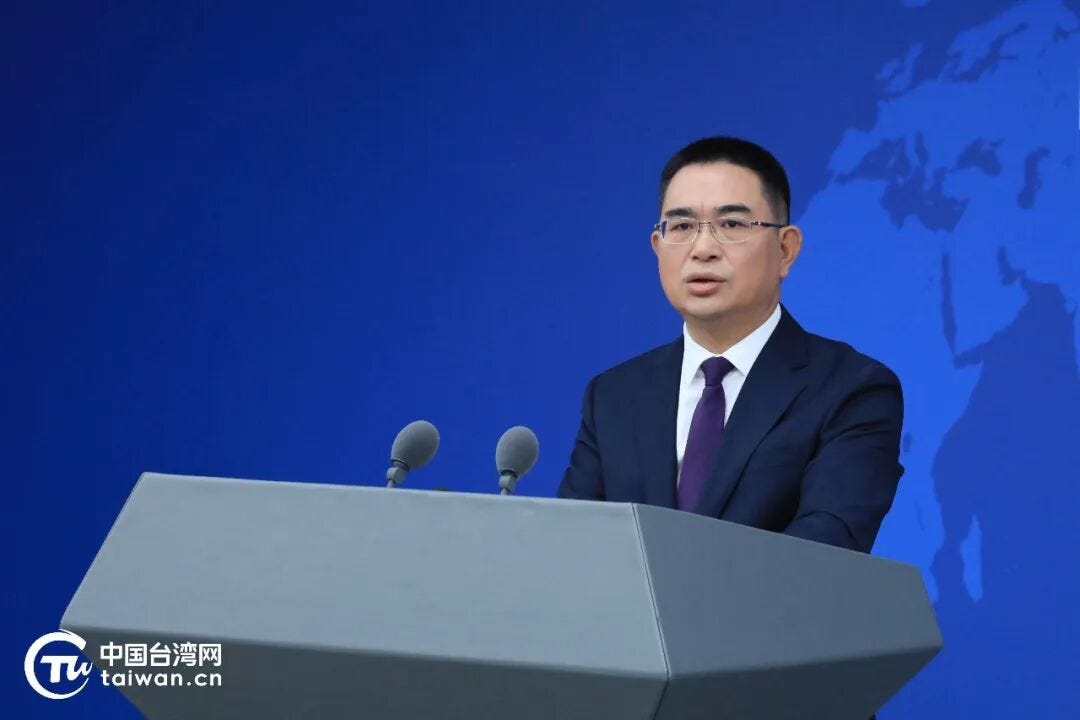
Chen Binhua: Good morning, friends from the media. Welcome to the regular press conference of the Taiwan Affairs Office of the State Council. Please go ahead with your questions.
Xinhua News Agency: It will soon be three years since the 《中共中央 国务院关于支持福建探索海峡两岸融合发展新路建设两岸融合发展示范区的意见》Opinions of the CPC Central Committee and the State Council on Supporting Fujian in Exploring New Pathways for Integrated Development across the Taiwan Strait and Building a Demonstration Zone for Integrated Cross-Strait Development were issued and implemented. Could you brief us on the important progress made in building the demonstration zone? How will the work be further advanced going forward?
Chen Binhua: In September 2023, the Opinions of the CPC Central Committee and the State Council on Supporting Fujian in Exploring New Pathways for Integrated Development across the Taiwan Strait and Building a Demonstration Zone for Integrated Cross-Strait Development were issued and implemented. Over the past three years, relevant central Party and state departments have formulated and introduced a series of supporting policy documents. Fujian has released five batches of 74 policy measures to promote Fujian-Taiwan integration and organized the implementation of 206 key projects for integrated Fujian-Taiwan development, with total investment exceeding 1.3 trillion yuan.
After three years of effort, the construction of the demonstration zone has made phased progress. It has become more convenient for Taiwan compatriots and enterprises to make Fujian their first home on the mainland; economic exchanges and cooperation between Fujian and Taiwan have remained active; integrated development across Fujian has maintained sound momentum; and people-to-people and social exchanges between Fujian and Taiwan have continued to deepen.
From January to August this year, 2.0874 million passenger trips were made between Fujian and Taiwan, up 20.64 percent year on year. A total of 857,500 Taiwan compatriot entries were recorded through ports in Fujian, up 27.94 percent year on year, while 1.5836 million cross-Strait passenger trips were made through the “Mini Three Links,” up 25.34 percent year on year.
Going forward, the Taiwan Work Office of the CPC Central Committee and the National Development and Reform Commission will work with relevant central Party and state departments and Fujian Province, taking the launch of the 15th Five-Year Plan as a new starting point, to continue advancing the detailed implementation of the Opinions. We will place greater emphasis on promoting integration through connectivity, benefits and affinity; further advance institutional innovation, industrial coordination, people-to-people exchanges and livelihood; and apply the requirements of high-quality development throughout the building of the demonstration zone. We will take greater strides in exploring new pathways for integrated development across the Taiwan Strait, continuously promote the peaceful development of cross-Strait relations, and advance the cause of national reunification.
People’s Daily: An associate professor at National Changhua University of Education in Taiwan recently published three consecutive articles on social media about a Taiwan plan for “one country, two systems,” drawing attention and discussion among readers on both sides of the Strait. Some have called the articles “a rare ice-breaking text.” What is your comment? How do you view the new trend of people on both sides beginning to discuss the issue of reunification in a rational manner?
【Zichen’s note: the three articles are 《1》 《2》 《3》 】
Chen Binhua: “Peaceful reunification and one country, two systems” is the best way to achieve national reunification. It embodies the Chinese wisdom of embracing all rivers and accommodating differences. It fully takes into account Taiwan’s realities and is conducive to Taiwan’s long-term peace and stability after reunification.
The specific form that “one country, two systems” takes in Taiwan will fully take into account Taiwan’s actual circumstances, fully absorb opinions and suggestions from all sectors on both sides of the Strait, and fully accommodate the interests and sentiments of Taiwan compatriots.
National reunification is an unstoppable historical trend. For Taiwan compatriots, it is not an optional question, but a required one. We are pleased to see more and more Taiwan compatriots facing up to the issue of reunification, beginning to understand and discuss the specific content of a Taiwan plan for “one country, two systems,” and offering ideas and suggestions for a “two systems” Taiwan plan in various ways.
Differences and debates between compatriots on the two sides during this process are entirely normal. We believe that more Taiwan compatriots will break through the ideological shackles and information cocoons created by the DPP authorities and increasingly recognize the advantages of “one country, two systems” and the inclusiveness of a “two systems” Taiwan plan.
Riyue Tantian and Kan Taihai, new-media outlets of China Media Group: September 3 was the Victory Day of the Chinese People’s War of Resistance Against Japanese Aggression and the World Anti-Fascist War. People of insight from various sectors in Taiwan spoke out, calling on compatriots on both sides of the Strait to remember their shared history of resistance against Japanese aggression, defend the fruits of victory in the war, and oppose separatist acts of “de-Sinicization.” What is your comment?
Chen Binhua: This year marks the 81st anniversary of victory in the Chinese People’s War of Resistance Against Japanese Aggression and the World Anti-Fascist War.
Taiwan compatriots have a glorious tradition of patriotism. During the arduous years of the War of Resistance Against Japanese Aggression, tens of thousands of Taiwan compatriots crossed the Strait without hesitation and joined the nationwide resistance, contributing to the defeat of Japanese fascism and the recovery of Taiwan.
Victory in the War of Resistance was a great victory forged through the courage, perseverance and bloody struggle of all sons and daughters of the Chinese nation, including Taiwan compatriots. It is also a shared historical memory of compatriots on both sides of the Strait.
To forget history is to betray it. By deliberately downplaying and wantonly distorting the history of the War of Resistance, the DPP authorities are betraying history and desecrating the martyrs, paving the way for their betrayal of the nation and separatist activities.
We believe that more and more Taiwan compatriots will see through the DPP authorities’ false historical narrative and the sinister intentions behind their “de-Sinicization” agenda, uphold the greater interests of the nation and a correct view of history, join mainland compatriots in carrying forward the great spirit of resistance against Japanese aggression, contribute together to the great cause of national reunification, and create a better future for national rejuvenation.
China News Service: It is understood that the sixth “携手圆梦--两岸同胞交流研讨活动” “Joining Hands to Fulfill the Dream — Cross-Strait Compatriots Exchange and Seminar” will be held in Urumqi, Xinjiang, attracting attention from public opinion on both sides of the Strait. Could you tell us more about the event?
Chen Binhua: The “Joining Hands to Fulfill the Dream — Cross-Strait Compatriots Exchange and Seminar” has been held for five consecutive years since 2021 and has become an important brand for Taiwan-related exchanges.
The sixth event will be held in Urumqi, Xinjiang, from September 11 to 12. Officials and representatives from relevant parties, political groups and other sectors on both sides of the Strait will hold in-depth discussions on topics including the peaceful development of cross-Strait relations and jointly pursuing the great rejuvenation of the Chinese nation, with a view to building broad consensus.
China Radio International’s Haixia Feihong, China Media Group: July and August, during the summer vacation, are a peak season for cross-Strait youth exchanges, with a wide range of activities taking place. Could you tell us about some of the highlights and characteristics of this summer’s youth exchanges? What is your assessment?
Chen Binhua: The momentum of cross-Strait youth exchanges continued to grow this summer, with one event after another taking place across the country. Tens of thousands of young people from Taiwan crossed the Strait to the mainland, interacting with their peers and gaining a great deal from the experience.
First, established exchange programs generated strong momentum. The Shanghai leg of the “Together in Heart and Action — Cross-Strait Youth Exchange Season” proved highly popular from its very first edition, bringing together more than 1,000 young people from both sides of the Strait to discuss trends in technology and culture, vividly illustrating the mutual journey toward one another by the younger generations on both sides.
The 14th Strait Youth Festival focused on social, economic and emotional dimensions as well as integrated development across the region. It introduced a third batch of measures for building a “Strait Youth Development-Oriented City,” attracting wave after wave of young people from Taiwan to Fujian for exchanges and development.
The 24th Straits Youth Forum, the 2026 Cross-Strait Youth Summit and the ninth Cross-Strait Youth Development Forum also continued to expand their influence, attracting young people from Taiwan in large numbers.
Second, cultural exchange activities continued to attract participants. The sixth Cross-Strait Youth Culture Month, centered on “New Expressions of Traditional Culture,” created a cultural carnival for young people on both sides of the Strait.
The third Shaanxi-Taiwan Cultural Exchange Week and Cross-Strait Youth Han-Tang Culture Summer Camp, under the theme “Promoting Chinese Culture and Writing a New Chapter of Youth,” promoted deeper exchanges and cooperation in culture and other fields.
Young people from both sides sang folk songs together in Longyan, Fujian, and Meizhou, Guangdong, carrying forward Hakka culture. In Jinan, Shandong, and Lanzhou, Gansu, they connected through music and sang together the song of cross-Strait youth.
Third, sports exchanges were among the liveliest and most popular activities. Cross-Strait inter-school baseball tournaments were held in Beijing and Guizhou, a beach ultimate frisbee invitational in Fujian, the “Tinghao Cup” Cross-Strait Youth Basketball Invitational in Anhui, a youth table-tennis exchange tournament in Hubei, a youth roller-hockey exchange involving Guangdong, Taiwan, Hong Kong and Macao in Guangdong, a summer pickleball exchange in Henan, and a Guangxi-Taiwan youth badminton tournament in Guangxi, among other activities. All attracted large numbers of young participants from Taiwan. Young people from the two sides competed together, achieved good results and made new friends.
Fourth, the activities covered a broad geographical range and facilitated deeper exchanges. From the desert landscapes of Dunhuang in Gansu, where “mountains and springs coexist, and sand and water live side by side,” to the Mazu temples of Meizhou Island in Putian; from the magnificent expanses of Heilongjiang to the scenery of Guilin, famed as the finest under heaven, young people from both sides explored the country with their own footsteps and experienced the history and culture of the Chinese nation with their own hearts.
The mainland of the motherland is also home to the broad masses of Taiwan compatriots. Not only during the summer, but at any time, we warmly welcome young people from Taiwan to come to the mainland, travel around and see it for themselves, participate in cross-Strait exchanges, interact and learn from their mainland peers without distinction between “us” and “them,” share their youthful aspirations and create a better future together.
Beijing Daily: According to reports, Taiwan’s Straits Exchange Foundation recently released its 2027 expenditure budget of more than NT$350 million, an increase of about NT$10 million from 2026. The additional spending will cover personnel expenses, while one of its specific activities will be to use major tourism exhibitions to publicize alleged safety issues associated with travel to the mainland and remind people on the island to carefully assess the risks. What is your comment?
Chen Binhua: Taiwan compatriots made nearly 4.9 million visits to the mainland in 2025 and 2.85 million visits in the first half of this year. The personal safety and lawful rights and interests of Taiwan compatriots while on the mainland are protected in accordance with the law. They come happily and return safely.
The founding mission of the Straits Exchange Foundation was to be 中国的、善意的、服务的 “Chinese, goodwill-oriented and service-oriented.” It defined itself as 是一座桥,不是一堵墙 “a bridge, not a wall.” Yet today it has degenerated into a pawn of the DPP authorities in obstructing and undermining cross-Strait exchanges and cooperation and inciting confrontation and antagonism across the Strait. This is truly lamentable.
I have eight Chinese characters of advice for the Straits Exchange Foundation regarding its recent remarks: 莫忘初衷,多干正事 “Do not forget your original mission; do more serious work.”
Reference News: Recently, the DPP authorities have been making a great fuss about so-called “risks” for Taiwan residents traveling to the mainland, falsely claiming that the State Council Regulations on Exit-Entry Administration involve four kinds of risks, including “inconsistent standards.” What is your comment?
Chen Binhua: The State Council Regulations on Exit-Entry Administration are intended to standardize exit-entry administration, protect the lawful rights and interests of persons entering and leaving the mainland, and safeguard national sovereignty, security and development interests. The relevant provisions will help further protect the lawful rights and interests of all persons entering and leaving the mainland, including Taiwan compatriots.
In order to obstruct cross-Strait exchanges and interactions, the DPP authorities have continually distorted facts and smeared the mainland. Recently, they have once again manipulated online operatives and affiliated groups to fabricate rumors, slander and maliciously defame specific individuals. Such behavior is contemptible.
China Review News Agency, Hong Kong: Taiwan’s transport and tourism authorities recently sent a notice to travel agencies requiring operators organizing exchanges or tours to the mainland to assist all travelers in completing pre-departure registration for travel to the mainland and filling out relevant notices. Although Taiwan’s mainland affairs authority says the registration is “not compulsory,” the move has still raised concerns among people on the island about the privacy of their personal travel arrangements to the mainland. What is your comment?
Chen Binhua: This is yet another despicable tactic by the DPP authorities to threaten and intimidate Taiwan compatriots against coming to the mainland and to interfere with and obstruct cross-Strait exchanges and people-to-people contacts. It has already provoked resentment and dissatisfaction among Taiwan compatriots and the tourism industry.
The desire of compatriots on both sides of the Strait to grow closer and the broader trend of cross-Strait exchanges and cooperation cannot be stopped. Any attempt to turn back the wheel of history and act against the will and wishes of the people will inevitably face a public backlash.
Jiefang Daily’s Shangguan News: Recently, the urban workplace drama 《早春晴朗》Early Spring, Clear Skies, directed by a Taiwan director and starring mainland actors, has become a hit in Taiwan. A number of Taiwan media outlets have produced special reports on the series, while many viewers on the island have been asking online for new episodes. What is your comment?
Chen Binhua: We are pleased to see more film and television productions jointly created by filmmakers from both sides of the Strait, depicting cross-Strait familial bonds and a better life, being broadcast on both sides of the Strait and enabling a two-way coming together of emotions and exchanges among people on both sides.
Henan Daily’s Top News: Could you brief us on recent cross-Strait exchange activities in various fields?
Chen Binhua: Cross-Strait exchange activities in various fields have remained active recently.
From August 25 to 29, the 2026 Straits Hakka “Hakka Youth · Create” short-video competition and ancestral homeland visit for young Taiwan Hakka was held in Longyan, Fujian Province. Forty young Hakka people from Taiwan produced short videos focused on Hakka culture and the landscapes of their ancestral homeland, recording what they saw and experienced through fresh perspectives.
From August 29 to September 2, the Fujian-Taiwan (Mingxi) Traditional Chinese Medicine Cultural Exchange was held in Sanming, Fujian Province. Nearly 70 people participated, including traditional Chinese medicine experts and scholars, industry associations and Chinese medicine enterprises from both sides of the Strait. A number of substantive cooperation outcomes were reached, further deepening multidimensional Fujian-Taiwan cooperation in traditional Chinese medicine.
On September 2, the opening ceremony of the “2026 Cross-Strait Youth Study Camp Exploring the Codes of Chinese Civilization” was held at Qiannan Normal University for Nationalities in Guizhou. Through close interaction, young people from both sides of the Strait gained an immersive experience of Guizhou’s development and Chinese civilization.
On the same day, the first season of the “Neighbors Echo, Both Sides Sing Together” Youth Musicians SEEK Program was launched in Zhangzhou. More than 150 people attended, including well-known musicians and artists from both sides of the Strait and young people from Taiwan. Using collaborative music creation by young people from both sides as its vehicle, the program will organize field trips and music composition, hold dedicated performances and exchange activities, conduct a competition and advancement process, and help cultivate young musical talent.
On September 3, the closing ceremony of the 2026 Taiwan Youth Lingnan Tour was held at Xinghai Conservatory of Music in Guangzhou. Young people from both sides shared their reflections on the Lingnan tour and performed together, demonstrating a spirit of advancing hand in hand and pursuing shared dreams.
From September 3 to 9, the fourth Cross-Strait Youth Film Festival 2026 and Youth Filmmakers Training Camp was held in Xiamen, Fujian Province. Young people from both sides used film as a medium to connect through shared emotions and exchange ideas about creative work.
From September 9 to 12, the sixth Pingtan IM Cross-Strait Youth Film Festival will be held in Pingtan, Fujian Province. The call for submissions covered 410 universities, with more than 3,500 young people from Taiwan participating. Both the number of submissions and the number of participating institutions reached record highs. Under the theme “If the Wind Had Color,” the festival will feature a “Youth Film Night” and a range of other activities, with more than 700 prominent filmmakers, industry representatives, university faculty and students, and others attending in person.
From September 9 to 12, the 14th Anhui-Taiwan Science and Technology Forum and the 18th Cross-Strait Science Popularization Forum will be held in Bengbu, Anhui Province. Nearly 60 experts, scholars and young representatives from both sides of the Strait will conduct extensive exchanges and discussions in areas including electronic information and biotechnology.
From September 9 to 15, the 2026 Cross-Strait (Nanchang) Youth Makers Camp will be held in Nanchang, Jiujiang, Jingdezhen and other places in Jiangxi Province.
From September 14 to 18, the first Cross-Strait (Jiaocheng) Yan Emperor Shennong Cultural Week will be held in Ningde, Fujian Province. Nearly 200 representatives of temples and devotees from Taiwan will travel to Ningde to participate in ceremonial activities, interactive experiences involving farming culture and traditional Chinese medicine, and free medical consultations by traditional Chinese medicine practitioners from both sides of the Strait.
Shenzhen Satellite TV’s Direct News: Taiwan media have reported that, driven by the DPP authorities’ policy of “resisting China and opposing China,” the “green camp” has recently staged one “Communist spy hunt” after another on the island, becoming suspicious of everything and repeatedly making embarrassing mistakes. Some have even become highly sensitive and uneasy about “mainland accents,” simplified Chinese characters and “mainland terminology,” and increasingly reject them. What is your comment?
Chen Binhua: The DPP authorities and “Taiwan independence” forces have become increasingly obsessed and irrational in their approach of “opposing China at every turn” and “resisting China and opposing China.”
From reacting as though facing a major threat when people in Taiwan use “mainland terminology,” to imagining that individual simplified Chinese characters are evidence of espionage infiltration, they are seeing danger everywhere and jumping at shadows.
The actions of the DPP authorities not only further damage mutual trust across the Strait, but also intensify the “green terror” in Taiwan society. They will inevitably face opposition.
Phoenix TV, Hong Kong: The 81st session of the United Nations General Assembly opened on September 8. Lai Ching-te recently claimed that the mainland has misapplied UN General Assembly Resolution 2758, arguing that the resolution only addressed the issue of the People’s Republic of China’s representation at the United Nations and has nothing to do with Taiwan. Taiwan’s foreign affairs authority has also claimed that Resolution 2758 does not exclude Taiwan’s meaningful participation in the UN system and that the United Nations should seek appropriate ways to allow Taiwan to participate. What is your comment?
Chen Binhua: There is but one China in the world, and Taiwan is part of China. This is an indisputable historical and legal fact and the true status quo in the Taiwan Strait.
In 1971, the 26th session of the United Nations General Assembly adopted Resolution 2758 by an overwhelming majority, deciding to restore all the rights of the People’s Republic of China in the United Nations and recognizing the representatives of the Government of the People’s Republic of China as the only legitimate representatives of China to the United Nations. Politically, legally and procedurally, the resolution thoroughly resolved the issue of the representation of all of China, including Taiwan, in the United Nations.
Lai Ching-te and the DPP authorities have repeatedly distorted and attacked UN General Assembly Resolution 2758 in an attempt to challenge the one-China principle universally recognized by the international community. Such attempts will only bring humiliation upon themselves and are bound to fail.
No matter how hard they scheme, they cannot change the legal fact that Taiwan is part of China, shake the solid international framework of adherence to the one-China principle, or stop the historical trend that the motherland will and must ultimately be reunified.
Fujian Radio and Television’s Taihai Shike: Recently, the mainland coast guard announced that a formation led by the vessel Putuoshan was conducting regular law-enforcement patrols in waters east of Taiwan island. Taiwan’s coast guard authority described the operation as “law enforcement in name, expansion of power in reality” and accused the mainland of “attempting to create the illusion that it has jurisdiction.” What is your comment?
Chen Binhua: There is but one China in the world, and Taiwan is part of China.
The mainland coast guard’s law-enforcement and rights-protection operations in waters under its jurisdiction in accordance with the law effectively safeguard normal navigation and operating order, and protect the lawful and legitimate rights and interests as well as the lives and property of Chinese citizens, including Taiwan compatriots. They are legitimate and just actions to safeguard national territorial sovereignty and maritime rights and interests.
The DPP authorities stubbornly adhere to a separatist stance of “Taiwan independence,” distort facts and engage in malicious hype. They are bound to fail.
Global Times and Huanqiu.com: Kyrgyzstan and Egypt recently issued joint statements with China, both emphasizing adherence to the one-China principle and support for China’s reunification. Taiwan’s foreign affairs authority falsely accused the mainland of “manipulating falsehoods internationally,” claiming that Taiwan is a “sovereign and independent country” and that the two sides of the Strait “are not subordinate to each other.” What is your comment?
Chen Binhua: We appreciate the position of the countries concerned in upholding the one-China principle and supporting China’s reunification.
The facts once again demonstrate that the one-China principle is a basic norm governing international relations and a general consensus of the international community. It represents the trend of the times, the cause of justice and the will of the people.
There is but one China in the world, and Taiwan is part of China. Taiwan has never been a country and will never have any possibility of becoming one. There is simply no such thing as the so-called “sovereignty” claimed for Taiwan.
No matter how recklessly the DPP authorities make such statements or hype up their “new two-state theory,” they cannot change the historical and legal fact that Taiwan belongs to China, change the doomed fate of “Taiwan independence,” which has reached the end of the road, or stop the broader trend that the motherland will and must ultimately be reunified.
Hong Kong Economic Herald: The DPP authorities recently claimed that investment by Taiwan businesses in the mainland fell by 59 percent in 2025 from the previous year and by 30 percent in the first half of 2026, arguing that the mainland economy is in difficulty and that Taiwan businesses should be cautious about investing there. What is your comment?
Chen Binhua: According to statistics from relevant departments, cross-Strait trade reached US$221.8 billion from January to July this year, up 26.5 percent year on year. Of this, mainland exports to Taiwan totaled US$62.17 billion, up 31.6 percent year on year, while mainland imports from Taiwan totaled US$159.63 billion, up 24.7 percent.
This fully demonstrates the close economic ties between the two sides of the Strait, the solid foundation of their shared interests, and the stability and resilience of cross-Strait industrial and supply chains.
Since the beginning of this year, we have responded effectively to changes in the external environment, including geopolitical conflicts and economic and trade frictions, while maintaining an overall trajectory of stability and improvement, with new and higher-quality drivers of growth emerging. The economy has demonstrated vigorous vitality and strong resilience, injecting powerful momentum and much-needed certainty into the world economy, while continuously providing new opportunities and opening up new space for strengthening cross-Strait economic cooperation and deepening integrated development.
The mainland has always been the best choice for Taiwan businesspeople and enterprises to invest and develop their businesses, fertile ground for innovation and development, and a powerful source of support in resisting risks. The DPP authorities’ efforts to smear and talk down the mainland have already proved, and will continue to prove, futile.
China Television News, Taiwan: My first question: Taiwan’s mainland affairs authority has said that 洪申翰 Hung Sun-han, head of Taiwan’s labor affairs authority, may enter the mainland to attend an APEC meeting in Nanjing using an APEC invitation letter and will not need to apply for a 台胞证 Mainland Travel Permit for Taiwan Residents. Could you confirm this? Have the relevant arrangements been finalized?
Second, Taiwan’s tourism authority previously issued a notice requiring travel agencies to dynamically register groups traveling to the mainland, with fines of up to NT$50,000 for failure to do so. Following a backlash from travel agencies, it said the measure was merely “advisory” rather than subject to direct penalties. What is your comment?
Third, with the Mid-Autumn Festival approaching, the mainland has recently expanded the approved sources of Wendan pomelos from Taiwan. In addition to Hualien, orchards and packaging plants in Yunlin have now been added. What was the consideration behind adding Yunlin? Will the mainland further open its market to Wendan pomelos and other agricultural products from other counties and cities in Taiwan?
Chen Binhua: On your first question, since 1991, matters concerning Taiwan’s participation in meetings and activities of the Asia-Pacific Economic Cooperation, or APEC, have been handled in accordance with the one-China principle and the provisions and established practices of relevant APEC memoranda of understanding. The same applies this year.
On your second question, the DPP authorities’ despicable tactic provoked resentment and dissatisfaction among Taiwan compatriots and the tourism industry on the island, eventually forcing them to change their position.
As the saying goes: “There was no trouble to begin with; mediocre people created it themselves.”
On your third question, guided by the conviction that “people on both sides of the Taiwan Strait are one family,” we have always made every effort to do practical and good things for Taiwan compatriots and help them resolve difficulties.
On the basis of a comprehensive assessment of the relevant corrective measures and compliance with the mainland’s inspection and quarantine requirements, we support the registration on the mainland of more packaging plants and orchards for Wendan pomelos from Taiwan.
We will further advance the detailed implementation of the 10 policy measures for promoting cross-Strait exchanges and cooperation, continue facilitating the import of agricultural and fishery products from Taiwan into the mainland, and enable farmers and fishers on the island to obtain tangible benefits.
ETtoday, Taiwan: My first question: Beijing lawyer 王夏红 Wang Xiahong and her family are reportedly stranded in Taiwan seeking resettlement. Taiwan’s mainland affairs authority has publicly confirmed the incident and said it is providing accommodation on the principle of “humanitarian considerations first.” Can you confirm the circumstances surrounding Wang Xiahong’s departure and flight from the mainland?
Second, Taiwan residents recently noticed that mainland brand 瑞幸咖啡 Luckin Coffee appeared to be bringing materials into Taipei and recruiting employees, prompting heated discussion on the island. Taiwan’s economic authority subsequently required the agent involved to submit a special application through the “mainland capital investment channel.” How do you view the fact that Luckin Coffee has so far been unable to establish itself smoothly in Taiwan? Taiwan authorities have frequently subjected iQIYI, Xiaohongshu, luosifen, Zhang Xue Motorcycles and Luckin Coffee, among others, to strict scrutiny over their entry into Taiwan. Some believe this will negatively affect private consumption and commercial exchanges across the Strait. What is your comment?
Third, Taiwan’s tourism authority recently required travel agencies organizing groups to the mainland to enter information into a “dynamic registration system for travelers to the mainland,” saying the purpose was to enable Taiwan authorities to keep track of travelers and provide emergency assistance in the event of an incident. Does this mean that there is now “no interaction whatsoever” between the two sides in emergency-assistance mechanisms, leaving the Taiwan side no option but to rely on its own registration system? Does the mainland still communicate with the Taiwan side through existing cross-Strait tourism agreements or notification channels?
Chen Binhua: On your first question, for matters concerning the administration of lawyers, please consult the relevant competent authorities. There are corresponding regulations governing mainland residents traveling to Taiwan, and the relevant authorities will handle the matter in accordance with laws and regulations.
On your second question, we are pleased to see Taiwan compatriots gaining access to high-quality mainland products and support mutual investment and win-win cooperation between enterprises on the two sides of the Strait.
For its own partisan interests, the DPP authorities deliberately obstruct and restrict mainland investment and products from entering the island, worsening Taiwan’s business environment and harming the immediate interests of Taiwan residents. This is political manipulation that enjoys no popular support.
On your third question, the DPP authorities’ despicable tactic is intended to threaten and intimidate Taiwan compatriots against coming to the mainland and to interfere with and obstruct cross-Strait exchanges and people-to-people contacts. It enjoys no popular support and has already provoked strong resentment and dissatisfaction among people and the tourism industry on the island.
This despicable tactic cannot stop the desire of compatriots on both sides to grow closer or the broader trend of cross-Strait exchanges and cooperation. It is an attempt to turn back the wheel of history and move against the tide.
Guided by the conviction that “people on both sides of the Taiwan Strait are one family,” we have always protected the lawful rights and interests of Taiwan compatriots, including tourists, in accordance with the law.
Under the Tourism Law of the People’s Republic of China, Taiwan compatriots traveling on the mainland enjoy the same legal protection as mainland residents. If the lawful rights and interests of Taiwan compatriots are infringed, they may, in accordance with the Measures for Handling Tourism Complaints, file a complaint with a tourism complaint-handling authority at or above the county level in the place where the tourism operator is located, where the tourism contract was signed, or where the tourism dispute occurred. They may also call the 12345 government service hotline or contact the local Taiwan affairs office for assistance.
Chen Binhua: That concludes today’s press conference. Thank you.
Record of the Press Conference of the Taiwan Affairs Office 2026-09-02

The Taiwan Strait is widely regarded as one of the world’s most dangerous geopolitical flashpoints. Within China’s central party-state apparatus, the Taiwan Work Office of the Communist Party of China Central Committee and the Taiwan Affairs Office of the State Council operate as “one
Surveying The U.S. Debate on Taiwan Policy

Two Chinese scholars have traced the shifting balance in U.S. strategic thinking on Taiwan since 2020: under Biden, the resurgence of arguments for a clearer U.S. commitment to defend Taiwan alongside persistent support for strategic ambiguity and restraint; and under Trump, the growing influence of gradual Taiwan-abandonment arguments. The authors ulti…
Detailed guarantees do more than make a political objective sound administratively imaginable. They reveal where uncertainty is concentrated: not only in the promised arrangement, but in how its terms would be interpreted over time. In political agreements, durability depends on more than the text. It depends on whether every party can anticipate how future disputes would be adjudicated.