

A former doctoral student turned blogger has shaken China’s academic establishment by publicly accusing prominent university scholars of fabricating data and manipulating papers, triggering investigations at several leading institutions and drawing rare attention from state media.
The most visible fallout came at Tongji University, a leading Shanghai university, which removed the dean of its School of Life Science and Technology after finding academic misconduct in a Nature paper the blogger had challenged. Nankai University, Sun Yat-sen University, and Shanghai University have also opened investigations into scholars he questioned.
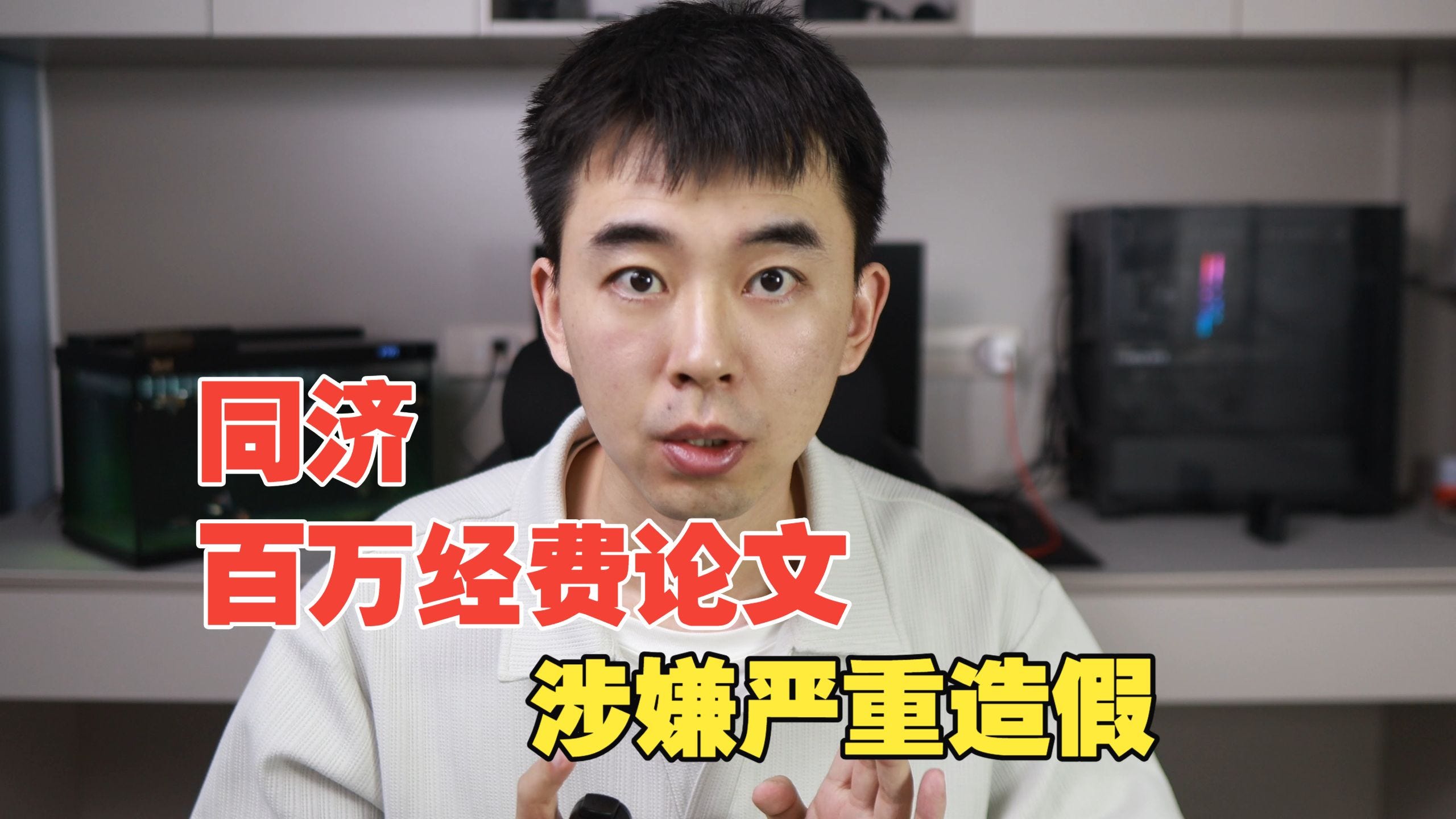
The blogger, known online as “Geng Tongxue Tells Stories,” is a former doctoral candidate at Beihang University in Beijing. He left the programme in 2025, citing growing disillusionment with a publish-or-perish research culture that, as he put it, rewarded flashy papers more than meaningful science.
From April 9 to May 12, Geng publicly questioned papers involving five prominent scholars at four universities. Some of those named hold some of China’s most coveted academic titles, including recipients of the National Science Fund for Distinguished Young Scholars.
The videos quickly spread far beyond academic circles. By 14 May, his Bilibili account had more than 1.8 million followers and about 230 million total views, while his Douyin [China’s equivalent of TikTok] account had 1.34 million followers. What might once have remained a narrow dispute over figures, images, and laboratory data has become a public reckoning over how Chinese academia rewards papers, grants, titles, and institutional prestige.
The controversy has since reached China’s state media, a sign that the issue has moved beyond a handful of disputed papers and is increasingly being treated as a symptom of deeper problems in the academic system. Xinhua News Agency, China’s official news agency, gave Geng a platform, publishing an interview that appeared supportive of his efforts to expose academic misconduct. People’s Daily Online also weighed in, pointing to weaknesses in academic oversight, pressure from rankings, project targets, opaque review procedures, and some institutions’ tendency to protect their own reputations.
In China’s academic system, papers, journal rankings, and grants often decide who wins elite labels such as Distinguished Young Scholar or Cheung Kong Scholar, with election to the Chinese Academy of Sciences or the Chinese Academy of Engineering standing at the top of the hierarchy. Those “talent hats” can then bring larger laboratories, more public funding, greater institutional status, and wider control over academic resources—but often, too, less scrutiny.
The same concern has echoed in the Chinese public debate. One influential expression of that view came from Wang Mingyuan, a researcher at the Beijing Reform and Development Research Association, who published a commentary on 21 May on the WeChat account Fuchengmen No. 6 Courtyard (阜成门六号院). In Wang’s view, once universities are run like factory production lines, academic life is reduced to a bureaucratic ledger of papers, projects, grants, and titles—a system that compacts the soil of academic life and drains it of the nourishment needed for originality.
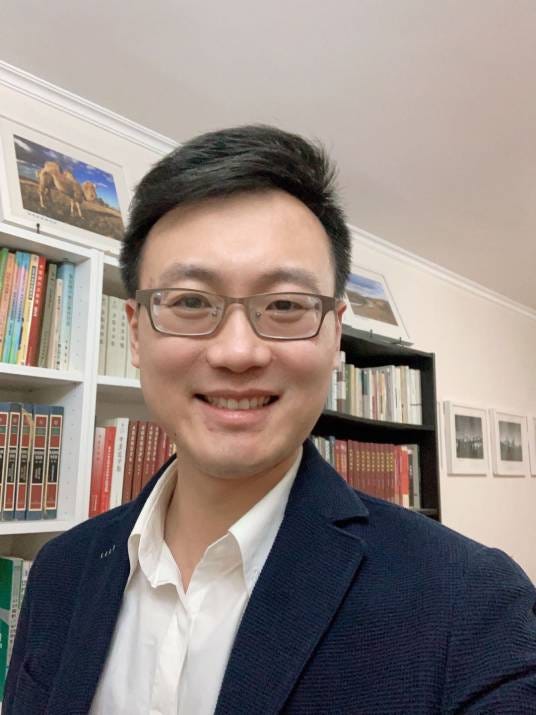
Lastly, an update on Geng Tongxue. In a video released on 27 May, he made fresh allegations of misconduct involving papers by prominent academics, among them Distinguished Young Scholar recipients, university deans, and a candidate for membership in the Chinese Academy of Engineering. He said he had reviewed only about one-tenth of Distinguished Young Scholar recipients and had already found, in his words, a “bumper harvest” of problems. But he also said he would stop reporting alleged misconduct directly to the scholars’ institutions, citing concerns over his family’s safety.
—Yuxuan Jia
中国学术的泡沫化、绩效网格化和板结化
The Publication Bubble, Bureaucratic Metrics, and the Stifling of Chinese Academia
Strip away the thick froth of inflated academic rankings, and a harder truth emerges: despite China’s extraordinary progress over the past two decades, the country still trails the United States by a wide margin in basic research, frontier technologies, and top-tier scientific achievements. In many respects, China remains in the second tier of global science, alongside countries such as Britain, Germany, and Japan.
The greatest value of academic and intellectual work lies in originality, not in the sheer volume of output. By nature, it resists precise measurement and is especially ill-served by fixed quantitative indicators. An overly bureaucratic, metric-driven evaluation regime risks compacting the soil of academic life, stripping it of the nutrients needed for intellectual growth.
The blogger “Geng Tongxue Tells Stories” has criticised prominent professors at elite universities, including recipients of the National Science Fund for Distinguished Young Scholars, for padding papers and fabricating data. His criticism exposes academic corruption and the “Great Leap Forward” in paper production. Judging from close observation of people around me, as well as from my broader analysis of China’s science and technology data over the past two years, these concerns feel deeply familiar.
Over the past two or three decades, treating academia like a factory production line and reducing scholarship to the manufacture of papers has become a common malaise in global higher education. In 1990, the world produced roughly 620,000 SCI-indexed papers. By 2024, that figure had risen to more than 2.3 million. The number of papers published over the past fifteen years exceeds the total output of the previous five thousand years of human civilisation. The number of papers included in Nature Index journals rose from around 56,000 in 2014 to about 100,000 in 2024, nearly doubling in just a decade.
Needless to say, this does not mean that science and technology have advanced dramatically in such a short period, or that humanity has suddenly discovered far more truths and created far more knowledge. It means, rather, that the academic factory has produced more standardised parts to bureaucratic specifications, many of them with little real novelty. Indeed, genuinely original and intellectually substantive work may have become much less common. The attacks on universities by American conservative politicians, along with repeated calls by some entrepreneurs to do away with universities, especially the humanities, are in part a reaction to the corruption and declining quality of global academia.
In China, this distortion has reached an extreme. During the Cultural Revolution, the country swung to the opposite pole, denouncing academic publishing as part of the “bourgeois white expert line”—a label used to attack technically competent but politically unreliable intellectuals. Most academic journals in the country were shut down, and China went an entire decade without publishing a single international paper. After reform and opening up, China became acutely aware that it had fallen behind. To improve university rankings, it began actively encouraging faculty members to publish papers. Over time, this turned into publishing for the sake of publishing and ranking for the sake of ranking. Backed by China’s enormous pool of human resources, the number of papers then expanded explosively.
Take SCI-indexed journal articles. In 1992, China published just over 6,200 of them. By 2024, the figure had reached 867,000, an almost 140-fold increase, far outpacing GDP growth. To be fair, China’s publication output was unusually low in the early reform period, and part of this rise reflected a genuine process of catch-up, until around 2010. But by 2015, China was already publishing 229,700 SCI papers a year. In the next nine years, that figure nearly tripled, adding about 640,000 papers, roughly equivalent to the entire annual publication output of Europe. This does not mean that the research capacity of Chinese universities tripled, nor that China produced, in just nine years, scientific progress equivalent to the output of the whole European research system.
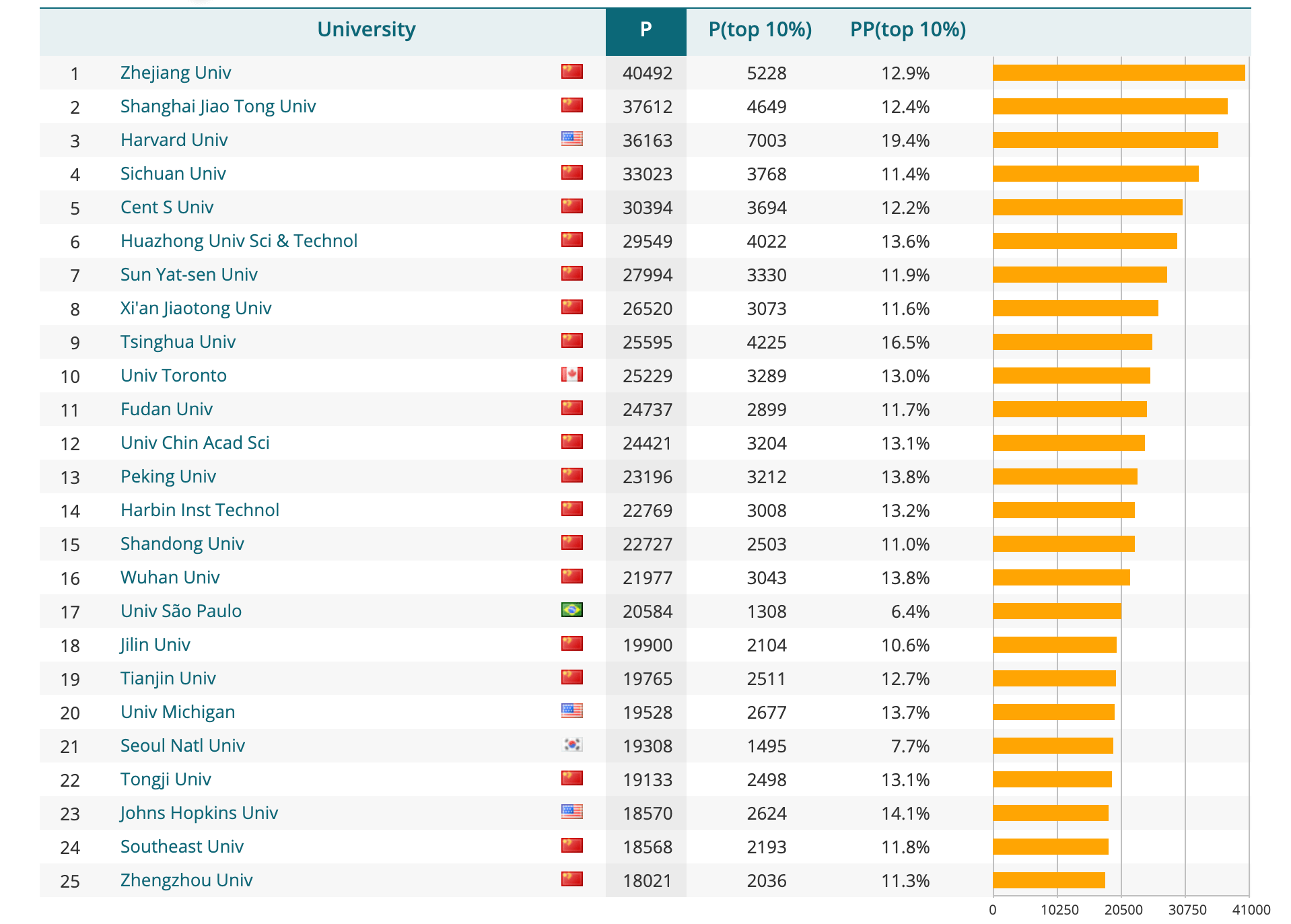
In the CWTS Leiden Ranking Traditional Edition, Chinese universities take 16 of the world’s top 20 spots when institutions are ranked by the number of publications among the top 50 per cent most cited in their field and year. This is an unparalleled quantitative advantage, even greater than the dominance enjoyed by American universities in the second half of the twentieth century. Zhengzhou University, for example, already ranks 25th globally by publication volume, ahead of Stanford and Oxford. And this ranking is based on data from 2020 to 2023. If the latest data were used, China’s advantage would likely appear even more pronounced.
The same ranking also shows that Jiangsu University, hardly regarded as one of China’s elite universities, has already surpassed long-established global institutions such as the University of Chicago, McGill University, Purdue University, and the University of Hong Kong in terms of publication volume. Jinan University, little known even in Shandong Province, ranks only one place below the Chinese University of Hong Kong internationally. One might ask whether those top-scoring students from Shandong who chose to study in Hong Kong should now regret their decision.
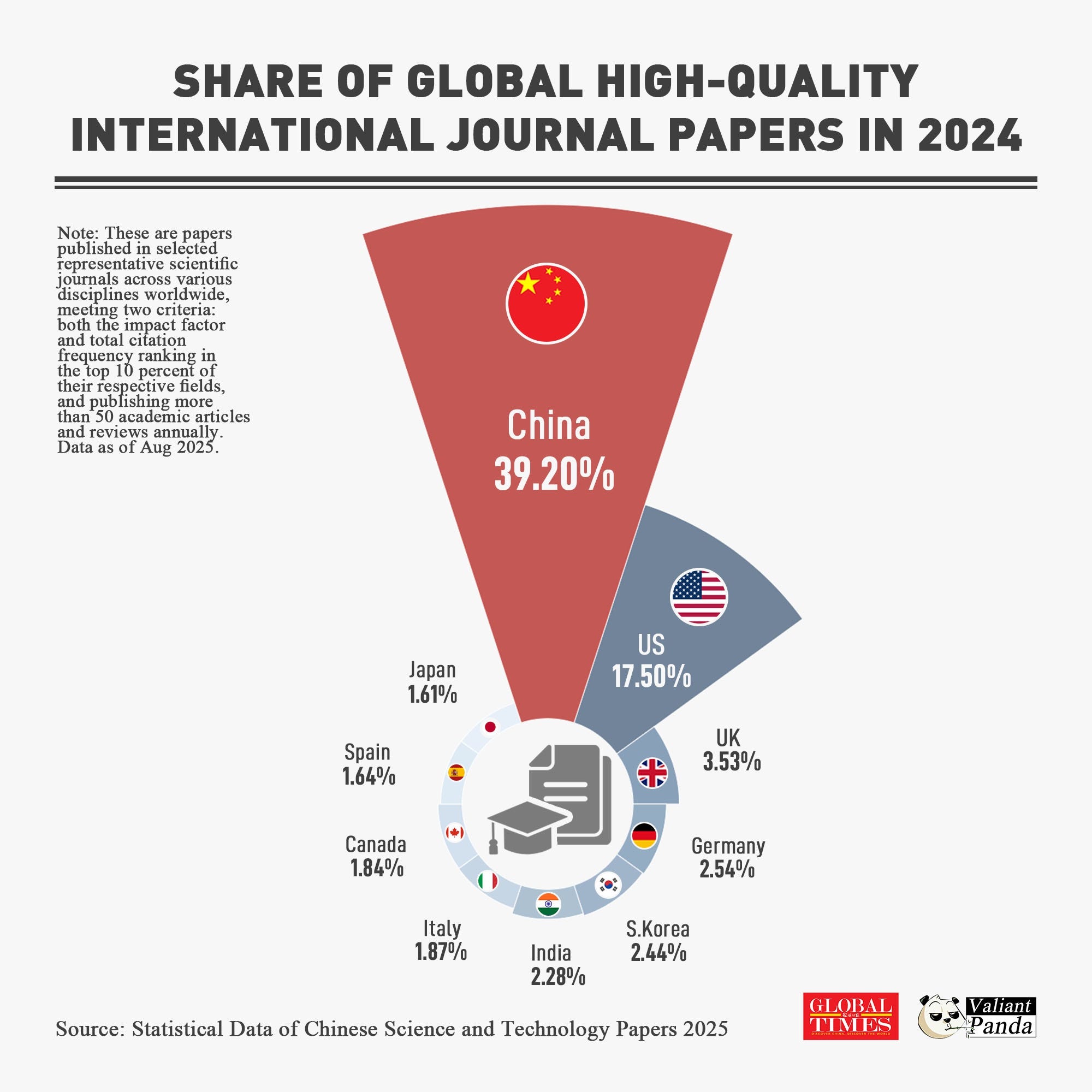
Looking at the Nature Index, which tracks higher-quality papers, from 2014 to 2024, China’s publication count rose from 5,022 to 32,122. In 2024, 892 universities in the Chinese mainland published papers included in Nature Index journals, accounting for 17 per cent of all institutions globally and more than 30 per cent of total papers. Among the world’s top 100 universities in the Nature Index, 42 were from the Chinese mainland. The rankings produce revolutionary scenes: Sichuan University ranks above Stanford, Jilin University above MIT, South China University of Technology above Oxford, and Nantong University appears broadly comparable to National Taiwan University and Northeastern University in the United States.
![FDownloader.net-914621744613887-(1440p).mp4 [video-to-gif output image]](https://substackcdn.com/image/fetch/$s_!W9cC!,f_auto,q_auto:good,fl_progressive:steep/https%3A%2F%2Fsubstack-post-media.s3.amazonaws.com%2Fpublic%2Fimages%2F72a8d7fa-66f6-44a8-98a8-9fcb36bb1e5e_1280x1280.gif "FDownloader.net-914621744613887-(1440p).mp4 [video-to-gif output image]")
Global university ranking organisations and leading academic publishers have also profited handsomely from the Chinese market. Web of Science established a consulting company in China, Clarivate Analytics Information Services (Beijing) Co., Ltd. Nature has set up a dedicated Chinese-language website. In the first half of 2025 alone, Chinese authors reportedly paid around RMB 140 million in article processing charges to Nature Communications. China has become both the most obedient participant in this academic evaluation system and its richest market.
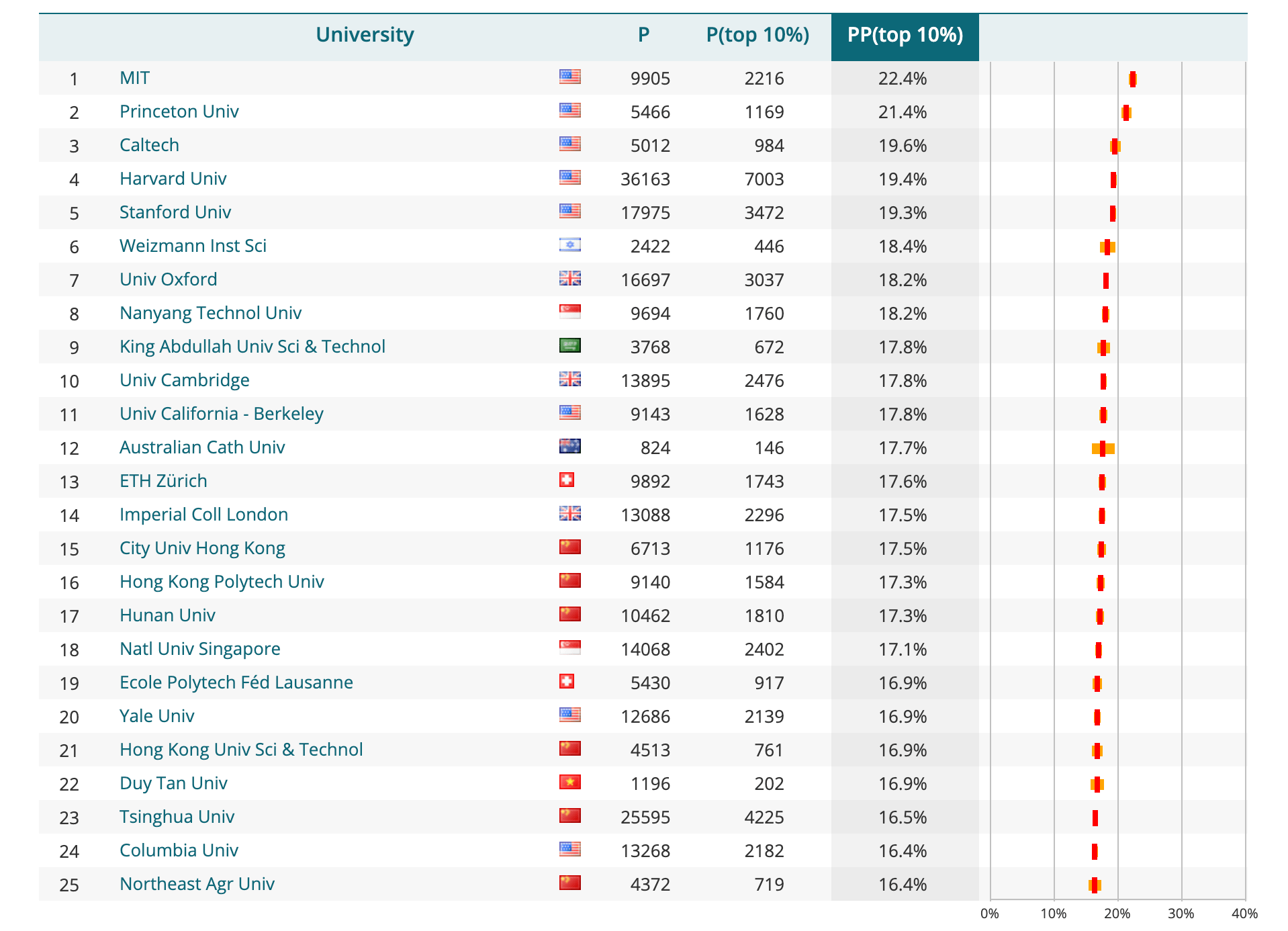
Yet if one adjusts the parameters in scientific publication databases even slightly, the true quality behind China’s supposed status as the “world’s No. 1 research power” becomes much clearer. Measured by the proportion of SCI papers ranked in the global top 10 per cent by citation impact, the top five institutions are all American universities. Among the global top 20, 11 are American and four are British. From the Chinese-speaking world, only Hong Kong Polytechnic University and City University of Hong Kong enter the global top 50, while the Chinese University of Hong Kong and the Hong Kong University of Science and Technology rank between 50th and 60th. Tsinghua University ranks 73rd globally, while Peking University ranks 164th. This is also one reason many outstanding students still choose to study in Hong Kong.
If the standard is made stricter still, and only papers in the global top 1 per cent are counted, Chinese universities and research institutions remain far behind their American and European counterparts. Between 2020 and 2023, the Chinese Academy of Sciences published more than 100,000 SCI papers, but only 1,525 entered the global top 1 per cent, a rate of just 1.4 per cent. Stanford University, by contrast, had a top-1-per cent rate of 3.8 per cent. Although Stanford published only 47,168 papers in total, 1,813 of them reached the global top 1 per cent. Among the world’s top 20 institutions by the number of top-1-per-cent papers, 11 are American and four are British.
Measured by the proportion of top-1-per cent papers, the performance of Chinese universities and research institutions becomes even more sobering. Only Bohai University enters the global top 100, but this is largely due to statistical distortion. Bohai University publishes relatively few papers overall, ranking outside China’s top 350 institutions, and its small base artificially raises the probability of a high top-1-per cent ratio. In practical terms, the highest-ranked institution from the Chinese-speaking world is the Chinese University of Hong Kong, which ranks 109th globally with a rate of 2.7 per cent. Tsinghua ranks 204th, Peking University 327th, and the Chinese Academy of Sciences—the world’s largest producer of papers—ranks only 765th.
Among the global top 20 by this metric, 10 are American universities and five are British. The top three are MIT, Stanford, and Princeton.
Take papers published in Nature itself. To generate commercial value, Springer Nature has in recent years promoted the so-called Nature Index, an expanded ranking system in which China’s position has risen rapidly. China’s Nature Index score has now exceeded 60 per cent of the U.S. level and is roughly four times that of the United Kingdom. But if one looks only at Nature itself, China still trails far behind the United States and remains below Britain. Last year, U.S. researchers published 1,431 papers in Nature, compared with 506 by British researchers and 471 by Chinese researchers, only slightly ahead of Germany’s 422.
Strip away the thick froth of inflated academic rankings, and a harder truth emerges: despite China’s extraordinary progress over the past two decades, the country still trails the United States by a wide margin in basic research, frontier technologies, and top-tier scientific achievements. In many respects, China remains in the second tier of global science, alongside countries such as Britain, Germany, and Japan.
The basic structure of global scientific competitiveness has not fundamentally changed. That is a reality China should confront with more sobriety.
Over the past couple of years, some scholars and experts have repeatedly claimed that the global centre of science and technology has shifted from the United States to China. The claim does not stand up to reality. Thanks to its vast market and dynamic technology companies, China has indeed become one of the world’s major centres for industrial R&D and technological application. But in science and technology research, the gap with developed countries remains large. Industrial rise depends on economic-system reform, which China has managed remarkably in the past. The rise of basic research and original innovation, however, depends on reforming the education system and the governance institutions of scientific research. On that front, China has made little progress over the past two decades.
No country in history has possessed scientific human resources on the scale that China does today. In 2025, China admitted more than 170,000 new doctoral students, roughly equal to the combined total of the United States, the European Union, and Japan—about 60,000, 100,000, and 12,000, respectively. To fundamentally overcome technological chokepoints, China must reform its university hiring systems, evaluation mechanisms, and student training models to genuinely encourage originality.
Academic and intellectual work, by nature, resists precise measurement and is especially ill-served by fixed quantitative indicators. Laozi produced the roughly 5,000 characters of the Tao Te Ching over a lifetime. Goethe spent forty years completing Faust. Several Japanese Nobel laureates over the past decade did not speak English fluently and had not published papers in international journals. Under today’s academic evaluation system, they would all have been filtered out.
The deepest value of academic and intellectual work lies in even the smallest measure of originality, not in piles of standardised papers and monographs. But originality needs unhurried time, independent thought, and an open intellectual and social environment in which it can take root.
If academia is managed like a factory assembly line or a bank-teller system, with bureaucratic indicators covering project rankings, funding, publication counts, titles, and countless other metrics, the result is a profound distortion of scholarship and a serious insult to intellectual creativity. Applied to teachers, researchers, and graduate students, such a box-ticking, metric-driven evaluation regime risks compacting the soil of academic life, stripping it of the nutrients needed for intellectual growth.
The current evaluation and training system will only reduce the efficiency with which China uses its intellectual resources. China may train more than three times as many PhDs as the United States, but its capacity for research, invention, and original creation will hardly rise by anything like the same multiple. Such a system only produces “professional practitioners of academic and research activities”—people skilled at managing relationships, chasing research grants, winning national projects, and accumulating titles. It does not help truly gifted minds emerge. Under such a system, figures such as Qian Sanqiang [father of the Chinese nuclear programme] and Chen Jingrun [Chinese mathematician] would very likely have been buried.

Lei Xiaoyan: the race between education and technology has come to China

A country with fewer children and more artificial intelligence will need a different kind of education system. And Lei Xiaoyan, Boya Distinguished Professor at Peking University, Party Secretary of the National School of Development (NSD), Director of the
BGI's Mei Yonghong on China's past, present, & future in science & technology

Mei Yonghong is Director and Executive Vice President of China's private BGI Group, one of the world's leading life science and genomics organisations that, in recent years, has become a prime target in the U.S. The Center for Security and Emerging Technology
Mei Yonghong on Scaling Discovery

The 20th Central Committee of the Communist Party of China (CPC) convened its fourth plenary session in Beijing from October 20 to 23 and approved its recommendations for the 15th Five-Year Plan; formal passage of the plan must wait til the National People’s Congress in March. In the meantime, we are offering some interesting expectations published on 1…
There is a lot of data manipulation and outright fraud in American universities, too. Every organization should know that if you judge people by a metric, then they will optimize that metric. At one time, we trusted university leadership to make judgments, but they are absolutely distrusted now, so some measure has to be chosen. I agree that this system selects against innovation. Keynes published little in his lifetime, but his two books were revolutionary. In literature, Tolkien published few "academic" papers, choosing to focus on real substance. Such people would not be welcome in academia today.
US universities rank higher in percent of papers in the top 10% cited? Huh?
Given Chinese universities rank higher in total top 10% papers, it means US universities are unproductive.
Chinese researchers produce top 10% papers as well as follow on research. 🤷♂️
Just FYI, top Chinese students going to US grad schools has collapsed. My son is graduating Tsinghua this year and has chosen to 保研 over acceptances at Ivies and UCs.