


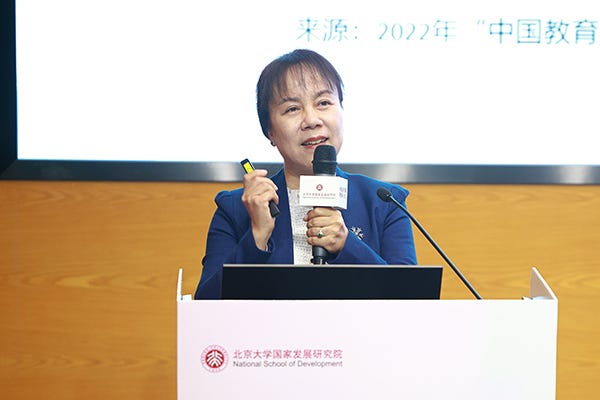
A country with fewer children and more artificial intelligence will need a different kind of education system. And Lei Xiaoyan, Boya Distinguished Professor at Peking University, Party Secretary of the National School of Development (NSD), Director of the China Center for Economic Research (CCER), and Director of the PKU Center for Healthy Ageing and Development, argues that China must move quickly.
China has made major gains at lower levels of education. Primary and junior secondary schooling are now nearly universal for younger cohorts. But upper-secondary completion and tertiary attainment remain relatively low, especially among the generations that make up most of today’s workforce. Compared with the United States, the G7, and even Russia, China still has a relatively large share of adults without upper-secondary education. In Lei’s view, faster investment in human capital is therefore essential to contain inequality and keep common prosperity within reach.
Her reform argument is that employers increasingly value analytical thinking, resilience, creativity, judgement, and communication. China, therefore, should not simply produce more STEM graduates or sideline the humanities and social sciences. It should strengthen the foundations of both the humanities and the natural sciences, promote deeper interdisciplinary training, and build an accessible lifelong-learning system for adults already in the workforce.
Lei made these remarks on 29 March 2026 at an NSD session on “investing in people”, a policy phrase that first entered China’s 2025 Government Work Report and was later reinforced at the Central Economic Work Conference in December 2025. Set against the country’s long emphasis on infrastructure and other forms of physical investment, it advocates for more resources into education, healthcare, skills, social welfare, and broader human development.
Lei’s remarks were published on the NSD’s official WeChat blog on 3 April. Lei has kindly authorised the translation.
—Yuxuan Jia
雷晓燕:教育如何应对老龄化与科技快进
Lei Xiaoyan: How Education Should Respond to Ageing and Rapid Technological Acceleration
Drawing on the twin trends of population ageing and technological transformation, I would like to offer several reflections on China’s human capital development strategy.
The future: fewer workers, smarter machines
A clear-eyed understanding is essential. The defining features of future society will be a smaller workforce and more intelligent machines.
Long-term demographic projections show that the shares of both the working-age population and children in China will fall markedly in the years ahead. In cross-country comparison, meanwhile, the growth of China’s population aged 65 and above far outpaces that of other countries. By the end of this century, China will become the world’s most aged society.
During the 2026 “Two Sessions”—annual meetings of the National People’s Congress (NPC) and the Chinese People’s Political Consultative Conference (CPPCC)—the effects of declining birth rates among school-age children sparked extensive discussion. The data show that the number of pre-school children in China has long since peaked and entered a downward trend, while the population of compulsory-school-age children has also begun to decline. As this trend continues, the upper-secondary-school-age population will reach its peak within the next three years before beginning to decline. A few years after that, the number of university graduates entering the labour market will likewise fall substantially.
The impact of declining birth rates is now moving up through the education pipeline. It is placing new demands on the allocation of educational resources and the configuration of the education system, while also reshaping the future scale of the labour market. The central task of educational development in China must now shift from expanding quantity to improving quality. The same logic applies to labour-market development: China needs to cultivate a higher-quality workforce.
On the technology side, China is currently in a phase of rapid advance. One indicator of such progress is the installation volume of industrial robots and the structure of market supply. The data show that China’s annual installations of industrial robots have grown rapidly. In 2024, China accounted for 54% of total global installations, reaching 295,000 units. Of these, the share supplied domestically rose to 57% in 2024, an important reflection of China’s technological progress.
Another indicator of technological progress that is profoundly reshaping society is artificial intelligence (AI). According to Stanford University’s AI Index Report 2025, China is already a world leader in both the total number of AI-related academic publications and patent filings. The number of representative AI models developed in China continues to rise, second only to the United States. In top-tier AI model development, the gap between China and the U.S. is also narrowing steadily, demonstrating the speed and the level of China’s technological advance.
As the demographic dividend fades and technological progress accelerates, can China rely on a technological dividend to sustain economic and social prosperity? How will the relationship between technology and human beings evolve? These are questions that require serious reflection today.
History: if education fails to keep pace with technology, inequality widens
A central argument advanced by Nobel laureate Claudia Goldin in her influential work is that technological progress creates demand for highly skilled labour. If educational expansion, especially high-quality and inclusive education, can keep pace with or even outstrip technological progress, it can raise the skill level of the wider population and enable shared prosperity. Conversely, if education lags behind, technology will primarily benefit a small group of highly skilled workers, thereby widening income inequality.
This argument is borne out by the historical experience of the United States in the twentieth century. Data show that in the decades after 1950, average years of schooling among the native-born population in the U.S. experienced a degree of stagnation, even as the country was going through a period of rapid technological advance. Over the same period, income inequality widened continuously, and the wage gap between university graduates and high-school graduates expanded sharply. This supports Goldin’s argument: when educational development fails to keep up with technological change, the incomes of high-skill groups rise substantially, while those of middle- and lower-skill groups fall behind, leading to a persistent widening of inequality.
China today is also experiencing rapid technological progress, and in some fields it is already approaching the U.S. frontier. On the education side, the China Family Panel Studies (CFPS) conducted by Peking University estimates educational attainment across birth cohorts from the 1940s through the 1990s. The data show that, thanks to the spread of compulsory education, more than 90 per cent of those born in the 1970s, 1980s, and 1990s completed primary and junior secondary education, while completion of compulsory education among the 1990s cohort is close to universal.
Yet the picture is far less encouraging at the upper-secondary and tertiary levels. Even among those born between 1990 and 1994, the upper-secondary graduation rate is only just above 60 per cent, while the share with junior college education or above is only around 40 per cent. Among those born in the 1980s, 1970s, and 1960s, the share with junior college education or above is even lower. It is worth stressing that the cohorts born in the 1970s, 1980s, and 1990s still make up the core of China’s labour force today.
Compared with other countries, average years of schooling among China’s adult population have continued to rise in recent years, but the gap with the U.S., the G7, and even Russia remains substantial. According to the OECD’s 2024 data on adult educational attainment, the share of China’s population with below upper-secondary education remains high by the standards of the world’s major economies, while the share with upper-secondary and tertiary qualifications remains relatively low.
Turning to educational investment. Education is a crucial component of “investing in people”. Although China has achieved the goal of public education expenditure amounting to 4 per cent of GDP, a clear gap remains compared with economies such as the U.S. and the EU.
Taken together, and viewed through the lens of Goldin’s framework, these facts point to a real source of concern. China is now at a stage where technology is sprinting ahead while education is still catching up. Could this imbalance between technological and educational development lead to a continued widening of income gaps, making the goal of common prosperity harder to achieve? To realise common prosperity, China must step up investment in people so that education can catch up with technological change as quickly as possible.
The CFPS data reinforce this judgement. Across age groups, for both men and women, higher education yields higher income returns, and those returns persist throughout working life. This fully demonstrates both the necessity and the urgency of increasing investment in human capital.
The AI era: what kind of talent should education cultivate?
Once the case for investing in education is clear, the next key question follows: in the age of AI, what kind of talent should the education system cultivate?
There is already extensive debate in both academia and industry over whether AI will substitute for human labour or complement it. The World Economic Forum’s Future of Jobs Report, released at the end of 2025, offers a systematic forecast of changes in the occupational structure ahead. According to employer expectations, the fastest-growing jobs globally over the next five years will be concentrated in technology-related fields, including Big Data Specialists, Fintech Engineers, AI and Machine Learning Specialists, and Software and Application Developers. By contrast, the jobs expected to shrink most rapidly are concentrated in clerical and secretarial occupations, including Cashiers, Ticket Clerks, Administrative Assistants, Executive Secretaries, Printing Workers, and Accountants and Auditors.
This suggests that technology does not affect labour by simply replacing “people” in the abstract. Rather, it replaces specific combinations of skills, because different skill combinations entail different requirements for human capability.
So what are the core skills employers will value most in the future? According to the same report, the top five are analytical thinking; resilience, flexibility and agility; leadership and social influence; creative thinking; and motivation and self-awareness. All are what are commonly described as “soft skills”.
This shift is already visible in hiring markets. The number of newly posted AI-related jobs has been rising year after year, especially in sectors most affected by AI. Compared with non-AI-related roles, AI-related jobs demand almost twice as much in the way of “soft skills” such as resilience, flexibility, and analytical thinking. These soft skills also command a significant wage premium.
A recent empirical study by Professor Erik Brynjolfsson and his team at Stanford Graduate School of Business provides further evidence. The researchers equipped more than 5,000 customer-service workers with AI assistants and tracked changes in their productivity and work content. They found a strong complementary relationship between AI and human labour: machines took over standardised information-processing tasks, while human workers focused more on judgement, decision-making, customer care, emotional connection, and other soft-skill-intensive tasks, with a significant improvement in overall productivity. This offers a vivid demonstration of why soft skills matter in the age of AI.
The conclusion is clear. The education system of the future should not be producing workers trained for a single task. It should be cultivating broadly capable people who can work alongside AI, continue learning, solve complex problems, and bring human judgment and care to what they do.
I recently came across a news report saying that of more than 200 graduating students this year from the computer science school of a top U.S. university, only 23 had secured jobs. This clearly illustrates that even specialised computing skills risk being displaced by AI, and that narrow technical competence on its own is no longer enough to meet the demands of the future labour market.
How should the education system break with the old and build the new?
Having clarified the core objectives of education, the next step is to ask where China’s education system is actually heading. In the process of breaking with the old and building the new, what kinds of reforms are already underway?
Recently, Professor Shen Yan and I, together with other colleagues, completed a study on changes in university discipline structure in the AI era. Public discussion often frames the trend as “science and engineering advancing while the humanities retreat”. But what do the facts show? Using the Ministry of Education’s full dataset on adjustments to undergraduate majors nationwide, we carried out an analysis. The data show that after 2017, universities across China added more majors in the natural sciences while discontinuing a fair number in the social sciences. That is the broad picture of current adjustment in higher education.
We then looked more closely at the pattern of change before and after 2016. Using the share of discontinued majors on the vertical axis and the share of newly added majors on the horizontal axis, majors can be grouped into three categories: relatively expansionary majors, relatively contractionary majors, and structurally reorganised majors (where additions and eliminations occur simultaneously). The data show that even after 2016, most majors in the social sciences, economics, and management still fell into the category of structural reorganisation. By contrast, humanities majors such as languages and design had clearly moved into contraction. Perhaps more surprisingly, foundational disciplines within the natural sciences, such as mathematics, also appeared to be in relative contraction, a result that differed from what we had expected.
At the same time, interdisciplinary majors have been growing vigorously. Since 2016, the majors with the largest net increases have all been in AI and related interdisciplinary areas, with AI plus engineering and AI plus management expanding particularly fast.
These changes suggest that Chinese universities are responding to market demand for STEM talent—science, technology, engineering, and mathematics. The rapid growth of AI-related interdisciplinary programmes can also, to some extent, help students adapt to changes in the demand for future jobs.
But a simplistic tilt towards engineering at the expense of the humanities and social sciences would be risky. Many of the core capabilities needed in the future labour market, including critical thinking, ethical judgement, communication, collaboration, and cultural understanding, are cultivated precisely through the humanities and social sciences. These soft skills are the foundation of innovation for good and effective governance in a complex society.
Educational adjustment should not be a one-way contraction, but a structural reconstruction. China should strengthen the foundations of both the humanities and the natural sciences, while fostering deeper integration between the humanities and social sciences, and science and technology.
Beyond the national education system for children and young people, attention must also be paid to those already in the labour market. Those born in the 1960s are gradually reaching retirement age, but many remain active in the labour market. Those born in the 1970s, 1980s, and 1990s make up the main body of the workforce, and as noted earlier, there remains significant room to improve their overall level of education. For these groups, the key instrument of human capital investment is a lifelong learning system, with in-service education as one of its most important vehicles.
The OECD’s Education Policy Outlook 2025 reports participation rates in in-service education across age groups in member countries. Even in developed economies, adult participation in education remains relatively low, and it falls further with age. Given that the overall educational attainment of the labour force in OECD countries is already higher than in China, this suggests that China’s need for in-service education is even more pressing.
The main funders of in-service education are employers. But the training they provide tends to focus on firm-specific skills tied to production and operational needs. We further analysed the content of formal degree and non-degree education undertaken by adults. In formal education, adults tend to pursue higher credentials, including postgraduate programmes such as MBAs and EMBAs. In non-degree education, training is concentrated in employer-relevant skills such as health and safety, computing, and software applications. General skills, including foreign languages, creativity, numeracy, physical activity, and literacy, especially the soft skills needed in the AI era, account for a much smaller share.
We have not yet found equivalent Chinese data, but the existing evidence suggests that China’s supply of training in general adult skills and soft skills is even weaker than that of OECD countries. That also means the country needs to accelerate the building of a lifelong learning system.
If lifelong learning is left only to the spontaneous actions of firms and individuals, it will remain focused mainly on specific vocational skills. If China is to cultivate the broad soft skills workers need in the AI era, it must build a lifelong learning system jointly sustained by government, enterprises, and individuals, with government providing policy support and basic guarantees, enterprises signalling demand and offering financial support, and individuals supplying intrinsic motivation. Such a system would not only help workers adapt to rapid technological and social change; it would also form a core strategy for responding to population ageing and activating China’s existing stock of human capital.
Conclusion: education must move faster
At the bottom, the answer to the changes of the age lies in moving education forward. On that basis, I would offer four recommendations.
First, continue investing in education and close the gap between educational development and technological advances. Soft skills should be placed at the centre, and the pace of educational progress should at least match, and where possible, modestly anticipate, the pace of technological change. This is fundamental to preventing wider inequality and advancing common prosperity.
Second, redefine the goals of education by putting soft skills at the centre. Curricula and evaluation systems should be reformed so that education moves away from rote knowledge transmission and towards the cultivation of capabilities centred on analysis, creativity, and resilience.
Third, optimise the structure of higher education and promote deeper interdisciplinary integration. While supporting the development of emerging interdisciplinary fields, China should also value and renew education in the humanities and social sciences to cultivate sectoral leaders with both technical depth and humanistic sensibility.
Fourth, build a society-wide lifelong learning ecosystem. The barriers between education and work should be broken down, and every worker, especially those in mid- and later career, should have access to convenient and effective pathways for upgrading their skills.
Cai Fang: theorising AI’s impact on China’s employment future

Cai Fang is a former Vice President—meaning Vice Minister—of the Chinese Academy of Social Sciences (CASS). He currently holds the title of Academician (学部委员 ), reserved for CASS’s highest-ranking scholars. He is also President of the Chinese Association of Labour Economics
Gordon G. Liu: Can AI reduce the price of healthcare?

Gordon G. Liu is BOYA Distinguished Professor of Economics, Dean of the Institute for Global Health and Development (GHD), and Director of the China Centre for Health Economic Research at Peking University.
Hu Bo: AI and the future of sea power

Hu Bo is Director of the South China Sea Strategic Situation Probing Initiative (SCSPI), as well as Research Professor and Director of the Center for Maritime Strategy Studies, Peking University. He also serves as Director of the Center for Marine Big Data and Intelligent Research
THE 2028 CHINESE INTELLIGENCE CRISIS

The 2028 Global Intelligence Crisis, a speculative macro memo published on 22 February 2026 by U.S. research firm Citrini Research on its Substack platform, has caused major tech and financial firms’ share prices to tumble, sparking heated debate among economists and strategists over the realism of its scenario.