


Europe remains a key focus for Chinese companies, which are making full compliance central to their long-term, sustainable development there, said Liu Jiandong, Chairman of the China Chamber of Commerce to the EU (CCCEU), Chairman of Bank of China (Europe) S.A., and General Manager of Bank of China Limited Luxembourg Branch.
Liu gave an interview to Yicai, the financial news arm of Shanghai Media Group, on the sidelines of the China International Fair for Investment & Trade (CIFIT), held from 8 to 11 September 2026.
The following is a translation of an excerpt from the interview. CCCEU has reviewed and agreed to the publication.
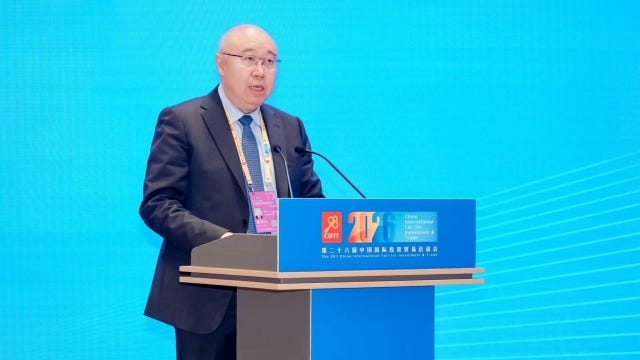
欧盟中国商会会长刘坚东:中企投资欧洲的挑战已发生明显变化|对话投洽会
Liu Jiandong, Chairman of the China Chamber of Commerce to the EU: The Challenges Facing Chinese Investment in Europe Have Clearly Shifted | A CIFIT Conversation
The Realities and Room in China-EU Economic and Trade Cooperation
Yicai: From your vantage point on the ground in Europe, how would you describe the current operating environment for Chinese enterprises in the EU? How has it changed compared with the past few years?
Liu Jiandong: Europe remains a key destination for Chinese investment.
Compared with other regions, Europe has several distinctive strengths. First, it has a highly mature consumer market of considerable scale. Second, its industrial and supply chains are well developed, as is its infrastructure. These features make Europe highly attractive to Chinese enterprises.
Chinese companies are also entering a new phase in their global operations. In the past, the focus was largely on exporting products; today, they are increasingly operating on a global basis. Europe’s strengths make it an important overseas market for Chinese enterprises and provide favourable conditions for them to integrate more deeply into global industrial and supply chains.
It is precisely this shift that has brought new changes to the business environment Chinese companies face in Europe. In the past, the main question was whether they could gain access to the market. Today, the focus has increasingly shifted to whether they can develop there in a more stable, sustainable, and compliant manner.
Every year, the China Chamber of Commerce to the EU (CCCEU) publishes its flagship annual Report on the Development of Chinese Enterprises in the EU. In the latest survey, 81 per cent of respondents said uncertainty in the EU business environment had increased. Across the seven years in which the CCCEU has published the report, this indicator has deteriorated for six consecutive years.
Overall, a series of EU policies have had a tangible impact on businesses. CCCEU survey found that 40 per cent of Chinese enterprises had experienced some degree of differential treatment because they were Chinese companies. The situation may need to be assessed from a broader range of perspectives, but there is no doubt that this perception among businesses is real.
The most pressing issue, therefore, is how Chinese enterprises in Europe can adapt to major changes in the international environment and respond effectively to the challenges arising from various policies. As many companies noted at CIFIT, compliance remains fundamental: businesses need to ensure that their operations are fully compliant as they pursue further development.
Yicai: As the EU steps up efforts to develop strategic industries, Chinese greenfield investment in Europe, including in sectors such as new-energy vehicles, has also been increasing. How can such investment create more room for mutually beneficial China-EU industrial chain cooperation while serving the development interests of both sides?
Liu Jiandong: From a broader trade and economic perspective, Europe’s biggest concern is not simply losing market share. At a deeper level, there is anxiety about losing control over core technologies and key industrial chains. Going forward, the two sides will need to find a better balance by building two-way cooperation in both technology and markets.
Companies certainly need to protect their core intellectual property, but commercial cooperation also involves technology collaboration and building on each other’s strengths. As the theory of comparative advantage suggests, even if some countries are ahead in particular fields, that does not leave no room for cooperation. Countries can still work closely together by drawing on their respective comparative advantages.
One of the biggest challenges for the EU at present is adjusting to this shift in roles. In the past, China-EU economic and trade relations largely involved Europe bringing capital, technology, and management expertise to China. Today, the comparative advantages of the two sides are shifting in some cutting-edge sectors. European businesses and policymakers will inevitably need time to come to terms with and adapt to this change. For Chinese companies, however, investing in Europe is about deeper cooperation and sustainable development, not about trying to dominate the market.
As the two sides adjust to this shift, some uncertainty, friction, and defensiveness on the European side are inevitable. It is therefore crucial to build mutual trust through tangible, mutually beneficial outcomes and sustained communication. Trust is essential to moving beyond the current tensions, and it can only be built through practical cooperation and long-term dialogue. As long as the two sides can identify where their interests align, China-EU cooperation in new energy and other industries can generate strong momentum and lasting benefits.
How Chinese Enterprises Can Build Deeper Roots in Europe
Yicai: As conditions overseas continue to evolve, how does the Chamber help Chinese enterprises adapt to and integrate more effectively into local markets? Looking ahead, what will be most important for Chinese companies in Europe to demonstrate the mutual benefits they can bring?
Liu Jiandong: I believe there are five key areas.
First, Chinese companies in Europe need to deliver tangible economic benefits through cooperation. The growth of Chinese enterprises must be closely tied to local interests. Chinese companies in Europe currently support 260,000 jobs directly. In areas such as green and low-carbon development, new energy, technological innovation, and advanced manufacturing, the two sides have complementary strengths that can make a tangible contribution to local economic growth, jobs, and livelihoods.
Second, companies need to objectively assess and understand local rules and culture. Once operating in Europe, businesses must have a clear grasp of employment policies, compliance requirements, and market-entry rules, rather than relying on assumptions drawn from past experience. They also need to assess policy developments rationally, without overstating their impact or creating unnecessary alarm. The key is to judge their actual effects objectively.
Third, companies need to keep strengthening their compliance and risk-management capabilities. Regulation in Europe is becoming more stringent, and businesses will struggle to operate effectively if their compliance and risk controls fall short of local standards. Taking chances or trying to exploit loopholes is simply not a viable approach. Long-term, stable development depends on operating lawfully and in full compliance.
Fourth, companies should put the principle of “in Europe, for Europe” into practice and become more deeply integrated into local communities. Localisation means more than hiring local employees; it also means engaging with local communities and culture and moving beyond an “outsider” mindset.
For example, the Bank of China (Europe) regularly arranges study visits and training programmes in China for outstanding local employees. After experiencing China first-hand, many of them return home and voluntarily share a more accurate and well-rounded picture of the country within their own communities. Messages conveyed by local people themselves are often more persuasive, while these experiences also significantly strengthen employees’ sense of belonging and loyalty to the company.
Fifth, companies should make effective use of legal channels to defend their legitimate rights and interests. They need not only to understand the rules, but also to be prepared to make their case when they encounter unfair treatment and to defend their rights in accordance with the law. The Chamber will continue to serve as a bridge and source of support for Chinese enterprises operating overseas.
Yicai: On 11 February 2026, the website for China’s national comprehensive overseas service was launched, bringing together legal, fiscal, financial, and foreign-affairs resources. As an organisation representing Chinese enterprises in Europe, what practical value does the platform bring to companies operating overseas? And how does the Chamber plan to coordinate its resources with the platform?
Liu Jiandong: The Chamber has actively participated in and promoted the development of comprehensive overseas service stations and plays an important role in providing integrated services to enterprises. Many of our existing practices and initiatives are closely aligned with the Ministry of Commerce’s approach to developing the national one. The core objective is to address a longstanding challenge facing companies going global: having to operate largely on their own and navigate unfamiliar markets without sufficient support.
Going forward, the Chamber’s coordination with the national comprehensive overseas service will focus on three main functions.
First, providing comprehensive services across the full business cycle. One of the Chamber’s core tasks is to help companies connect with and integrate local business and investment resources, while also organising specialised training and professional support on newly introduced laws and regulations. In the future, the Chamber will also work with qualified third-party providers in legal, tax, and fiscal affairs to offer companies market assessments, policy guidance, and end-to-end advisory services.
Second, strengthening communication and policy advocacy at multiple levels. Internally, the Chamber systematically collects companies’ concerns and needs. Externally, it works to maintain effective high-level channels for dialogue between government and business.
When the EU introduces major policies, the Chamber conducts detailed assessments of their potential impact on Chinese enterprises. It also conveys, in a timely, structured, and forceful manner, the practical concerns and difficulties faced by Chinese companies in Europe. For example, the Chamber put forward 336 policy recommendations in its Report on the Development of Chinese Enterprises in the EU 2025/2026.
At the same time, the Chamber is deepening exchanges with the Chinese and European business communities, academia, and think tanks, building cooperative and symbiotic relationships with local enterprises, and encouraging more rational voices in public debate through greater mutual understanding.
Third, strengthening collective representation and rights protection. When companies face major policy risks, individual businesses often have limited influence on their own. In response to measures such as the EU’s anti-subsidy investigation into Chinese new-energy vehicles, the Chamber has worked through its Automotive Working Group to hold several rounds of direct talks with senior European Commission officials, giving Chinese companies a direct and authoritative channel through which to make their case.
Financial institutions are also playing an increasingly important supporting role. As Chinese companies go global, their needs are shifting from basic trade settlement towards globalised and asset-intensive operations. Demand has therefore risen sharply for services such as overseas cash pooling, cross-border fund transfers, and foreign-exchange risk management.
Bank of China, for example, has a service network covering 64 countries and regions. Through comprehensive services covering the full business life cycle, financial institutions are providing essential support for the stable and sustainable overseas development of Chinese enterprises.

Huang Yiping on China Shock 2.0 debate

As Europe grapples with a new wave of debate over “China Shock 2.0”, Huang Yiping, Boya Distinguished Professor, Dean of the National School of Development (NSD), Dean of the Institute of South-South Cooperation and Development (ISSCAD) at Peking University, argues that Europe’s anxiety reflects both the pressure from China’s industrial rise and its own…
Brussels Blames China. The Data Point Elsewhere

One of the most convenient stories in Brussels today is that Europe is facing a second “China Shock”: a flood of cheap Chinese goods, pushed abroad by overcapacity, subsidies, and weak demand at home.