


On 28 May 2026, Japan and the Philippines agreed to launch formal negotiations on their maritime boundary east of Taiwan, prompting strong objections from Beijing and a series of Chinese maritime enforcement operations.
The East is Read has previously published an analysis released by the South China Sea Strategic Situation Probing Initiative (SCSPI), arguing that Japan and the Philippines had yet to demonstrate that their proposed delimitation area could be separated from China’s maritime claims.
In the article below, Hu Bo, Director of SCSPI and Research Professor and Director of the Centre for Maritime Strategy Studies at Peking University, argues that the Japan–Philippines maritime delimitation initiative is unlikely to achieve much in practice, whether or not the two countries eventually reach an agreement. He maintains that China nevertheless has legitimate grounds to respond, both to safeguard its maritime rights and to assert its position as an interested party.
The article was published in Issue 10, 2026 of 现代舰船 Modern Ships, a magazine run by China State Shipbuilding Corporation Limited (CSSC)’s in-house think tank.
日菲海域划界谈判及中国的反应
Japan–Philippines Maritime Delimitation Talks and China’s Response
The Japan–Philippines initiative to pursue maritime delimitation talks clearly has an even more sinister motive: to further advance the “de-Sinicisation” of Taiwan through such practices.
On May 28, 2026, Japan and the Philippines upgraded their bilateral relationship to a “Comprehensive Strategic Partnership” in Tokyo. The same Joint Statement also outlined the initiation of formal negotiations to delimit the boundary between their respective exclusive economic zones and continental shelves.
China’s Ministry of Foreign Affairs responded by stating that “the area involved in their planned talks is east of China’s Taiwan island. According to China’s domestic law and international law including UNCLOS, China has exclusive economic zone and continental shelf in this area… Any delimitation concerning waters to the east of Taiwan must have China as a party to the talks. Japan and the Philippines’ attempt to bypass China and initiate the so-called maritime delimitation talks constitutes a severe violation of UNCLOS and other international laws and basic norms governing international relations. It also seriously infringes on China’s maritime rights and interests.”
China’s Ministry of Transport then mobilised maritime administration, navigation support, and rescue resources to launch a special maritime traffic law enforcement operation in waters east of Taiwan Island. The China Coast Guard also announced regular law-enforcement patrols in the relevant waters.
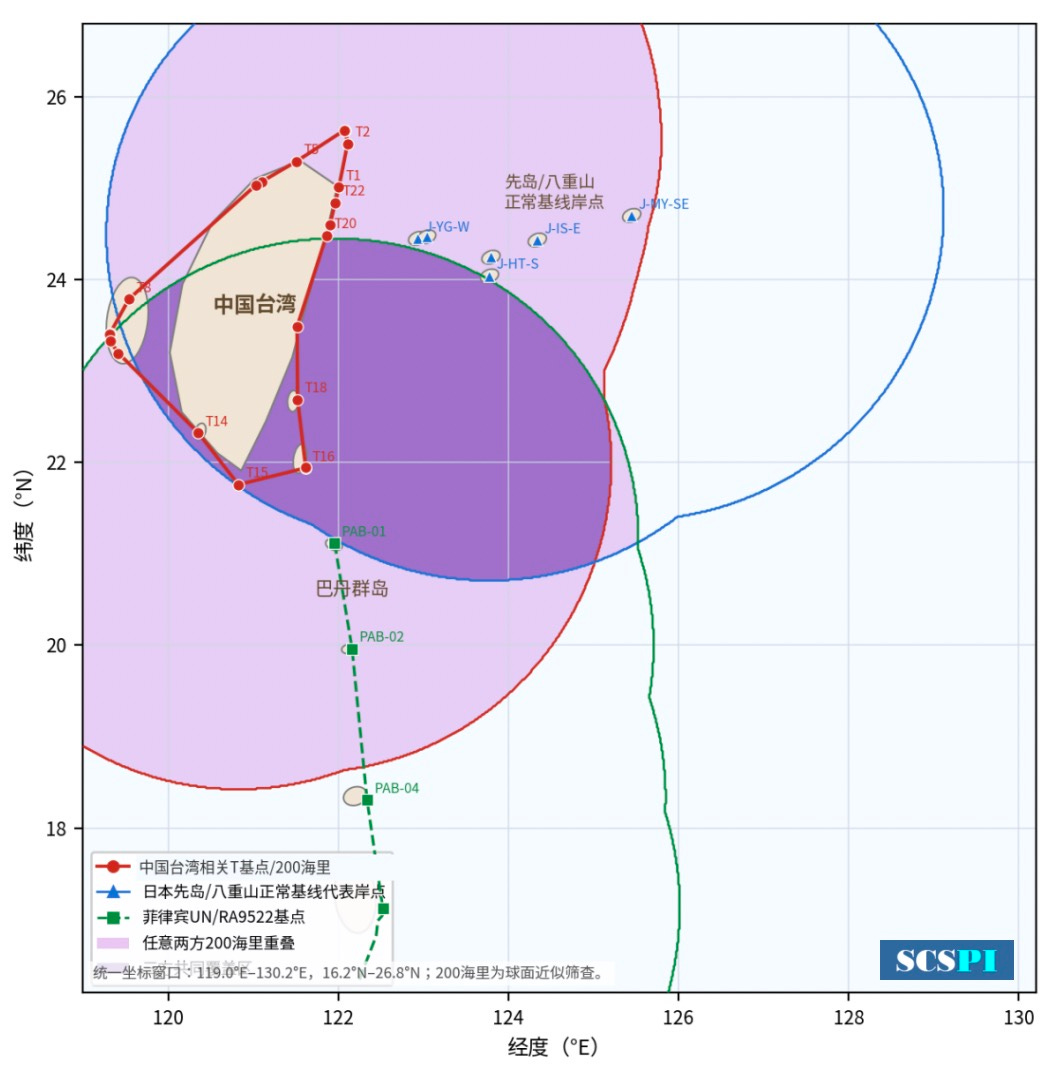
Taiwan’s east coast forms a continuous main coastline facing the Philippine Sea Basin. Japan’s potential maritime claims in the area are based primarily on the Sakishima/Yaeyama island chain, while the Philippines bases its claims on the Batan Islands to its north and its archipelagic baselines. The maritime claims of Japan and the Philippines in this area, including where they overlap, inevitably involve the maritime rights and interests of China’s Taiwan region. In effect, the maritime claims of China, Japan, and the Philippines intersect and overlap east of Taiwan. By abruptly announcing delimitation negotiations without consulting China, Japan and the Philippines have shown a profound disregard for China’s rights, inevitably provoking a strong response from Beijing.
Japan’s Chief Cabinet Secretary Minoru Kihara stated that even if Japan and the Philippines reached an agreement on their maritime boundary, it “would not be legally binding on third parties”. Philippine President Ferdinand Marcos Jr. described the negotiations as “essentially a bilateral discussion between Japan and the Philippines”. Such statements suggest that the talks would cover only overlapping Japanese and Philippine claims, not areas also claimed by China’s Taiwan region.
In theory, based on the current maritime claims of Japan, the Philippines, and China’s Taiwan region, there is only a very small area where Japanese and Philippine claims overlap without involving waters claimed by China. However, the relevant coastlines and baselines, the capacity of islands to generate maritime entitlements, and the potential reach of maritime claims projected from a third party’s coast all affect the limits of what the two countries are entitled to delimit between themselves. In practice, it is difficult to determine whether China’s claims can be clearly separated from the area subject to Japan–Philippines maritime delimitation negotiations.
If Japan and the Philippines continue to exclude Beijing and proceed towards a final delimitation without demonstrating that the waters they intend to delimit can be separated from those claimed by China, they would not only violate international legal obligations of good faith, cooperation, and restraint, but could also infringe upon China’s maritime rights east of Taiwan Island, potentially constituting an internationally wrongful act.
Whatever the outcome of the Japan–Philippines delimitation talks, it must not infringe upon China’s legitimate rights. There are essentially two possible scenarios. In the first, the negotiations struggle to make progress and ultimately come to nothing. This is highly likely, given the extremely expansive maritime claims made by both countries. Although Japan and the Philippines are seeking closer strategic ties to contain China, resolving even the many technical issues involved in maritime delimitation would be unrealistic in the short term. The initiative to launch these talks came rather abruptly in both countries and was, to a considerable extent, an impulsive decision made privately by Sanae Takaichi and Ferdinand Marcos Jr. themselves. Whether the initiative can be sustained as domestic political circumstances change in either country remains uncertain.
In the second scenario, the two countries reach an agreement and establish a maritime boundary. Under international law and established practice, however, such an agreement cannot bind other interested parties and would therefore have no legal effect on China. This has left many international experts questioning what practical purpose the Japan–Philippines maritime delimitation talks could serve beyond provoking Beijing.
The fact that such an agreement would not be legally binding on China does not mean that China has no grounds to respond. First, as an interested party, China cannot simply remain silent. Making diplomatic representations and lodging protests, requesting consultations, refusing to recognise coordinates that prejudge the outcome, publicly stating its position and gathering evidence are all established peaceful means of preserving its rights.
Second, the China Coast Guard and China’s maritime authorities can conduct patrols and inspections, protect fisheries, carry out rescue operations, and maintain orderly navigation and maritime activities in accordance with domestic law. Such measures also serve to preserve China’s rights, establish the facts, and exercise jurisdiction over the relevant waters and activities. There would seem to be little reason to object to them.
Finally, the actions of Japan and the Philippines undoubtedly constitute a major provocation against China. A response from Beijing through diplomatic, military, and legal channels is therefore entirely understandable.
The Japan–Philippines initiative to pursue maritime delimitation talks clearly has an even more sinister motive: to further advance the “de-Sinicisation” of Taiwan through such practices. Given the increasingly negative developments in Japan’s and the Philippines’ recent approaches to the Taiwan question, China’s response is even less surprising.

Zheng Zhihua: Why China Opposes the Japan–Philippines Maritime Boundary Process

Earlier this month, China disclosed that it had conducted a seabed survey in waters east of Taiwan from August 10 to 31, while the China Coast Guard carried out what it described as its third “routine law-enforcement patrol” in the area since June. The growing Chinese presence has been portrayed outside the country as part of Beijing’s effort to assert …
Hu Bo: AI and the future of sea power

Hu Bo is Director of the South China Sea Strategic Situation Probing Initiative (SCSPI), as well as Research Professor and Director of the Center for Maritime Strategy Studies, Peking University. He also serves as Director of the Center for Marine Big Data and Intelligent Research