


Hu Bo is Director of the South China Sea Strategic Situation Probing Initiative (SCSPI), as well as Research Professor and Director of the Center for Maritime Strategy Studies, Peking University. He also serves as Director of the Center for Marine Big Data and Intelligent Research at Peking University’s Chongqing Institute of Big Data, where he has led the development of maritime domain awareness data services through Mingkun Technology Ltd.
In a recent article, Hu argues that artificial intelligence is beginning to rewrite the grammar of sea power and that organisational adaptation is every bit as important as technological innovation.
This article first appeared in Issue 3, March 2026 of 现代舰船 Modern Ships, a magazine run by China State Shipbuilding Corporation Limited (CSSC)’s in-house think tank. It was also published on Mingkun Technology’s official WeChat blog on 7 March.
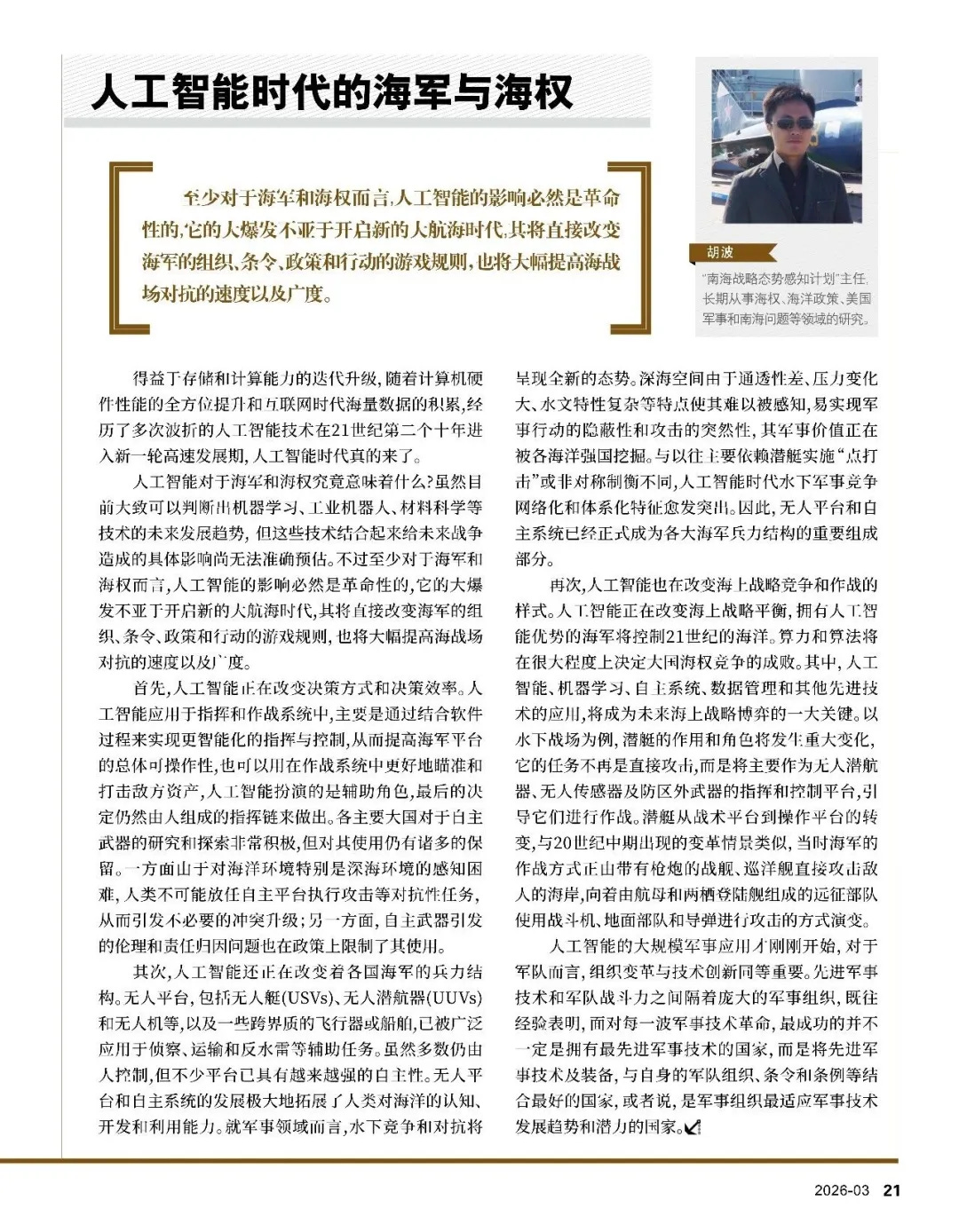
胡波:人工智能时代的海军与海权
Hu Bo: Navies and Sea Power in the Age of Artificial Intelligence
Driven by iterative upgrades in storage and computing power, broad improvements in computer hardware, and the accumulation of vast quantities of data in the Internet age, artificial intelligence (AI) has entered a new phase of rapid development in the 2020s after decades of repeated setbacks. The AI age has truly arrived.
What, then, does AI mean for navies and for sea power? Although the broad trajectories of technologies such as machine learning, industrial robotics, and materials science are already visible, the precise effects of their convergence on future warfare remain difficult to forecast. Even so, one point is already clear: for navies and maritime power, the implications of AI will be transformative. Its explosive rise may prove no less consequential than the opening of a new Age of Discovery. It is set to directly reshape the rules governing naval organisation, doctrine, policy, and operations, while also significantly expanding both the speed and the scope of competition at sea.
First, AI is changing how decisions are made and how quickly they can be made. In naval command and combat systems, AI is primarily used to enable more intelligent command and control through the integration of advanced software processes, thereby improving the overall operability of naval platforms. It can also strengthen combat systems by enabling more accurate targeting and more effective strikes against hostile assets. In this context, AI plays an auxiliary role, while final decisions are still made through a human command chain.
The world’s major powers have been actively investing in the research and development of autonomous weapons, yet they remain cautious about their actual deployment. One reason is the inherent difficulty of sensing and interpreting the maritime environment, especially the deep sea. Human operators cannot grant autonomous platforms full freedom to conduct offensive or confrontational missions, given the risk of unintended escalation. Another reason lies in the ethical and responsibility attribution problems raised by autonomous weapons, which impose policy constraints on their use.
Second, AI is also reshaping the force structure of navies around the world. Unmanned platforms, including unmanned surface vessels (USVs), unmanned underwater vehicles (UUVs), unmanned aerial vehicles (UAVs), and a range of cross-domain aircraft and vessels, are already widely used in support missions such as reconnaissance, transport, and mine countermeasures. Although most remain under human control, many platforms are acquiring ever greater autonomy.
The development of unmanned platforms and autonomous systems has greatly expanded humanity’s capacity to understand, exploit, and utilise the oceans. In the military sphere, in particular, underwater competition and confrontation will assume an entirely new character. The deep sea, with its low visibility, extreme pressure, and highly complex hydrological conditions, is inherently difficult to monitor and understand. These characteristics make it especially conducive to covert operations and surprise attacks, and its military value is now being explored by the world’s major maritime powers.
Unlike the past, when “point strikes” or asymmetric deterrence relied largely on submarines, underwater military competition in the AI age is becoming increasingly networked, integrated, and system-based. Unmanned platforms and autonomous systems have now formally become an important component of the force structure of major navies.
Third, AI is also transforming the patterns of maritime strategic competition and naval warfare. It is reshaping the strategic balance at sea, and the navies that possess an advantage in AI will command the oceans in the twenty-first century. Computing power and algorithms will, to a large extent, determine the success or failure of great-power competition for sea power. In this context, the application of AI, machine learning, autonomous systems, data management, and other advanced technologies will become a key factor in future maritime strategic rivalry.
Taking the undersea battlespace as an example, the function and role of submarines will undergo major changes. Their mission will no longer be direct attack; rather, they will function primarily as command-and-control platforms for unmanned underwater vehicles, unmanned sensors, and standoff weapons, directing them in combat. This evolution of submarines from tactical platforms into operational nodes is similar to the transformation of naval warfare in the mid-twentieth century, when fleets moved away from battleships and cruisers conducting direct bombardment towards expeditionary forces built around aircraft carriers and amphibious assault ships, using aircraft, ground forces, and missiles to conduct strikes.
The large-scale military application of AI has only just begun. For armed forces, organisational transformation is every bit as important as technological innovation. Between advanced military technology and actual combat effectiveness stands a vast military organisation. Past experience has shown that in each wave of military-technological revolution, the most successful country is not always the one that possesses the most advanced military technology, but rather the one that best integrates advanced military technology and equipment with its own military organisation, doctrine, and regulations. In other words, the most successful country is the one whose military organisation is best adapted to the trajectory and potential of military technological change.

Hu Bo: The Decline of U.S. Maritime Hegemony Exposed by Nimitz Aircraft Crashes

Hu Bo is Director of the South China Sea Strategic Situation Probing Initiative (SCSPI), and Research Professor & Director of the Centre for Maritime Strategy Studies, Peking University.
Hu Bo: de-hegemonisation of the international maritime order and the risk of regression

This is our fourth article translated from the special series in this year’s 16th issue of 世界知识 World Affairs, a Chinese-language magazine published by World Affairs Press under China’s Ministry of Foreign Affairs. The series features contributions from some of China’s “foremost scholars,” according to the magazine, on the theme
Transcript: Hu Bo on South China Sea

The South China Sea is again in the headlines, and I’m posting the transcript of my Peking Playbook podcast interview with Hu Bo, Research Professor and Director of the Center for Maritime Strategy Studies of Peking University and Director of the South China Sea Strategic Situation Probing Initiative (SCSPI)