


How Chinese Scholars View U.S. Think Tanks on Taiwan
An academic study published by a Chinese Academy of Social Sciences journal offers a revealing look at how mainland researchers interpret Washington’s influence on the Taiwan Strait—and where their arguments warrant closer scrutiny.
The following is our translation of a lengthy paper published in Taiwan Studies (台湾研究), an academic journal run by the Institute of Taiwan Studies at the Chinese Academy of Social Sciences (CASS). Written by three researchers from Xiamen University’s Graduate Institute for Taiwan Research, a major mainland research institution specialising in Taiwan policy, the paper examines how major American think tanks discuss the Taiwan Strait and how their research and policy recommendations might influence developments across the Strait. Although published as an academic study, the paper clearly has broader policy implications.
The authors say they examined 1,070 publications—249 research reports and 821 commentaries—produced by ten major U.S. think tanks between January 2020 and November 2025. The institutions are the American Enterprise Institute (AEI), the Atlantic Council, the Brookings Institution, the Carnegie Endowment for International Peace, the Center for Strategic and International Studies (CSIS), the Council on Foreign Relations (CFR), the Heritage Foundation, the Hudson Institute, the RAND Corporation, and the Wilson Center. Based on their analysis, the authors argue that these institutions have increasingly portrayed a military conflict over Taiwan as imminent, amplified perceptions of a “China threat”, and encouraged Washington and its allies to become more involved in Taiwan’s security. The paper also examines the influence of think-tank funding, political affiliations, and personnel moving between research institutions and government. Interestingly, it identifies a growing number of American voices advocating greater restraint on Taiwan, particularly in the context of Donald Trump’s second presidency.
We believe the paper is worth reading not necessarily because its conclusions are persuasive, but because of what it reveals about how mainland Chinese scholars specialising in Taiwan understand the American policy community. These university-based researchers belong to an academic and policy research ecosystem that helps inform mainland China’s discussions of Taiwan policy. The United States occupies a unique position in cross-Strait affairs, and understanding how Chinese researchers interpret American assessments, intentions, and policy recommendations is valuable in its own right—even when those interpretations are open to question.
This was a long article, and translating it took quite a bit of time. As we worked through the text, however, we noticed two issues. First, in two instances, the Chinese authors’ descriptions of English-language reports do not seem to match what those reports actually say. Yuxuan Jia has flagged both discrepancies in two in-text notes. Second, some of the arguments themselves are not entirely convincing. For example, the paper attributes growing public concern about cross-Strait conflict in Taiwan to U.S. think tanks’ efforts to “foster hostility and fear” without establishing a causal link or adequately considering other explanations. It also tends to characterise military scenario planning as fearmongering and presents U.S. arms sales to Taiwan primarily as a source of heightened tensions. What exactly contributes to stability or increases the risk of confrontation is, of course, a matter of considerable debate.
The authors are
The essay was published on 20 April in Issue 3, 2026 of 台湾研究 Taiwan Studies, a journal run by the Institute of Taiwan Studies at CASS. It is also available on the official WeChat blog of the Institute of Taiwan Studies.
美国主流智库对台海形势的话语塑造及其影响
How Mainstream U.S. Think Tanks Shape Discourse on the Taiwan Strait and Its Impact
Abstract
Mainstream think tanks are important participants in U.S. political life and have a significant influence on U.S. foreign policy decisions. Previous research has focused primarily on U.S. mainstream think tanks’ basic understanding of Taiwan policy but has not yet examined how they shape the situation in the Taiwan Strait.
This paper analyses research reports and commentaries on the Taiwan Strait situation published by ten major U. S. mainstream think tanks over the past five years, summarising the basic characteristics, main features, and impact of their discourse in shaping the Taiwan Strait situation.
The study finds that in the past five years, the number of research reports and commentaries on the Taiwan Strait situation published by U.S. mainstream think tanks has increased significantly and that the narratives advanced by these institutions have become highly similar: extensive portrayal of an imminent “Taiwan Strait war,” fabrication of the “China threat” fallacy, efforts to dominate the international discourse on the Taiwan Strait situation, thereby exerting public opinion pressure on China.
Keywords: U.S. Mainstream Think Tanks; Taiwan Strait Situation; Taiwan Question; Discourse Shaping
Funding: Major Project of the National Social Science Fund of China in Education, 2021, “Research on the History, Current Situation, and Future Strategies of Education in China’s Taiwan Region” (VOA210008).
Introduction
The United States is the most consequential external factor affecting the Taiwan question1, and its think tanks play an important role within this broader influence. The U.S. political system gives think tanks extensive opportunities to participate in national political life and influence government policy, allowing them to function as a “fourth power” alongside the legislative, executive, and judicial branches.2
In recent years, amid intensifying China–U.S. strategic competition and in support of Washington’s strategy of “using Taiwan to contain China,” U.S. think tanks have shifted from academic research towards strategic communication. They have actively reinforced U.S. political messaging3 by publishing large numbers of Taiwan-related reports and commentaries, seeking to influence developments in the Taiwan Strait by shaping public opinion and discourse, fostering misleading perceptions within the international community, and further heightening cross-Strait tensions. Their latest trends, motivations, and effects merit attention.
I. Mainstream U.S. Think Tanks and the Shaping of Taiwan Strait Discourse
As a form of political practice4, discourse refers to the use of language, symbols, and systems to construct and shape how people understand the world.5 It embodies ideas and conveys political concepts through texts, narratives, frameworks, and other forms. Through interaction among different actors, discourse helps construct shared understandings, beliefs, and social realities, thereby shaping perceptions.
Discourse shaping is one of the important functions of think tanks. Through agenda-setting, they influence public opinion and gradually build influence around the world. 6
Existing academic research focuses mainly on mainstream U.S. think tanks’ perceptions of Taiwan-related issues and their role in shaping perceptions of China7, while relatively little attention has been paid to how they shape discourse on the Taiwan Strait. Since the outbreak of the Russia–Ukraine conflict, mainstream U.S. think tanks have actively steered international discussion of the Taiwan Strait, spreading misperceptions of the Taiwan question and the Taiwan Strait situation, helping the United States rally allies to “counter China,” and safeguarding U.S. strategic interests in the Asia-Pacific.
The Taiwan Strait situation refers broadly to the state of political, economic, and military relations across the Strait, as well as social conditions and public opinion in Taiwan. Drawing on the University of Pennsylvania Library’s ranking of leading U.S. think tanks, this article selects ten mainstream institutions with significant political influence and substantial investment in Taiwan-related research. Their relevant research reports and commentaries form the analytical sample.
The Taiwan Strait situation mainly refers to the overall state of political, economic, and military relations across the Strait, together with social conditions and public opinion in Taiwan. Drawing on the University of Pennsylvania Library’s ranking of leading U.S. think tanks, this study selected ten mainstream think tanks with significant political influence and substantial investment in Taiwan-related research, using their relevant research reports and commentaries as the analytical sample. 8
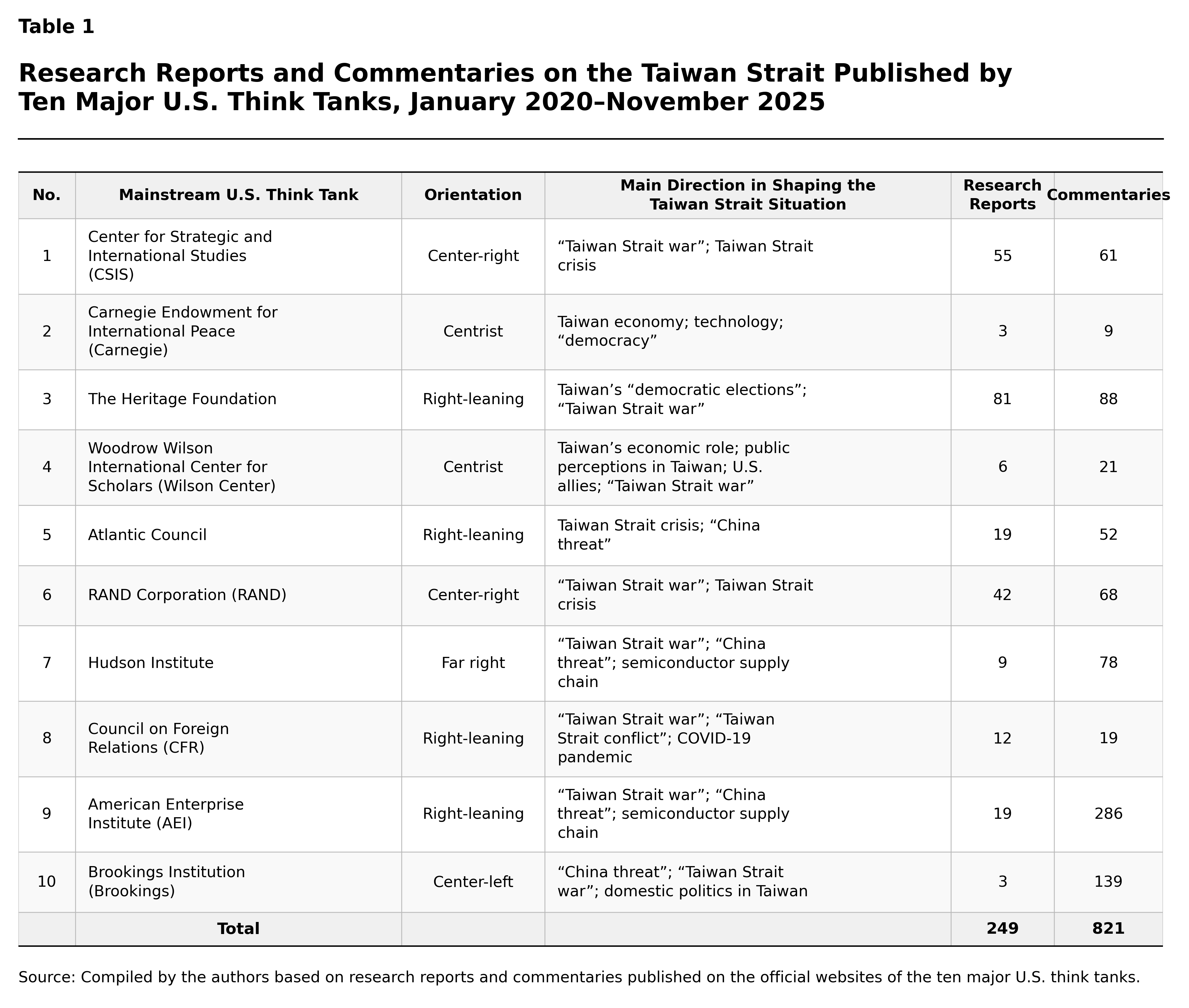
Using “Taiwan” as the keyword, this study searched the publications of these ten institutions for Taiwan-related research published between January 1, 2020 and November 25, 2025. The sample comprises 249 research reports and 821 commentaries, for a total of 1,070 items. Several patterns stand out.
(I) The Russia–Ukraine Conflict Has Intensified Efforts to Shape International Perceptions of the Taiwan Strait
As China–U.S. strategic competition has intensified, the Russia–Ukraine conflict has increasingly been linked to the Taiwan question. Mainstream U.S. think tanks have worked in step with the U.S. government to step up the promotion and amplification of Taiwan-related issues.
First, they extend the Russia–Ukraine conflict to a hypothetical “Taiwan Strait conflict” and draw analogies between the two.
For example, CSIS invokes the Russia–Ukraine conflict in discussing the Taiwan Strait, claiming that “Ukraine now, but Taiwan soon.” The Hudson Institute and the Heritage Foundation tend to advance a narrative that China is about to “invade” Taiwan, claiming that “the economic impact would be much more devastating and profound than that of the Ukraine war”, and call for “joining hands with America’s global allies and partners” against “the CCP threat.” They argue that “Even without direct military intervention from the United States, a Taiwan-China war would devastate the global economy like a weapon of mass destruction.” The Council on Foreign Relations (CFR) similarly argues that an expansion of the Russia–Ukraine conflict “could trigger corresponding actions by mainland China toward Taiwan.”
Yuxuan’s note: The CFR commentary cited in the original article does not appear to contain the claim that the Russia–Ukraine conflict “could trigger corresponding actions by mainland China toward Taiwan.”
Second, after the outbreak of the Russia–Ukraine conflict, the volume of Taiwan-related research published by mainstream U.S. think tanks increased markedly, drawing greater international attention to the Taiwan Strait. RAND and the Hudson Institute were particularly active. In the two years after the conflict began, RAND published 46 Taiwan-related reports, twice the number released in the preceding two years. Many of these drew on the Russia–Ukraine conflict to simulate scenarios of a “Taiwan Strait war.” The Hudson Institute published 51 studies over the same period, also a substantial increase. Taiwan-related discussion at the Heritage Foundation and other major think tanks likewise remained at a high level or increased significantly.
(II) A Detailed Focus on Cross-Strait Military Conflict and Calls for Early U.S. Preparation
Mainstream U.S. think tanks devote considerable attention to the possibility of cross-Strait military conflict. They construct hypothetical “Taiwan Strait war” scenarios in vivid detail, heightening a sense of crisis and encouraging Washington to intervene proactively to “prevent” conflict.
First, they focus heavily on cross-Strait military scenarios and develop them in considerable detail. In January 2023, CSIS published The First Battle of the Next War, simulating a hypothetical “amphibious invasion of Taiwan” by the Chinese mainland. The scenario described “an opening bombardment destroys most of Taiwan’s navy and air force in the first hours of hostilities. Augmented by a powerful rocket force, the Chinese navy encircles Taiwan and interdicts any attempts to get ships and aircraft to the besieged island. Tens of thousands of Chinese soldiers cross the strait in a mix of military amphibious craft and civilian rollon, roll-off ships, while air assault and airborne troops land behind the beachheads.” In June 2024, CSIS published another report detailing possible methods by which the Chinese mainland could blockade the island of Taiwan.
During the same period, the CFR released four Taiwan-related reports. These argue that “The post–Cold War era has drawn to a close, replaced by an era of great power competition and potentially great power conflict, with Taiwan being the most probable flashpoint,” and that “A conflict between the United States and the People’s Republic of China over Taiwan is becoming increasingly imaginable.” On January 7, 2025, CFR released its annual conflict-risk assessment, listing a Taiwan Strait crisis as a “Tier I contingency” for the eighth consecutive year and arguing that “Intensified military and economic pressure by China toward Taiwan precipitate a severe cross-strait crisis involving the United States and other countries in the region.”
RAND, meanwhile, has conducted intensive simulations of various models of a Taiwan Strait conflict, describing in detail scenarios such as Beijing employing multiple grey-zone tactics against Taiwan. Since 2023, it has published four volumes of Alternative Futures Following a Great Power War, each describing specific scenarios of a “Taiwan Strait war” in detail, including one in which “China begins the conflict with an attempted blockade of Taiwan” and even another in which China “detonated a nuclear weapon in the Pacific.”
In November 2024, RAND published another four-volume study centred on a potential “Taiwan Strait war,” further examining how the United States might employ military capabilities against China.
Second, they emphasise that a Taiwan Strait conflict would threaten global security and the international order, portray Taiwan as a U.S. “strategic partner,” and call on U.S. allies to step up their support for Taiwan. CSIS constructs an exaggerated role for Taiwan in U.S. national security and the international community, invoking the potentially negative impact of a conflict on the global economy to urge U.S. allies to help safeguard Taiwan’s security.
One commentary, for example, argues that Japan should “protect Taiwan from intensifying military intimidation and coercion”; another argues that Germany “emphasizes Taiwan’s importance as a trade and investment partner and suggests Berlin will be closely tracking Chinese aggression across the Taiwan Strait and broader Indo-Pacific”; and a third plays up the claim that the Philippines “increasingly recognize that they would have national security interests in any crisis around Taiwan.”
The Brookings Institution has also highlighted the role of the Taiwan authorities during the COVID-19 pandemic and called on the international community not to isolate Taiwan.
(III) Close Attention to the Impact of Taiwan’s Semiconductor Industry on U.S. and Global Technology and the Economy
Mainstream U.S. think tanks generally focus on Taiwan’s technological and economic position in global industrial and supply chains and call on the U.S. government to guarantee “Taiwan’s security” to strengthen the security and resilience of global supply chains.
On the one hand, they seek to elevate Taiwan’s role in U.S. technological and economic development and call on Washington to safeguard “Taiwan’s security.” The Carnegie Endowment for International Peace and the Wilson Center, for example, play up Taiwan’s “economic competitiveness” and its role in China–U.S. competition and the global semiconductor supply chain. They also advocate “better leverag[ing] partnerships with U.S. and other international players” to “bolster Taiwan’s standing in the global marketplace.”
A Hudson Institute commentary claims that “losing access to Taiwan’s semiconductor industry would have a negative impact on the U.S. economy greater than either the global financial crisis of 2008 or the COVID lockdown of 2020” and that “If the U.S. were no longer able to access Taiwan’s semiconductor industry, it would have a devastating impact on the U.S. economy.” The Heritage Foundation argues that Taiwan will remain the preferred centre of semiconductor manufacturing and calls for ensuring that it continues to supply the United States with high-quality, low-cost chips so that U.S. chip technology can retain its global lead. It therefore recommends greater U.S. investment in the Indo-Pacific and stronger deterrence in the region.
On the other hand, these institutions strongly emphasise the possible impact of a “Taiwan Strait war” on the global economy and semiconductor supply chains. Mainstream U.S. think tanks tend to link a hypothetical Taiwan Strait war to global geopolitics and the vulnerability of semiconductor supply chains, arguing that geopolitical shifts could create enormous risks for Taiwan and the rest of the world.
A RAND report states that production of the highest-end semiconductors “exists almost entirely in Taiwan” and argues “China’s desired unification with Taiwan could lead to disruptions in the fabrication of semiconductors in Taiwan, which would have ripple effects across the U.S. and global economies.” It adds that effective short-term responses are generally lacking, while “players in the TTX were surprised at the degree of interdependence” and “were not aware of the time and expense that would be required to reorient an industry built up over decades.”
The Wilson Center argues that “CCP control of Taiwan would erode US global power to a level last seen in the early 1900s.” A CSIS report titled Crossroads of Commerce: How the Taiwan Strait Propels the Global Economy states that more than 20 per cent of global maritime trade passes through the Taiwan Strait and accuses China of using a range of measures to “pressure Taiwan,” potentially causing severe disruption to global trade.
These think tanks seek to tie the prospect of a “Taiwan Strait conflict” to global economic and technological interests, using Taiwan’s importance and rising tensions in the Strait to incite and encourage greater international interference in Taiwan Strait affairs.
(IV) Some Think Tanks Have Begun to Advance More Positive Arguments on the Taiwan Question from the Perspective of Stabilising China–U.S. Relations
Some U.S. think tanks and policy elites have begun to reassess cross-Strait relations from a more pragmatic, positive, and constructive perspective. They argue that maintaining peace in the Taiwan Strait and promoting the peaceful development of cross-Strait relations are important to stabilising relations between China and the United States. Some have even begun, from the standpoint of U.S. interests, to consider the possibility of peaceful reunification across the Strait. This trend has become more evident since Trump began his second term.
First, they emphasise the importance of China–U.S. relations and argue that the relationship is becoming increasingly important to U.S. global strategy. They regard keeping the situation in the Taiwan Strait under control as a fundamental prerequisite for maintaining stable bilateral relations.
For example, an Atlantic Council article published in February 2025 argues that “China and the United States have decided that coexistence is the preferable direction for their relationship…Their rivalry has been channeled through other pathways short of war…And they’ve found, more than occasionally, that their interests actually intersect.”
A CSIS report published in March 2025 argued that during Trump’s first term, China and the United States maintained hardline positions and found it extremely difficult to reach agreements. During Trump’s second term, however, the two sides might be able to reach a deal on Taiwan-related security issues: “Washington could pledge to oppose (or at least “not support”) Taiwan’s de jure independence, and Beijing could commit to not attack the island.”
Second, some think tanks have explored the possibility of accepting “peaceful reunification,” giving rise to a new form of the “Taiwan abandonment” argument.9 Since 2020, a new round of such arguments has emerged within the U.S. strategic community. They hold that Washington should not overstate the costs of “losing Taiwan” and should pursue a more rational and pragmatic Taiwan Strait policy.
Representative figures include RAND Senior Political Scientist Michael Mazarr and Quincy Institute Senior Research Fellow Michael Swaine. They advocate a gradual abandonment of Taiwan, reject an unconditional commitment to “assist in Taiwan’s defence, stress that Taiwan is a non-vital U.S. interest, and argue that Washington should distance itself from “Taiwan independence” forces.10
For example, RAND published Stabilizing U.S.–China Rivalry, a report led by Mazarr, which recommends adjustments to Washington’s long-standing approach of strategic ambiguity and calls for more proactive reassurance, including stating that the United States “does not support Taiwan independence, seek a permanent separation across the Straits, or oppose peaceful unification,” with the aim of encouraging Beijing to favour gradual and peaceful approaches to unification over the use of force. Such language is extremely rare in open U.S. policy debate.
Foreign Affairs, published by the Council on Foreign Relations, has also carried several articles containing elements of the “Taiwan abandonment” argument. One, The Taiwan Fixation: American Strategy Shouldn’t Hinge on an Unwinnable War, argues that exaggerating Taiwan’s strategic significance and importance to the United States could precipitate a catastrophic conflict. It advocates that “the United States insulate its regional interests from Taiwan’s fate” and that “instead of clarifying its commitment to defend Taiwan, Washington should retain an ambiguous stance.”
Another Foreign Affairs article, Toward a Taiwan Truce, argues that the United States would find it difficult to achieve a decisive victory in a potential military conflict in the Taiwan Strait and should therefore adjust its current strategy to avoid a direct military confrontation with the Chinese mainland.
Leon Hadar, a senior fellow at the Foreign Policy Research Institute, also published an article titled Taiwan and the limits of American power: Should America really send its daughters and sons to die in the Taiwan Strait? He argues that Taiwan is a “peripheral interest” for the United States but a “core interest” for mainland China. Citing assessments that “China would likely prevail in a conventional conflict over Taiwan,” Hadar argues that current U.S. policy toward Taiwan risks becoming a “costly overextension of American power” and is inconsistent with genuine U.S. national interests. He therefore recommends that the United States “explore diplomatic solutions that acknowledge Chinese concerns about sovereignty while preserving Taiwan’s democratic autonomy.”
Such arguments, which contain elements of both “opposition to Taiwan independence” and “Taiwan abandonment,” signal an important shift underway within the U.S. strategic community. They indicate that U.S. strategists have begun to reassess Taiwan’s role and place in U.S. global strategy and place great emphasis on avoiding a China–U.S. military conflict.
II. The Context Behind Emerging Trends in U.S. Think-Tank Discourse on Taiwan
(I) Changes in China–U.S. Strategic Competition Have Increased the Incentive to Exploit the Taiwan Question
First, China–U.S. strategic competition has entered a new stage. As Taiwan’s geopolitical value has become more pronounced, U.S. think tanks have increasingly sought to play the “Taiwan card” to pressure China and preserve U.S. strategic advantages. In October 2018, then U.S. Vice President Mike Pence delivered a speech at the Hudson Institute in which he levelled groundless accusations and malicious smears against China. This speech was the first time since the Clinton administration that a senior U.S. leader had openly attacked China in explicitly Cold War terms, marking a new stage in U.S. strategic containment of China.11
After Biden took office in 2020, U.S. strategy toward China shifted from the Trump administration’s first-term focus on the growth of Chinese military power to greater concern over challenges posed by China to U.S. security interests in the Asia-Pacific, with increasing attention directed toward Taiwan. The outbreak of the Russia–Ukraine conflict in 2022 further heightened U.S. anxiety over the Taiwan Strait.12 At the same time, the DPP authorities intensified efforts to “seek independence by relying on external forces” and expanded their ties with the United States, contributing to continued cross-Strait tensions.
Mainstream U.S. think tanks accordingly stepped up their support for Washington’s intervention in and exploitation of Taiwan. Some have even advocated moving U.S. Taiwan policy from “strategic ambiguity” toward “strategic clarity” and brazenly called for preparations for the possibility of direct armed conflict between China and the United States in the Taiwan Strait.13
Second, Taiwan’s semiconductor industry enjoys distinctive advantages amid the current wave of artificial intelligence, making Taiwan’s role in global industrial and supply chains increasingly important in U.S. assessments. Since the beginning of the twenty-first century, a new industrial revolution centred on artificial intelligence has gathered pace, yet the United States remains heavily dependent on semiconductors manufactured in Taiwan. It is widely believed in the United States that any disruption to semiconductor supply chains could deal a major blow to both the U.S. and global economies, while Chinese dominance of the semiconductor market would pose serious economic and security risks. Republicans, in particular, have urged the U.S. government to build semiconductor markets and supply chains that are not dependent on China, protect and accelerate the development of critical industries such as artificial intelligence, and, on that basis, deepen military support for Taiwan.
(II) Trump’s Second Term Has Prompted U.S. Think-Tank Elites to Consider More Actively How to Avoid China–U.S. Conflict
For many years, official U.S. language on Taiwan Strait policy largely stopped at “opposing” or “not supporting Taiwan independence.” Trump’s second term, however, has profoundly disrupted the global landscape and geopolitics and upended a century of U.S. global strategy.14 These changes in the international environment have prompted Washington to rethink the direction of its China policy. To avoid being drawn into an uncontrollable spiral of conflict, China–U.S. relations need to move towards a model of limited and managed competition.
First, the Trump administration has shifted the priorities of U.S. global strategy, placing greater emphasis on stable competition between China and the United States. Since Trump began his second term, U.S. global strategy has undergone significant change. His “America First” foreign policy approaches Taiwan through a more transactional and instrumental lens, recognising the importance of the Taiwan question to China and placing greater weight on stability in China–U.S. major-power relations.
On January 17, 2025, during a phone call with the Chinese leader, Trump stated that “As the most important countries in the world, the United States and China should get along well for years and beyond and work together for world peace.” During another call between the two leaders on June 5, Trump said that he has “great respect for President Xi, and the U.S.-China relationship is very important. The U.S. wants the Chinese economy to do very well...The U.S. will honor the one-China policy.”
The new U.S. National Security Strategy strongly reflects this adjustment in Trump’s policy. It places greater emphasis on U.S. security interests in the Western Hemisphere and, to some extent, seeks to play down great-power competition and the “China threat” narrative.15 At the same time, it attaches greater importance to economic relations with China, assesses Taiwan’s value more through its geographical position and leading role in the semiconductor industry, and makes conflict prevention a priority.
This shift echoes more restrained voices emerging in the United States, which favour steering China–U.S. relations towards a path of manageable competition in which cooperation takes precedence over confrontation, thereby creating greater space to avoid major-power conflict and preserve the international order. More U.S. think tanks are expected to reassess Taiwan’s position and China–U.S. relations against the backdrop of this strategic adjustment and to analyse the future course of cross-Strait relations more rationally.
Second, U.S. society and policymakers are taking a more rational view of China’s proposal for “peaceful reunification and one country, two systems.” As China’s strength continues to grow and the United States’ relative advantage narrows, Taiwan’s instrumental value and marginal utility in U.S. strategic competition are gradually declining. Some think tanks have begun urging Washington to take a more open attitude towards China’s proposal for peaceful reunification and to regard Taiwan as a bargaining chip in China–U.S. negotiations and strategic rebalancing, pushing U.S. policy towards Taiwan from “using Taiwan to contain China” towards “risk management.”
This shift is reflected in RAND’s suggestion that “the United States could balance its commitments to Taiwan with leveraging its influence to ensure that Taiwan’s actions do not escalate tensions with China and destabilise cross-Strait security”, as well as in views expressed by Mazarr and others that the United States should “not oppose peaceful unification”.16
(III) Differences in Think Tanks’ Taiwan Strait Narratives Reflect Partisan Alignment and Funding Sources
Many think tanks, under the authorisation or influence of the U.S. government, provide ammunition for U.S.-led public-opinion and cognitive warfare by creating concepts, advancing propositions, and publishing reports. Although mainstream U.S. think tanks all seek to shape the discourse on the Taiwan Strait, they advance different narratives reflecting their respective partisan backgrounds and funding sources.
First, differences in partisan orientation and funding lead think tanks to portray the Taiwan Strait situation in different ways. Most U.S. think tanks have partisan backgrounds and also receive financial support from the U.S. government and its allies. Since 2019, the U.S. government has directly provided at least US$1.49 billion to major think tanks, of which US$1.4 billion went to RAND, which provides services to the U.S. government. Major think tanks also frequently receive funding from U.S. Department of Defense contractors or foreign agents. Differences in funding sources require these institutions to take funders’ interests into account when producing research and policy recommendations, resulting in varying degrees of assertiveness in their portrayals of the Taiwan Strait situation.
RAND, for example, given its close ties to the U.S. military-industrial complex, regularly publishes studies that amplify the “China threat” narrative and assess China’s military power17, with a particular focus on a “Taiwan Strait war” and Taiwan Strait crises.
In addition, mainstream U.S. think tanks differ markedly in the language they use to frame the situation in the Taiwan Strait, reflecting the support they receive from different political parties. The Brookings Institution receives support from Democrats; the Heritage Foundation and the AEI from Republicans; while centrist institutions such as RAND and CSIS receive bipartisan support or work on a nonpartisan basis.
Republican-supported think tanks are more supportive of Taiwan and more likely to use political language that carries separatist and hegemonic implications, such as “aggression,” “invade,” and “annex,” which employ hostile and disparaging rhetoric about China and frame the Taiwan Strait in ways favourable to Taiwan. Think tanks with Democratic ties, such as Brookings, tend to use more moderate language and publish fewer articles invoking the “theory of Taiwan’s undetermined status,” relying more often on comparatively neutral terms such as “blockade” and “Taiwan Strait conflict.”
Second, the extent of a think tank’s interaction with the DPP authorities affects its position on Taiwan-related issues. The deeper the contact, the more supportive the think tank tends to be of the Taiwan authorities’ position. According to the authors’ statistics, between 2020 and 2025, the DPP authorities met delegations from the ten major U.S. think tanks 23 times: six from the Atlantic Council, five from Brookings, four from the Heritage Foundation, three from CSIS, two from AEI, and one each from the Hudson Institute, RAND, and the Wilson Center.18 Leaders of the Taiwan authorities received most of these delegations, which helped deepen the think tanks’ support for Taiwan in areas including trade, technology, and values.
In addition, the DPP authorities frequently co-host seminars with mainstream U.S. think tanks or are invited to deliver speeches. For example, the Hudson Institute invited Tsai Ing-wen to speak on Taiwan’s external, economic, and security challenges. The Taiwan authorities also cooperate annually with several mainstream U.S. think tanks, including Hudson, on issues such as Taiwan Strait security, Taiwan–U.S. relations, and Taiwan’s participation in international activities. This fuels further discussion of Taiwan Strait issues and amplifies the “theory of Taiwan’s undetermined status.”
III. Motives and Effects of Mainstream U.S. Think Tanks’ Efforts to Shape Taiwan Strait Discourse
(I) Creating Public-Opinion Pressure and Influencing U.S. Taiwan Strait Policymaking
Under the leadership of the U.S. government, think tanks, media organisations, and other social actors actively participate in manipulating public opinion and shaping perceptions. The U.S. government first uses think tanks and other third-party institutions to provide theoretical packaging for its policy positions and formulate policy recommendations, then relies on media hype and support from politicians to disguise these positions as “social consensus,” before ultimately implementing policies in the name of public opinion.
First, think tanks publish large numbers of Taiwan-related reports and commentaries, providing strategic recommendations and policy ideas to the U.S. government, creating platforms for dialogue, and promoting discussion of Taiwan Strait issues, thereby serving as a reference for government decision-making on Taiwan.
Heritage Foundation commentaries, for example, not only explicitly advise the U.S. government to shift toward “strategic clarity,” but also spell out how the United States could intervene in a “Taiwan Strait conflict.” The Heritage Foundation has further argued that the United States needs Taiwan to win the semiconductor race and should deploy munitions in the Taiwan Strait region to deter China. 19
CSIS’s 48-page report Strengthening Resilience in Taiwan devotes roughly 40 pages to detailed policy recommendations on how the United States should respond to a “Taiwan Strait war” and confront China. RAND likewise constructs Taiwan Strait conflict scenarios from multiple angles before advancing concrete policy recommendations for the United States, including expanding military exchanges, increasing arms sales to Taiwan, revising the long-standing policy of “strategic ambiguity,” and strengthening U.S. “commitments to Taiwan.”
The large volume of research and policy recommendations produced by these think tanks provides a substantial body of material for policy debates and legislative initiatives across the U.S. government. Think tanks also seek to shape public opinion on Taiwan Strait issues by organising seminars and report launches, publishing commentaries in mainstream media, and giving interviews, thereby influencing government decision-making. U.S. State Department spokespersons frequently cite data and examples from think-tank reports, helping these views spread rapidly through international media.20
Second, think-tank personnel can enter relevant government departments through the “revolving door,” directly participate in decision-making on Taiwan-related affairs, or testify before Congress in support of or opposition to specific legislation, thereby influencing Taiwan policy.
Rush Doshi, now a Senior Fellow for Asia Studies at the Council on Foreign Relations, had directed the Brookings China Strategy Initiative before entering government. From 2021 to 2024, he served as the National Security Council’s Senior Director for China and Taiwan, helping coordinate U.S. government policy on Taiwan. His book The Long Game: China’s Grand Strategy to Displace American Order discusses U.S. strategy on the Taiwan Strait and directly influenced the Biden administration’s Taiwan policy.
Ely Ratner previously served as a Senior Fellow for China studies at the Council on Foreign Relations and as an Associate Political Scientist at RAND. From 2021 to 2025, he served at the Department of Defense as Assistant Secretary for Indo-Pacific Security Affairs, directly participating in decisions on arms sales to Taiwan and deterrence.
Former Secretary of State Mike Pompeo joined the Hudson Institute as a Distinguished Fellow and took part in policy discussions while there. Former Vice President Mike Pence joined the Heritage Foundation as a Distinguished Visiting Fellow. Kathleen Hicks of CSIS was nominated during the Biden administration to serve as Deputy Secretary of Defense.
Think-tank experts also provide members of the House and Senate with analyses and professional assessments of the Taiwan Strait through non-public channels, including rapid briefings and position papers,21 thereby influencing Taiwan-related legislation.
On 7 February 2023, for example, Brookings scholar Melanie Sisson testified before the House Armed Services Committee that “The modernization of the PLA has changed the regional military balance and significantly…It is therefore essential that Congress ensures DOD is equipped in concept and in capability to deter PLA aggression.” She argued that the United States should join in the defense of Taiwan and “encourage the government of Taiwan to adopt a defense concept.”
Subsequently, on 18 April 2023, the House Armed Services Committee took part in drafting the FY2024 National Defense Authorization Act. The legislation called for the United States to provide Taiwan with security assistance, defence articles, and services; continue supporting the development of Taiwan’s military capabilities to maintain its defensive capacity; and strengthen Taiwan’s reserve forces. It also required the Director of National Intelligence to “seek to enter into a contract with an eligible entity to conduct a comprehensive study on the global economic impact of a military invasion of Taiwan by the People’s Republic of China or certain other aggressive or coercive actions taken by the People’s Republic of China with respect to Taiwan.” The NDAA was signed into law on 22 December 2023. These provisions illustrate the growing role of mainstream U.S. think tanks in shaping Taiwan-related legislation and the extent to which their arguments are taken up and endorsed by government institutions.
(II) Linking the Taiwan Strait to International Security Interests and Encouraging Allies to Share Defence Responsibilities
At present, many countries do not fully share the U.S. view of the importance of peace and stability across the Taiwan Strait, while many of Washington’s major allies lack a basic understanding of Taiwan’s history, the state of cross-Strait relations, and regional geopolitics. Mainstream U.S. think tanks therefore argue that Washington needs to address this perception gap, strengthen its messaging on the Taiwan Strait, and repeatedly explain how peace and stability across the Strait serve the interests of individual countries.22
For example, in June 2024, RAND published Middle-Power Equities in a Cross-Strait Conflict, which examined the interests of four U.S. allies—Australia, Canada, Japan and the United Kingdom—in a cross-Strait conflict. The report found that these countries were relatively unlikely to become actively involved in a “Taiwan Strait war”, yet RAND still recommended that they develop a trade sanctions plan targeting China.
U.S. think tanks use “interest bundling” to depict scenarios in which the Chinese mainland “invades, threatens, or launches war,” playing up the threat posed by China’s military and hyping the risks of a Taiwan Strait conflict to push U.S. allies to align more closely with Washington’s China policy.23
A RAND report published in November 2025 discusses economic measures that the United States, Australia, Japan, the United Kingdom, and other countries could take to deter a hypothetical “blockade or invasion on Taiwan”. It particularly recommends heightening fear and hostility toward the perceived threat from China within Japan and leveraging Japan’s “technical ability to impose a variety of sanctions on China within a relatively short time.”
Yuxuan’s note: The RAND report mentioned here presumably refers to Economic Deterrence in a China Contingency, published in November 2025. The report does state that Japan has the “technical ability to impose a variety of sanctions on China within a relatively short time.” However, I could not find a corresponding passage recommending that fear or hostility toward China be heightened among the Japanese public, as the Chinese text suggests.
Mainstream U.S. think tanks seek to influence public opinion and attitudes in other countries, encouraging U.S. allies and other stakeholders to share responsibility for defence and respond collectively to a conflict.
(III) Supporting the Taiwan Authorities’ Publicity Efforts and Shaping Hostility toward the Mainland among Taiwan’s Public
First, mainstream U.S. think tanks lend support to the DPP authorities’ domestic and international messaging efforts by shaping public discourse on Taiwan and seeking to influence U.S. policymaking on Taiwan. By co-hosting conferences with the Taiwan authorities, they help “give Taiwan a voice.”24
For example, in August 2025, a Brookings delegation including Ryan Hass met Lai Ching-te to discuss strengthening military capabilities and cooperation in the Indo-Pacific. In September 2025, the Heritage Foundation invited Chiu Chui-cheng, head of Taiwan’s Mainland Affairs Council, to the United States to promote the Taiwan authorities’ external policy positions.
Mainstream U.S. think tanks have also actively promoted the narrative that the Chinese mainland will use force to reunify Taiwan in 2027, which helps the DPP authorities formulate their so-called “defence” plans. Amid escalating political confrontation across the Strait, mainstream U.S. think tanks have sought to goad the Taiwan authorities into purchasing U.S. weapons for “self-defence”, further heightening the risk of conflict in the Taiwan Strait.
Second, mainstream U.S. think tanks seek to influence public opinion in Taiwan and shape how Taiwanese people perceive the situation across the Taiwan Strait, thereby strengthening support for the Taiwan authorities’ “defence” policies. Through a large volume of commentaries and op-eds by think-tank researchers in the media, they portray cross-Strait conflict as imminent and stoke public fears of war.
A 2023 poll by Taiwan’s Global Views Monthly found that only 23.5 per cent of respondents believed war across the Strait was possible within the next five years, while 64.6 per cent considered it unlikely. By contrast, a 2025 survey by the magazine found that 53.7 per cent believed war was possible within the next three years, while only 38.2 per cent considered it unlikely. Similarly, a 2022 survey by Taiwan’s CommonWealth Magazine found that more than 60 per cent of respondents were not worried about a cross-Strait war within the next year. By October 2023, however, 46 per cent of respondents expressed concern about a possible war within the next five years.
This shift in public perceptions is closely related to the sustained efforts of mainstream U.S. think tanks to foster hostility and fear toward the Chinese mainland among Taiwan’s public.
Conclusion
Mainstream U.S. think tanks’ efforts to shape discourse on the Taiwan Strait constitute an important part of Washington’s cognitive warfare against China and the U.S. effort to shape international discourse. Over the past five years, mainstream U.S. think tanks have frequently published research reports and commentaries on the Taiwan Strait, manipulating public narratives. Their discourse has been highly consistent, playing up the prospect of an inevitable war across the Strait, shifting primary responsibility for escalating tensions onto the Chinese mainland, promoting the narrative of China seeking to “annex Taiwan”, and attempting to portray China as a “revisionist state seeking hegemony”.
This discourse not only generates public pressure on the U.S. government and influences its Taiwan-related policymaking, but also has a knock-on effect on U.S. allies. It further shapes the Taiwan authorities’ cross-Strait policy choices and influences public perceptions of the situation across the Taiwan Strait.
In response, China should, on the one hand, closely monitor the latest developments in mainstream U.S. think tanks’ efforts to shape discourse on the Taiwan Strait, rebut erroneous views, and expose their attempts to exploit the Taiwan question to undermine China. On the other hand, China should strengthen regular exchanges and cooperation with U.S. think tanks and actively shape perceptions of cross-Strait relations within the U.S. intellectual community.
Surveying The U.S. Debate on Taiwan Policy

Two Chinese scholars have traced the shifting balance in U.S. strategic thinking on Taiwan since 2020: under Biden, the resurgence of arguments for a clearer U.S. commitment to defend Taiwan alongside persistent support for strategic ambiguity and restraint; and under Trump, the growing influence of gradual Taiwan-abandonment arguments. The authors ulti…

In their research reports and commentaries, mainstream U.S. think tanks almost invariably refer to “China” and “Taiwan” side by side when discussing cross-Strait relations. This contravenes the one-China principle: Taiwan is part of China and should not be placed on an equal footing with China. However, to accurately reflect how these think tanks portray the situation across the Taiwan Strait, this article has left their original wording unchanged when quoting their publications.
Song Lu and Wu Cong, “How U.S. Conservative Think Tanks Influence Government Policy toward China” (《美国保守派智库如何影响政府对华政策》), People’s Tribune (《人民论坛》), no. 26 (2020), pp. 125–127.
Zheng Yibing and Yang Xianghui, “The Shifting Mission of U.S. Think Tanks: From Academic Research to Strategic Advocacy” (《美国智库的任务转向:从学术研究到战略宣传》), Peace and Development (《和平与发展》), no. 1 (2024), pp. 109–131.
Norman Fairclough, Language and Social Change (《话语与社会变迁》), translated by Yin Xiaorong, Beijing: Huaxia Publishing House, 2003, p. 62.
Wang Jinqiang and Huang Meibo, “The Construction of Discourse on the ‘Global South’ in the West and China’s Theoretical Transcendence” (《西方“全球南方”话语构建与中国的理论超越》), Northeast Asia Forum (《东北亚论坛》), no. 3 (2025), pp. 3–21.
Henry Huiyao Wang and Mabel Lu Miao, The “Fourth Force” Behind Great Powers (《大国背后的“第四力量”》), Beijing: China CITIC Press, 2017, p. 155.
For studies of U.S. think tanks’ policy positions on China strategy, military security, economic and technological relations, and Taiwan policy, as well as mainstream U.S. think tanks’ views on Taiwan policy following the Russia–Ukraine conflict, see Zhou Wenxing, “U.S. Think Tanks’ Perceptions of China Policy, Their Origins and Responses: A Comparative Analysis Based on Think Tank Experts’ Research on China” (《美国智库对华政策的认知、根源及其应对——基于智库专家涉华研究的比较分析》), Journal of Intelligence (《情报杂志》), no. 2 (2023), pp. 57–64; Zhou Wenxing and Yao Huanyu, “Mainstream U.S. Think Tanks’ Perceptions of Taiwan Policy and Their Impact Following the Russia–Ukraine Conflict” (《俄乌冲突后美国主流智库对台政策认知及其影响》), Taiwan Strait Studies (《台海研究》), no. 1 (2023), pp. 148–162. Lou Yaping and Wang Huitian find that mainstream U.S. think tanks’ views on Taiwan policy have become increasingly conservative and their positions on China increasingly hard-line. See “An Assessment of Mainstream U.S. Think Tanks’ Views on Taiwan and Their Influence (2017–2023)” (《美国主流智库的涉台认知及影响力评估(2017–2023)》), Taiwan Studies (《台湾研究》), no. 6 (2024), pp. 71–83; Zeng Cheng and Liu Wei, “Framing Taiwan-Related Issues in U.S. Conservative Think Tanks and China’s Countermeasures: A Case Study of the Hudson Institute” (《美国保守派智库涉台议题框架建构及中国对策——基于哈德逊研究所的分析》), Think Tank: Theory & Practice (《智库理论与实践》), no. 3 (2024), pp. 136–145.
The classification of U.S. think tanks’ political orientations in this article draws primarily on Li Dingxin and Huang Hui, “Moving to the Right: A Brief Analysis of the Political Leanings of Major U.S. Think Tanks and Their Positions on China in Recent Years” (《走向右倾——近年来美国主要智库政治倾向与对华立场简析》), Think Tank: Theory & Practice (《智库理论与实践》), no. 4 (2022), pp. 108–112.
Professor Charles Glaser of George Washington University is regarded as the first scholar to systematically advance the “abandon Taiwan” argument. In 2011, he published two consecutive articles in Foreign Affairs, arguing that the United States should abandon its security commitment to Taiwan and withdraw from the Taiwan issue to avoid a war between China and the United States over Taiwan. He reiterated this view in 2021, arguing that as China’s power grows, the strategic costs of maintaining U.S. security commitments to Taiwan have risen significantly and that Washington must reassess its policy. See Charles Glaser, “Will China’s Rise Lead to War? Why Realism Does Not Mean Pessimism,” Foreign Affairs, 1 March 2011, https://www.foreignaffairs.com/articles/asia/2011-03-01/will-chinas-rise-lead-war.
Yuan Zheng and Guan Chenglong, “The Rise and Impact of a New Wave of ‘Abandon Taiwan’ Thinking in the U.S. Strategic Community” (《美国战略界新一轮“弃台论”的兴起及影响》), Taiwan Strait Studies (《台海研究》), no. 4 (2025), pp. 12–22.
Zhu Feng and Ling Banghao, “From Trump 1.0 to Trump 2.0: An Examination of U.S. Strategic Competition Policy toward China” (《从特朗普1.0到特朗普2.0:美国对华战略竞争政策透视》), International Outlook (《国际展望》), no. 2 (2025), pp. 1–24.
Wu Xinbo, “The Evolution of U.S. Asia-Pacific Strategy and the Future Regional Security Landscape” (《美国亚太战略演变与地区安全格局走向》), World Economics and Politics (《世界经济与政治》), no. 9 (2025), pp. 3–22.
Diao Daming, “From 1.0 to 2.0: Continuity and Policy Changes in the Trump Administration’s China Security Strategy” (《从1.0到2.0:特朗普政府对华安全战略的延续与政策变化》), Journal of International Security Studies (《国际安全研究》), no. 1 (2025), pp. 96–114.
Xin Qiang and Diao Guoxuan, “‘America First’: U.S.–Taiwan Security Relations Heading Toward Divergence in Trump’s Second Term” (《“美国优先”:特朗普第二任期美台安全关系走向分歧》), Taiwan Studies (《台湾研究》), no. 1 (2025), pp. 9–19.
Gideon Rachman, “Trump’s America and a Clash of Civilisations with Europe,” Financial Times, 8 December 2025, https://www.ft.com/content/953635f0-4b87-41a4-a087-e8b1d71470b6; “Die Transatlantische Allianz Existiert Nicht Mehr” [The Transatlantic Alliance No Longer Exists], Tagesschau, 8 December 2025, https://www.tagesschau.de/ausland/amerika/usa-sicherheitsdoktrin-europa-100.html; “Trumpworld Thinks Europe Has Betrayed the West,” The Economist, 2 December 2025, https://www.economist.com/international/2025/12/02/trumpworld-thinks-europe-has-betrayed-the-west.
On 14 October 2025, RAND publicly released a report advancing what has been described as an “abandon Taiwan” position. The report stated: “Examples could include U.S. statements that it does not support Taiwan independence, seek a permanent separation across the Straits, or oppose peaceful unification.” The report has since been withdrawn for further review. See Michael J. Mazarr, Amanda Kerrigan, and Benjamin Lenain, “Stabilizing the U.S.–China Rivalry”, RAND, 14 October 2025.
Li Dingxin and Huang Hui, “Moving to the Right: A Brief Analysis of the Political Leanings of Major U.S. Think Tanks and Their Positions on China in Recent Years” (《走向右倾——近年来美国主要智库政治倾向与对华立场简析》), Think Tank: Theory & Practice (《智库理论与实践》), no. 4 (2022), pp. 108–135.
The author counted the number of visits by delegations from Taiwan’s Democratic Progressive Party (DPP) to ten leading U.S. think tanks between 1 January 2020 and 25 November 2024.
Michael Cunningham, “Should the USA Maintain Its Policy of Strategic Ambiguity Towards Taiwan?” The Heritage Foundation, June 24, 2024, https://www.heritage.org/china/commentary/should-the-usa-maintain-its-policy-strategic-ambiguity-towards-taiwan; Wilson Beaver and Jim Fein, “The U.S. Needs More Munitions To Deter China,” The Heritage Foundation, December 29, 2023, https://www.heritage.org/defense/commentary/the-us-needs-more-munitions-deter-china.
Zeng Xiaonan, “U.S. Think Tanks and U.S. Cognitive Warfare Against China” (《美国智库与美国对华认知战》), United Front Forum (《统一论坛》), no. 4 (2024), pp. 11–15; Huang Rihan and Zhang Danqi, “Implications of U.S. Think Tanks’ Opinion Production and International Communication for China” (《美国智库的舆论生产与国际传播对中国的启示》), Think Tank: Theory & Practice (《智库理论与实践》), no. 4 (2022), pp. 93–99.
“The 18th China–U.S. Political and Economic Forum: Report Launch and Seminar on ‘The Role of Think Tanks in U.S. Political and Economic Policymaking’ Held Successfully” (《中美政经论坛(第十八期)“智库在美国政治经济政策制定中的作用”报告发布与研讨会成功举行》), National Academy of Development and Strategy, Renmin University of China, 17 March 2025, https://nads.ruc.edu.cn/zkdt/698cf91a4bde4f089c018b1aa60ace7a.htm.
“U.S. Think Tank Report: Countries’ Own Interests Are More Likely to Spur Concern About the Taiwan Strait Situation” (《美国智库报告:切身利益更能激发各国对台海局势的关切》), Lianhe Zaobao (Singapore), 9 June 2025, https://www.zaobao.com.sg/news/china/story20240215-1468365.
Zhao Minghao and Yang Hongjia, “New Trends in Great-Power Competition and U.S. Intervention in the Taiwan Issue” (《大国竞争与美国干涉台湾问题的新趋向》), Contemporary American Review (《当代美国评论》), no. 1 (2024), pp. 1–24.
Guo Jinyue, “Taiwan’s ‘Agents’ Lobbying the U.S. Congress (2021–2023): A Micro-Level Examination Based on U.S. Department of Justice Records” (《台湾“代理人”对美国国会的游说(2021~2023)——基于美国司法部档案的微观考察》), The Chinese Journal of American Studies (《美国研究》), no. 3 (2024), pp. 85–106.