


China has a knack for turning dusty anniversaries into live ammunition. A Bilibili creator’s interpretation of the Dream of the Red Chamber as coded “anti-Qing (1644-1911), pro-Ming (1368-1644)” politics has helped push “1644” from a textbook date, when the Qing took Beijing from the Ming, into a ready-made worldview: the Ming–Qing transition as a civilisational rupture, the Qing as an “alien” regime, modern China’s later troubles as a delayed bill for Manchu rule, and “Han civilisation” as the only legitimate core.
Millions, if not more, in China have since watched and spread the nonsense. The pile-on moved fast enough to trigger official pushback. In a video released on 15 December, Xinhua, China’s state news agency, described the trend as a “traffic business” that twists history to “fit” the present, stitching together pseudo-facts to sell “emotional value,” and essentially an “anger-bait” machine designed to profit from controversy.
Two days later, Zhejiang Publicity, the Zhejiang Provincial Party Committee’s publicity department’s official WeChat blog, went further, spelling out what it sees as the real danger. It summarised the “1644 worldview” as treating 1644 as “the interruption of Chinese civilisation”, labelling the Qing an “external colonial regime”, and blaming the “century of humiliation” on Qing rule. Most pointedly, it argues that this kind of rupture story ends up offering ammunition to claims that deny the historical legitimacy of China as a unified, multi-ethnic state.

On 22 December, Global Times published another rebuttal by Ma Rong, Professor of Sociology at Peking University, arguing that pre-modern groups like the “Mongols” and “Manchus” should not be viewed as modern nations. He also claimed that domestic efforts promoting the 1644 view could exploit internal divisions within the Chinese nation, a tactic long employed by external forces to fragment China.
As with most viral worldviews, the “1644 view” doesn’t explain more; it explains less, swapping messy history for ethnic grievance and a neat, satisfying moral script. Part of the draw is the smug thrill of “I’ve seen the real truth,” plus the cosy warmth of belonging to a knowing in-group. Call it a Boxer reflex in algorithms.
All of which is oddly familiar. As Shiping Tang put it in a 2015 essay, China cannot keep “sipping” imperial history while trying to engage with the modern world. He argued that this fixation on the past, particularly on court politics and dynastic drama, not only prevents the country from properly understanding the forces that shape the modern world but also steers it down well-worn detours, and sometimes even onto the wrong paths.
And it echoes an even older appeal. Back in 1901, Liang Qichao was already warning that “today’s world is a new world” (今日之世界,新世界也), full of “new ideas, new knowledge, new regimes, new laws…” Yet a century later, the same sermon still has to be preached, after the internet has rediscovered another dynastic grievance.
—Yuxuan Jia
The following is perhaps Shiping’s most well-read commentary in China. A decade later, it’s clear as day that his advice went unheeded.
— Zichen Wang
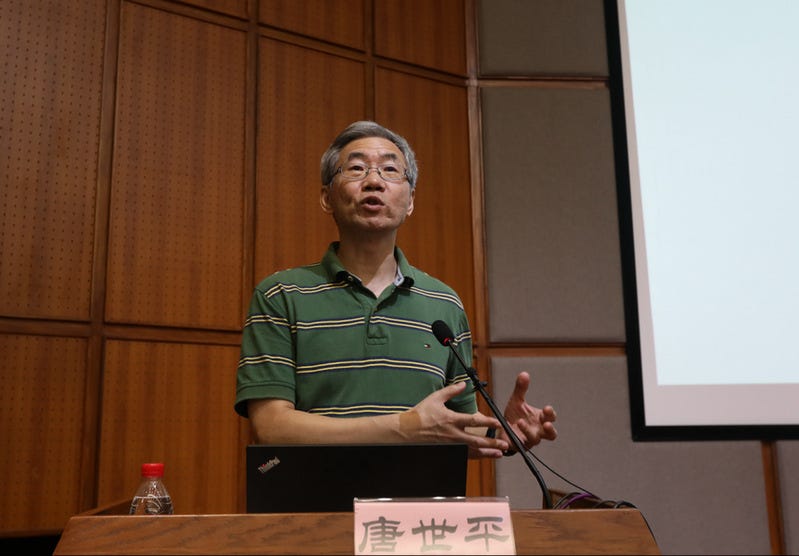
Shiping Tang is Distinguished Professor at Fudan University, Shanghai, China. He also holds a “Chang-Jiang/Cheung Kong Scholar” Distinguished Professorship from the Chinese Ministry of Education. One of Asia’s most influential and innovative social scientists, Prof. Tang was elected as one of the three vice-presidents (2025-26) of the International Studies Association (ISA). He is the first Chinese scholar to be elected to this position. In 2024, he was honoured as one of the three Distinguished Scholars of ISA’s Global IR Section (GIRS).
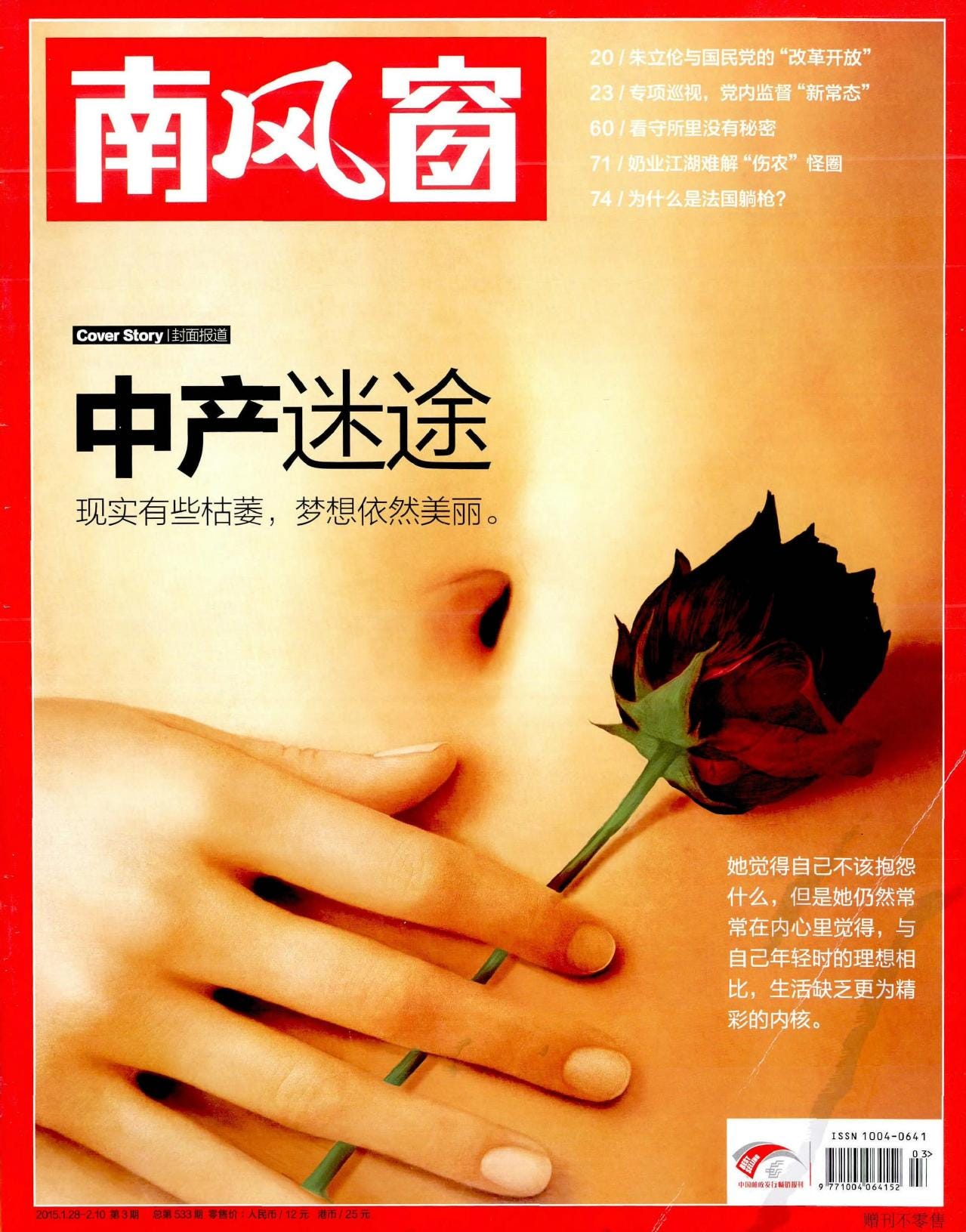
This article was first published in Issue 3 (2015) of South Reviews 南风窗, a Guangzhou-based biweekly magazine founded in 1985 that, according to its official website, is read mostly by professionals in government agencies, academic institutions, and large enterprises.

多了解一点世界
Learn More About the World
Ever since Lecture Room/China History Talks [百家讲坛, CCTV’s televised lecture series on Chinese history and literature] became a hit, Chinese history and so-called “national studies” [国学 guoxue, or the study of traditional Chinese culture] have come to dominate mass media and popular knowledge. In my view, this fixation on China’s ancient past and even on its early modern era is extremely unhealthy.
What the Chinese public and governing elites need far more urgently is an understanding of how the modern world came into being. Without it, it is impossible to understand how modern China took shape, let alone how the country works today. The priority, then, is to spend more effort in understanding the world.
Chinese history, especially before the First Opium War in 1840, is, in fact, strikingly monotonous. It is essentially a cycle of dynastic rise and fall, with few truly fundamental transformations aside from the reforms led by Dong Zhongshu and Wang Anshi. At the very least, it is far less relevant than world history after 1500.
More troubling still, an over-immersion in Chinese history can subtly foster a society-wide infatuation with court politics: power as manoeuvre, factional struggle, and the craft of outplaying rivals.
To a considerable extent, court politics forms the central, and the bloodiest, thread of Chinese history. For individuals, the ultimate thrill of self-fulfilment may lie in wielding the power of life and death—a pleasure that can be intoxicating. Yet, this kind of ultimate self-gratification is also the most destructive for society and the state.
Court politics is the core operating logic of rule by men, not the rule of law, and it often obstructs the latter. The point of the rule of law is precisely to shrink the space in which such power manoeuvring can work. A country without the rule of law cannot truly achieve modernisation.
Because China has long been governed, from top to bottom, by rule by men, the vast majority of people, despite the constant emphasis of collectivism, are, in practice, “destructive” individualists. They all want the others to follow the rules, but resist being bound by rules, especially those set by someone else. This tendency is the strongest among those with power.
This pattern is vividly reflected in both Chinese history and the many dysfunctions of today’s officialdom. Ordinary people are not naïve: if those in power disregard rules with impunity, why should common citizens comply? As a result, whenever rule-breaking carries no cost, ordinary people see little reason to abide by them.
Consequently, in a society that seems to prize collectivism, when individuals are forced to choose between personal and collective good, many choose the former. The reason is that once coercive authority disappears, and when collective goals demand personal sacrifice, what passes for “collectivism”, lacking a foundation of individual moral commitment, quickly dissolves.
In contrast, Chinese people often marvel at how many individuals in seemingly very individualistic countries are willing to step forward, even to the point of sacrificing their lives, when their nation or people are in need. The reason is actually quite simple: beneath the surface of apparent individualism, there is quite a sense of voluntary loyalty to the country among its citizens.
An over-fixation on Chinese history, paired with a belief in China’s singular exceptionalism, can easily slide into intellectual isolation.
Many people may be genuinely unaware that, throughout world history, there have been dozens of rapid ascents and striking “miracles,” far beyond China alone. From virtually any perspective, Spain’s rise and expansion between 1469 and 1500 were no less dramatic than the rapid growth of any modern state. Britain’s ascent from Europe’s periphery between 1600 and 1780, to the world’s foremost empire for more than two centuries, is even more awe-inspiring. The United States’ rise after the Civil War is often highlighted, but even countries such as Argentina, Brazil, and Mexico each enjoyed two or three decades of impressive high-speed economic growth.
Yet, among the many countries that have enjoyed bursts of rapid ascent and apparent brilliance, only around thirty ultimately became fully modernised states. Many others later slid into decline. Modernisation is like a lonely island: most attempts to reach it end in failure, and success is the exception. On the path towards modernisation, countless countries have stalled, been pulled into whirlpools, or simply gone under. These painful lessons are exactly what China—having no second chance at comprehensive modernisation—must take seriously.
If China stays excessively enamoured of its own past while neglecting the arduous routes other societies have taken towards modernity, it will struggle to internalise their experience. The result will be that in pursuing a fully modern China and through that, the great rejuvenation of the Chinese nation, China is still paying the high costs other countries have already paid, taking pointless detours, and sometimes even heading down the wrong road.
In China today, both political and academic circles often talk about “competing for discourse power” in international society and global affairs. But there is a huge difference between “competing for discourse power” and merely “voicing China’s perspective.” China can speak, but if no one is willing to listen, it is just shouting into the void, at best generating an echo, not a response. Discourse power is not won by chanting “I want discourse power”; that is self-entertainment, and ultimately self-deception.
If China wants real discourse power internationally, it cannot stay trapped in its own preoccupations. It has to care for and engage with other people’s problems. Only then can it gradually build discourse power, even if its views are not immediately accepted.
If China wants to discuss other countries’ problems with sophistication, it first has to understand those countries. Real international discourse power will come only from a serious understanding of the world, and by offering knowledge the world can use: solid diagnoses of global problems and practical fixes. Those cannot be improvised from instinct or armchair theorising; they have to be grounded in solid understanding and rigorous research.
Going forward, China needs more people who care about universal issues, produce universal knowledge, and solve concrete problems—not self-styled experts and scholars who do little more than chant slogans, stay indifferent to (China’s and others’) problems, and ultimately fool themselves. Those who dismiss or deny universal problems, cannot provide universally relevant knowledge, and cannot help others tackle concrete challenges are unlikely to add much to China’s discourse power in international society.
To better understand the world, the way history and social science are taught to the Chinese public needs a quick course correction.
Public education should spend less time on ancient Chinese history and put much more emphasis on modern Chinese history and modern world history. Right now, thin knowledge of modern world history and deep immersion in China’s past have already left many of China’s intellectual elites and leaders both unwilling and unable to understand the outside world, particularly the forces that shaped modernity.
Academically, research on modern Chinese history and modern world history, particularly comparative social-science research, should be substantially strengthened. Only through comparison can China better absorb the experiences and lessons of others, avoid unnecessary detours, and steer clear of misguided paths.
In plain English, China cannot keep sipping Empresses in the Palace and The Empress of China and expect to engage with the modern world.
Ge Jianxiong on "Chinese territory since ancient times"

“X has been Chinese territory since ancient times” is perhaps the most common Chinese expression one would encounter when it comes to territory disputes involving China.

Qin Hui on the cyclicality of Chinese history

"Through painstaking efforts, the Party has found a second answer to the question of how to escape the historical cycle of rise and fall. The answer is self-reform," said President Xi Jinping in his report to the 20th National Congress of the Communist Party of China (CPC).
"Academically, research on modern Chinese history and modern world history, particularly comparative social-science research, should be substantially strengthened. Only through comparison can China better absorb the experiences and lessons of others, avoid unnecessary detours, and steer clear of misguided paths." Hear this, Hear this.