

China’s high-end industries keep chalking up technical breakthroughs. But one Spring Festival trip back to the countryside suggests that, at least in some parts of the country, many people are still waiting to feel the benefits. In a personal homecoming essay, the author describes a local economy where casual work has dried up, wages feel under pressure, and many low-skilled workers face increasingly precarious ways of getting by.
The social fallout, as seen through the author’s hometown, is equally stark. Decades of son preference have left villages full of unmarried men, driving bride prices higher and sustaining a shadow market for “Vietnamese brides” that can slide into fraud, coercion, and trafficking. Young people, especially young women, are drifting away from rural patriarchy and the obligation-heavy world of kinship and “face”, while the influencer economy and short-video apps offer fantasies of easy money to teenagers with weak school prospects.
The article was published on Cherry Big House 樱桃大房子’s personal WeChat blog on 1 March 2026. Cherry Big House is a social media commentator with a focus on the property market. By 7 March, this article had been read more than 46,000 times.

The obvious caveat is that this comes from one writer’s personal experience, not firm evidence of nationwide conditions.
—Yuxuan Jia
春节回乡见闻,感受明显不同了
My Spring Festival trip back home hit differently this year
A lot of long-time followers enjoy my yearly notes about going back to my hometown for Spring Festival. I like writing about it too, and I also hope to see more comments and discussion, so I can learn about the new changes happening in different parts of the country.
This year, many people used the Spring Festival as a chance to travel. For me, though, I usually finish any trips before the holiday, and then head back to my hometown in the countryside. As long as my parents are still living there, spending Spring Festival with them, and taking a look at how the village has changed, still feels like the best choice.
These days, people who can afford to travel are often those working in cities, families whose children have done well in urban areas, or retirees with a stable pension.
But for many rural families, travelling simply isn’t an option financially.
My hometown is in rural Xiangxiang County, Hunan, and my husband’s family is in the outskirts of Yiyang City, Hunan. This year, my hometown still looks much the same as always. Many households have cars parked out front—mostly because their children have come back for the New Year—but the overall feeling is different.
1
Let me start with the situations and finances of most grassroots migrant workers. I asked around among the uncles and aunties in my hometown, and the answers were the same: it has become harder and harder to make money. People feel the economy is going downhill, worse every year. And looking at this year, many still struggle to see hope.
For farmers who spend most of their time in the village, there wasn’t much casual work last year, either. The going rate was around 200 RMB [$29] a day. It hasn’t fallen, but the real issue is that there is very little work to pick up, because hardly anyone is building houses in the countryside anymore. Twenty years ago, when families put up those small multi-storey homes, it was common to tile the exterior to make the place look more “presentable”, to save face. In recent years, people renovate to make their homes more comfortable to live in. Those with the means to tear down an old house and rebuild a small villa have largely already done so. And those who still want to build but haven’t simply do not have the money.
The village road network and transport links were completed long ago. Over the past couple of years, there were a handful of projects in my village—reservoir and hydropower repairs, wind power, high-voltage lines, street lighting, and so on—but most of that work has now wrapped up as well. So last year, even if someone stayed in the village and managed to pick up the occasional day of work, it was usually only enough to cover the basics.
My uncle lives at home on his own and farms a little over an acre. These days, most of the work is mechanised, so it is no longer the backbreaking labour it once was. But with grain selling at only about 4 RMB per kilo, there is little money to be made. It’s mainly just that relatives buy grain from him for their own tables, because it is cheaper than buying it in the city. In many villages now, households typically plant just one rice crop a year—just to make sure they have enough grain for themselves. Nobody grows grain with the expectation of making money, and hardly anyone raises pigs or cattle, because there’s not much profit in that.
That leaves most working-age people with little choice but to go out and work. Yet even migrant-worker incomes have been dropping. In my production team (生产队), there is a man born in the 1980s who has long worked away from home. He spent the first half of last year in Zhejiang, then went to Guangdong in the second half, moving between several construction sites doing short-term gigs. When flats cannot be sold, projects stall, and once the work dried up, he returned home early at the beginning of December.
This was probably a common experience for migrant workers across the country last year. With both property and infrastructure slowing at the macro level, it’s really hard for the incomes of hundreds of millions of migrant workers to rise. Even working casual jobs year-round, earning 30,000 to 40,000 RMB [$4,349–5,799] is genuinely a very tough ask.
People running small businesses in the city have been saying the same thing, that they didn’t make money last year.
One neighbour, a man born in the 1990s, used to run a stall in Changsha selling spiced dried tofu. Over the course of last year, he watched his sales fall day by day. In the end, his father went back home to farm, and he opened a small mahjong parlour in Changsha just to make enough for day-to-day living.
His older sister runs a small electric scooter shop in Changsha, doing both sales and repairs. She said she sold fewer scooters last year, but took on more repair work. This is probably consistent with what has happened in home appliances and other big-ticket spending.
My sister also runs a restaurant in Changsha. For two years in a row now—last year and the year before—she hasn’t made any profit. Staying afloat has become harder than it was before COVID. New restaurants have it even tougher: a few shareholders pool together more than a million RMB, pour it in, and if it fails to make money within a few months, that investment is basically written off. And, to be fair, city residents can feel this directly, too—offline shops changing hands all the time has become totally normal.
That said, my brother-in-law mentioned that business did pick up a little after this Spring Festival. The main reason seems to be an increase in tourists coming into Changsha, pushed up spending. But whether it can last is hard to say.
Over the past few years, they kept opening new branches, but the business didn’t keep up, so all the shareholders ended up buried in debt. Now, even when they do manage to turn a small profit, it largely goes straight to repaying what they owe. Nobody dares to invest on a whim anymore.
The only relative who is still making some money is someone who left the Juewei Duck Neck franchise and switched to Mixue Ice Cream & Tea. Turns out businesses that cater to tight budgets can still deliver a bit of profit.
In my husband’s city, relatives who work in foot massage have all said the second half of the year was even tougher than the first. As soon as one person starts making money, others immediately open the exact same kind of shops nearby. The competition is completely brutal.
This year, a few relatives barely earned anything, so they did not even come home for the Lunar New Year.
Overall, back where I’m from, migrant workers who rely on physical labour just don’t have much work. And for those working in the city—doing shift work in shopping centres, supermarkets, restaurants, and other small, consumer-facing businesses—monthly pay is generally around 3,000 RMB [$434]. Forget about a raise. If it stays the same as the year before last, that’s already considered decent.
So when it comes to improving the material living conditions of people at the bottom, there’s still no clear way out in the short term. For rural families who want life to get better, the only real hope is that their children can “make it”.
These days, very few people are still living off the government’s minimum living standard guarantee (dibao). A lot of households that used to receive dibao have been removed from the programme. Now it’s basically only elderly people living alone with no children, or people with serious illnesses, who can qualify. The dibao payment is 400 RMB [$58] a month.
This time when I went back, I visited a man born in the 1980s who’s on dibao. I don’t know exactly what illness he has, but it’s something that can’t be cured. He stays in his room all day—eating, drinking, and taking care of everything in there—and he can’t walk at all. His three kids are being raised by their grandparents, and he’s also relying on his parents. Honestly, he’s just living like an animal.
I also asked people in my follower group what things look like where they live. In some townships with factories, there is still work, and migrant workers can return home to take jobs in local plants. But where I’m from, there are no factories. So at the end of the day, the key really is having industry.
2
In the past few years, my village and the surrounding area have been packed with unmarried men born in the 1980s and 1990s. Girls have become a real rarity, so when it comes to dating and marriage, they can afford to be very choosy. Last year, I didn’t hear of any weddings in the village at all—except for one cousin of mine, who married a Vietnamese wife. The bride price was something like 200,000 to 300,000 RMB [$28,996-43,494]. She is now pregnant and due soon.
Because of that, people back home have even started making a business out of “Vietnamese brides,” matchmaking for 200,000 to 300,000 RMB a time. But this isn’t new to us. In our production team, there have been cases where the woman took the bride price and disappeared. Some stayed long enough to have a child, and then still ran off. Parents grind for years, saving every last bit, and in the end, it all goes down the drain on their son. There are also rumours of organised rings operating behind the scenes—people who do this professionally to defraud families of bride prices.
If you want a bride who is less likely to leave, it only works if your family is genuinely well-off and life with you is clearly better than back in Vietnam, or the match is introduced through an acquaintance. My cousin was the second kind, having been introduced through an acquaintance. He has a flat in Changsha, and he’s got two capable sisters who are very supportive of him. But for men still living in rural areas, the chances of the bride running off are pretty high.
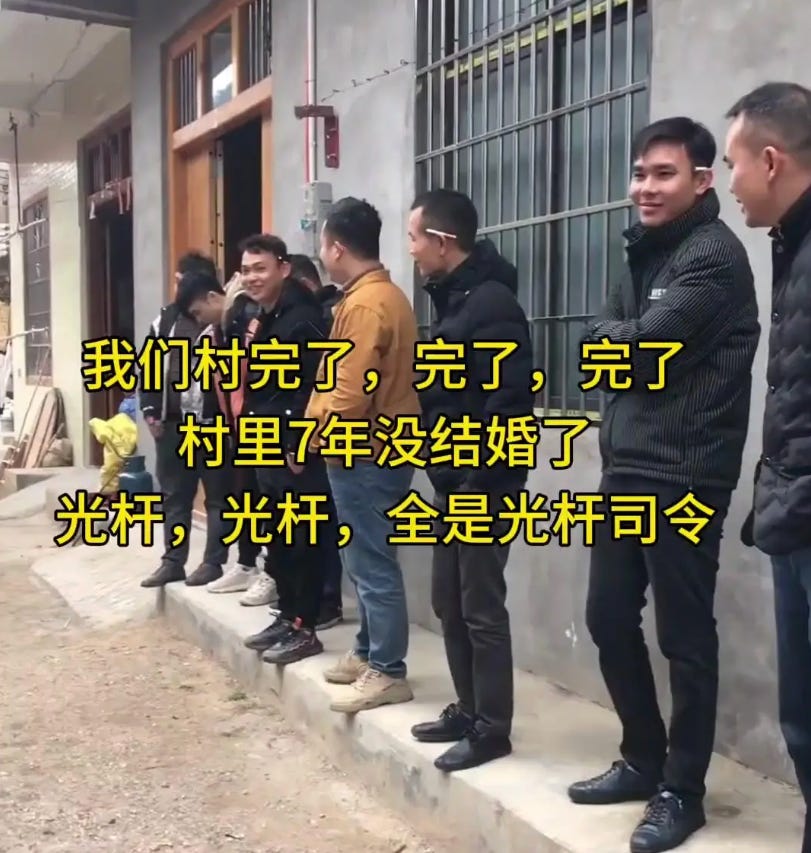
Even so, plenty of people are so desperate to get married that they’ll take the risk and pay anyway. Standards have dropped too: fine, if she runs, she runs—just leave a baby first to carry on the family line, and then at least the bride price won’t have been “for nothing”.
Of course, most single men who don’t have money have largely stopped expecting they’ll ever marry. The older generation has also given up hoping. Anyway, when bachelors are everywhere, it doesn’t feel shameful anymore.
3
People born in the 2000s have had a huge shift in mindset. They don’t really care about other people’s opinions and are more in their own lane. Whatever feels good is how they are living.
I’ve got a 25-year-old nephew. He stayed in Changsha over Spring Festival, just gaming by himself, and didn’t go back home at all. He thinks going back means endless rounds of visiting relatives, which is just boring. On top of that, he will be nagged about marriage and grilled on how much he earns, and those questions drive him mad. So he simply didn’t go.
He’s not interested in dating or getting married either. He’s done the maths: his income isn’t steady month to month, and if he gets a girlfriend, there’s the gift money, and then the flat—way too heavy a burden. In his view, living that stressed-out life isn’t worth it; being single is freer and more comfortable. And if things go south and it ends in divorce, the money spent along the way is down the drain.
People used to be keen on comparing—whose car was nicer, who owned how many flats in the city. But now electric cars are everywhere, and house prices have fallen, so that kind of flexing has cooled off a lot.
There’s also a young man in our production team. He originally bought a flat in the county to prepare for getting married, and with the bride price on top, he racked up debts of several hundred thousand RMB. Later, the day-to-day pressure got so heavy that he eventually sold the flat too. Lightening the load came first.
4
In my village, there’s also a “leftover woman” who’s almost 40 and still single. In the past, if a woman was still not married by 40, people would definitely gossip and talk behind her back. Now it’s different. It’s not that she can’t find anyone; it’s that she can’t find the right person and does not want to force a compromise. So she just got donor sperm and had a baby on her own. She bought a flat in Shenzhen and is raising the child herself. She’s not forcing herself to get married simply for the sake of it—because if the match is not right, you’ll end up divorcing anyway.
Divorce is way more common now. There are tons of middle-aged couples splitting up, and even older people are doing it, too. Back in the day, if someone in their 50s or 60s got divorced, people would laugh and gossip. Now nobody really cares. If you can’t make it work anymore, you just divorce.
With more divorces, fewer marriages, and young people all heading to the cities, it’s no surprise the countryside is getting emptier. In our whole town, there’s only one primary school and one middle school left. The high school has been shut down as well. Everyone else goes to the city for school. Families who are a bit better off will go to the county, buy a flat there, and enrol their children locally.
5
Across the whole town, as far as my parents know, four nursing homes have been built. Some are privately funded, and some were built directly by the government. Fees are set in tiers: for older people who can play cards and more or less look after themselves, it’s only 1,200 RMB [$174] a month; for those who are unwell, it’s 1,500 RMB [$217].
There are even single men living in these nursing homes. They can still earn a bit of money themselves, so they just pay a small monthly fee for room and board. And for households covered by the poverty-stricken population support programme (wubao), if they move into a government-run nursing home, they can live and eat there for free.
These days, the government also provides subsidies for building nursing homes. Private investors are doing it mainly for those subsidies too, because there isn’t much profit to be made relying on that 1,000-and-something RMB a month in fees.
6
Some young people have been poisoned way too much by the whole influencer economy. Nowadays, the second they pick up their phone, it’s either gaming or scrolling Douyin [TikTok’s sister app] and Kuaishou [China’s second-largest short-video platform] for hours. They see how quickly some streamers make money, and for some middle school and high school kids who don’t do well academically and don’t see much of a way forward, they start daydreaming about becoming bloggers and internet celebrities, “changing their fate”, and making easy money.
One relative of mine who’s still in secondary school told me there are more young, good-looking girls getting into transactional sex now. Even if they have a boyfriend, they won’t sleep with him for free. In her words, they’ve “come back to reality”: they want to sell themselves for a good price, or get kept. In the past, this kind of thing was arranged through offline nightlife venues. Now it’s done straight through the internet, using livestream platforms to connect with big tippers and make deals. She said it’s still different from being a prostitute, though: it’s not like they’re openly taking anyone. There’s still some picking and choosing. If the guy is young and good-looking, he might get it cheaper. If it’s some older bloke, then it has to be expensive. Either way, it’s all for the same thing: making money the easy way.
She herself is also in that “lying flat” mode. In her view, girls are scarce now anyway, and a bride price of a few hundred thousand RMB is enough to live on.
7
Being an influencer isn’t the easy money it used to be. One of my cousins does Douyin livestreams in Changsha and lives off tips and virtual gifts. She said her income last year fell off a cliff compared with the year before. Even her biggest tippers don’t have money like that anymore. In the second half of the year, she more or less stopped streaming and took a break. Four hours a night, every night, was also just too much for her body to handle.
Last year, she sold off a flat she’d bought as an investment in Changsha. Once she had cash in her pocket, she began “lying flat”. She’s not earning right now, but she still has savings. When she feels like it, she’ll take a trip here and there. For her, it’s all about living lighter, staying relaxed, and enjoying life while she can.
Her husband does tiles and flooring, and with the property market in a deep freeze, he’s basically had no business. But since they still have some money put away, he’s not planning to switch careers either. He’s just riding it out. Cash flow is king, I guess.

Back home in Hunan, I honestly haven’t seen a single person with any direct link to semiconductors, chips, new energy, or any of these emerging industries. Everyone is still just scraping by in the traditional sectors.
To them, those high-end industries feel miles away. Without education or qualifications, how are they even supposed to get a foot in the door?
If you zoom out and look at the big picture, in China’s current GDP mix, something like 60–70% still comes from traditional industries, and 30–40% comes from emerging industries. But when it comes to growth, it’s basically the reverse: around 60–70% of economic growth is being driven by emerging industries, while the traditional sectors are sliding badly.
You can think of it like this: out of ten people, six or seven are still in traditional industries, and their incomes are flat at best, or even falling. Only three or four get to benefit from the new economy.
This trend is already locked in, and it’s not going to reverse. The old economy isn’t coming back. From here, it all depends on how fast the emerging industries can grow, and when that growth can finally flow through to consumption and the service sector. But that kind of transition and upgrading is going to take time.
Back in my hometown, women over 40 who don’t have much education or formal skills are being shut out of a lot of service jobs. There are very few ways left to make a living. Most of the time, it boils down to cleaning, working as a nanny, or doing elderly care.
For older male workers, there’s no work on construction sites, so they end up driving Didi, cleaning streets, working security, collecting scrap—whatever they can find. Delivering parcels or takeaway is getting too physically demanding for them as well. And once you’re over 65, even restaurants won’t take you on to wash dishes or do kitchen odd jobs; they’re afraid you might have a sudden health emergency on the job, and the restaurant would be liable.
Of course, it varies by province and by city. My domestic helper is from Duyun County in Guizhou. Where she’s from, people mostly go to Zhejiang to work in factories—often small ones with only around a dozen workers. They run on two shifts, with each shift doing 12 hours a day. Pay-wise, even the low end is 6,000+ RMB [$870+] a month, and the higher end can reach 10,000+ RMB [$1,450+]. You usually need a bit of experience, and even middle-aged or older people can still do that kind of factory work. In their county, a few big factories have also moved in over the past few years, but the pay there is lower, around 2,000 to 3,000 RMB [$290-435] a month.
If more factories from the coast could relocate to central and western China, and give migrant workers a new way to get by, that would be a huge help. Even 2,000 to 3,000 RMB a month is much better than having no income at all.
Feel free to share your own back-home observations in the comments. It’d be good to hear what things look like in different parts of the country.

Wang Ou: Migrant workers, after the honeymoon

A young woman who once described her cheery days in Shenzhen later sits on a doorstep in a Guangxi village, exhausted, saying the happiest and brightest days of her life are behind her. Mothers leave before dawn while children are still asleep, or ask grandparents to take them out so they will not see the goodbye, dreading the day they return and the ch…
Dandan Zhang: China’s factory workers go gig

Dandan Zhang is a Professor in Economics (with tenure) and Deputy Dean (in research, internal and international cooperation) at the National School of Development (NSD), and Deputy Dean of the Institute of South-South Cooperation and Development, Peking University.
Zhao Yushun: the last generation of Chinese smallholder farmers

China’s traditional smallholder farming is consolidating into larger-scale operations run by large growers or agricultural companies. Villagers lease plots for roughly 600–1,000 yuan [84-140 U.S. dollars] per mu a year and often return as hired labour on the same fields.
Great post. Reports from Chinese-born people living in China is much more believable than “armchair analysts” writing from outside China.
Thank you. That is a fascinating article. Just a small view of the incredible socio-economic shift we are in.