

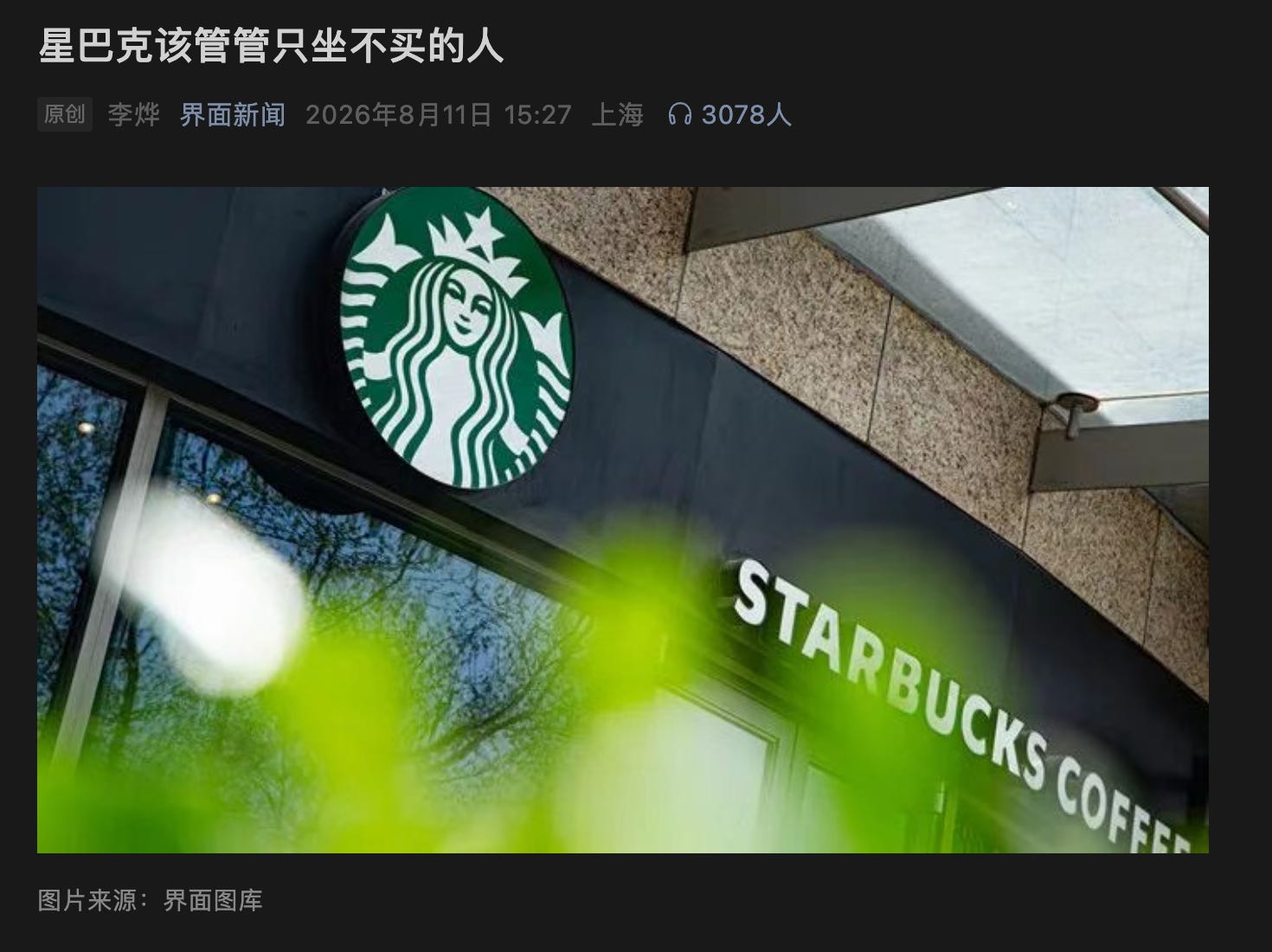
A problem has arisen at Starbucks in China. Some people sit in its cafés for hours without buying anything, sometimes bringing their own food and drinks. Paying customers complain that they cannot find a seat.
A perfectly legitimate subject for journalism. Jiemian News 界面新闻, a Shanghai-based financial-news outlet, duly made it one. But it went further. After considering Starbucks’s competition, average spending per customer and its “third place”—the idea that its cafés should be welcoming spaces outside home and work where people can linger—the article arrived at a prescription: paying customers should come first; those occupying tables without buying anything should, in effect, buy something or leave.
Starbucks may not have realised that what it lacked was management advice from Jiemian. In China, there is plenty more available.
The most industrious provider may be the Economic Daily 经济日报, whose publisher is an institution directly under the Communist Party’s Central Committee. In 2021, after the government’s crackdown on private tutoring wrecked New Oriental’s core business, Yu Minhong—a legendary figure in Chinese entrepreneurship whose New Oriental story was famously dramatized in American Dreams in China—decided to try selling agricultural products by livestream.
The Economic Daily was unconvinced. In “New Oriental Should Not Copy Li Jiaqi”, it warned that New Oriental risked jumping “from one quick-money industry to another”. Li was China’s best-known livestream salesman. Happily, the paper had alternatives ready. New Oriental could take education into rural China. Or it could try study tours, which might make money less quickly but better suited its educational background.
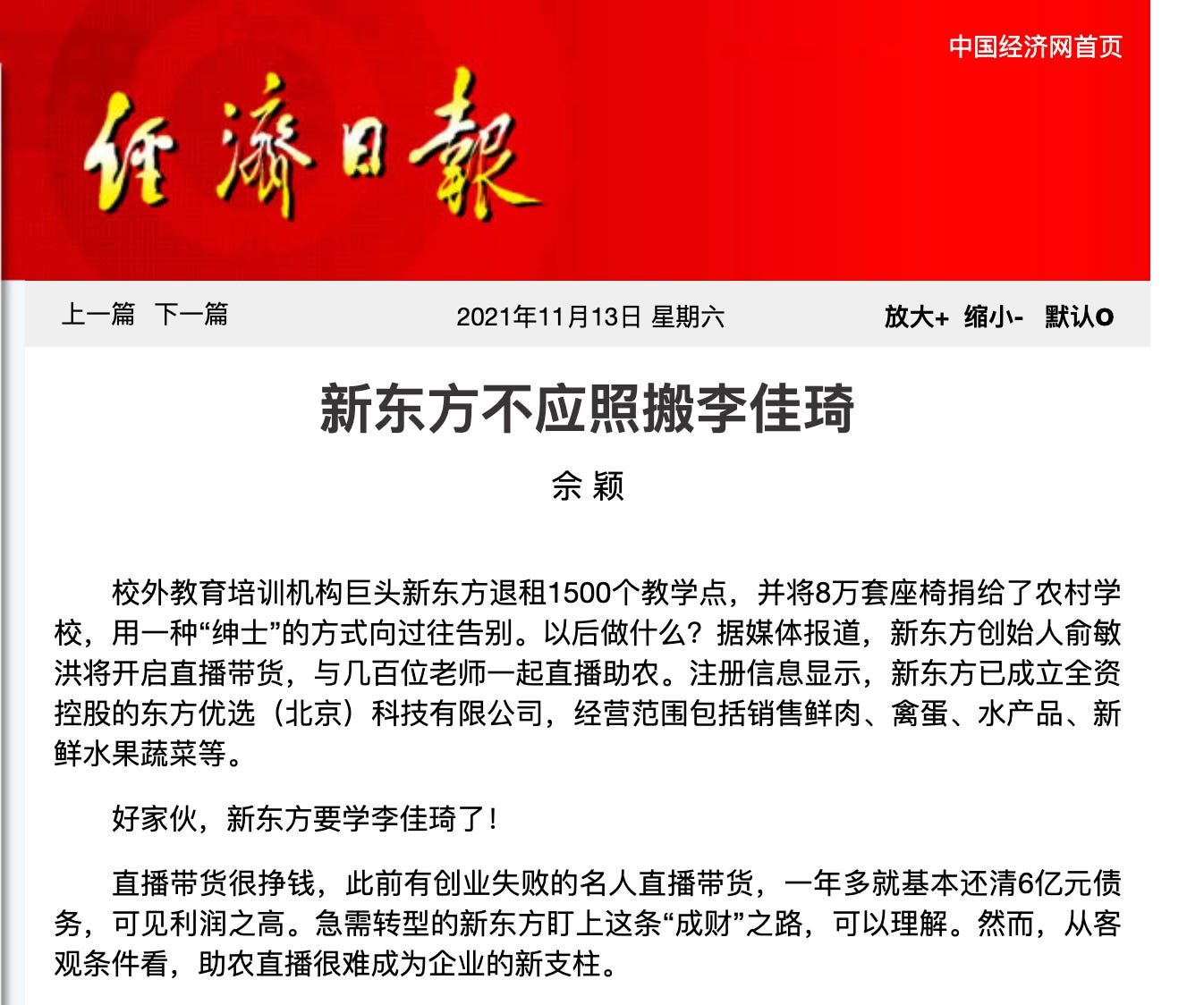
Mr Yu thanked the columnist for the “kind advice”. New Oriental went ahead. Its livestreaming arm, East Buy, generated 4.39 billion yuan in sales last year. The market did not establish that the Economic Daily understood New Oriental better than its founder did.
This did little to discourage the paper.
When tea chains began selling drinks for 9.9 yuan ($1.40), the Economic Daily declared that “new tea beverage competition cannot rely solely on price cuts”. Companies should deepen their core businesses, find new growth and focus on healthier products. Cultural-product companies should combine tradition with fashion, use big data and artificial intelligence, build brands, improve marketing and pursue cross-industry collaborations. In June it told grain brokers to bid farewell to their “muddled accounts”, praising mandatory transaction records as not a burden but “a higher level of protection and industry empowerment”.
Taken together, the Economic Daily can resemble a management consultancy whose clients have neglected to hire it.
Two things distinguish the genre. One is the tone. Companies “should” do this—Starbucks, for example, “should do something about people who sit without buying”—“must” improve that and “cannot” rely on something else. Trade-offs become instructions. Uncertainty disappears. The voice is that of an instructor marking homework: lecturing, paternalistic and serenely sure of itself.
The other is the advice. Innovate. Understand consumers. Improve quality. Build brands. Use technology. Find new growth. Pursue sustainable development.
Most of it is correct. Almost none of it is useful. Running a business consists precisely of deciding how to innovate, which consumers to chase, when to cut prices and whether scarce capital belongs in branding, factories, research or distribution. “Improve quality” is excellent advice in roughly the same sense that “buy low and sell high” is excellent investment advice.
The confidence is especially curious because many institutions dispensing it do not themselves live by quite the market disciplines they prescribe. Many outlets benefit from public funding, taxpayer-funded subscriptions, political status, privileged access, and restricted competition. After voluntary subscriptions have all but evaporated, their commercial revenues are not always entirely conventional either. Companies advertise, sponsor conferences and enter “strategic partnerships” for exposure, certainly. Maintaining cordial relations with influential media organisations may have value of its own, to put it nicely. Institutions partly insulated from ordinary market competition can be remarkably eager to lecture those exposed to it.
Commercial inexperience, though, explains only part of the arrogance. Chinese media have traditionally been expected not merely to report society but to guide it. The most influential media in particular are not simply observers of political authority. They are an extension of it. From conveying what the authorities expect of businesses, it is a short step to assuming that businesses require instruction.
The same instinct shapes coverage of the business environment. A new industry appears, competition intensifies, or a risk emerges, and the prescriptions are strikingly familiar: strengthen supervision, standardise development, close loopholes, prevent disorderly competition.
Sometimes more regulation is plainly warranted. Far rarer is the suggestion that government may already be doing too much—or that doing less might itself improve the business environment. Chinese public discourse likes to balance the market’s “invisible hand” with the government’s “visible hand”. The press has a habit of volunteering as another finger on the latter.
Markets are inconvenient because they do not come with answer sheets. Some companies win by cutting prices; others by charging more. Some build brands; others manufacture for them. New Oriental survived by entering a business the Economic Daily thought unsuitable.
Perhaps Starbucks should ask people who buy nothing to leave. Perhaps it should welcome them. That is a choice about customers, brand and money. The telling thing is not that Jiemian has an opinion. It is how naturally, in some journalism, an opinion becomes an instruction. (Enditem)

Reading China through its most courageous reporting

Announced on 28 February 2026 via the WeChat blog of Liu Hu 刘虎, a veteran investigative journalist, the winners of the 7th Journalists Home News Prize offer a rare guide to some of the strongest Chinese journalism still being produced today. In stark contrast to the state-run
Are you advising newspapers how to write their articles?🤣
On the Starbucks story: It’s not a new problem. When I lived in Jinan about ten years ago, the flagship Starbucks was regularly crowded with senior citizens and mothers with children escaping the sweltering heat. Many weren’t consuming anything: they would recline, sleep, and some even smoked.
I asked the staff why they didn’t intervene, as this clearly put off paying customers and affected the experience. They told me they had no means to ask these people to leave “because the authorities did discourage it”. I’m not sure that explanation was actually true, but the staff were clearly instructed to avoid confrontation at all costs.
Starbucks, like most customer-facing businesses in China, seems to be aware and afraid of customer backlash and shitstorms that can hit when things go wrong. What makes this even trickier is that customer attitudes seem to be shifting, particularly among younger generations.
Easy indeed for Jiemian to say “make a clear choice”; much harder for Starbucks to implement it across thousands of stores while trying to keep everyone happy.