


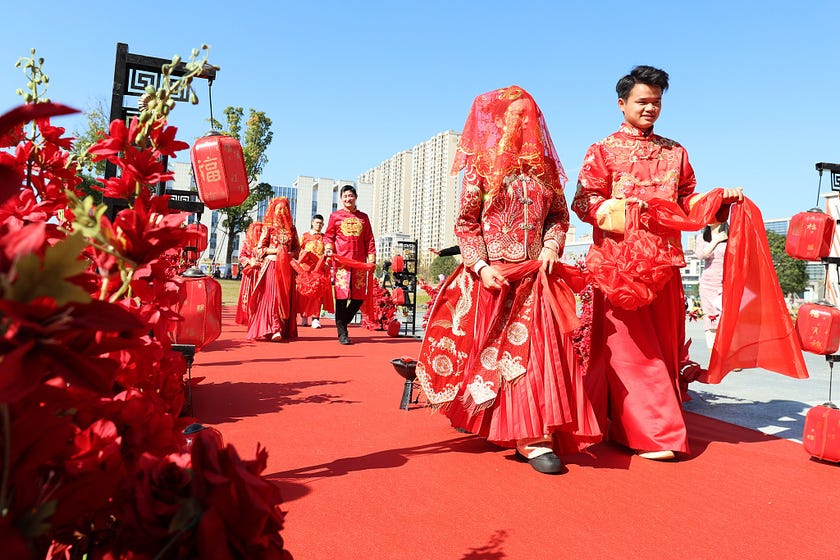
Caili, or bride price, is the money or goods a groom’s family gives to the bride’s family before marriage. It is an old Chinese custom, but in recent decades it has become one of the country’s most contentious marriage costs.
Since the 1980s, bride prices have risen sharply in many parts of rural China, driven by a skewed sex ratio rooted partly in long-held son preference, rising wedding and housing costs after market reforms, and the movement of young women from villages to richer regions. What was once a local custom has become a costly barrier to marriage, especially for young, unmarried men from rural areas who earn their living in low-paid and insecure urban jobs.
The government has tried to rein it in. “Sky-high bride prices” have appeared in China’s No. 1 Central Document—the year’s first major policy statement issued by the Communist Party leadership and the State Council—every year since 2021. In 2022, eight central bodies, including the Ministry of Agriculture and Rural Affairs, the Ministry of Civil Affairs, and the All-China Women’s Federation, launched a campaign against high bride prices, lavish weddings, and competitive gift-giving.
From the legal side, the Supreme People’s Court has moved to standardise how bride-price disputes are handled, clarifying rules on when bride price should be returned. State media have also criticised excessive bride prices, portraying them as a burden on rural families and a distortion of marriage customs.
A new paper by Minhee Chae and Dandan Zhang, published in February 2026, focuses on young male migrant gig workers in manufacturing, a group often caught between rural marriage expectations and insecure urban work. The authors estimate the average bride price in the workers’ hometowns at 127,300 yuan. That was about six times what the workers had saved, on average, in the previous year, even before housing and other marriage costs were included. Coming from a place with that level of bride price was associated with a perceived chance of marriage about 7.5 points lower than in places with no bride price. The effect becomes sharper after 25, when marriage pressure typically rises, and is strongest among men with less education.
Together, the findings give sharper form to a broader social question: What happens when the cost of marriage rises beyond what young men at the bottom of the labour market can realistically afford?
Dandan Zhang has kindly reviewed the translation.
—Yuxuan Jia


Minhee Chae is an Assistant Professor at the School of Economics, Nankai University. Dandan Zhang is a Professor in Economics (with tenure) and Deputy Dean (in research, internal and international cooperation) at the National School of Development (NSD), and Deputy Dean of the Institute of South-South Cooperation and Development, Peking University.
The paper, “Bride Price, Marriage Expectations, and Intentions among Young Male Migrants in China: Evidence from Manufacturing Gig Workers”, was published in Economic Modelling in February 2026. A Chinese summary was posted by the NSD’s official WeChat blog on 12 May 2026. The text below is an English translation of that summary, lightly edited for clarity and consistency with the original paper.
Bride Price, Marriage Expectations, and Intentions among Young Male Migrants in China: Evidence from Manufacturing Gig Workers
Abstract:
This study explores how regional bride price norms shape family formation attitudes among young, low-income male migrants in China, focusing on manufacturing gig workers. Demographic challenges in this vulnerable population are critical, yet research is limited due to scarce, recent data. Using unique surveys on manufacturing gig workers and bride prices, we analyse the relationship between these financial burdens and attitudes towards marriage. Results show that men from high bride price regions are less likely to expect marriage or parenthood and exhibit lower marriage intentions, especially in their late 20s. These associations are stronger for less-educated migrants, suggesting financial barriers are disproportionately linked to those with lower socioeconomic status. Evidence also shows that such pressures may extend migration and push men into riskier informal employment, further delaying family formation and career development. These findings highlight the role of financial constraints in shaping family formation among low-income groups in China.
Research Background
Surging bride prices.
Since the 1980s, the bride price has surged sharply, driven by a highly imbalanced sex ratio resulting from family planning policies and the rapid increase in marriage-related expenses following market-oriented reforms. Moreover, the migration of unmarried women from rural to wealthier regions further exacerbates the challenges faced by rural men and contributes to rising bride price levels.
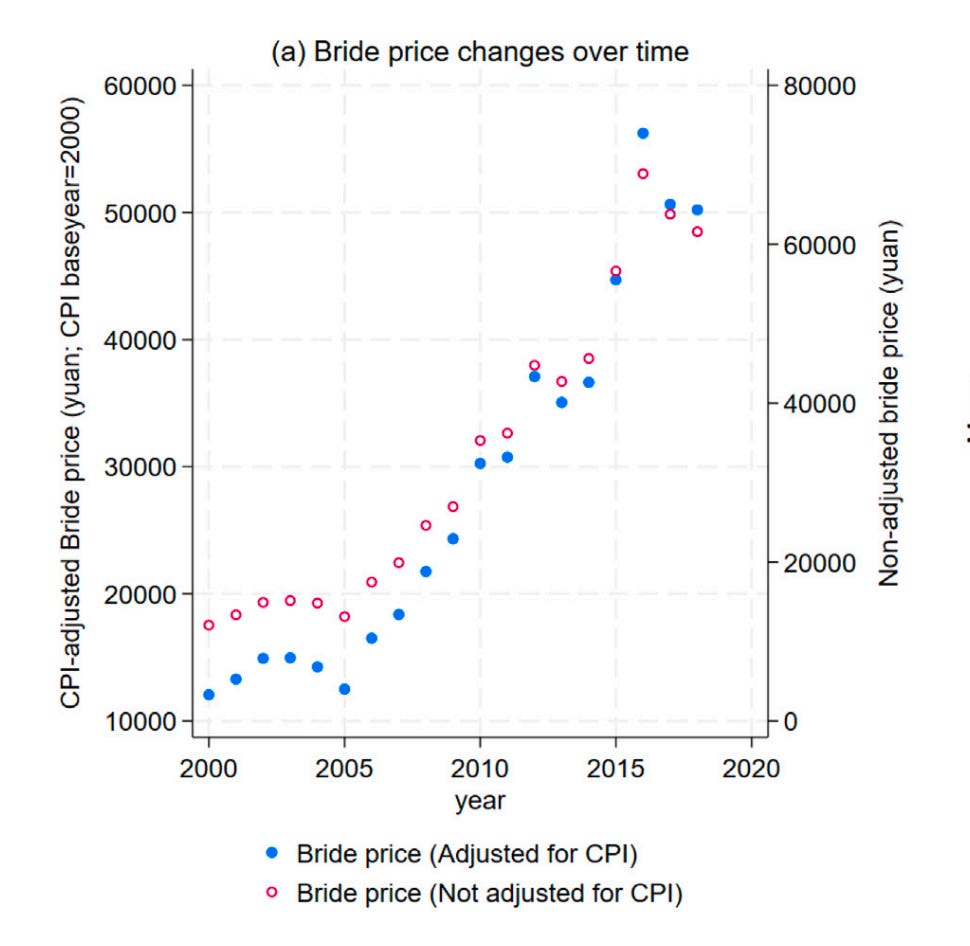
According to calculations using the China Health and Retirement Study (CHARLS) data, the average bride price between 2013 and 2018 was 46,861 yuan (≈ 6600 USD), while the average annual per capita income in the surveyed sample was 20,723 yuan, which may lead to significant financial stress, especially among low-income populations.
Growing marriage difficulties among low-income groups.
Low-income young men with rural backgrounds face intense competition and rising financial demands in the marriage market, which makes it increasingly difficult for them to form families. Although these financial demands are a consequence of underlying demographic imbalances rather than their cause, they exacerbate in-equality in marriage prospects, as elevated bride prices may delay marriage and reduce the likelihood of parenthood among economically disadvantaged men. Rural migrants have long been among the most economically vulnerable groups in China’s labour market, often concentrated in low-wage jobs.
Over the past decade, digital automation in manufacturing has further displaced low-skilled migrant labour, leading many of these workers into gig economy employment characterised by flexible, short-term, and often informal arrangements. These jobs typically lack formal contracts and social protections, deepening migrants’ economic insecurity and further con-straining their ability to meet the rising financial demands of marriage and family formation.
Research gap.
Despite the importance of this issue, existing research remains limited due to data constraints. A key challenge is the lack of recent, in-depth surveys focused on young rural migrants, and reliable regional-level data on bride prices are also scarce. Little is known about how bride price burdens shape marriage and fertility expectations or intentions among economically disadvantaged youth in contemporary settings.
Research Question
Based on the above research background, this study explores how regional bride price norms shape family formation attitudes among young, low-income male migrants in China.
Research Design
Data sources
The 2024 survey on manufacturing gig workers in China
The survey covers 3,732 workers, providing detailed personal, household, employment, marriage, and fertility information, in addition to their future intentions and expectations regarding these matters.
The 2025 survey on regional bride price in China
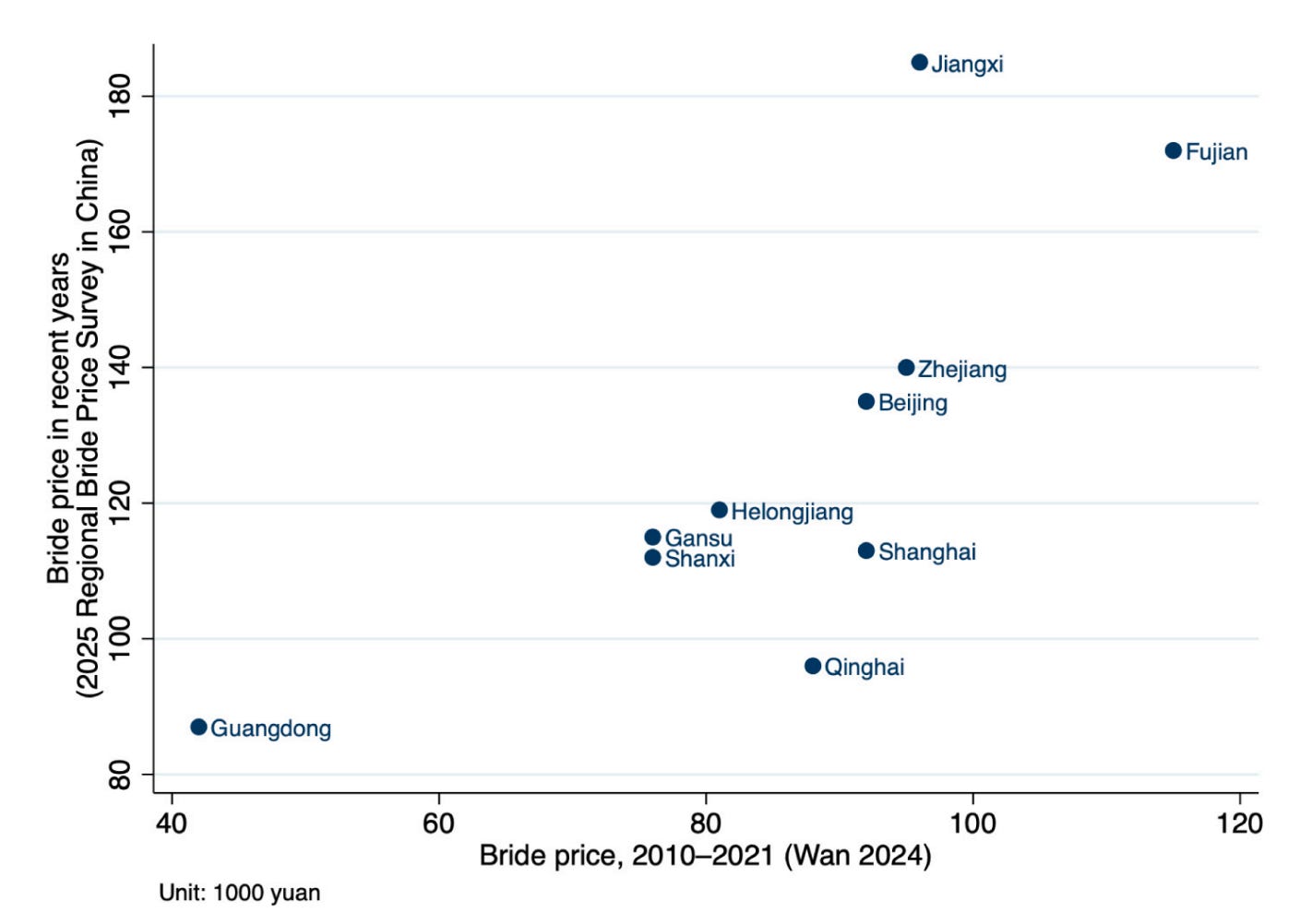
The survey covers 3914 respondents from 289 prefectures, of whom 50.97% were male. It collected information on perceived bride price levels in respondents’ hometowns. The bride price survey question is stated as follows: “Based on your understanding, how much is the typical betrothal gift (bride price) in your hometown in recent years? The betrothal gift here refers to the money or goods given by the man to the woman. If goods are included, please convert their value into RMB. This does not include the housing for marriage.” The survey also asked questions about dowries and housing contributions as part of marriage arrangements. Reported values of bride price ranged from 0 to over 300,000 yuan, with 4.39% reporting that the bride price is zero in their hometowns.
Main sample
Our main sample consists of 1338 never-married male migrants aged 16 to 29 at the time of the survey in March–April 2024, after excluding missing or ineligible data.
Variables and methods
Dependent variables: self-assessed marriage and fertility expectations or intentions.
Independent variable: the average bride price in a respondent’s hometown prefecture.
Method: Regression analysis.
Findings
Descriptive statistics
Marriage and fertility intentions. Among 1338 never-married male migrant workers in our sample, 76% report an intention to marry, and 81% of them express fertility intentions. However, their expectations of getting married are notably lower: they see the chance of marrying by age 30 as only 62% and the chance to have at least one child before turning 30 as 55%. These figures are concerning, given that marrying after the age of 30 is generally considered non-ideal in rural China.
Bride price and education. The average bride price is 127,300 yuan (≈ USD 17,700), with a range from 0 to 270,000 yuan. Only 18% of individuals in our sample hold a college degree or higher. In contrast, 33% completed middle school or less, 21% graduated from an academic high school, and 25% attended vocational school.
Employment and savings. The average savings from the previous year is 21,096 yuan, with a standard deviation of 26,133 yuan and a maximum of 125,000 yuan. A rough calculation sug-gests that, on average, it would take a migrant worker approximately six years to accumulate the bride price amount (=127,300/21,096), even before accounting for additional costs such as housing.
Stable relationship status. About 20% of respondents report being in stable relationships with their partners; in other words, 80% of them do not have stable partners.
Bride Price and Marriage/Fertility Intentions
The overall results suggest that male migrant workers from prefectures with higher bride price levels are less optimistic about their chances of marrying and becoming fathers by age 30. A 100,000 yuan increase in the hometown bride price (≈ USD 14,000) is associated with a 5.88 percentage point decline in the self-perceived likelihood of marrying by age 30. This means that men from regions without any bride price customs and those from regions with an average bride price of 127,300 yuan differ in perceived marriage likelihood by approximately 7.5 percentage points (=-0.588 × 12.73). In addition, a 100,000 yuan increase in bride price is associated with a 5.37 percentage point decrease in self-assessed likelihood of having a child by age 30.
Further analysis finds that the negative association becomes more pronounced particularly from age 25 onward. This implies that financial pressures associated with bride prices increasingly discourage marriage intentions as men approach the socially expected age of marriage. At age 29, a 10,000 yuan increase in the hometown bride price is associated with a 1.3 percentage point reduction in the probability of intending to marry.
Moreover, even among those who intend to marry, higher marriage payment customs in their hometown are associated with lower expectations of achieving marriage in the near future.
The Role of Education
The negative association is more pronounced among men with lower education, a high school degree or below. This suggests that individuals with lower socioeconomic status face greater difficulty in coping with elevated marriage-related expenses.
Bride Price and Labour Market Choices
Men from regions with higher bride prices tend to extend their stay in urban areas. A 100,000 yuan increase in bride price is associated with extending their migration by 4.27 months. Workers from higher bride price regions are more likely to engage in informal or non-permanent employment, such as day labour, despite the increased risks and absence of benefits, as this arrangement often provides higher hourly wages than factory jobs with fixed long-term contracts.
Conclusion and Discussion
This paper examines how marriage-related financial burdens shape marriage and fertility expectations and intentions, as well as labour market choices, among low-income male migrant workers in China. The analysis focuses on migrant gig workers in urban manufacturing areas, a group characterised by insecure employment and high rates of remaining unmarried, making them particularly vulnerable to the financial pressures associated with marriage.
The study finds that higher bride prices are associated with significantly lower expectations and intentions of marriage and childbearing. The pattern is particularly strong among less-educated men and those in their late twenties.
The study also finds that men from higher bride price regions are more likely to extend their stay in destination areas and take informal jobs with limited labour protections. This pattern indicates that high financial expectations towards men may hinder long-term career development and further delay family formation.
This study provides up-to-date evidence on marriage and fertility issues among migrant gig workers in China and highlights the importance of addressing financial barriers to marriage.
However, the analysis mainly relies on provincial fixed effects and province-specific time trends to mitigate potential omitted variable bias. In other words, this approach may not fully address the disentangling the effects of local marriage customs from the main estimates. More research is needed to overcome these challenges and further clarify the causal mechanisms linking bride price to individual demographic and labour market outcomes.
Dandan Zhang: China’s factory workers go gig

Dandan Zhang is a Professor in Economics (with tenure) and Deputy Dean (in research, internal and international cooperation) at the National School of Development (NSD), and Deputy Dean of the Institute of South-South Cooperation and Development, Peking University.
Dandan Zhang on why mandating fewer working hours in China may be premature

Few ideas sound more sensible than giving overworked Chinese workers more rest. Surveys suggest that non-agricultural employees in China were averaging more than 50 hours a week in 2023, while fieldwork indicates that gig factory workers put in 10 to 12 hours a day, six or seven days a week.
Wang Ou: Migrant workers, after the honeymoon

A young woman who once described her cheery days in Shenzhen later sits on a doorstep in a Guangxi village, exhausted, saying the happiest and brightest days of her life are behind her. Mothers leave before dawn while children are still asleep, or ask grandparents to take them out so they will not see the goodbye, dreading the day they return and the ch…
Interesting study, but I think the framing deserves some pushback. The entire paper is built around one narrative: men want to marry, bride price is too expensive, therefore they can't. But this treats marriage difficulty as a purely financial threshold problem and strips away a lot of what's actually going on.
For one, women are almost entirely absent as agents in this research. They show up as demographic variables — a sex ratio, a migration pattern — but nobody asks why they leave, what they want from marriage, or what bride price actually means from their side. When you only tell the story from one direction, it's hard not to read the paper as sympathizing with men who "can't afford" to marry, which gets uncomfortably close to framing women as goods priced out of reach.
There's also a deeper issue the paper doesn't touch: many young men in this demographic struggle in the marriage market not just because of money, but because of a widening gap between their expectations and those of contemporary women. Education, emotional compatibility, domestic labor sharing, personality — these all matter, and increasingly so. Reducing the problem to "bride price too high" lets men externalize a much more complex set of reasons into a single, conveniently blameable number.
And while I understand "bride price" is standard academic terminology, it's worth noting how much work that word does. The Chinese terms — caili, pinli — are relatively neutral, pointing to gifts or ritual. "Bride price" literally prices the bride. That linguistic choice fits neatly into the paper's cost-burden framework, but it also quietly reinforces the commodification it should be questioning.
None of this means the financial pressures aren't real. They clearly are. But a paper that isolates one variable and builds its entire narrative around it, without acknowledging the broader texture of why these men remain single, ends up telling a incomplete story — and an incomplete story is never truly objective.