


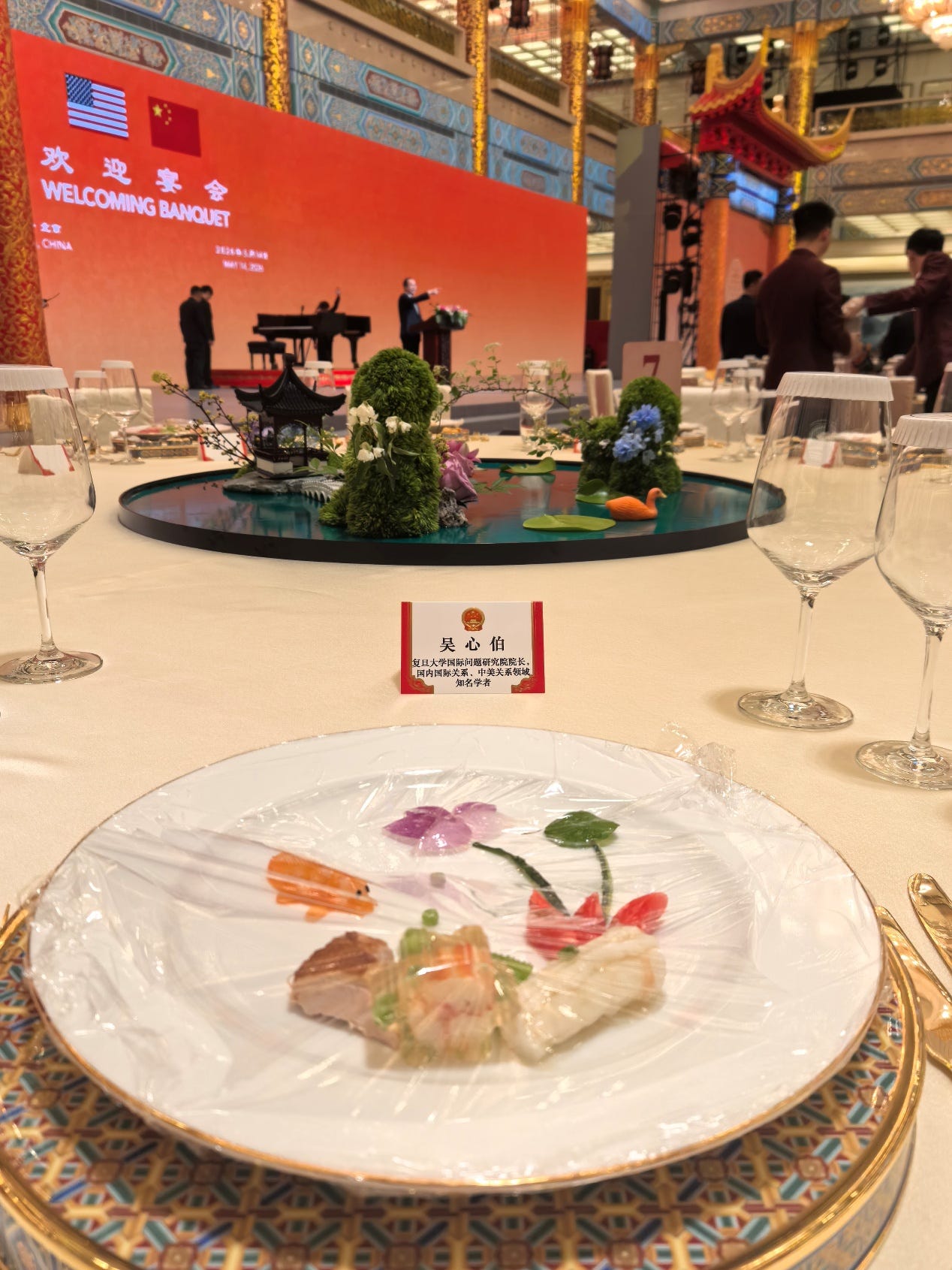
Wu Xinbo, Professor and Dean, Institute of International Studies, and Director at the Center for American Studies, Fudan University, was one of two Chinese scholars invited to attend the welcoming banquet for U.S. President Donald Trump at the Great Hall of the People on 14 May 2026.
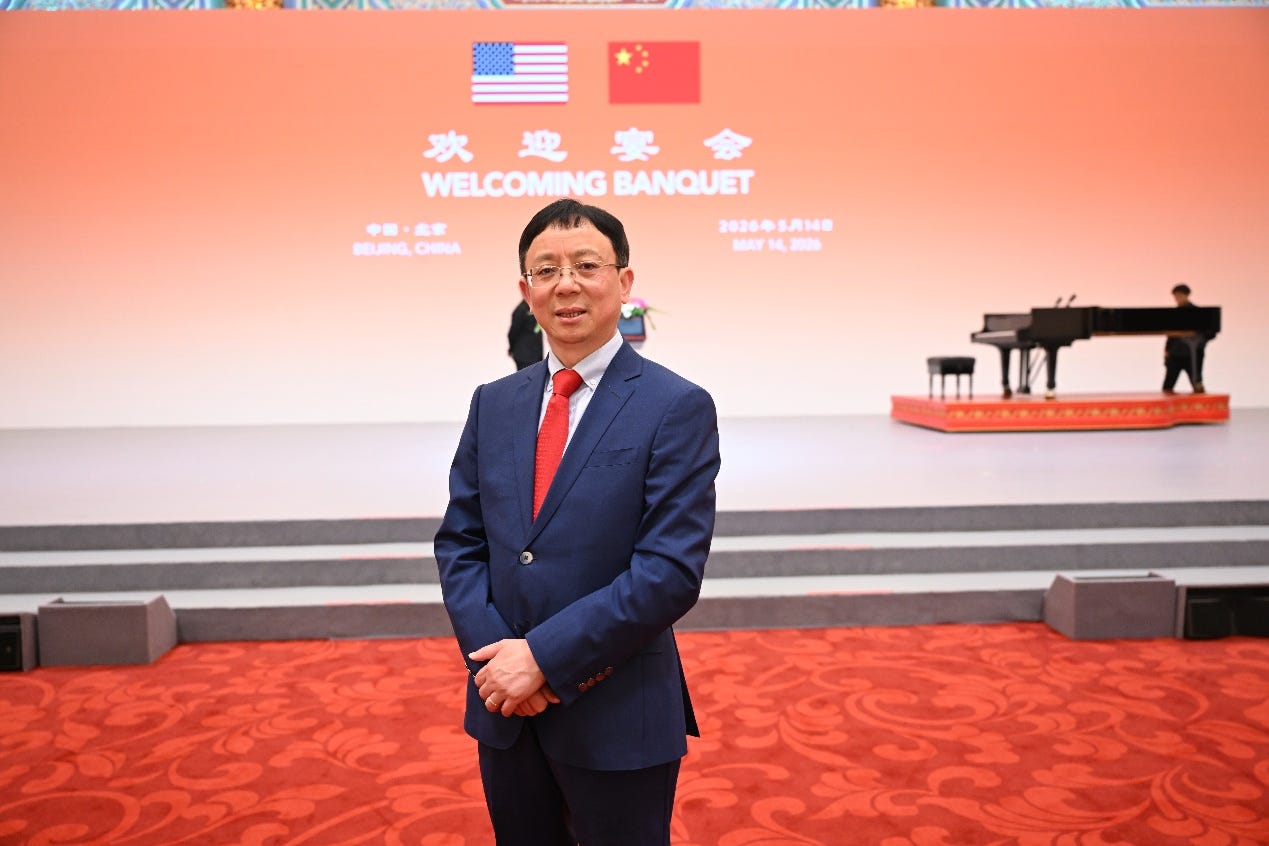
In the days that followed, he gave a series of interviews to China Central TeleVision News, Zhengshier (a WeChat blog run by The Beijing News), and Buyidao, a Global Times-affiliated commentary platform, offering firsthand readings.
Across the interviews, Wu argued that the most important change since Trump’s 2017 visit is China itself: stronger, more confident, and more experienced in dealing with Washington. He described the new positioning of “a constructive China–U.S. relationship of strategic stability” as the central political outcome of the meeting. But whether it endures, he suggested, will depend largely on execution: building mechanisms to expand cooperation, manage competition, contain differences, and preserve peace. Above all, he identified Taiwan as the decisive test. Only if the United States stops arms sales to Taiwan and makes clear its opposition to “Taiwan independence” can peace across the Taiwan Strait and stability in China–U.S. relations be sustained. —— Yuxuan Jia
Interview with CCTV News
吴心伯教授接受央视新闻频道访谈:“中美关系新定位,如何相向而行?”
Broadcast 15 May 2026
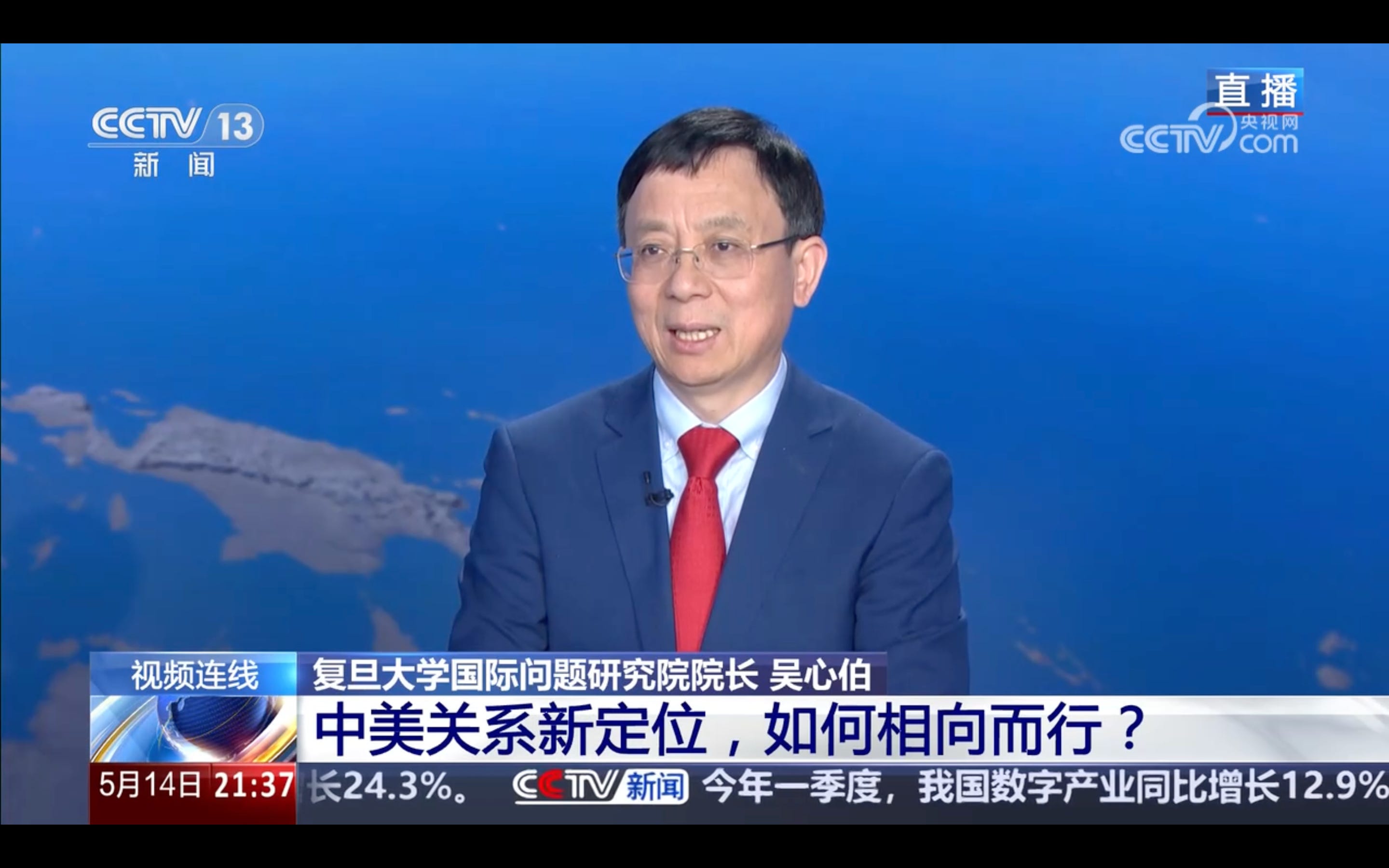
CCTV News: What impact will the new positioning of “a constructive China–U.S. relationship of strategic stability” have on the future development of China–U.S. relations?
Wu Xinbo: I think that, under the guidance of this new positioning, cooperation should first be made the main feature of China–U.S. relations. The two sides should work together to expand the pie of China–U.S. cooperation.
Second, competition between China and the United States is unavoidable. But this competition should be healthy, not destructive. It must also be managed so that it does not spiral out of control and damage the overall relationship.
Third, China and the United States will continue to have differences in many areas. These differences cannot be resolved in the short term, but they can be well managed. The key is to prevent them from developing into crises or even conflicts.
Finally, and most importantly, China and the United States must maintain peaceful relations.
So, in my view, this new positioning sets out what needs to be done in different areas going forward. In essence, it answers the question of how China and the United States should get along in the right way.
CCTV News: What mechanisms are needed to implement the new positioning of China–U.S. relations?
Wu Xinbo: In the past, China–U.S. relations have also had constructive positionings and visions. But whether these positionings and visions can truly be translated into action is a test for both sides.
That is why I think it is entirely right for both sides to emphasise implementation and execution. Under these circumstances, an important task for China and the United States is to establish a series of working mechanisms to promote cooperation, manage competition, control differences, and maintain peace.
This means setting up dialogue, working, and exchange mechanisms across a range of areas, including trade and the economy, diplomacy, people-to-people exchanges, and security. Institutionalising China–U.S. relations is an important guarantee for the steady and long-term development of bilateral ties.
CCTV News: How should China’s renewed emphasis on the Taiwan question be understood under the new positioning of China–U.S. relations?
Wu Xinbo: Whether the new positioning of China–U.S. relations can truly be implemented depends, to a large extent, on how the Taiwan question is handled. For a long time, Taiwan has been a serious point of disagreement in China–U.S. relations. It concerns China’s core interests and allows no room for concession.
The U.S. side has had geopolitical calculations and domestic political considerations on the Taiwan question. For this reason, China should state directly and firmly to the United States that, if the new positioning of China–U.S. relations is to be realised, the Taiwan question must be handled properly.
Specifically, on arms sales to Taiwan, the United States should change its policy and stop such sales. It should also make clear its opposition to “Taiwan independence.” Only this would be conducive to peace across the Taiwan Strait and stability in China–U.S. relations.
CCTV News: In which areas is China–U.S. economic and trade cooperation most likely to achieve breakthroughs next?
Wu Xinbo: I think the first area is trade. In the past, the U.S. side tried to address trade imbalances by launching unilateral tariff wars. Going forward, I think the usefulness of tariffs in managing China–U.S. trade relations will gradually decline.
The problems in China–U.S. economic and trade relations can only be solved by expanding the pie of trade. That is why trade is the area where breakthroughs are most likely.
In science and technology, as China makes technological progress, U.S. companies have also come to realise that if they do not sell high-tech products to China now, they may lose the Chinese market permanently in a few years’ time. That would not be good for U.S. development. Many visionary people in the United States, including in the business community, have been making this argument.
In investment, Chinese companies are willing to invest in the United States, and U.S. companies are also willing to expand investment in China. So long as the relevant policies are adjusted, this potential can be released. Across all the major areas of China–U.S. economic and trade relations, there is enormous potential and room for cooperation.
CCTV News: Under the new positioning of China–U.S. relations, will there be new changes in science and technology cooperation?
Wu Xinbo: I hope science and technology will become one of the main areas where China–U.S. economic and trade relations achieve breakthroughs in the next stage.
At present, many visionary people in the United States, including business leaders, are calling on Washington to adjust its unreasonable and ineffective policies of technology suppression and control against China. The presence of so many leading figures from the technology sector at this China–U.S. meeting reflects the importance they attach to the Chinese market. It also shows that the Trump administration takes their concerns seriously.
What comes next will depend on how the two sides use cooperation mechanisms to restart economic and trade cooperation, and whether they can turn science and technology cooperation into a highlight of bilateral economic and trade cooperation.
Interview with Zhengshier 政事儿
专访吴心伯,谈特朗普访华
Published 16 May 2026
On the Background to Trump’s Visit to China
“The biggest change is…China today is stronger, more confident, and more experienced in handling relations with the United States.”
Zhengshier: Compared with 2017, what fundamental changes have taken place in the broader context and global environment surrounding President Trump’s visit to China this time?
Wu Xinbo: I think the biggest change is China itself. In interviews with foreign media over the past few days, I have made the same point: compared with nine years ago, when Trump last visited China, China today is stronger, more confident, and more experienced in handling relations with the United States. It is also more assured, both strategically and tactically.
In conversations with American friends, I have heard some of them say things like, “How should our two superpowers handle this?” I found this quite surprising. In China, people often describe the country as a major power, but rarely as a superpower. Yet in their eyes, China is clearly seen as one. I feel that more and more Americans are beginning to see it that way.
Zhengshier: Compared with nine years ago, how has Trump changed?
Wu Xinbo: Since beginning his new term, Trump has gone through a process of reassessing China and China–U.S. relations. After several rounds of back-and-forth last year, he has come to realise that China is no longer the China it once was — or, more precisely, not the China of his first term. He has recognised China’s strength and strategic resolve. I remember him saying last year that “[China is] a very strong adversary, and they only respect strength.”
Second, Trump has also rethought his understanding of China–U.S. relations. In the past, he tended to see the relationship in zero-sum terms. He often complained that China had taken advantage of the United States in trade and economic affairs. But last year’s exchanges, especially after China took relevant countermeasures, changed that perception. The U.S. imposed high tariffs, Chinese exports to the U.S. fell sharply, and daily necessities began to run short in American supermarkets. At that point, he started to realise that China–U.S. relations were not the zero-sum game he had imagined.
China needs the United States, and the United States also needs China. That is why, after Trump met President Xi Jinping in Busan last October, he said in an interview after returning home that, “I think we can be bigger, better, and stronger by working with them as opposed to just knocking them out.”
I believe that, based on his reassessment of China and China–U.S. relations over the past year or so, Trump now sees better relations with China as serving U.S. interests and also his own political interests. Of course, some people worry about the unpredictability of Trump’s policies. But in my view, if he were to return to the old approach, he would only be hurting himself. Trump has learned lessons from his first term. One cannot step into the same river twice.
On the Significance of the China–U.S. Leaders’ Meeting
“This provides strategic guidance for China–U.S. relations over the next three years and beyond.”
Zhengshier: What is the most important significance of this meeting for China–U.S. relations?
Wu Xinbo: At this particular moment, whether China–U.S. relations can move forward is crucial. Since his first term, Trump has defined China–U.S. relations through the lens of great-power competition. U.S. policy towards China has become increasingly negative and confrontational. The Biden administration, over its four years, largely inherited that approach.
After a period of economic and trade friction last year, followed by the China–U.S. leaders’ meeting in October, bilateral relations entered a period of relative stability. But that stability was temporary. China and the United States lacked consensus on major issues and cooperation in important areas to support it. Moreover, even during this relatively stable period, the U.S. side continued to challenge China’s interests.
This time is different. This meeting was historic. The two heads of state agreed to define a “constructive bilateral relationship of strategic stability” as the new framework for bilateral ties. This provides strategic guidance for China–U.S. relations over the next three years and beyond. It is also the most important political consensus reached at the meeting. It means that this stability is not temporary, but strategic and sustainable.
On a “Constructive China–U.S. Relationship of Strategic Stability”
“The two countries could find the right way for major countries to get along and create a new paradigm for major-country relations.”
Zhengshier: At the beginning of the two leaders’ talks, President Xi Jinping raised “three questions” about China–U.S. relations. How do you understand them?
Wu Xinbo: At the formal talks, President Xi Jinping opened with three profound questions rooted in deep concern: “Transformation not seen in a century is accelerating across the globe, and the international situation is fluid and turbulent. Can China and the United States overcome the Thucydides Trap and create a new paradigm of major-country relations? Can we meet global challenges together and provide greater stability for the world? Can we build a bright future together for our bilateral relations in the interest of the well-being of the two peoples and the future of humanity?”
I believe President Xi approaches China–U.S. relations with historical depth, strategic vision, and a global perspective. China does not look only at its immediate interests. It has a sense of history, strategic thinking, and concern for the well-being of humanity. The United States is different. It is only focused on its own interests. During Trump’s term, it withdrew from many international arrangements.
President Xi’s “three questions” reflect China’s vision and sense of responsibility as a major country.
Zhengshier: A “constructive China–U.S. relationship of strategic stability” has been defined as the new framework for bilateral ties. How should “strategic stability” be understood?
Wu Xinbo: During the Cold War, the United States and the Soviet Union, as two nuclear powers, also pursued strategic stability. But that stability was based on mutually assured destruction: if you dared to attack me, I could destroy you. Strategic stability was maintained by deterrence, by making the other side afraid to act. That was a negative stability.
What is being proposed now is “constructive strategic stability.” President Xi explained its core meaning from four dimensions: positive stability with cooperation as the mainstay, healthy stability with competition within proper limits, constant stability with manageable differences, and lasting stability with expectable peace.
Cooperation as the mainstay means that China and the United States should continue to strengthen the resilience of their relationship through exchanges and cooperation, and expand the pie of shared interests. Competition within proper limits means avoiding a zero-sum game in which one side’s gain is the other side’s loss. Manageable differences mean the relationship cannot swing up and down like a roller coaster. Expectable peace means there must be no conflict, confrontation, or war. This is what makes it “constructive”: these elements together support strategic stability.
Zhengshier: What long-term impact would a constructive China–U.S. relationship of strategic stability have on the development of the two countries?
Wu Xinbo: If China and the United States can realise such a relationship over the next three years, then for China, it will extend our period of strategic stability and give us more time and space for development. For China–U.S. relations, it would explore a new paradigm of peaceful coexistence and win-win cooperation between an emerging major power and an established major power, or superpower.
For the United States, this would also be a good thing. If America wants to be great again, it cannot do so without China or without sound cooperation with China. The United States needs to improve its economy and people’s livelihoods through a mutually beneficial approach. In international affairs, it can also draw on China’s strength to help achieve stability.
The United States is gradually moving away from the China policy that dominated Trump’s first term and the first year of his second term—one centred on competition and pressure—towards a policy that places greater emphasis on stability, cooperation, and the management of differences.
If the new vision and new framework of a constructive China–U.S. relationship of strategic stability can be implemented, and if both sides use it as a guide for pragmatically handling bilateral affairs, then the pattern of great-power competition, and even confrontation, seen in recent years could be reversed. The two countries could find the right way for major countries to get along and create a new paradigm for major-country relations. Years from now, when we look back on this visit, it may well be seen as a turning point in China–U.S. relations. I believe the significance of Trump’s visit to China will become clearer over time.
On the Taiwan Question
“China’s position was direct, and its tone was firm.”
Zhengshier: The Taiwan question was one of the key issues at this meeting. How do you view the future situation across the Taiwan Strait?
Wu Xinbo: On the Taiwan question, President Xi stressed that the Taiwan question is the most important issue in China-U.S. relations. If it is handled properly, the bilateral relationship will enjoy overall stability. Otherwise, the two countries will have clashes and even conflicts, putting the entire relationship in great jeopardy. “Taiwan independence” and cross-Strait peace are as irreconcilable as fire and water. Safeguarding peace and stability across the Taiwan Strait is the biggest common denominator between China and the U.S.
China’s position was direct, and its tone was firm. I believe this was intended to send several signals to the U.S. side. First, it reaffirmed that the Taiwan question lies at the very core of China's core interests and is the “red line of red lines” in China–U.S. relations. Second, it expressed dissatisfaction with recent U.S. moves, including arms sales to Taiwan, and served as a warning. Third, it emphasised that if the United States wants peace across the Taiwan Strait, it must clearly oppose “Taiwan independence,” and it must handle the Taiwan question with the utmost caution.
Stopping U.S. arms sales to Taiwan and taking a clear and unequivocal position against “Taiwan independence” are the specific demands China has put forward to the United States.
On China–U.S. Economic and Trade Cooperation
“The U.S. side has remained optimistic about the Chinese market. The resilience and momentum of China’s economy have exceeded their expectations.”
Zhengshier: Another major highlight of Trump’s visit to China was the business delegation accompanying him. Jensen Huang, Elon Musk, Tim Cook, and others all expressed confidence in China’s long-term development and market opportunities. How do you assess this?
Wu Xinbo: Since last year, through my contacts with the American business community, I have sensed that their expectations for China’s economic growth have been improving. In particular, after the Fourth Plenary Session of the 20th CPC Central Committee and the release of China’s vision for the 15th Five-Year Plan, the U.S. side has remained optimistic about the Chinese market. The resilience and momentum of China’s economy have exceeded their expectations. Businesspeople follow business logic. These entrepreneurs are optimistic about China’s vast market and hope to share in the dividends of China’s economic development.
Of course, their main concerns are still geopolitical. They worry that if China–U.S. relations are not handled well, and if political disputes between the two countries continue, those tensions will spill over into economic and trade relations and affect their dealings with China. From the China–U.S. leaders’ meeting last October to Trump’s visit this time, bilateral relations have generally shown a trend of improvement. That has given American businesspeople greater confidence to increase their investment in the Chinese market.
China has shown its willingness to further open its market. Of course, the United States should also open up further to Chinese investment. It is foreseeable that, in the coming period, China–U.S. economic and trade relations will stop declining and stabilise, and may even gradually enter an upward phase.
Zhengshier: In which areas do you think China–U.S. economic and trade cooperation is most likely to see breakthroughs?
Wu Xinbo: The most likely breakthrough is in trade. Going forward, I do not think we need to worry too much about the United States playing the tariff card against China. U.S. courts have already ruled that such tariffs lack legal legitimacy. Moreover, judging from last year’s China–U.S. trade war, the tariffs did not achieve the results Trump had expected. China’s overall exports last year still reached a historic high. So I believe the effectiveness of the U.S. tariff card is limited.
On technology, China will of course rely primarily on its own innovation and step up investment to accelerate breakthroughs. But there is also a sense of anxiety within the U.S. technology sector. Many have come to realise that Washington’s technology restrictions have not held China back. On the contrary, they have prompted China to invest more heavily in domestic innovation and make further progress. That could mean U.S. technology companies losing opportunities in China’s huge market.
This will, in turn, put pressure on the U.S. to ease some of its technology restrictions on China. Otherwise, the Chinese market may increasingly move beyond the reach of U.S. firms, which would ultimately hurt America’s own technology sector. In fact, there are already discussions within the Trump administration about how to strike a better balance between national security concerns and market competition.
So far, the two economic and trade teams have reached a broadly balanced and positive set of outcomes. These include continuing to implement the understandings reached in earlier consultations, setting up the Board of Trade and Board of Investment, addressing each other’s concerns over agricultural market access, and expanding two-way trade under a reciprocal tariff-reduction framework. I believe the two sides will work out more detailed arrangements in the next stage.
On Attending the Welcoming Banquet
“The atmosphere was relaxed and friendly…It was something I had not seen for many years.”
Zhengshier: You attended the welcoming banquet on the evening of May 14. What was your impression?
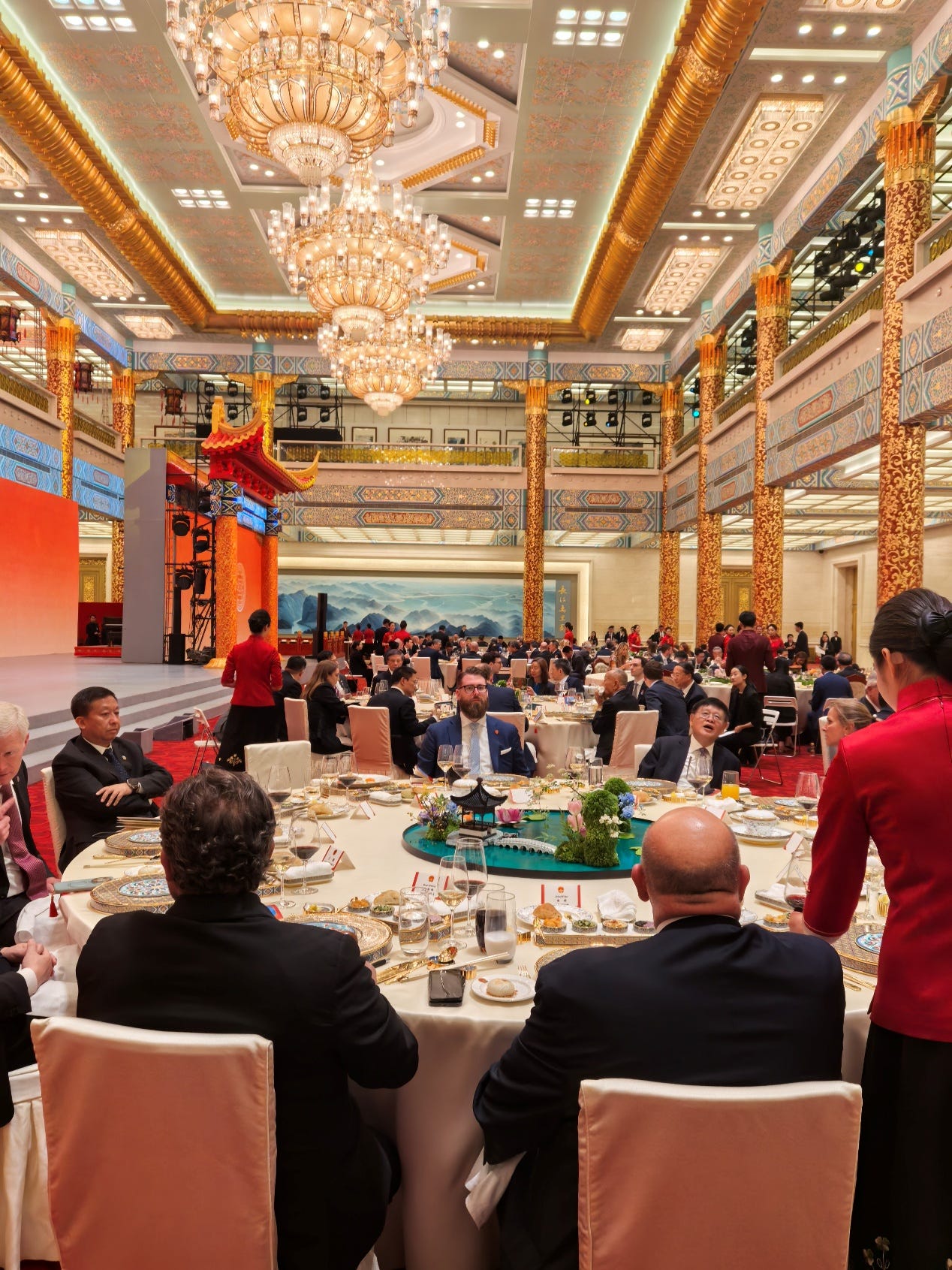
Wu Xinbo: The atmosphere was relaxed and friendly. To be honest, I had not experienced that kind of atmosphere in China–U.S. relations for many years. The last time I attended a similar event was in June 2016, during the final round of the China–U.S. Strategic and Economic Dialogue under the Obama administration. I was also invited to the dinner held at the Diaoyutai State Guesthouse.
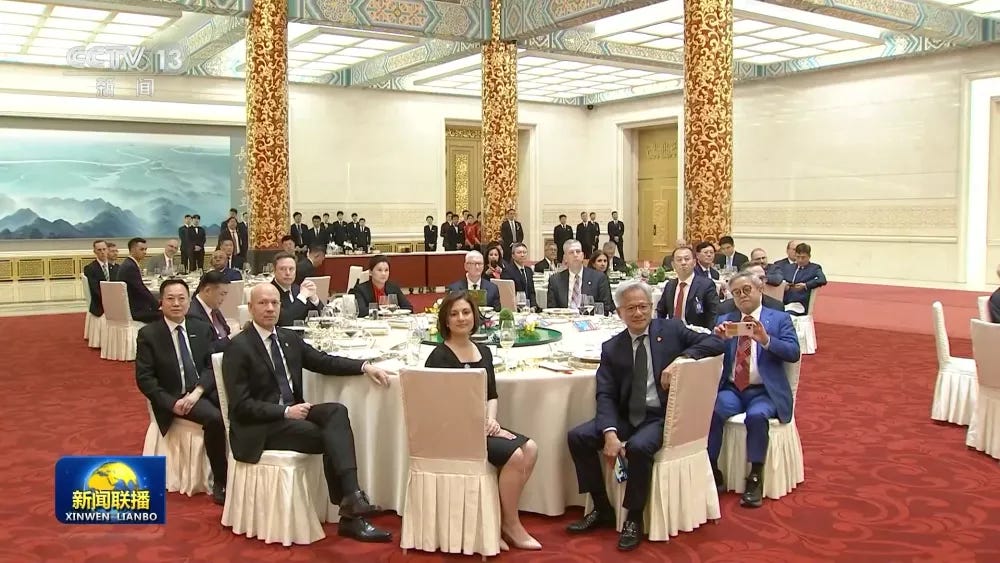
This year marks the second year of Trump’s second term. Over the past nine years, China and the United States have gone through many turns and turbulences. At this banquet, the leaders of the two countries spoke highly of bilateral relations, including their personal rapport. Chinese and American guests were seated alternately, and there was a great deal of interaction between the two sides.
I was seated between John Hiller, Deputy Assistant to the President at the White House, and Bret Baier, Fox News’ chief political anchor. We talked about a wide range of issues. Overall, the atmosphere in the room felt quite relaxed and pleasant, and the conversations flowed naturally. It was something I had not seen for many years.
Zhengshier: What did you talk about most?
Wu Xinbo: They were quite surprised to see a university professor at an occasion like that. In their mind, such banquets are usually attended by government officials and business leaders.
When they heard that I was from Shanghai, Bret Baier said Shanghai was a wonderful place. His mother had told him that he must visit Shanghai because it was an amazing city. I asked Baier how the U.S. media would cover the meeting. He gave me three key words: strength, stability and cooperation, and friendship—especially the personal friendship between President Xi Jinping and President Trump. He said those would be the main focus of the coverage.
After John Hiller learned that I knew the United States well, he told me that his daughter works at the Center for Strategic and International Studies and hosts a podcast, and that she might invite me to join the programme.
We also talked about the U.S. midterm elections and how to understand President Trump’s interactions with the Chinese side during this visit. The conversation ranged from food and U.S. domestic politics to China–U.S. relations. Americans are warm, outgoing, and enjoy conversation. When Chinese and American people sit down together, it is quite easy for them to get along.
Zhengshier: Were there any other details that left a strong impression on you?
Wu Xinbo: One detail at the dinner stood out to me. The musical programme included classic Chinese and American pieces such as Yulin Folk Tune, China in the Lights, As Wished, and Edelweiss. But the finale was Y.M.C.A., the American song familiar to many Chinese internet users and often described as Trump’s campaign anthem.
The moment the American guests heard it, they became visibly excited. Many took out their phones to film the band, and some began imitating Trump’s signature moves. After Trump finished his remarks, U.S. business representatives and others stood up and applauded. That was not something we would have seen in the past. In a way, it also reflected changes in American political culture.
Interview with Buyidao 补壹刀
独家!我们对话了亲历中美国宴的中国学者
Published 18 May 2026
Buyidao: You attended the China–U.S. state banquet. What were your personal impressions?
Wu Xinbo: At the state banquet on the evening of May 14, the two heads of state delivered warm and enthusiastic remarks on bilateral relations. Guests from various sectors in both countries had friendly exchanges, and the atmosphere was relaxed and pleasant.
One detail stood out to me. At the welcoming banquet, when Y.M.C.A. began to play, the American guests immediately lit up. Hearing what has often been described as Trump’s “campaign anthem,” they seemed to relax instantly. Some even began imitating Trump’s signature dance moves to the rhythm of the music.
In terms of seating, apart from the main table, Chinese and American representatives were seated alternately at the other tables. This created convenient conditions for close interaction between the two sides.
For example, I was seated with a Deputy Assistant to the President at the White House on my left and a Fox News anchor on my right. Guests from China and the United States were able to have direct conversations throughout the banquet. The event created opportunities for dialogue and communication, which is precisely what China–U.S. relations need at this moment: more exchanges and more conversations.
This positive atmosphere between China and the United States gave me a feeling I had not had for a long time. It also helped me appreciate the historical significance of this leaders’ meeting: after a period of turbulence and setbacks, bilateral relations are moving towards a more stable new stage.
Buyidao: How do you view this “more stable new stage”?
Wu Xinbo: The agreement between China and the United States to build “a constructive China–U.S. relationship of strategic stability” is the most important political consensus reached at this leaders’ meeting.
During Trump’s first term, U.S. policy towards China was shaped by a narrative of competition. Under that framework, Washington’s China policy shifted sharply towards toughness and pressure, and China–U.S. relations were marked by constant friction and a steady downward slide.
During the Biden administration, China tried to consult with the United States on a new guiding principle for bilateral relations, one that could move beyond the conceptual framework of “great-power competition.” But the U.S. side continued, in the name of “competition”, to contain and suppress China. Friction and conflict became recurring features of the relationship.
Against this backdrop, the consensus reached this time on building a constructive China–U.S. relationship of strategic stability offers a new vision for bilateral ties.
Buyidao: How do you understand a “constructive China–U.S. relationship of strategic stability”? How is it different from the past?
Wu Xinbo: First, there is the idea of “strategic stability.” After the China–U.S. leaders’ meeting last October, bilateral relations entered a period of relative stability. The reason was that the U.S. side, after waving the “big stick” of tariffs and sanctions against China and encountering strong countermeasures from China, had no choice but to call a truce and seek some breathing space.
But that kind of short-term stability was neither sustainable nor solid. It was a sort of “tactical stability.”
Strategic stability, by contrast, means that both sides are prepared to build major consensus on important issues or pursue active cooperation in key areas, so as to manage competition and differences effectively and provide real support for the stability of bilateral relations.
Moving from tactical stability to strategic stability means that the substance of stability becomes richer, the period of stability can extend over the next three years or even longer, and the foundation of stability becomes more solid.
The second keyword is “constructive.” During the Cold War, the United States and the Soviet Union also sought strategic stability. But that stability was mainly based on each side’s capacity for “mutually assured destruction”—their vast nuclear arsenals. Strategic stability based on mutual deterrence was negative and non-constructive.
The strategic stability that China and the United States have agreed to advance this time relies mainly on constructive means. On the one hand, the two sides can strengthen cooperation and expand the pie of shared interests. On the other hand, they can manage competition and differences effectively. This is strategic stability with a positive orientation.
The new positioning of a constructive China–U.S. relationship of strategic stability will help soften the competition narrative and improve expectations for bilateral relations. If both sides work together to sustain this goal, it will mean that the two countries have found a new paradigm for major-country relations in the 21st century and can move beyond the so-called “Thucydides Trap.”
Buyidao: Could you tell us more specifically what important outcomes were achieved at this China–U.S. leaders’ meeting?
Wu Xinbo: I believe this leaders’ meeting produced a series of important outcomes in improving and developing bilateral relations, and in expanding cooperation and exchanges.
First, the economic and trade field. The experience of the past turbulent period shows that economic and trade ties remain the ballast stone of China–U.S. relations. They cannot guarantee that the giant ship of bilateral relations will always sail smoothly, but they can help prevent it from being overturned by heavy waves.
The understandings reached this time in the economic and trade field include continuing to improve bilateral trade conditions, reducing tariff and non-tariff barriers, and promoting growth in two-way trade. The two sides will also explore ways to expand two-way investment: the U.S. side will allow Chinese companies to increase investment in non-sensitive sectors, while China will open more areas to U.S. investment. In addition, the two sides agreed to establish two working mechanisms—the Board of Trade and the Board of Investment—to help address problems in trade and investment.
These important understandings will help stabilise bilateral economic and trade relations and may put them back on a growth track.
Second, the Taiwan question. Taiwan was one of the key issues at this meeting. When U.S. media figures interviewed me, they said they were surprised by how directly China spoke about Taiwan and by the firmness of its tone.
I told them that the message China conveyed to the United States was very clear: the Taiwan question concerns China’s core interests, holds a priority position on China’s national security agenda, and is extremely important and extremely sensitive. U.S. arms sales to Taiwan and similar moves send the wrong signal to “Taiwan independence” forces, and China firmly opposes them. If the United States wants to stabilise China–U.S. relations and maintain peace across the Taiwan Strait, it must take a clear and unequivocal position against “Taiwan independence.”
I believe that, through in-depth and effective communication, the U.S. side can gain a clearer and more comprehensive understanding of China’s position, attach greater importance to China’s concerns, and neither endorse nor accept any move towards “Taiwan independence.” This engagement with the United States on the Taiwan question will help encourage Washington to handle arms sales to Taiwan and contacts with Taiwan more cautiously in the coming period, thereby helping preserve the strategic stability of China–U.S. relations.
Third, the two sides agreed to broaden dialogue, exchanges, and cooperation across many areas, including diplomatic contacts, military-to-military exchanges, law-enforcement cooperation, and people-to-people exchanges.
At the beginning of President Trump’s second term, his China policy was, to a large extent, problem-oriented. It focused only on narrow issues such as trade and fentanyl. It showed little interest in many other important issues in China–U.S. relations and was reluctant to establish multi-level dialogue and communication mechanisms with China.
At this leaders’ meeting, the U.S. side agreed to engage with China in a wide range of areas. This reflects the practical needs of the bilateral relationship. It will also help expand the positive side of China–U.S. relations and provide stronger support for a constructive China–U.S. relationship of strategic stability.
Fourth, cooperation and coordination on international and regional issues. As two major countries in the international system and the world’s two largest economies, China and the United States bear important responsibilities for world peace and security, as well as for the stability and prosperity of the global economy. And both have a significant influence in these areas.
That is precisely why this China–U.S. summit drew attention from around the world. During the meeting, the two leaders did not focus only on bilateral relations. They also discussed a range of important international and regional issues, expressed their respective positions and concerns, and explored possible ways to coordinate and cooperate.
Stronger China–U.S. coordination and cooperation in international affairs will help uphold world peace and stability. It will also provide an important driving force for the development of bilateral relations.
Buyidao: Some people may still worry that, given the repeated shifts in the U.S. leader’s China policy during his first term, new twists and turns may emerge after this visit. What is your view?
Wu Xinbo: I believe we should have full confidence in the future development of China–U.S. relations.
First, China is no longer the China it was nine years ago. Compared with that time, China today has stronger national power, greater confidence, richer experience in dealing with the United States, and more sophisticated strategic and tactical planning. Frankly speaking, the current stability and improvement in China–U.S. relations did not come about because the U.S. side suddenly showed kindness or goodwill. It is something China has secured through hard work and struggle. As China’s strength grows and its strategic will is further tested and strengthened, China’s ability to shape China–U.S. relations will only increase.
Second, President Trump himself, during his second term, has also gone through a process of reassessing China and China–U.S. relations. From the intense China–U.S. contestation in 2025, he came to recognise China’s strength and the firmness of its strategic resolve. He also realised that China–U.S. relations are not a zero-sum game in which one side wins and the other loses. The United States has to respect China and seek the right way to deal with China.
Against this background, U.S. policy towards China now places greater emphasis on maintaining stability in bilateral relations and on reciprocity. These changes will continue to affect China–U.S. relations, both now and in the future.
Third, this leaders’ meeting achieved many important outcomes and understandings. Next, both sides need to act actively in accordance with the requirements of the two leaders and implement those outcomes. At the same time, President Xi will pay a state visit to the United States this autumn, and both sides need to create favourable conditions and a positive atmosphere for the next summit.
This means that, in the coming period, exchanges between China and the United States will increase significantly, the benefits of cooperation will be released one after another, and the atmosphere in bilateral relations will further improve. This is an important opportunity for the development of China–U.S. relations.
Of course, twists and turns are unavoidable on the road ahead. U.S. hegemonic thinking and domestic politics are the two main factors shaping its China policy, and they are also the main sources of volatility in China–U.S. relations. President Trump himself is very satisfied with this trip to China, but American conservatives and China hawks are not. They will certainly continue to influence U.S. policy towards China and obstruct the development of China–U.S. relations.
The results of this year’s U.S. midterm elections will also bring new challenges to China–U.S. relations. Even so, China has both sufficient sincerity to meet the United States halfway and promote the opening of a new stage in bilateral relations, and sufficient intellectual and policy preparation to properly respond to sharp fluctuations in the relationship.

Diao Daming: Beijing should be more active to steer China-U.S. engagement

This is our third article translated from the special series in this year’s 16th issue of 世界知识 World Affairs, a Chinese-language magazine published by World Affairs Press under China’s Ministry of Foreign Affairs. The series features contributions from some of China’s “foremost scholars,” according to the magazine, on the theme