

Why did China manage to build a globally competitive high-speed railway network, yet struggle for decades to create a world-class conventional car industry?
Wei Chen and Shiping Tang argue that the difference was not state support itself, but coordination. High-speed rail had a powerful “pilot agency” — the Ministry of Railways — able to centralise procurement, bargain with foreign technology providers, set technical standards and coordinate manufacturers, suppliers, local governments and research institutions. That authority helped turn imported technology into domestic capability.
The automobile industry, by contrast, had no equivalent commanding institution. Responsibility was fragmented among ministries, industry associations, and local governments, leaving no agency strong enough to coordinate technology transfer or align carmakers with suppliers and researchers.
The following is an excerpt from Wei Chen and Shiping Tang, “The Political Logic of the Developmental State: Causes of Hits and Misses in China’s Industrial Policies,” published in the Journal of Contemporary China on 2 October, 2025.

Wei Chen is an Assistant Professor at the School of International and Public Affairs, Shanghai Jiao Tong University. Her research interests include the developmental state, comparative political economy and Chinese Political Economy.

Shiping Tang is Chair Professor at the School of International Relations and Public Affairs and Director of the Centre for Complex Decision Analysis, Fudan University.
Tang has authorized this publication.
The Political Logic of the Developmental State: Causes of Hits and Misses in China’s Industrial Policies: Excerpt
KEYWORDS
East Asian developmental state; policy coordination; China’s high-speed railway industry; China’s automobile industry
ABSTRACT
As an East Asian developmental state (EADS) with a long socialist legacy, China regularly implements industrial and science and technology (S&T) policies to ‘create winners’ in key industries. This article examines the political logic behind China’s EADS model, arguing that its success partly hinges on an institutional system that can, though not always, coordinate policies across local governments, enterprises, and different bureaucracies. We demonstrate the principle through two in-depth case studies. The high-speed railway (HSR) industry achieved rapid catch-up because its pilot agency coordinated policies effectively, while the automobile industry failed to make significant progress due to poor coordination. By identifying the political reasoning behind the EADS model, our study offers important lessons for other countries developing their industrial and S&T policies.
Introduction
China has made tremendous technological progress over the past four decades, becoming the world’s largest manufacturing economy.1,2 However, China’s economic ‘miracle’ poses a major puzzle for mainstream economic theories. How can a nation prosper with a weak rule of law, rampant corruption, and widespread misallocation of resources? More specifically, how can an economy that started with technology far behind global standards catch up so rapidly and reach the technological frontier in key industries such as high-speed railways, information technology, mobile phones, solar panels, and wind turbines, now home to many leading global companies like BYD (electric vehicles and battery technology), CATL(battery technology), DJI (unmanned aerial vehicles or drones), and Huawei (telecom and mobile phones)?
Unsurprisingly, many scholars have tried to explain China’s economic miracle from the perspective of ‘unorthodox economics’, with the East Asian developmental state (EADS) being a key model. Since 1978, China has been a typical EADS with a long socialist legacy. This EADS status and socialist legacy have two main features: 1) a relatively complete industrial system with mostly outdated technologies, and 2) a long history of economic planning with industrial policies and science and technology (hereafter, S&T) policies.
According to the EADS literature, one political logic is critical for crafting and implementing industrial policies: coordination among various governmental agencies is essential for successful industrial policies. This article provides evidence for this key feature of China as a typical EADS identified in the literature on developmental states. We argue that China’s industrial and S&T policies have succeeded partly because the country has an institutional system that can, though not always, coordinate policies across different bureaucracies.
We provide detailed qualitative evidence to support the argument, including two in-depth case studies: one positive example where China has caught up and one negative example where China has failed. Our case studies show that a targeted industry can achieve rapid catch-up when Chinese bureaucracies coordinate policies effectively, whereas it fails when policies are poorly coordinated. The former is illustrated by China’s high-speed railway (HSR) industry, while the latter by China’s automobile industry (producing internal combustion engine, or ICE, vehicles). Together, these studies highlight policy coordination as a key political factor influencing the success or failure of China’s industrial policies.
The rest of the article is organized as follows. Section two briefly introduces the EADS model and its implications for understanding China, then presents our main arguments. Section three provides two case studies of China’s industrial and S&T policies to support the political logic behind the EADS model. Section four discusses implications and concludes.
China as an EADS
According to the EADS literature, five political features are central. First, the state, especially its leadership, focuses on development or catch-up, a form of economic nationalism. Second, the state is fairly capable, especially with a cohesive and meritocratic bureaucracy. Third, the state’s bureaucracy is mostly insulated and autonomous, yet it maintains a symbiotic relationship with the business class when making its policies (hence, ‘embedded autonomy’). Fourth, the state seeks to ‘govern the market’ via carefully crafted and closely coordinated industrial policies targeting specific strategic industries. Fifth, the state puts a pilot organization in charge of crafting and coordinating industrial policies, with the prominent examples being Japan’s MITI, Singapore’s Economic Planning Board, and China’s National Development and Reform Commission (NDRC).
More concretely, when governing the market, insulated or autonomous bureaucracies or agencies identify key industries and emerging technologies and then craft industrial and S&T policies to foster domestic firms’ growth and technological progress in these sectors. In short, they aim to ‘create (and pick) winners’. When implementing these policies, a pilot agency (like the NDRC) will coordinate different agencies and require that they work together effectively. Agencies responsible for industrial policies and S&T policies often coordinate with other agencies that oversee tariffs, taxes, and other financial and fiscal matters to increase the probability of policy success further. This political process of policy coordination is the primary focus of this article.
In addition to a pilot agency, China and traditional EADS share several key characteristics, including: (1) a strong commitment to economic development; (2) consistent economic, industrial, and S&T policies since the mid-1990s; (3) a cohesive national bureaucratic system unified by a consensus on prioritizing economic growth. While China’s economic structure, dominated by SOEs, differs from those of Japan and South Korea, it bears a strong resemblance to that of Taiwan, China between the 1960s and the 1990s. In both economies, SOEs control natural monopoly industries and strategic sectors and dominate banks and stock markets; privately owned enterprises are concentrated in non-strategic sectors with strong competitiveness.
As the largest EADS, China has successfully promoted technological progress across many industries through industrial and S&T policies. Since the mid-1990s, China has launched far more ambitious and integrated industrial and S&T policies. Successive initiatives targeting SEIs, such as the ‘973 Plan’ (also known as ‘National Key Basic Research Program’, released in March 1997), the ‘985’ initiative (officially launched in May 1998 to replace the ‘863’ project), the ‘Medium and Long-term Plan for Science and Technology (2006–2020)’ (released in March 2003), SEI Initiative (initiated in November 2009 and finalized in October 2010), have all clearly outlined their approaches for picking key technologies and industries. The policies have been specifically designed to promote rapid technological catch-up and even leapfrogging by Chinese sectors and firms to ‘seize the commanding heights of the new technological revolution’.
Under Premier Wen Jiabao (2003–2012), there was a significant revitalization, institutionalization, and rationalization of industrial policy and S&T policy.Two aspects are especially notable. First, the organizational structures for economic planning, including crafting industrial policy, were stream lined. Most prominently, a powerful super-planning agency, the National Development and Reform Commission (NDRC), was created. A key responsibility for NDRC is initiating and coordinating significant industrial and economic policies among ministries (like the Ministry of Education and the Ministry of Finance), other government agencies (like the central bank and state-owned com mercial banks), and industries. Additionally, a new and more powerful Ministry of Science and Technology (MOST), responsible for crafting S&T policies, was also created.
Second, policymaking processes became more institutionalized and efficient. The top leadership issues key directives to guide overall industrial and S&T policies for a significant period. Following the top leadership’s directives, MOST is responsible for initiating and drafting S&T policies by consulting with scientists. Although the top leadership has the final authority, the NDRC handles initiating and drafting industrial policies by gathering input from scientists, economists, local governments, and other ministries. These measures have ensured policy continuity over a significant time frame.
According to the EADS literature, a pilot agency capable of policy coordination is essential for the success of industrial policies. We thus reason that China’s achievements in industrial and S&T policies are also partly due to the country’s institutional system that can, though not always, coordinate policies across various bureaucracies. Such policy coordination is even more vital for industries with highly complex technologies, diverse participants, and extended industrial chains, such as most ESIs that China has targeted. In short, a powerful pilot agency is a necessary condition for the success of industrial policies: only with a pilot agency that can effectively coordinate industrial and S&T policies, can these policies succeed.
The Effects of Policy Coordination: Two Case Studies
This section examines two sectors: a sector that has succeeded in technological catch-up and a sector that has not. The former is represented by China’s high-speed railway (HSR) industry, and the latter by China’s automobile industry. For our aims, they share two additional sets of similarities.
First, both sectors are SEIs identified by the state, and the government has implemented clear and consistent industrial and S&T policies for each to promote technological catch-up. As early as 1990, developing quasi-high-speed trains was included in the ‘National Science and Technology Tackling Key Problems Program (1991–1995)’. In 2004, the 34th Executive Meeting of the State Council approved the ‘Medium- and Long-Term Railway Network Plan’, which officially started the rapid catch-up process of the HSR industry. Then, ‘Agreement on the Joint Action Plan for Indigenous Innovation of China’s High-speed Railways’ was issued in 2008 to promote the indigenous innovation strategy.
The automobile industry was prioritized even earlier in the national plan. In 1985, the CPC Central Committee proposed the automobile industry as a key pillar sector in its ‘Proposal for Drafting the Seventh Five-Year Plan for National Economic and Social Development (Draft)’. Following that, China released its first comprehensive industrial policy, ‘Industrial Policy for the Automobile Industry’, in 1994. In 2004, the NDRC introduced ‘The Development Policy for the Automobile Industry’ to encourage domestic innovation in the auto sector. In summary, both sectors underwent the technological upgrading from introduction, learning and absorption, to independent R&D.
Second, initially, SOEs dominate the vehicle manufacturers in these two industries while supplies and parts are mostly supplied by private businesses. Even in the HSR industry, which is usually considered to be dominated by SOEs, many key components are supplied by private companies such as Xincheng New Materials (Pantograph), Huawu Co., Ltd. (braking system), Yonggui Electric (cou pler), Bode Transportation (door and window system), KTK Group (bogies, door and window system), and others.Also, in both sectors, while SOEs are responsible for introducing key technologies through joint ventures with foreign companies, private enterprises mostly developed their products on their own.
To compare the two industries, we measure the success or failure of industrial catch-up from two perspectives: technology and market. Regarding technological catch-up, we choose ‘Can domestic companies reach the world’s cutting-edge technology through indigenous innovation?’ Regarding market catch-up, we use the export of high-end products as the key indicator. As becomes clear below, China’s HSR industry has been a remarkable success because MOR has closely coordinated various policies with different organizations. In contrast, China’s automobile industry has become a dismal failure without a powerful pilot agency to coordinate policies effectively.
Policy Coordination Behind China’s High-Speed Railway Industry
Overview of the Industry
Before 2004, Chinese railway manufacturers could not produce high-speed bullet trains ( > 200 km/ h). In January 2004, the China’s State Council approved the ‘Medium- and Long-Term Railway Network Plan’. This plan set key guidelines for China’s railway industry to import advanced technology, engage in joint design and manufacturing, and ultimately build China’s high-speed railways with indigenous technology. The State Council tasked MOR with implementing the plan.
From 2004 to 2008, MOR focused on importing and absorbing technology through joint ventures. MOR supervised the import of HSR technology from four key foreign companies: Bombardier (Canada), Kawasaki Heavy Industries Ltd. (Japan), Siemens (Germany), and Alstom (France). Joint ventures were formed and worked on developing HSR series like CRH1 (200 km/h), CRH2 (200/250 km/h), CRH3 (350 km/h), and CRH5 (250 km/h).Thanks to technology transfer from foreign firms, Chinese companies could quickly adopt advanced manufacturing techniques and enhance their design skills through reverse engineering.
In February 2008, MOR and MOST issued the ‘Agreement on the Joint Action Plan for Indigenous Innovation of China’s High-speed Railways’. This document marked the start of the second phase of developing China’s HSR industry (2008–2012). China shifted its focus toward indigenous technology innovation by encouraging domestic companies to engage in forward design and technology integration after successfully importing and absorbing cutting-edge technologies from leading foreign firms.
In 2015, China’s HSR industry successfully launched its own 350 km/h electric multiple unit (EMU) train, with Chinese technical standards. Since then, China has achieved many technological milestones, setting three of the world’s four highest speed records in the HSR industry and making breakthroughs in many core technologies, such as traction conversion, microcomputer network, braking technology, etc.
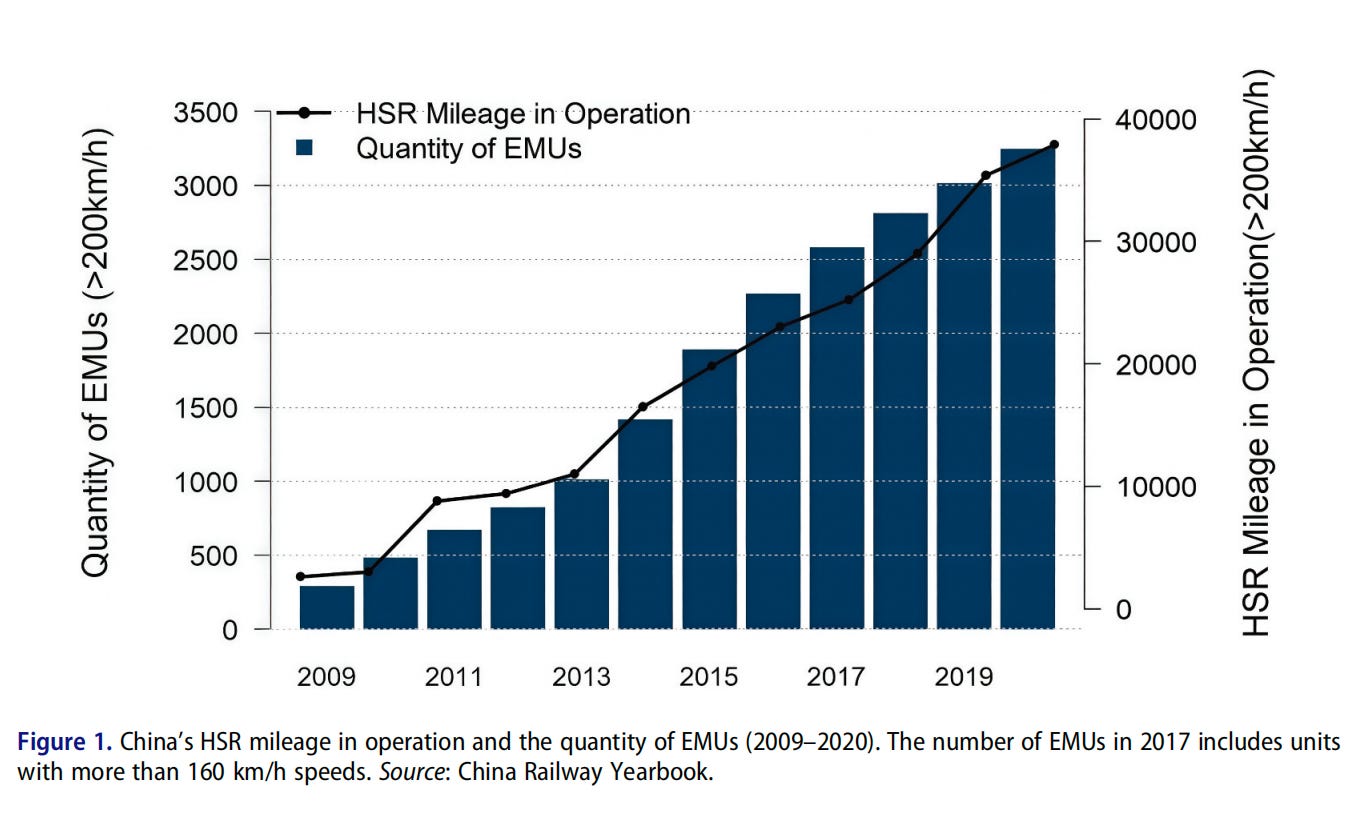
Moreover, the number of China’s EMUs has increased more than ten times, from 285 in 2009 to 3,241 in 2020. By 2022, China’s HSR system reached 42,000 kilometers, making up 60.8% of the world’s total length. Figure 1 shows China’s growing HSR mileage in operation over the past decade. With advanced engineering and equipment manufacturing technologies, China’s HSR industry has become highly competitive globally over the past ten years. Its HSR equipment has been exported to over 100 countries. The top export destinations include Malaysia, Vietnam, Turkey, Israel, Mexico, Ecuador, Nigeria, Ethiopia, Australia, the United Kingdom, and others. In addition, China has undertaken numerous HSR construction projects overseas, such as Indonesia’s Jakarta- Bandung HSR Project, Saudi Arabia’s Haramin HSR Project, and others.These accomplishments demonstrate China’s rapid technological progress in the HSR industry.
History of the Pilot Agency
How did China significantly leap forward in the HSR industry within such a short period? The authors argue that MOR, the powerful pilot agency, with its ability to mobilize resources and coordinate policies across different agencies and enterprises, has been the key driver behind its success.
Although MOR has been restructured multiple times from 2000 to 2019, its core role in organizing the entire industry remains unchanged. Its central position has allowed it to draft, coordinate, and enforce industry policies. Figure 2 visually presents the history of these reforms.
Before 2000, MOR managed China’s railway industry as a closed system, exerting comprehensive regulatory control over planning, construction, equipment manufacturing, communication signals, transportation management, research and development (R&D), and higher education. The system’s R&D and production network includes over thirty engineering companies and four specialized research institutes focusing on locomotive and vehicle development. Although reforms have been underway since the 1990s to separate various functions (such as engineering, manufacturing, communication signals, and R&D) from MOR, MOR retained overall control of the industry.
In 2000, the Locomotive and Vehicle Research Institute Corporation was officially separated from MOR and divided into two large SOEs, China South Locomotive Corporation Limited (CSR) and China North Locomotive Corporation Limited (CNR). From 2000 to 2015, CSR and CNR were responsible for designing and manufacturing HSR equipment, including locomotives and coaches. They competed against and collaborated with each other, which further accelerated technological progress.
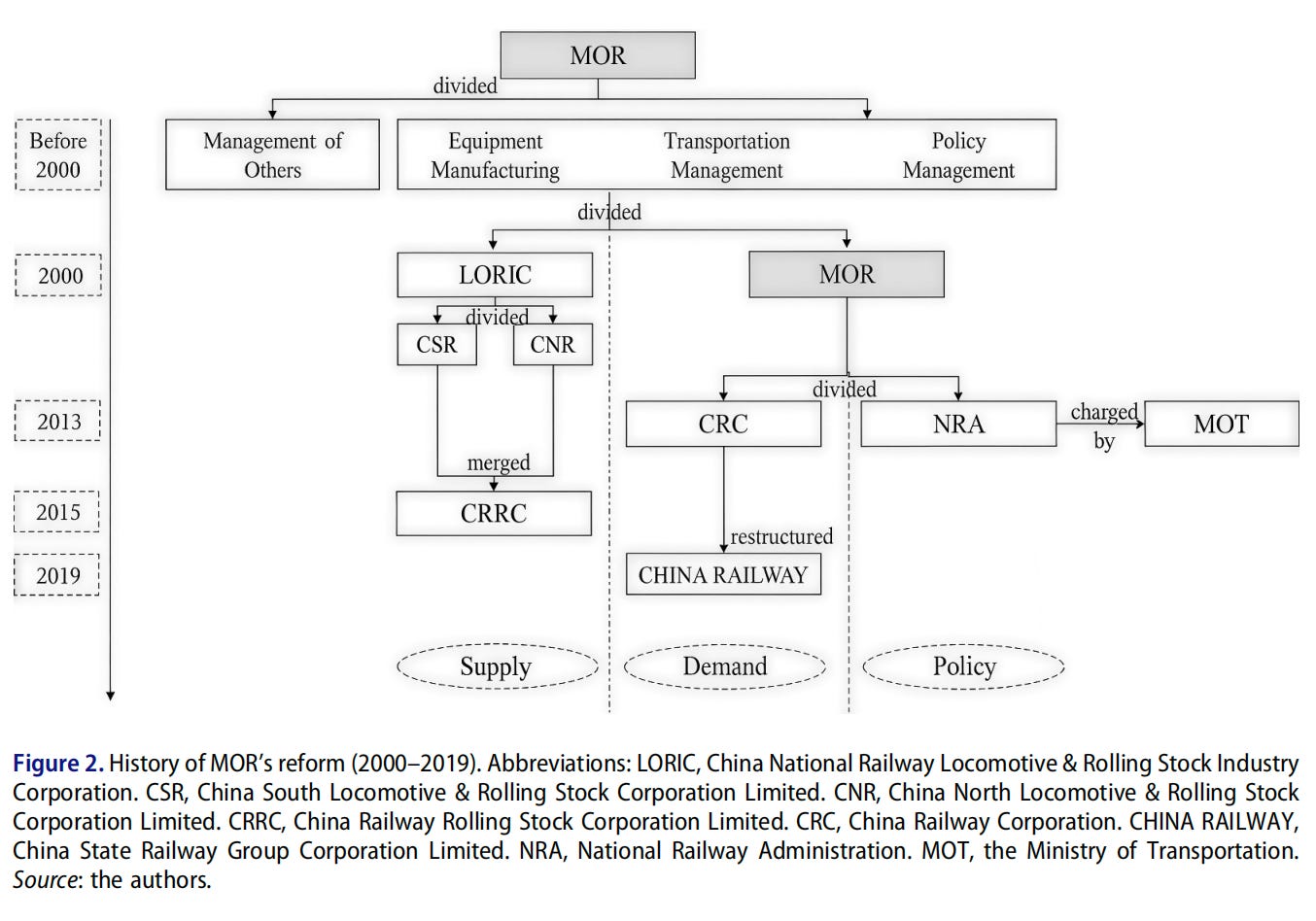
In 2013, MOR was split into two entities: China Railway Corporation (CRC) and the National Railway Administration (NRA).CRC is an SOE managed by the central government, primarily responsible for providing transportation services. CRC maintains its monopoly over the demand market for locomotives and systems in the railway industry. NRA, which retains the MOR’s administrative function, is subordinate to the Ministry of Transportation (MOT) and holds a vice-ministerial ranking within MOT. NRA is responsible for implementing industrial policies and overseeing the industry.
Throughout the reform, which lasted from 2004 to 2018, MOR has maintained a stable core position in the industry. With its powerful position, MOR can accumulate economic resources, technical knowledge, and industrial networks, giving it overwhelming power to regulate the industry. Indeed, MOR was so powerful that it could motivate industry participants to engage in HSR projects even without support from central leadership from 1995 to 2003. The Qin-Shen Passenger Dedicated Line (essentially a renamed HSR line) and the early self-developed ‘China Star’ EMUs are achievements made by MOR during that period.
In 2002, Liu Zhijun became Minister of MOR and, in 2003, also the Secretary of the Party Committee. As a result, MOR has been under Liu’s complete control and has become more aggressive in advancing HSR projects.
Successful Coordination
From 2004 to 2018, MOR and its related entities maintained stable authority and close coordination with organizations such as CSR, CNR, MOST, MOT, universities, and other R&D institutions. As a result, policies for the HSR industry were articulated quickly and carried out effectively. Coordination led by MOR operated across three dimensions: vertical-1 (over local railway bureaus), vertical-2 (over HSR enterprises), and horizontal (with other central ministries and departments).
First, MOR successfully coordinated policies with local railway bureaus by leveraging its unique strength. This coordination allows MOR to regulate the demand for products and technologies, thereby boosting the negotiating power of domestic companies when dealing with foreign firms for effective technology transfer. In 2005, MOR eliminated forty-one medium-sized local railway bureaus and merged them into eighteen regional bureaus. Most importantly, it regained the procurement rights from regional bureaus and created a unified market with a single buyer. By doing so, MOR became the sole gatekeeper for locomotive manufacturers and gained extensive power to set criteria for market access, product performance, and technical specifications. For instance, MOR required that only joint ventures could supply China’s HSR systems, thus forcing foreign companies to transfer technology to their Chinese partners. To effectively oversee technology transfer, MOR also created an evaluation system to monitor the results, with its primary measure being whether Chinese firms have successfully acquired the transferred technologies. If the technology transfer was deemed unsuccessful, MOR would refuse to pay for the products.
Consequently, companies from Germany, Japan, and France competed intensely to secure Chinese orders. Leveraging strong bargaining power, China successfully introduced the Velaro EMU (designed for 320 km/h) from Siemens in 2005. Chinese companies not only reduced the price of each train model from 350 million RMB to 250 million RMB and the technology transfer fee from 390 million euros to 80 million euros, but also gained more favorable conditions for technology transfer.
In addition, MOR has coordinated effectively with local governments to ease its financial constraints. By leveraging the spillover effect of HSR on economic development and the desire of local governments to have HSR earlier than their competitors, MOR successfully launched the ‘rail-local strategic cooperation’ project based on the principle of ‘whoever pays first, whose HSR will be built first’.By doing so, MOR has forced provinces and municipalities to co-fund 158 projects, attracting more than 1.4 trillion yuan of investment.
Second, MOR coordinated policies with the EMU manufacturers closely and effectively to promote technological innovation. This coordination scheme has enabled MOR to motivate those manufacturers and help them build innovation capabilities. MOR used its almost complete control to consolidate an oligopolistic supply market into just three high-speed EMU manufacturers: CSR Qingdao Sifang Locomotive and Rolling Stock Co., Ltd (CSR Sifang), CNR Changchun Railway Vehicles Co., Ltd (CNR Changchun), and CNR Tangshan Railway Vehicles Co., Ltd. (CNR Tangshan). On the one hand, MOR established clear technical criteria and required these three manufacturers to compete against each other based on technical goals rather than short-term profits.
To push these enterprises toward rapid technological learning, absorption, and innovation, MOR set strict localization standards and technical specifications for domestically produced equipment.Only producers with advanced technology and competitive prices can secure MOR’s orders. As a result, EMU manufacturers had to continually invest in technological upgrades and reduce costs. For example, CSR Sifang had to independently develop EMUs capable of over 300 km/h to compete with CNR Changchun, based on the imported technology that initially supported 200 km/h speeds. This EMU model was later named the CRH380A (L).
On the other hand, MOR used the oligopolistic nature of the EMU market to ensure the three companies had enough funds to invest in R&D. EMU manufacturers could invest in technological innovation with a more or less guaranteed net profit margin of about 15%.In addition, MOR formed a group of experts in 2003 focused on rail equipment modernization to assist CSR and CNR in upgrading technology. MOR also set up an office to ensure effective daily communication with the enterprises.The experts and the two EMU manufacturers jointly set the specific operational details of the technology introduction and approved the plan ‘Outline for Accelerating the Implementation Process of Locomotive and Rolling Stock Equipment Modernization’.
Third, MOR also effectively coordinated policies with other central ministries and departments, especially MOST, to enhance the industry’s overall innovation capacity. The partnership between the two ministries was officially launched in 2008 with the signing of the ‘Agreement on Joint Action Plan for Indigenous Innovation of China’s High-Speed Railway’. To improve coordination, MOR and MOST established ‘Office 226’ as the command center to oversee and address various planning and coordination issues.
Most importantly, and in line with our thesis that S&T policies should be considered as part of China’s industrial policies, China’s ‘863 plan’ and other national S&T programs allocated significant funds to the HSR industry, including the major project ‘Research and Development of Key Technologies and Equipment for China’s High-Speed Trains’. These funds were allocated solely to consortia comprised of enterprises, universities, and research institutions.By doing so, MOR and MOST established a highly effective Enterprise-University-Research (EUR) cooperation system to make and implement S&T policies dedicated to the HSR industry. It includes ten core enterprises affiliated with CNR and CSR, twenty-five universities, eleven scientific research institutions, and fiftyone key laboratories and engineering research centers.
Effective coordination among the EUR is essential for technological innovation in HSR. High-speed trains are highly complex, consisting of more than 40,000 parts. These product features require locomotive manufacturers to work effectively with other stakeholders. The EUR system allows participants to share knowledge, techniques, human resources, and other scientific and market resources. By involving agencies with advanced research capabilities outside the traditional rail system, manufacturers can learn cutting-edge technology, directly enhancing their efficiency in upgrading technology. With the assistance of universities, enterprises could address technical problems more effectively. For example, when engineers at CNR Changchun, which imported technology from Alstom, faced the repeated fracture of its new wheel-rail during operation, they sought help from Southwest Jiao Tong University (SWJTU). SWJTU professors helped the engineers create a dynamic analysis model of the wheel-rail that improves related technical parameters and successfully resolves the issue.
The system also provides a space for trial and error, allowing manufacturers and their suppliers to build long-term collaborative relationships through joint innovation. Through effective coordination with suppliers, CSR successfully developed a highpower-density IGBT chip, breaking the supply monopoly of foreign companies.China’s CRH380 series EMU trains demonstrate China’s capability of integrating innovation, showcasing the prowess of the EUR system.
To summarize, effective policy coordination among MOR, MOST, enterprises, R&D institutions, and other relevant agencies has been a crucial force behind China’s HSR industry’s successful technological catch-up. By comparison, the lack of effective coordination has directly caused the dismal failure of China’s automobile industry.
Lack of Policy Coordination in China’s Automobile Industry
Overview of the Industry
China has invested heavily in developing its automobile industry since the late 1980s. China first declared the auto industry ‘a critical pillar industry’ in its 7th five-year plan (1986–1990). In 1994, China’s State Council released the country’s first ‘Industrial Policy for the Automobile Industry’ that set clear developmental goals and strategies. Because China’s auto industry was significantly behind the technological frontier at that time, China aimed to jumpstart the sector through rapid technological learning and absorption. Specifically, China planned to obtain technology transfers from foreign firms through joint ventures by leveraging its potentially enormous market (‘market for technologies’, yishichang huan jishu) and hoped to reach targets for large-scale production and industry concentration, setting a goal that the CR3 of the industry should reach 70% by 2000.
Unfortunately, China’s first decade (1994–2004) of industrial policy for its auto industry was a dismal failure marked by technological stagnation.After a decade of enormous push, China’s vehicle manufacturers still could not independently design and develop new vehicle models.
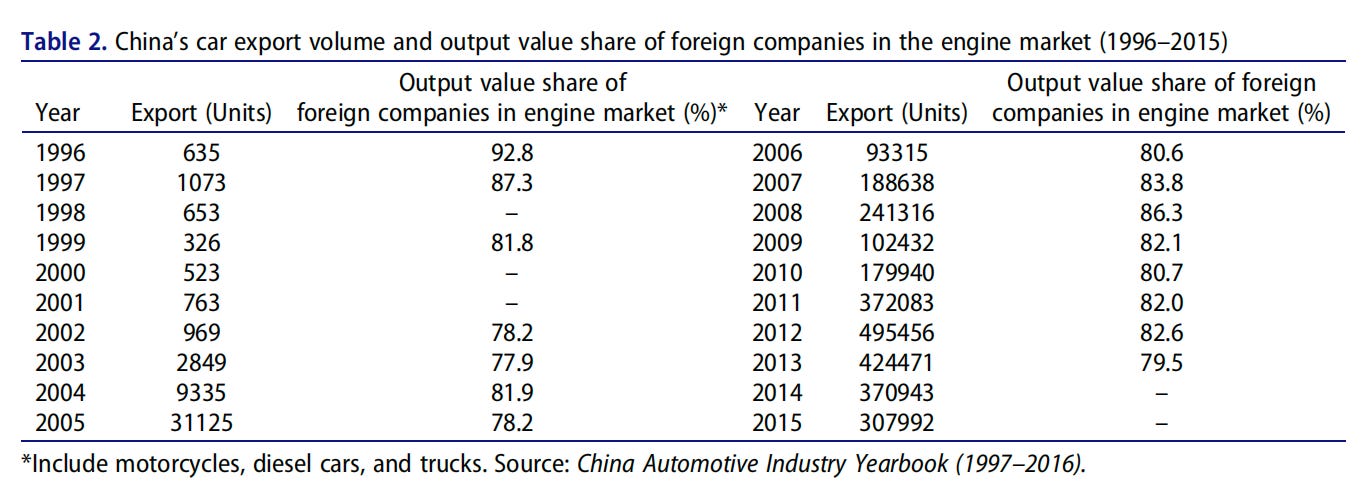
Worse yet, the R&D capability of auto parts suppliers was significantly lower than that of vehicle manufacturers. By 2004, joint ventures dominated the domestic car market, with foreign companies supplying core components, especially engines and transmissions. Car exports from China were nearly nonexistent (see Table 2).
To tackle the worsening situation, NDRC introduced a new industrial policy in 2004, ‘The Development Policy for the Automobile Industry’. This new policy focused on industry concentration and set specific targets for domestic companies, including improving their indigenous innovation capabilities. In its ‘11th Five-Year Plan (2006–2010) for the Automobile Industry’, NDRC set a key goal: by 2010, domestic firms should capture 60% of the domestic market share.
In terms of technological catch-up, while both China’s car makers and parts suppliers have made tangible progress during this second decade,progress has been extremely limited. Most promi nently, while China’s indigenous car-makers could independently design and manufacture new models, they could only do so with dated technologies. As a result, vehicles made by Geely, Chang’an, and Great Wall could only compete in low-end and mid-end car markets.Parts suppliers faced a similar technological situation. While domestic companies could produce auto parts or components with dated technologies, they still could not independently develop core components, especially engines and transmissions.As Table 2 shows, foreign companies accounted for about 80% of the total output value in China’s engine market from 2004 to 2013.
Regarding exports, China’s auto industry did not perform well either. Although the export volume has increased dozens of times, it remains extremely low. In 2015, China exported about 300,000 vehicles. However, most were produced by Chery, Geely, Great Wall, and other mid- and low-end automakers and then exported to Russia, Iran, Vietnam, Afghanistan, and other countries.
History of the Pilot Agency
What were the causes behind the disappointing performance of China’s auto industry? Again, consistent with the EADS model, lacking effective policy coordination has been the key cause. Most importantly, unlike MOR and its successors (i.e., CRC and NRA) in the HSR industry, no powerful pilot agency has ever held dominating authority over the auto industry. Without a powerful pilot agency to coordinate policies, no clear and binding targets have ever been issued for technological learning, absorption, and catching up for the auto industry.
Figure 4 highlights key reform events in China’s auto industry. As shown, the pilot agency in China’s auto sector has shifted among SOEs, industry associations, and administrative bodies from the 1980s to the 2000s. This repeated reshuffling has seriously weakened its ability to develop sufficient technical expertise and industrial networks to create, implement, and enforce consistent industrial policies.
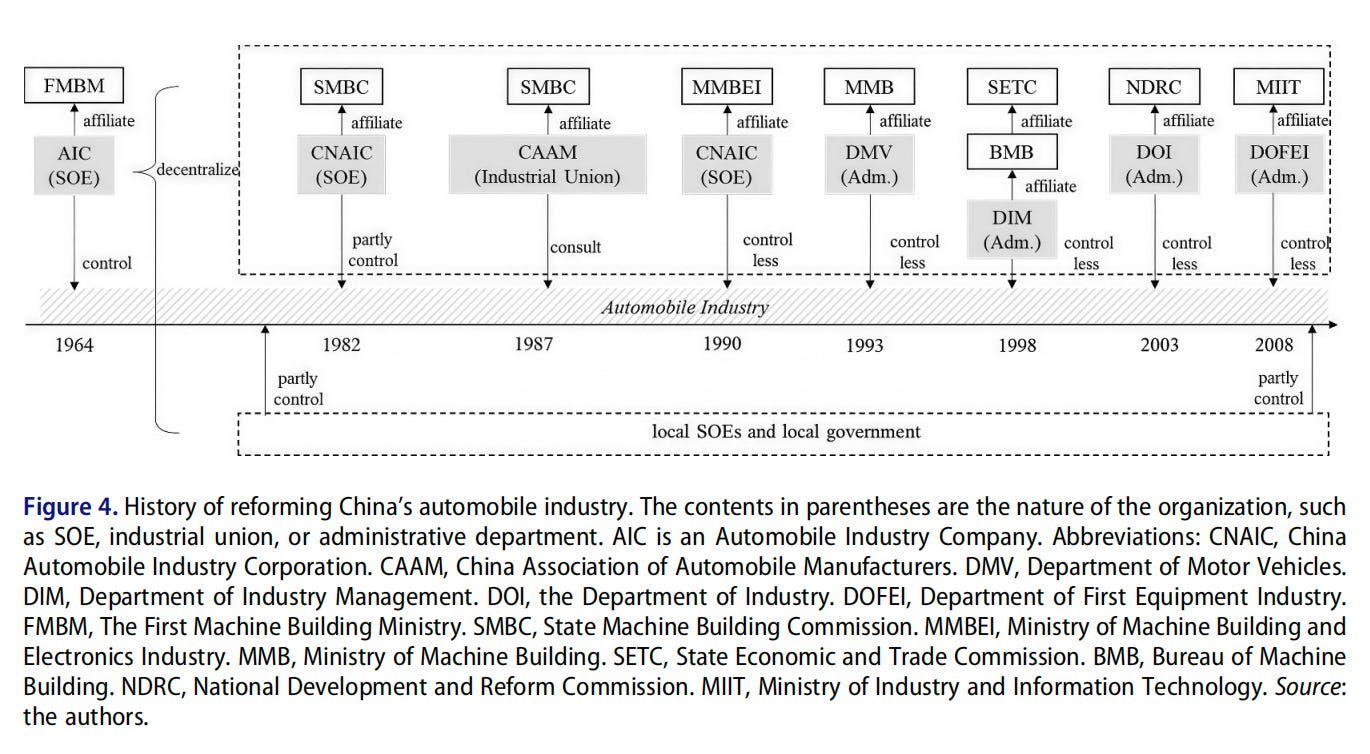
In 1987, the China Association of Automobile Manufacturers (CAAM) became the industry’s pilot agency. However, CAAM was simply a voluntary organization of companies and institutions that provide consulting services for the industry. In 1990, China Automobile Industry Corporation (CNAIC) took on the role, but it was an SOE. As such, neither CAAM nor CNAIC had sufficient administrative power or capacity to oversee the whole industry. Thus, for over 21 years (1987 to 2008), China lacked a consistent administrative agency to oversee the auto industry.
In 2003, the Department of Industry (DOI) was established under NDRC to craft and implement industrial policies across various sectors, including the auto industry. Self-evidently, with so much on its plate, DOI could only dedicate very limited time and resources to the auto industry. More importantly, DOI still lacked the administrative authority because it was merely a division within NDRC hierarchy. Due to its lower administrative status, DOI’s directives were often ignored by most local governments, which have enjoyed considerable autonomy in creating and enforcing policies since the 1960s.
After 2008, the Department of First Equipment Industry (DOFEI) of the Ministry of Industry and Information Technology (MIIT) took over DOI’s role. This reorganization, however, still did not solve the problems associated with DOI. Here, suffice to say that DOFEI is also a bureau/department-level organization. As such, in China’s bureaucratic hierarchy, DOFEI has very limited power over other ministries and local governments, just as its predecessor did. In short, DOFEI has been no more effective than DOI.
Furthermore, apart from DOI or DOFEI, several other central government agencies were respon sible for drafting and implementing specific automobile industry policies. These agencies include MOT, the Ministry of Public Security, the State Bureau of Quality and Technical Supervision, the State Environment Protection Administration, the Department of Motor Vehicles under the Ministry of Machine Building, and the Department of Industry Management under the State Economic and Trade Commission. These agencies can issue various policies related to quality supervision, technol ogy development and management, transportation, market access, and project approval that often overlap with but contradict each other. With such a fragmented institutional setup, effective policy coordination in the auto industry is all but impossible.
Failed Coordination
We now examine how policy coordination has failed in the automobile industry in detail. First and foremost, the pilot agencies responsible for making and coordinating policies have been almost completely powerless in regulating local governments. As a result, the various supposed pilot agencies for the industry had little control over technology transfer, market access, and localization requirements, making it difficult for the auto industry to obtain transfer technologies more effectively. While the central government developed a strategic plan called the ‘Big Three and Small Three’ to promote large-scale production and high industry concentration, this directive had been completely ignored. With lower administrative levels and limited policy tools, the supposed pilot agencies could not coordinate the product market or incentivize the assigned local governments to develop the auto industry. Among the designated production bases, only Shanghai had actively pursued the plan, while Guangzhou and Beijing did not prioritize the auto industry in their regional development strategies at all.
Meanwhile, many local governments left outside the plan, lured by the potential profits of the automobile industry, rushed to establish their carmakers, in open defiance of the directives from the central government. Most prominently, Wuhu, a municipality in Anhui province, secretly established Chery Automobile. Although numerous regulations and directives were issued to rein in local governments, they were almost universally dismissed.As shown in Figure 5(a), between 1994 and 2014, there were roughly 120 automakers in China, more than the number of companies worldwide. These automakers competed intensely for technology transfer, thus weakening their own bargaining power while strengthening the bargaining power of foreign companies. Without strong bargaining power, Chinese companies could not obtain key and advanced technologies from foreign firms.
Second, the various pilot agencies have also failed to coordinate domestic automakers and parts suppliers. Because the pilot agencies in the auto industry kept changing from the 1980s to the 2000s, none of them could establish close industrial networks or accumulate enough technical knowledge and economic resources. Lacking those resources, these pilot agencies could not develop technical standards or create an oligopolistic supply market.Without practical technical standards, such as requirements for new car models, the agencies failed to motivate automakers, especially joint ventures, which were most capable of technological innovation at the time, to invest in R&D as long as those enterprises could profit from assembling and selling existing and dated products.
Furthermore, with a market in oversupply and fierce competition, enterprises lacked sufficient funds for R&D. Intense competition prevented individual enterprises from securing enough orders or expanding their scale. In 2001, 60% of China’s automakers produced fewer than 5,000 units annually, significantly below the average size of global automakers. The R&D investment ratio of China’s auto industry remained below 2% from 1998 to 2014, much lower than that of foreign competitors.
Indigenous brand automakers, despite their stronger motivation for innovation, also struggled to achieve sufficient profits due to outdated techniques and their smaller size. In 2009, 33% of these manufacturers were small shops, and nearly half were unprofitable. Even well-known brands such as Geely and Chery continued as imitators and relied on operational process improvements rather than product innovations to earn profits.
Pilot agencies also failed to coordinate auto parts suppliers. For example, to promote the localization of Santana, a model made by Shanghai-Volkswagen, the central government established the Santana Parts Community that aimed to coordinate national auto parts suppliers to collaborate and provide quality parts for Santana. However, in 1997, Shanghai-Volkswagen purchased 85.5% of parts from local suppliers instead of national suppliers, and even 50% of total parts from within its own group.Coordination failures like this case led to the technical stagnation of China’s auto parts companies before 2004.
Third, the supposed pilot agencies could not effectively coordinate with other central departments either. In fact, their low administrative ranking has made them essentially irrelevant. Unsurprisingly, when different policies issued by various central agencies conflicted with each other, the supposed pilot agencies could hardly resolve these conflicts. Without adequate policy coordination across departments, these supposed pilot agencies have been unable to establish an effective EUR system to facilitate innovation as MOR did for the HSR industry. There was no command center or consensus on working principles guiding participants in China’s auto industry. Within the system, firms, universities, and research institutions were guided by different departments and focused on specific tasks rather than the larger picture. Indeed, there is no clear division of labor between those organizations or in-depth cooperation. This coordination failure has deprived the auto industry of the opportunity to build an efficient system to foster innovation capabilities.
Overall, China’s auto industry failed to meet the objectives outlined by its industrial policies: mass production, increased industry concentration, and technological innovation.
Conclusion
Industrial policy has become more prominent recently, partly due to the growing geopolitical competition (especially the Sino-U.S. rivalry) and the need for industrial transformation of developed capitalist countries.Exploring the success or failure of industrial policy has become a focus of political economy again. As a successful EADS in the twenty-first century, China’s experience with industrial policies provides valuable lessons for crafting and implementing industrial policy. In this article, we highlight a central political logic behind China’s industrial and S&T policies: a strong pilot agency is necessary for effective policy coordination and successful industrial and S&T policies. This finding is more applicable to latecomer industries with more complex technologies, higher capital requirements, and higher industrial concentration. China’s development experience offers a new perspective for re-examining the EADS model.
In addition, our article also offers important insights for two broader areas of literature: the potential synergy between the ‘carrot’ and ‘stick’ in implementing industrial policies and the role of state capacity. First, most studies on industrial and S&T policies have focused on supporting policies as ‘carrots’. However, EADS’s experience has long taught us that effective industrial and S&T policies must also include ‘sticks’: firms receiving support must meet pre-set targets (such as absorbing key technologies or exporting) or face the consequences. Intuitively, ‘carrots and sticks’ should work better than ‘carrots’ or ‘sticks’ alone. Our case studies strongly support this idea. MOR had both ‘carrots’ and ‘sticks’, whereas no agency in China’s automobile industry has enough ‘sticks’.
Second, the EADS model explicitly assumes a strong state with adequate state capacity. The model’s focus on state capacity aligns with the renewed interest in the state’s role, state capacity, and governance quality in political economy and broader social sciences.In this context, one can argue that China’s robust state capacities in mobilizing resources and implementing policies are key factors in its success at catching up in major industries. In short, China’s bureaucracies and top decision-makers, supported by their ‘embedded autonomy’, have made some correct decisions despite many mistakes.
State capacity, however, does not operate in isolation: successful economic development also relies on institutions and specific policies. Therefore, state capacity, institutional frameworks, and socio-economic policies form a ‘new development triangle’.Unfortunately, due to issues with conceptualization and measurement, much of the empirical research on the relationship between state capacity, governance quality, and economic, social, and political outcomes has been inconsistent and unpersuasive. More rigorous work is urgently needed.


This is a very good article and I agree with its core conclusions (I'm honored to see they cite some of my research, too). I would respectfully push back somewhat on Chen and Tang's characterization of auto sector industrial policy as a "dismal failure". I think this is broadly true for the 1994-2004 period for the reasons they emphasize and more, but in my view they somewhat understate the direct and indirect contributions of industrial and technology transfer policies post-WTO to the sector's subsequent development. I also think it's important to remember that creating globally-competitive conventional auto brands is extraordinarily difficult. There's a reason only one country -- South Korea -- has managed to do so post-World War II that did not have a robust auto manufacturing sector before the war, and it took South Korea two-plus decades to get there. There's no doubt industrial and technology transfer policies in conventional autos underperformed relative to leaders' (unrealistic) expectations, but I think ten or even twenty years is too short a time frame to assess these policies' full impact. That said, I do appreciate that this article periodizes the sector's policy trajectory. Too much commentary over-indexes on the 1980s and 1990s and extrapolates into the future. What I would like to see more research on is whether, to what extent, and in what ways conventional auto sector industrial policy-linked development contributed to the subsequent rise of NEVs. My own cursory research suggests the effects were non-trivial, though also not decisive.
China isn't planning a D-Day invasion of Taiwan; they’re executing a slow, systematic strangulation. While the U.S. waits for domestic chip fabs to come online in 2030, Beijing is tightening the noose today using the Russian playbook. Here is why a sliver of silicon is the most dangerous geopolitical flashpoint on earth.https://triggledger.substack.com/p/the-silicon-choke-point-why-the-next?utm_source=share&utm_medium=android&r=8gc1qf