


In this reflection on the 25th anniversary of China’s WTO accession, Tu Xinquan, Professor and Dean of the China Institute for WTO Studies, University of International Business and Economics, argues that external rules, benchmarks, and pressure have often helped China’s opening-up translate more effectively into domestic reform. In that sense, WTO accession gave Beijing external constraints, clear reference points, and political discipline to push through difficult reforms, reduce coordination costs, and lock China more firmly into a liberalising trajectory.
Today, though, the conditions are very different. The WTO is weakened, and the U.S. has turned more protectionist, shifting Beijing towards “autonomous and unilateral opening up”. Yet Tu argues that this approach has so far delivered only modest results, precisely because it lacks the external pressure and institutional reference points that once helped make reform effective.
His message is clear: despite tensions with the West, China still has a strong interest in preserving the WTO system—and in playing a larger role in shaping the fragmented trade rules of the post-globalisation era.
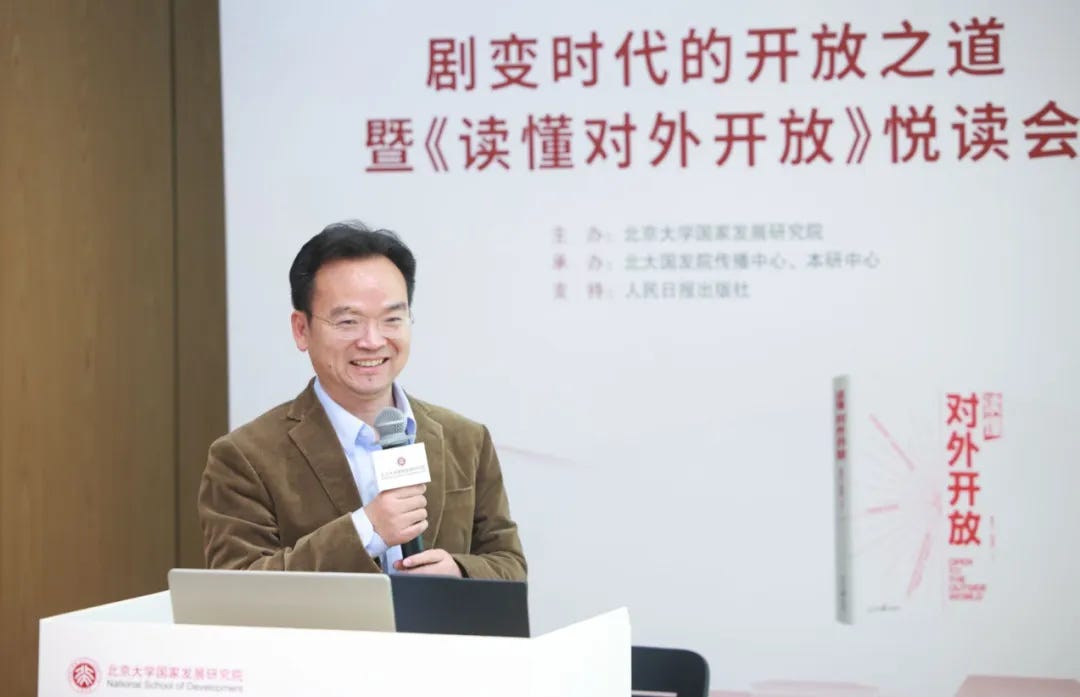
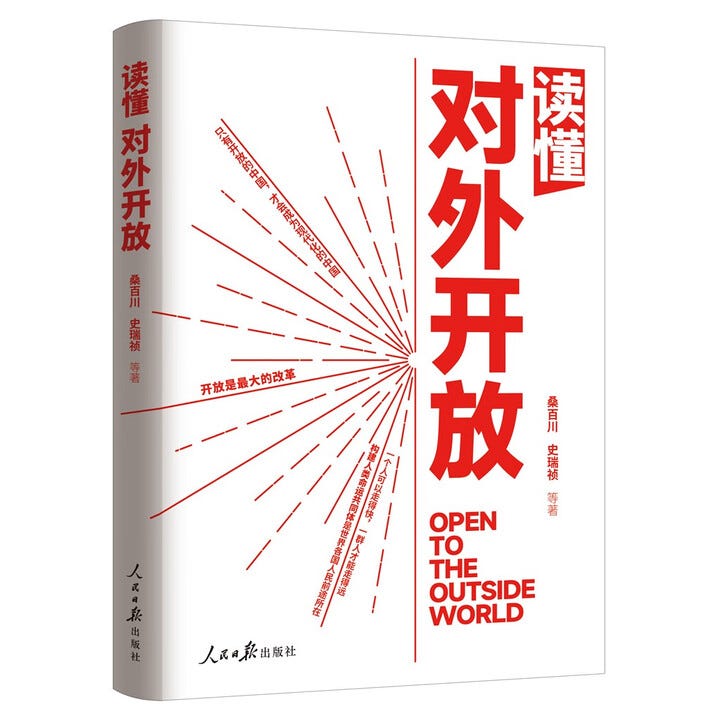
The reflection was delivered at a book seminar for Open to the Outside World, the latest book by Sang Baichuan, Professor of Economics and Dean of the Institute of International Economy at the University of International Business and Economics. The event was held at Peking University’s National School of Development (NSD) on 8 April 2026, and Tu’s remarks were later published on the NSD’s official WeChat blog on 28 April.
Tu reviewed the translation before publication.
—Yuxuan Jia
屠新泉:从中国入世25周年探究开放的本质与未来选择
Tu Xinquan: Exploring the Essence and Future Choices of Opening Up from the Perspective of the 25th Anniversary of China’s WTO Accession
Congratulations to Professor Sang Baichuan on the publication of his new book, Open to the Outside World, by People’s Daily Press. I have known Professor Sang for many years. In 1996, after graduating from Peking University and starting work at the University of International Business and Economics, I met him for the first time. He is not only a senior colleague, old friend, and peer, but also someone I regard as a teacher. Over the years, we have had many exchanges, so I am very familiar with his views and intellectual framework.
I know very well that, in Professor Sang’s thinking, opening up is not a tool, but an idea; one could also say it is a value. In academic circles, we like to give certain economists nicknames, such as “Wu Market” for Wu Jinglian and “Li Shares” for Li Yining. Professor Sang could be called “Sang Opening Up.” His thinking on opening up has been consistent throughout.
The University of International Business and Economics has a deep tradition of research on opening up. In the past, the university was affiliated with the Ministry of Foreign Trade and Economic Cooperation, and was naturally oriented toward promoting opening up as its mission. Professor Sang and I are highly aligned in our intellectual frameworks.
Understanding the Essence of Opening Up Through China’s WTO Accession
My main area of research is the World Trade Organization, and I have studied it for many years. This year marks the 25th anniversary of China’s accession to the WTO. I would therefore like to discuss the relationship between China and the WTO, mainly from the perspective of the active and passive dimensions of opening up.
China began reform and opening up in 1978. There was certainly a passive element to that decision, as both domestic and international conditions at the time created considerable pressure. Fundamentally, however, China’s reform and opening up was also an active choice. It was a reform led by China itself, rather than the implementation of a plan or roadmap set by any other country or international organisation. China’s opening up was also unilateral and autonomous. No international organisation or foreign country forced China to open up. Under the visionary leadership of that generation of Chinese leaders, China actively chose the path of reform and opening up.
In this sense, reform and opening up was a revolution in ideas. Compared with the past, it marked a profoundly transformative break.
China began applying for “GATT resumption” in 1986, seeking to restore its status as a contracting party to the General Agreement on Tariffs and Trade. In 1995, the WTO was formally established, replacing the GATT. The original contracting parties automatically became WTO members, so China’s application shifted from “GATT resumption” to “WTO accession,” meaning a formal application to join the WTO.
This process was very different from China’s earlier opening up, which had been advanced independently and autonomously. The negotiations over GATT resumption and WTO accession were always accompanied by considerable external pressure. To join a mature international organisation and accept a set of established international rules, a country must make corresponding adjustments to its own institutional arrangements in line with that organisation’s requirements and operating logic. In many respects, China could no longer decide entirely on its own.
From 1986 to 2001, China’s negotiations over GATT resumption and WTO accession lasted 15 years, and the process was extremely difficult. Although China made every effort in the negotiations to defend its own rights and interests, it ultimately accepted most of the demands put forward by the other side. Whether in intellectual property protection, tariff reductions, or the opening up of trade in services, even China’s WTO accession protocol was largely drafted by the WTO. China could only make limited adjustments to certain details, such as tariff rates.
The fundamental reason China found itself in such a passive position was that it was a latecomer to the rule system. As the party applying to join, China had little choice but to accept the established body of rules if it wanted to obtain the “entry ticket” to the WTO. It had no say in the formulation of those rules, so it naturally occupied a very passive position in the negotiations.
From the perspective of that time, China inevitably felt a sense of humiliation during the WTO accession negotiations, especially in the face of intense pressure from the United States and its consistently forceful posture. The 15-year negotiation process was not easy for China who was always in a passive position.
Interestingly, however, from the perspective of long-term development outcomes, WTO accession brought highly positive results for China. In the negotiations, China did everything it could to secure rights and development space for itself. Although it ultimately accepted the relevant rules in full, this also enabled a major breakthrough in opening up and created opportunities for rapid development. Today, the United States has long regretted allowing China to join the WTO. But for China, WTO accession has indeed continued to play a very important role in the country’s development and opening up.
An important experience of China’s reform and opening up is incrementalism. China’s 15-year WTO accession process was, in fact, a practical process of incremental reform and opening up. Because of the requirements for WTO accession, China’s reform and opening up during those 15 years had a complete and clear set of reference indicators. Although WTO rules were also being adjusted, China’s overall direction was to move forward according to an internationally established coordinate system.
China did not achieve the goal overnight. Instead, it spent 15 years gradually moving towards it. This can be seen clearly in the changes to China’s tariff levels. From 1994 to 2001, tariffs were reduced substantially. Before WTO accession, China’s tariff level was around 17 percent. After accession, it fell to 10 percent. This process fully reflected the characteristics of incremental opening up.
What I want to emphasise is that WTO rules formed an institutional system jointly accepted at the time by more than 140 members. This system was highly comprehensive. It covered not only trade rules, but also rules in areas such as trade in services, investment, intellectual property rights, and customs. It was an internationally recognised institutional system for a market economy. Therefore, what WTO accession brought to China was not only opening up, but also reform.
In my view, China’s accession to the WTO was the country’s largest instance of top-down institutional opening up. The WTO’s international rule system was a mature achievement formed through decades of practice by many countries. It provided China with a direct reference model and a clear coordinate system for reform, so that China did not have to explore everything entirely on its own.
From the perspective of opening up, therefore, although the WTO accession negotiations were difficult, they greatly simplified China’s reform process and reduced the costs of reform, especially internal transaction costs and coordination costs. Reform and opening up involved adjustments to different domestic interest structures, and was inherently difficult to advance. Against the background of WTO accession, there was a simple and effective way to resolve the coordination costs of reform: “These are WTO rules, and China must comply with them.”
This provided an important basis for the central leadership and the Ministry of Commerce in advancing related reforms. Since China had already made international commitments, it had to comply with them strictly. There was no room for arbitrary bargaining or compromise. Otherwise, China would be seen as violating international rules. This also confirmed the idea of “promoting reform through opening up”: the external pressure generated by WTO accession played a very positive role in China’s internal reform process.
Looking back, China has not joined another international rule system of such a high standard since its accession to the WTO. It can therefore be said that WTO accession was the only comprehensive construction of a market-economy system in the more than 40 years of China’s reform and opening up that was systematic, top-down, and advanced with reference to international rules. It was an extremely rare opportunity.
This opportunity brought many positive outcomes for China’s development.
First, it locked in China’s path towards marketisation and liberalisation. The WTO has always emphasised that opening up can only move forward and not backward. The constraints of international rules made it impossible for China to change direction at will.
Second, it stabilised the confidence of foreign enterprises and capital in the Chinese market. Before China joined the WTO, foreign investment in China was relatively limited and came mainly from overseas Chinese capital. After WTO accession, large amounts of capital from Western countries flowed into China.
This shows that the external pressure created by WTO accession had a significant driving effect on China’s opening up process.
The New Environment and a New Model of Opening Up: Autonomous and Unilateral
However, the current international situation is completely different. The WTO has fallen into stagnation, even paralysis. This year, I attended the WTO’s 14th Ministerial Conference in Cameroon, and the meeting produced no substantive results. This is enough to show the extent of the WTO’s current dysfunction.
For China, a new task has now emerged. Whether in the 15th Five-Year Plan or in policy documents released in recent years, autonomous opening up and unilateral opening up have been repeatedly emphasised. On the one hand, there are no longer new, unified international rules at the global level. On the other hand, although China has applied to join the Comprehensive and Progressive Agreement for Trans-Pacific Partnership (CPTPP), the chances of a successful application are extremely low due to political factors. Therefore, at the current stage, China’s opening up needs to rely more on autonomous and unilateral opening up.
This model of opening up demonstrates China’s posture as a major country amid deglobalisation. However, judging from actual performance and outcomes over the past few years, autonomous opening up is not easy, and its overall effects have been limited. The problems are mainly reflected in the following areas.
First, although China has internal motivation to open further, and although the national leadership and government departments at all levels attach great importance to opening up, the objective incentives are weaker than before. There is less external pressure, and internal discipline is not yet strong enough. Field visits to pilot free trade zones discover that the work is energetic and active, but the overall results remain limited.
Second, autonomous opening up lacks a clear reference point. During the WTO accession process, WTO rules gave China a ready-made benchmark. China could engage in imitative innovation, and the path forward was relatively clear. Today’s autonomous opening up is closer to original innovation. China must explore on its own, without a clear external guide. Some international rules still exist, but their global legitimacy and acceptance are much weaker. The CPTPP is a case in point. Although it was initially shaped under U.S. leadership, the United States itself has abandoned it, making its international recognition even more uncertain. Some Chinese regions are experimenting with reforms based on CPTPP rules, but the process remains full of uncertainty.
Third, China is now a major world power, and when a major power opens unilaterally, it risks giving away future bargaining leverage. Recent policy shifts by the Trump administration and the European Union follow a clear logic: by raising their own trade barriers through tariffs and investment restrictions, they regain negotiating leverage and use it to pressure other countries to lower their barriers. If China pushes autonomous opening up too far, it may face a similar problem: in future negotiations, it may have too few concessions left to exchange.
For this reason, the ideal path forward should still be to rebuild international consensus and promote WTO reform. At this year’s 14th WTO Ministerial Conference, all members offered views on WTO reform, but progress remains extremely difficult. One Chinese ambassador to the WTO once described the problem vividly: the WTO’s biggest challenge today is “AI,” meaning America and India. The actions of these two countries continue to disrupt and obstruct the organisation’s operation.
China’s opening up is a strategic choice rooted in its own history and development conditions. Different countries change their attitudes towards openness at different stages of development. The United States, once an extremely open economy, is now moving towards closure. But for China today, the conclusion remains clear: it must continue to advance opening up with firmness and consistency.
Future Pathways for Opening Up
At the current stage, China’s external opening up mainly has two pathways.
First, within the WTO framework, China should actively promote progress in rule-making. For example, China is currently leading efforts within the WTO to advance the Investment Facilitation Agreement. This agreement was first proposed by China and has received broad support. At present, only India opposes it. In addition, China is also an active participant in negotiations on the E-commerce Agreement under the WTO framework, and some participating members have already agreed to implement provisional rules.
This is a very important pathway for opening up: relying on the WTO framework, some members can formulate new rules around specific issues, thereby further improving existing rules. The scale of such progress may not necessarily be very large, but it is real progress nonetheless.
Second, China should rely on regional rules to carry out external cooperation. The Regional Comprehensive Economic Partnership, or RCEP, is a major step forward that China has achieved in trade rules in recent years. However, this agreement still has room for improvement. On the one hand, it needs to expand its membership and include more countries. On the other hand, it needs to raise the standards of its rules. In these respects, China can become a leader.
China has already become the world’s second-largest economy and largest trading nation, while the size of its domestic market continues to expand. Looking ahead, China’s external opening up needs to give greater consideration to the idea of “exchanging opening up for opening up.” Autonomous and unilateral opening up are one feasible pathway. But I believe China should rely more on the advantage of its ultra-large domestic market, use it as bargaining leverage, and secure greater benefits for Chinese enterprises and capital in global markets.
China should also do more to promote the formulation of international rules. For example, since China has already become the world’s second-largest outward investor, it needs to make greater efforts to improve international investment rules. Active exploration is needed, whether in bilateral or regional rules. The WTO Investment Facilitation Agreement mentioned earlier is one example of such practice. Other pathways can also be explored, such as working with a group of relevant countries under the Belt and Road framework to build cooperative rules.
Against the background of the current era, the formulation of international rules is fragmented, and this is unavoidable. Whether rule unification can be achieved in the future remains to be seen. China now already has a certain degree of capability in this area. Although this capability is still not especially strong, the direction of development is clear. Moreover, China’s strength in manufacturing, technology, and other fields is becoming increasingly significant. It is therefore necessary for China to actively exert its own influence and proactively shape the construction of new international rules and trade systems.
Sang Baichuan: China’s struggle with institutional opening up

The concept of institutional opening up was first introduced at China’s 2018 Central Economic Work Conference, and has since become a recurring theme in top-level discussions, including the most recent 2025 Central Economic Work Conference.
Tu Xinquan on China's foreign trade and outward investment

Tu Xinquan, Professor and Dean of the China Institute for WTO Studies, University of International Business and Economics, recently wrote in Peking University’s PKU Financial Review about the new changes in China’s foreign trade and outward investment. He highlights the "new trio" — electric vehicles, lithium batteries, and photovoltaics — as an embodi…