

Beijing announced this morning that Xi Jinping had invited Cheng Li-wun, leader of Taiwan’s opposition Kuomintang (KMT), to visit the Chinese mainland with a party delegation from April 7 to 12.
Speaking to reporters in Taipei at around 11 a.m., Cheng said she would gladly accept the invitation and described the trip as an effort to ease tensions across the Taiwan Strait while maintaining Taiwan’s ties with the United States. The visit would be the first by a sitting KMT chair to the mainland in a decade.
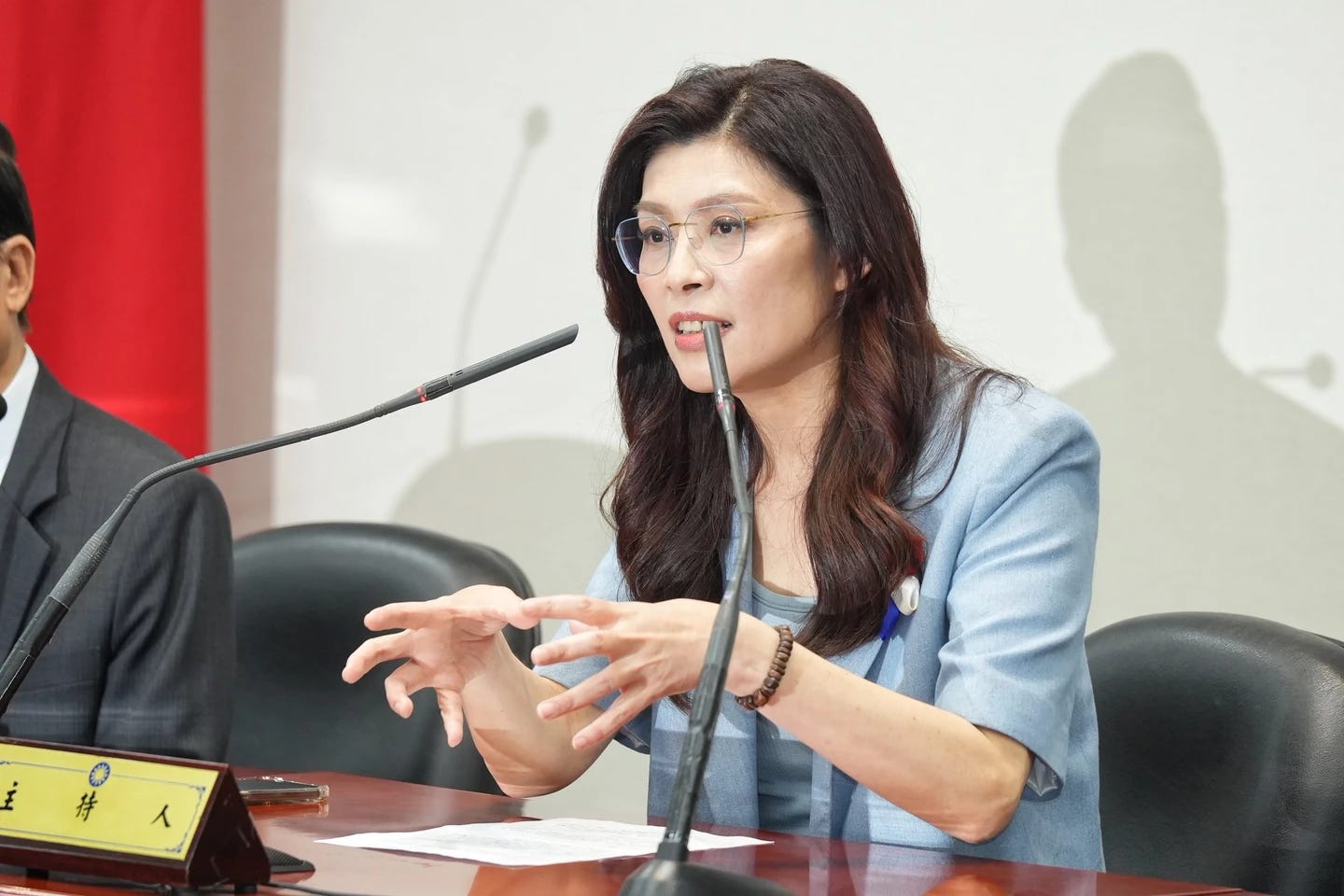
The transcript below is an English translation based on a livestream replay of Cheng’s remarks and exchanges with reporters.
Cheng Li-wun
Good morning, friends from the media.
About an hour ago, the Central Committee of the Communist Party of China (CPC) publicly announced that it, together with General Secretary Xi Jinping, welcomes and invites Li-wun to lead a delegation to visit the Chinese mainland. Here, I would like to express my gratitude and gladly accept the invitation.
In 2005, Chairman Lien Chan invited me to join the Kuomintang so that I could help him advance that historic, ice-breaking journey of peace. That year, I travelled with the delegation as its spokesperson. It was the first time in my life that I set foot on the mainland. Now, more than twenty years later, it is clear that Chairman Lien’s courage, resolve, and vision laid the foundation for the KMT–CCP platform, which became an important mechanism for cross-Strait communication and played an irreplaceable, pivotal role in safeguarding peace across the Strait. What followed was President Ma Ying-jeou’s eight years in office, during which cross-Strait relations were peaceful and stable, exchanges and interaction flourished, and our international space expanded across the board. There was even the very rare phenomenon of a diplomatic truce across the Strait.
It is deeply lamentable that a decade has now passed since the last visit to the mainland by a chairman of the Chinese Kuomintang. Today, I hope to take a solid first step for peace and stability across the Strait, and I want to make this clear to everyone: from Chairman Lien Chan, to President Ma Ying-jeou, to Cheng Li-wun’s visit to the mainland today, all of us have stood on the same political foundation — that is, opposition to Taiwan independence, and adherence to the 1992 Consensus. By opposing Taiwan independence, we can avoid war. By upholding the 1992 Consensus, we can create peace.
That is why my visit to the Chinese mainland today is neither more nor less than this, with nothing added and nothing taken away: we will continue to uphold the 1992 Consensus and oppose Taiwan independence. We want to prove to the people of Taiwan, and to the world, one thing: War between the two sides is not inevitable; the two sides do not need to descend into danger and armed conflict. With our own wisdom and effort, we can together forge a broad road to peace. We have a choice.
For the sake of both sides of the Strait, for regional stability, and for the well-being of the next generation, we must firmly choose the path of peace. Since Chairman Lien’s 2005 visit to the mainland, the principles of the 1992 Consensus and opposition to Taiwan independence have been formally written into the Kuomintang Party Charter. This has been the Kuomintang’s consistent cross-Strait line, and the eight years of the Ma Ying-jeou administration proved that it was the right line. In keeping with the party charter, it is also consistent with the provisions and spirit of the Constitution of the Republic of China.
Friends from the media, and all those concerned about the international situation and the future of cross-Strait relations: this is not only the Kuomintang’s party charter, and not only an express provision of the Constitution of the Republic of China. The whole world, in fact, follows a one-China policy and a shared position of not supporting Taiwan independence. That includes our long-standing ally, the United States, whose stance has remained consistent and clear regardless of which party is in power. On this shared foundation—a one-China policy and opposition to Taiwan independence—I believe no one wants to see the Taiwan Strait become a source of turmoil. Washington has stressed this again and again. It is also the earnest hope of the international community: that the two sides can stop confrontation through dialogue, communicate and engage with one another, and prevent hostility from escalating and war from spreading. I believe this is our shared expectation today, and the deeply felt expectation of Taiwan’s mainstream public opinion.
In recent years, the Taiwan Strait has even been described by international media as one of the most dangerous places in the world. We hope the April visit can mark the beginning of a somewhat warmer spring across the Strait—a first step toward expanding mutual goodwill and building shared trust. Peace across the Strait is not only Taiwan’s aspiration; it is also the highest shared expectation of the mainland and of Beijing. We are willing to work for peace across the Strait, for regional stability, and even to make a positive contribution to peace for humanity, so that the whole world can feel reassured and no longer fear the outbreak of war across the Strait.
Finally, I would like once again to thank our party’s two vice chairmen responsible for cross-Strait exchanges, Vice Chairman Chang and Vice Chairman Hsiao. You have worked very hard during this period. I also want to thank Song Tao, Director of the Taiwan Affairs Office of the CPC Central Committee, for his sincere, responsible, proactive, and thoughtful communication and arrangements throughout this process. In a very short period of time, we completed exchanges through the KMT–CCP think tank forum, and will soon proceed with the visit to the Chinese mainland. I hope this trip can mark a successful first step toward laying the foundation for lasting and enduring peace across the Strait.
Thank you all.
Chou Yu-hsiang, China Times
Hello. I wanted to ask whether, either before or after the Cheng-Xi meeting, there will be a meeting between you and President Lai to discuss matters related to it, such as its outcomes. I also wanted to ask whether you could introduce the members of this delegation, and whether there will be a media delegation as well.
Cheng Li-wun
First, with regard to the delegation members and other related details, we will probably report those to you later. As of now, we have only just confirmed the invitation to visit, so there is still much that needs further communication and confirmation. Going forward, I also hope we will be able to brief everyone again promptly on all the relevant details.
Let me add that, as I have repeatedly said in response to the media’s concerns, everyone has been very focused on when this visit to the Chinese mainland would take place. I have also said that, the moment it was confirmed, we would immediately hold a press conference to announce it. So after the Taiwan Affairs Office of the CPC Central Committee formally issued the invitation this morning, we immediately contacted all media friends across Taiwan and convened this press conference to brief everyone without delay.
Second, you asked whether I would meet President Lai Ching-te. In fact, on the day I took office as party chair, and throughout these past four-plus months, I have consistently sent a very important message to Taiwanese society: I very much hope the ruling and opposition camps can engage in dialogue, and that politics in Taiwan can return, rationally, to the democratic spirit and normal functioning of political life. Taiwan truly cannot go on tearing itself apart through endless partisan strife and internal attrition. So when it comes to cross-Strait exchanges and cross-Strait dialogue, I naturally hold very high hopes. I believe it is a shared wish in Taiwan that, regardless of party, we should work together to advance peace, dialogue, and exchange.
So, when it comes to President Lai Ching-te, I am of course very willing to meet and speak with him, whether before the trip or after the visit is over. There are simply too many knots that need to be untied. Taiwan cannot go on with this endless internal fighting.
Last Friday night, I went to see Secret Love in Peach Blossom Land. There is a famous line in it that left a particularly deep impression on me: Shanghai is so big, yet the two of us were able to meet there—who would have thought that Taipei would be what defeats us.
I have said publicly before that, for the sake of cross-Strait peace, there is no person I would not meet and no step I would not take. Today, I am prepared to cross the sea, cross the Taiwan Strait, and travel to the Chinese mainland to send an important message to the world about the pursuit of peace. Yet President Lai and I are only a short distance apart in Taipei, and still cannot meet or hold a conversation. I believe that, too, runs against the expectations of Taiwan’s 23 million people. Are we really going to keep fighting and grinding ourselves down like this? So I hope we can be open and candid. For the sake of Taiwan, Penghu, Kinmen, and Matsu, I am willing at any time to meet President Lai and engage in dialogue with him for regional stability and peace, for cross-Strait development, and even for resolving the domestic turmoil and constitutional deadlock.
Thank you.
Liu Kuan-ting, Central News Agency
Madam Chair, earlier today Mayor Lu [Lu Shiow-yen, Mayor of Taichung] said in a media interview that the arms procurement package she supports is in the range of NT$800 billion to NT$1 trillion. That seems somewhat at odds with the position of the KMT legislative caucus. Has there been any communication issue, or are people questioning whether this is out of step with the party leadership? Thank you.
Cheng Li-wun
Mayor Lu and I are as close as sisters. There has never been any problem with communication between us. Before her visit to the United States, I am also very grateful that she made a special trip to the party’s central headquarters to see me, and naturally we had a full exchange on all the issues everyone is concerned about, including arms procurement.
Let me say first that I am also very grateful to Mayor Lu. She has worked very hard. During her visit to the United States, she also clearly conveyed and explained our party’s position to the U.S. side. Let me briefly restate our legislative caucus’s position. We are the opposition party. Strictly speaking, arms procurement involves external affairs, especially concrete conclusions and agreements reached with the U.S. side, so it should be the Ministry of National Defense that bears the responsibility of explaining the matter, submitting a full report, and sending the proposal to the Legislative Yuan for review.
But up to now, what we have seen is still frustratingly vague. Apart from a broad framework and a headline figure, what exactly does the package contain? To this day, we are still waiting for a proper explanation and report from the ruling party. As a result, all we can base ourselves on is the very limited information available to us—not information provided by our own government, but what was formally announced by the U.S. side, together with a pricing letter sent to Taiwan. That is why our current party version is NT$380 billion plus n. The n reflects what remains unknown and unavailable to us. It also means that we are not saying we support only NT$380 billion. Once formal and complete information becomes available, we will immediately review the U.S. arms procurement package as well.
So what Mayor Lu expressed is, in fact, something everyone already knows: it is unlikely to be only NT$380 billion. We understand that too. The problem is that the specific follow-up details are still unavailable. As the opposition, this really puts us in a difficult position. We sincerely hope the government will be open and candid in explaining the matter.
And beyond U.S. arms procurement, this is not just about purchases from the United States. It also involves so-called commercial procurement, as well as possible U.S. procurement from and investment in Taiwan, and we have even less idea what those details actually are. So I apologise for taking a bit more time to clarify this.
That said, our party already has a very complete version and a well-developed argument. As you mentioned, our caucus meeting has also formally convened and decided the contents of the party’s version. We respect the caucus’s autonomy, and we believe that, in the course of future negotiations and clashes between the ruling and opposition camps—including whether certain adjustments may be needed to ensure the bill can pass smoothly—all of that will be handled in full by our caucus in the Legislative Yuan.
Thank you.
Huang Yang, Xinhua News Agency
Hello. I would like to ask what Chair Cheng expects from this trip. Thank you.
Cheng Li-wun
In early February, we very smoothly held the first KMT-CPC think tank forum in nearly a decade. Naturally, it reflected many things. After a ten-year interruption, there is strong expectation across Taiwan’s industries and trades for cross-Strait relations to return to normal, because this concerns industrial contraction as a whole, and even the loss of many people’s basic livelihoods.
But beyond that, we also raised more forward-looking issues: the challenges both sides of the Strait face together, and even the challenges facing humanity as a whole—climate change, energy conservation and emissions reduction, the age of AI, and energy issues. These are all challenges Taiwan is confronting today. So we also hope that, through these major issues, the wisdom of both sides of the Strait can be brought together not only to solve cross-Strait problems, but even to make a more positive contribution to humanity.
So this visit to the Chinesen mainland is meant not only to continue showing our deep hope for peace, but also to express concern for Taiwan’s industries and for Taiwanese businesspeople, who have been neglected for far too long. On some of these forward-looking issues, it is also about whether there is room for cooperation and exchange across the Strait, so that we can make a positive contribution to both sides and humanity more broadly.
Of course, the time is very limited. Even so, we hope that through this visit we can begin to change the atmosphere that has been built up around the Strait as one of looming danger and armed conflict, and instead create a different atmosphere, one that reflects the strong desire for peace on all sides. That is our broad direction and guiding principle. So I would also like to thank the Taiwan Affairs Office of the CPC Central Committee on the other side for its careful and thoughtful arrangements.
As for the final itinerary, it has not yet been fully settled. Once it is finalised, we will announce it to everyone in due course.
Thank you.
The New York Times
Madam Chair, The New York Times. We would like to understand why, after taking office, you appear to have given priority to arranging a visit to the Chinese mainland. How are you thinking about the U.S. side? Many people say you have prioritised engagement with the Chinese mainland, while placing interaction with the United States in a secondary position. How do you respond to that? Thank you.
Cheng Li-wun
I think both are extremely, extremely important to us. I have said this many times already: this is not an either-or choice, nor is it a question of which matters more. There is a popular line online: children choose—Taiwan wants it all. I have also said many times that I hope cross-Strait relations will not be a zero-sum game, no longer a matter of one side surviving only. We absolutely can achieve win-win outcomes, shared prosperity, and mutual benefit.
The same is true of U.S.-China relations. I also very much hope to see the active building of peaceful, friendly, and mutually beneficial ties between the U.S. and China. And within Taiwan itself, I hope for the same even more strongly. Since the question has come up today, let me say once again that Taiwan must not continue down the path of irrational internal confrontation. That is absolutely contrary to the welfare, interests, and expectations of the Taiwanese people. I sincerely hope party politics in Taiwan can return to reason, uphold and embody the spirit and norms of democracy, and work together for Taiwan’s future and well-being.
From the standpoint of the Chinese Kuomintang, this is all the more true. Cross-Strait relations are of paramount importance. Relations with the United States are equally so. There is no need to sacrifice one side’s relationship or interests to achieve peace across the Strait, or to preserve Taiwan’s solid friendship with the United States. I do not see any contradiction there, nor do I believe one side must be sacrificed to secure the other.
As I said earlier, the U.S. one-China policy and its non-support for Taiwan independence have been clear and longstanding. The U.S. has also long hoped that war will not break out across the Strait, and that the two sides can begin a dialogue.
So, because there has been no exchange and no visit for ten years, I naturally hope that, if this trip can proceed smoothly, we can share that good news with our friends at the earliest possible moment, so that our American friends can also see a dawn of peace. Here in Taiwan, we must be courageous and responsible, and take up the mission of safeguarding peace across the Strait, rather than becoming troublemakers. The moment our efforts receive a positive response of goodwill from the other side, the work of peace has already begun.
But we absolutely need the support and blessing of the international community, and we need the support and blessing of the United States all the more. So I also very much hope that our American friends can understand this and share in it at the earliest possible opportunity. This is not a question of what comes first or what matters more.
Thank you.
Reporter
Madam Chair, I would like to ask: if the Kuomintang is ultimately able to pass your version of the defence budget, can the party guarantee to the United States that it will submit another defence budget in six months’ time? Thank you.
Cheng Li-wun
Why six months?
Reporter
I mean, if this is to be done in instalments.
Cheng Li-wun
All right. I did not know why six months in particular, but that is fine. As I have just explained, when the Kuomintang’s party version was passed at our caucus meeting in the Legislative Yuan, we formally made clear the “plus n” component. The “plus n” means that once the specific contents and budget figures become available, and as we also expect there may be further U.S. arms procurement items, there is no fixed time limit saying it must be done within a certain period. That kind of restriction does not exist.
My understanding of our party version, the version passed by the caucus, is that whenever the U.S. side has new arms procurement items, the Legislative Yuan should immediately begin the review process. Yes.
Hsiang-ho, Awakening News Networks
Hsiang-ho from Awakening News Networks. Madam Chair, public opinion in Taiwan is generally very hostile towards the Chinese Communist Party, especially because of the frequent PLA aircraft sorties around Taiwan, which cause strong anger. People seem to be interested only in cross-Strait peace and agricultural trade. Do you expect this trip to deliver results in those two areas? Thank you.
Cheng Li-wun
I believe that if both sides across the Strait can send a clear public message to the world that they hope to resolve differences, as well as unnecessary misunderstandings and hostility, through peace and exchange, that in itself would already be the most precious and significant message, and the most important result.
And as I mentioned earlier, this goes well beyond the agricultural products you referred to. It involves far too many sectors. Our tourism industry is the engine of Taiwan’s entire service sector, yet over the past ten years tourism has been extremely depressed and difficult to sustain. That has in turn caused a serious contraction across Taiwan’s wider service sector. This affects a great many industries and a great many jobs.
In addition, the termination of certain items on the ECFA [Economic Cooperation Framework Agreement] early harvest list has in fact dealt a blow to many of Taiwan’s traditional industries. So this affects matters across the board. Even cross-Strait academic and cultural exchanges are now facing all kinds of unconstitutional and unlawful obstruction, creating a chilling effect and unnecessary barriers. These are all misguided policies that hinder cross-Strait dialogue and exchange, prevent the two sides from getting to know and understand one another, and block the accumulation of goodwill and the expansion of the foundations for peace.
All of this, I hope, can be actively addressed and eased in the future.
Thank you.
Meet Cheng Li-wun, the new Chair of KMT

The election for the Chair of the Kuomintang (KMT), the opposition party in Taiwan, was concluded on October 18. Cheng Li-wun was elected as the new party chair.

Thank you for sharing. Ms. Cheng is correct — and forthright — to make it clear that the United States does not support “Taiwan independence”.
Washington can certainly do more. President Trump has announced plans to visit China in mid-May. Many observers have floated the idea of a fourth China-US joint communiqué on the Taiwan question. That sounds like a worthwhile proposal.