


The article below, published on 24 February by 跑哥的自留地, a popular commentator on his personal WeChat blog, is a humorous take that both pokes fun at and celebrates the middle class’s unwavering devotion to rules and work ethic.
—Yuxuan Jia
社会的三层生态
The Three-Tiered Society
This year, one thing has really stood out to me: the people who’ve truly broken away from traditional ties are the ones who went off to university and moved to big cities to start fresh.
These individuals don’t stay in touch much with family back home. In the city, the friends they’re closest to are mostly coworkers, and they don’t seem to have many deep, meaningful connections. In a way, they’ve really become more “atomised.”
This group of people once held a lot of status and symbolised upward mobility. However, over the years, that halo has slowly faded in their hometowns. The main reason is that people back home have begun to realise that those who moved to the big cities are now almost entirely disconnected. They may earn a lot in the city, but back home, they can’t offer much help; they can’t even secure a hospital bed for their parents if needed.
On the other hand, those who stayed behind, including those who entered the civil service, still maintain tight-knit relationships. Especially in smaller towns, where resources are scarce, knowing the right people can be a huge advantage. The “insiders” are often well-connected, and if they need something, like a hospital bed, they usually start by calling someone they know. When it comes to money-making ventures, they tend to stick within these trusted circles. But I’ll leave it at that.
In small towns, there’s a complex web of unwritten rules. If you approach someone to get something done and offer money, it becomes illegal and risky—they might just ignore you.
But if it’s handled through favours and personal connections, they’ll take care of it for you, and you won’t have to pay a cent—everything appears perfectly “proper.” The catch, though, is that the debt of favours must be repaid later. It might not be you who repays it; it could fall on the intermediary you approached for help, and then you’ll owe them instead.
You see, favours are a type of currency, but one that only works within a network of acquaintances. Stay in a big city long enough, and anything you need is an app order away, so little by little, you forget how “favours” work at all.
This is also why, as mentioned earlier, when those who moved to big cities return home, their status often doesn’t hold up the way it used to. They might be earning well, but in a small town, their influence is non-existent. Even with a solid income, it’s not like they can walk in with a bank card and expect someone to “do a favour.” No one will even take them seriously.
In many places, locals hold civil servants in the highest regard, and that’s not just prejudice. Being in the civil service isn’t just about job security; they can actually make a few calls, get in touch with the right people, and get things done. They may not personally hold much power, but people respect them, and that becomes a real capacity to get things done. To put it simply: if people trust you, you have leverage.
It’s precisely this aspect of small towns that leads young people from big cities to periodically feel like their hometowns “aren’t so bad after all.” Every few years, a new wave of civil-service exam fever and “returning home” takes over. At its core, it’s about atomised individuals realising that the risks of the market are too high and trying to seek refuge again in the safety of “the organisation” or a network of familiar faces.
But for most, going back isn’t that simple. Even if they do return, life often doesn’t turn out as expected. So, after every “escape from Beijing, Shanghai, and Guangzhou” trend, fresh graduates find themselves heading back to the big cities once more.
Of course, it’s entirely possible to live in a small town with no connections at all. But having even just a few connections completely changes the experience of life.
That’s the upper end; now for the lower end.
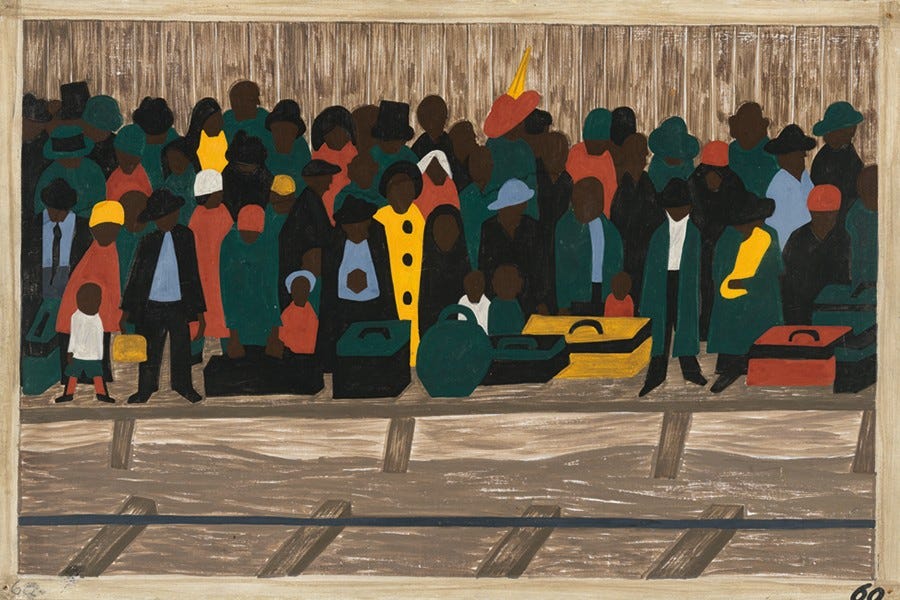
For those who didn’t go to university, especially those from very poor families, staying in their hometown can be much harder. So they go out to work as migrants, usually by first contacting a relative in a city, moving there to rely on them, and starting anew with that relative as a base.
This is especially true in construction, catering, and renovation, where having a “fellow-townsman” network can make all the difference. Even at a food delivery station, if there’s an old acquaintance to guide you, you’ll likely find your footing quickly. On the flip side, without someone to help, you could face obstacles at every turn, leaving you stuck in a passive, vulnerable position for a long time.
In an extreme case, there’s a guy from my hometown who started by joining a construction crew and then brought along all the other men from the village. This crew worked on tunnels, from Jiangxi all the way to Iceland. The pay overseas was high, but so were the living costs. Despite this, these guys were relentless in their frugality. Each of them managed to save two to three million RMB. They became legends back home.
Which raises the question: do big cities really not operate on connections at all?
Of course not. The same game applies in high places. For the extremely wealthy, if their kids go overseas for one of those “easy” master’s degrees, do they line up for interviews like everyone else? Obviously not. Usually, the parents make a call, and it’s sorted. And later, if someone else comes asking for a favour, those parents will return the favour in kind.
There was a viral clip from a livestream antique appraisal show not long ago: someone called in to have a Ming-dynasty Yongle era Buddha statue authenticated. She said she’d helped someone secure a worry-free job for life, and the other party gave her this handicraft as a gift. The host concluded it was real, said the thing is worth seven million RMB. I still can’t wrap my head around what kind of job is worth seven million.
People in the comments who seemed to know the ropes pointed out: don’t think the Buddha gift ends the deal—you’ll still need to repay the favour. Because without the right connections, you wouldn’t even be able to give away a Buddha in the first place.
It’s the same in developed countries. As far as the operating logic goes, the U.S. TV show Billions captures it best: there are rules and protocols, but the upper echelons of society are also filled with backroom deals and private negotiations.
In other words, in every society, it’s the middle class who truly follow, defend, and believe in the rules.
Both the lower and upper classes aren’t as committed to the rules. Over the years, after speaking with many people, it’s clear that only white-collar workers truly believe that success can come without connections, especially in big cities. Oddly enough, people from back home and the ultra-wealthy think in a similar way: they believe that relationships are the most important thing—without them, nothing gets done.
And honestly, that’s the norm in every society.
At the grassroots level, resources are too scarce, and with little money, people rely on kinship and hometown connections to get ahead. A reader who worked as a delivery driver once told me that their station manager was from Anhui, and the “management” at the hub were all from Anhui too. These managers didn’t have much education; they were promoted quickly solely because of their relationship with the station manager, so they no longer had to grind through wind and rain.
At the top, the issue is that licenses, inside information, and such aren’t available in the open market. You’ve probably heard the saying: if you don’t already know the outcome of a bid or tender, you probably don’t have a chance.
There was a book that discussed this dynamic in developed countries, can’t remember which one. It said the top has become “club-like,” while the bottom has become “tribal.” The middle class climbs out of the bottom’s tribe through education, but hasn’t entered the top’s club; they live by the rules.
Put plainly: money is standardised, but power and trust are “non-standard.” That echoes my earlier piece, Bureaucrats make it on merit; generals make it on connections. Different classes evolve different survival strategies.
One last point: looking back three hundred years, almost no one believed in rules; almost everyone lived within networks of favours and relationships. This is also Fei Xiaotong’s argument: traditional China had a “differential mode of association,” where everything was measured by proximity and connections.
The rise of modern cities and the emergence of the urban middle class finally allowed some to break free from the grip of traditional “connections.” Today, many people live their entire lives without pulling strings or flattering anyone, and they do just fine. That may be modernisation’s greatest achievement, and the size of this group is growing.
So, when those well-connected insiders with a crushing advantage or bizarre inside stories emerge, it’s best to stay calm. Chances are, even a hundred years from now, these things will still exist. The top will have its own playbook, and the bottom will have its own way of getting by. For those in the middle, society is actually doing quite well, and barring any surprises, the middle class’s way of life will increasingly become the mainstream.
That’s the whole piece. If you liked it, don’t forget to like and subscribe.

4:30 A.M. at a day labour market in China, a drink to start a day’s toil

China’s informal labour markets are fleeting theatres of toil—unmarked spaces that spring to life before dawn and vanish by the break of day, playing out daily in nearly every major city, from Shanghai to Hefei. In Guiyang, the capital of the mountainous, landlocked province of Guizhou, one such stage comes alive at 4:30 a.m. A stretch of bare concrete …
Ma Dugong: glad that we are all clowns in different makeup

Ren Chonghao, known by his pen name Ma Qianzu (foot soldier) or Ma Dugong (foreman), is a popular Chinese commentator on military and geopolitical affairs. He engages a substantial audience through various media platforms, with over two million followers on
Excellent.
You should write a book
Yes, I think you should write. There will be an audience outside China. Go for it.