

The Taiwan Strait is widely regarded as one of the world’s most dangerous geopolitical flashpoints. Within China’s central party-state apparatus, the Taiwan Work Office of the Communist Party of China Central Committee and the Taiwan Affairs Office of the State Council operate as “one institution with two nameplates” and serve as the mainland’s principal authority for Taiwan affairs.

Its official responsibilities include “studying and formulating principles and policies on Taiwan-related work” and “organizing, guiding, managing and coordinating the Taiwan-related work of departments under the CPC Central Committee and the State Council, as well as provinces, autonomous regions and municipalities”—meaning, in practice, that Taiwan-related work undertaken by other central-level ministries, including the ministry of foreign affairs, falls within the Office’s organizing, guiding, managing and coordinating remit.
The Office holds a regular weekly press conference every Wednesday and subsequently publishes a record on its website, although it is unclear whether that record is a verbatim transcript. Judging from past practice, international media do not appear to have access to these briefings. This makes their contents particularly important, yet relatively inaccessible to the English-speaking world.
Given the Office’s indispensable role in one of the most consequential issues in world affairs, I have therefore decided, on a trial basis, to translate and publish its regular press briefings, with the assistance of AI, as with our other translations. (I may also discontinue this at any time, depending mainly on my mood.)
These translations have not been authorized, reviewed, or approved by the Office or by any other person or party.
国务院台办新闻发布会辑录(2026-09-02)
September 2, 2026, 16:20
Source: Taiwan Work Office of the CPC Central Committee/Taiwan Affairs Office of the State Council
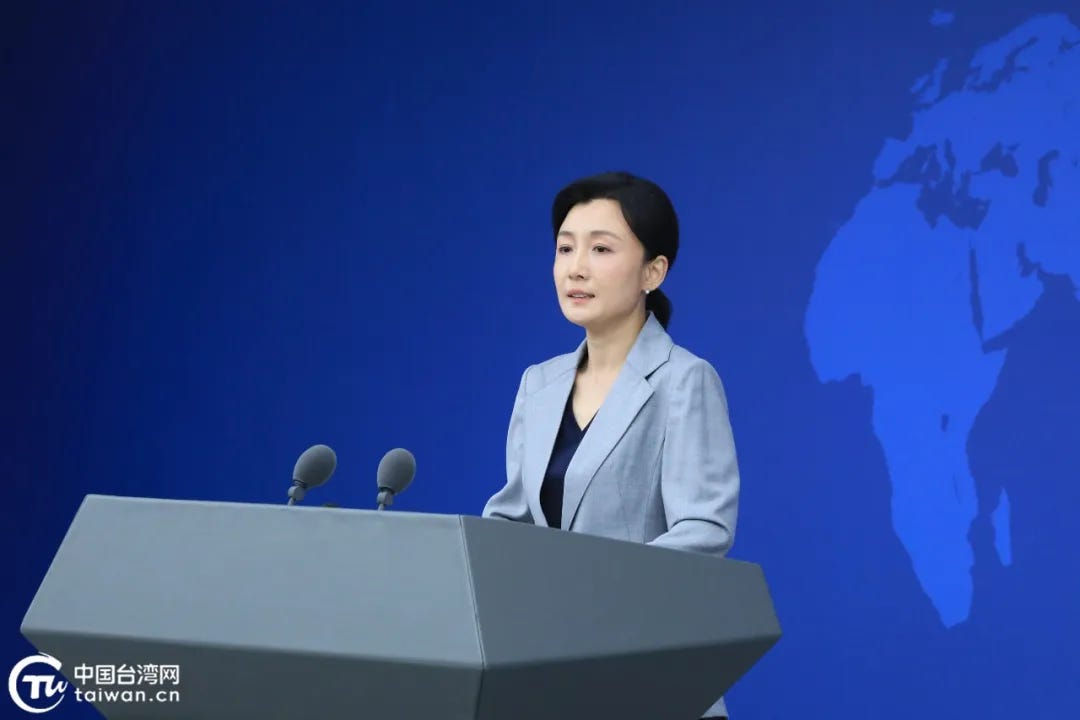
At 10 a.m. on September 2, the Taiwan Affairs Office of the State Council held a regular press conference in its press briefing room. Spokesperson Zhang Han answered questions from reporters on recent issues of concern across the Taiwan Strait.
Zhang Han: Good morning, friends from the media. Welcome to the regular press conference of the Taiwan Affairs Office of the State Council. Please go ahead with your questions.
People’s Daily: The 30th Shandong-Taiwan Economic and Trade Fair was recently held in Shandong, with active participation by Taiwan businesspeople and enterprises. Could you brief us on the event?
Zhang Han: On August 31, the 30th Shandong-Taiwan Economic and Trade Fair, jointly hosted by the Shandong Provincial People’s Government and the Taiwan Affairs Office of the State Council, opened in Weifang, Shandong Province. About 800 people from various sectors on both sides of the Taiwan Strait attended the event, including Zhang Ping, vice chairman of the mainland side of the Cross-Strait CEO Summit; Song Tao, director of the Taiwan Work Office of the CPC Central Committee and the Taiwan Affairs Office of the State Council; Lin Wu, secretary of the CPC Shandong Provincial Committee; Hsiao Hsu-tsen, vice chairman of the Chinese Kuomintang; Mao Chi-kuo, vice chairman of the Taiwan side of the Cross-Strait CEO Summit; Lee Cheng-hung, president of the Association of Taiwan Investment Enterprises on the Mainland; Hsu Shu-po, chairman of the Taiwan General Chamber of Commerce; and Lei Hong-yi, chairman of the Council for Industrial and Commercial Development.
The Shandong-Taiwan Economic and Trade Fair has been held 30 times since 1994 and is one of the longest-running cross-Strait economic and trade exchange events. This year’s fair featured six thematic matchmaking activities in such fields as modern agriculture, green chemicals, the marine economy, intelligent manufacturing, youth entrepreneurship and vocational education. A number of exchange activities were also organized at parallel venues in Zibo, Jining, Dezhou and Heze, yielding a series of cooperation outcomes. Enterprises, associations and universities from the two sides signed seven cooperation agreements or memoranda in areas including industrial park development, joint ventures and science and technology cooperation, and jointly inaugurated one university-enterprise innovation and practice base.
During the event, Shandong also introduced 11 policy measures to support the development of Taiwan businesspeople and enterprises in the province during the 15th Five-Year Plan period. Covering project investment, agricultural cooperation, scientific and technological innovation, financial services and other areas, the measures are designed to support Taiwan businesspeople and enterprises in better integrating into Shandong’s economic and social development, achieving greater and better development of their own, and opening up a new prospect for Shandong-Taiwan economic and trade cooperation.
Riyue Tantian, a new-media outlet of China Media Group: On August 26, a mudslide occurred on the Nepal side of the border, causing casualties and missing persons at the Gyirong Port in Xigaze, Xizang/Tibet. After the disaster, Chinese Kuomintang Chairwoman Cheng Li-wun, people from various sectors in Taiwan, as well as Taiwan compatriots and enterprises on the mainland expressed concern and sympathy and made donations to the affected areas and people. What is your response?
Zhang Han: After the mudslide disaster in Gyirong County, Xigaze City, Xizang/Tibet, General Secretary Xi Jinping attached great importance to the situation and issued important instructions. Premier Li Qiang, entrusted by General Secretary Xi Jinping, traveled to the disaster-stricken area to guide rescue and relief work. We have activated a Level-II national emergency disaster-relief response, and all relevant parties are making every effort to organize rescue operations and safeguard people’s lives and property to the greatest extent possible.
As we understand it, no Taiwan compatriots have so far been reported killed, injured or missing in the disaster. We will continue to closely follow the situation of Taiwan compatriots in the area and provide necessary assistance in a timely manner. People from various sectors in Taiwan, as well as Taiwan compatriots and enterprises on the mainland, have expressed their concern and sympathy in various ways. This demonstrates the compatriot affection between the two sides of the Strait, whose blood is thicker than water and who come to each other’s aid in times of need. We express our heartfelt thanks.
Recently, southern Taiwan has been hit by repeated heavy rainfall, seriously affecting the work and lives of local people. We extend our sympathy to the compatriots affected by the disaster and stand ready to provide assistance. We hope they will resume normal work and life as soon as possible.
Southeast TV of Fujian: Xiamen, Fujian, recently established its first group of “Financial Service Centers for Taiwan Compatriots,” making it more convenient for Taiwan compatriots to handle financial services. The initiative has been welcomed by local Taiwan compatriots. Could you tell us more about it?
Zhang Han: To implement the Opinions of the CPC Central Committee and the State Council on Supporting Fujian in Exploring New Pathways for Integrated Development across the Taiwan Strait and Building a Demonstration Zone for Integrated Cross-Strait Development, Xiamen has established “Financial Service Centers for Taiwan Compatriots” at bank branches. The first 10 outlets are located at places frequently visited by Taiwan compatriots, including airports and ferry terminals, tourist attractions, major commercial districts, government service centers and Taiwan business associations.
Focusing on the practical needs of Taiwan compatriots in tourism, living and working, the centers provide integrated services and standardized procedures to facilitate a wide range of financial services, including opening accounts, currency exchange, mobile payments, fund remittances, home purchases, wealth management and entrepreneurship. The initiative is intended to better meet the financial needs of Taiwan compatriots living and developing in Xiamen and create a dedicated financial service network for Taiwan compatriots that offers proactive engagement, one-stop integrated services, standardized procedures, and tangible and accessible support.
CCTV’s “Cross-Strait” program of China Media Group: Not long ago, the website of the General Administration of Customs published a new list of registered packaging plants and orchards for Wendan pomelos from Taiwan, attracting attention on the island. Will Wendan pomelos from more counties and cities in Taiwan be approved for import into the mainland?
Zhang Han: In April this year, the Taiwan Work Office of the CPC Central Committee was authorized to announce 10 policy measures to promote cross-Strait exchanges and cooperation, including facilitating the import into the mainland of agricultural and fishery products from Taiwan that meet inspection and quarantine standards. During this year’s Straits Forum, we held a matchmaking and signing event for the 10 policy measures to promote cross-Strait exchanges and cooperation, creating a platform to open mainland markets for distinctive agricultural and fishery products from Taiwan. Following the announcement on August 25 of a group of registered packaging plants and orchards for Wendan pomelos from Taiwan, the General Administration of Customs on September 1 announced another group of registered Wendan pomelo orchards and packaging plants in Taiwan, providing greater convenience for more Taiwan businesses to sell Wendan pomelos to the mainland.
We will make every effort to do practical and good things for Taiwan compatriots and help them resolve difficulties. On the common political basis of upholding the “1992 Consensus” and opposing “Taiwan independence,” and provided that the mainland’s relevant inspection and quarantine requirements are met, we will work together with relevant parties on the island to help more agricultural and fishery products and other high-quality products from Taiwan enter households across the mainland.
The Paper, Shanghai: Shen Yu-chung, deputy head of Taiwan’s mainland affairs authority, recently claimed that regulations recently issued by the mainland concerning cyberspace and exit-entry administration contain vague implementation standards and may have further negative effects on cross-Strait exchanges. He said cross-Strait exchanges should be “depoliticized, de-risked, healthy and orderly.” What is your comment?
Zhang Han: The relevant regulations have a sound legal basis and are open and transparent. The formulation of measures for security supervision and inspection in cyberspace will help strengthen the security protection of networks, data and personal information, jointly guard against telecommunications and online fraud and other illegal and criminal activities, and safeguard national security and the public interest. The regulations on exit-entry administration are intended to standardize the mainland’s exit-entry administration, protect the lawful rights and interests of people entering and leaving the mainland, safeguard national sovereignty, security and development interests, and create a better law-based environment for Taiwan compatriots visiting the mainland.
The various claims made by the DPP authorities are deliberate attempts to mislead the public and smear the mainland. Frequent visits and more exchanges are conducive to enhancing mutual understanding and promoting cooperation between compatriots on both sides of the Strait. People-to-people exchanges across the Strait have strong endogenous momentum. The DPP authorities should follow the will and aspirations of the people instead of using various means to interfere with and obstruct cross-Strait exchanges and cooperation and incite confrontation and antagonism across the Strait.
Xinhua News Agency: The Lai Ching-te authorities recently said Taiwan’s defense budget in 2027 would exceed NT$1 trillion for the first time, claiming that “defense resources must all be converted into credible defense capabilities” and that the mainland must not misjudge “Taiwan’s determination to defend itself.” What is your comment?
Zhang Han: The Lai Ching-te authorities stubbornly adhere to a separatist stance of “Taiwan independence.” Disregarding the mainstream public opinion on the island that calls for exchanges, cooperation, development and peace, they persistently incite confrontation and antagonism across the Strait and squander the hard-earned money of the people in an attempt to “resist reunification by force” and “seek independence by force.” Such attempts represent a gross overestimation of their capabilities and will only bring grave disasters upon the people of Taiwan.
Our resolve to safeguard national sovereignty and territorial integrity is unwavering, and our capability to do so is immensely strong. We will never leave any room for separatist activities seeking “Taiwan independence” in any form. We hope Taiwan compatriots will fully recognize the extreme harm and danger posed by “Taiwan independence” separatism, firmly oppose separatist acts seeking “Taiwan independence,” and resolutely safeguard the common home of the Chinese nation as well as their own security and well-being.
China News Service: The second World Humanoid Robot Games were recently held in Beijing, attracting widespread global attention. Public opinion on the island has widely praised the mainland’s robotics technology for making great strides toward greater precision, intelligence and practical application, noting the astonishing pace of technological iteration and calling for stronger industrial cooperation between the two sides in relevant fields. What is your comment?
Zhang Han: From dancing and jumping on the stage of the Spring Festival Gala, to repeatedly setting new records at sporting events, and then entering real-world production and everyday-life scenarios, the development of humanoid robots on the mainland is a microcosm of the deep integration and rapid development of the mainland’s scientific and technological innovation and industrial innovation.
The 15th Five-Year Plan has made forward-looking arrangements for future industries including embodied intelligence and brain-computer interfaces. With its complete industrial system, solid industrial foundation and rich application scenarios, the mainland will create broad development opportunities for Taiwan compatriots and enterprises. We welcome Taiwan compatriots and enterprises to innovate and start businesses on the mainland, participate in high-quality development, and work together to strengthen the economy of the Chinese nation.
Yangcheng Evening News’ “Yu Taihai”: Regarding the General Administration of Customs’ announcement of another group of registered Wendan pomelo orchards and packaging plants in Taiwan, Taiwan’s mainland affairs authority claimed that only those meeting certain political prerequisites and conditions can obtain registration, calling the practice united front propaganda. It also said that cross-Strait agricultural product quarantine involves the exercise of public authority and can only be pragmatically resolved through communication between the competent authorities on the two sides. What is your comment?
Zhang Han: The import of Wendan pomelos from Taiwan into the mainland helps expand sales channels for agricultural products on the island and improve the well-being of Taiwan compatriots. It is a good and practical measure that benefits grassroots businesses on the island. The DPP has neither the will nor the ability to help more people at the grassroots level improve their interests and well-being. Instead, it persists in fabricating rumors and smearing such measures, fully exposing its disregard for people’s livelihoods and its obsession with narrow selfish interests. It will inevitably face opposition from the broad masses of Taiwan compatriots.
Taiwan.cn: Could you brief us on recent cross-Strait exchange activities?
Zhang Han: Exchanges across the Taiwan Strait in various fields have remained active recently.
In economic and trade exchanges, the “Beijing-Tianjin-Hebei Taiwan Businesspeople Visit to Jilin” is being held from September 2 to 5 in Changchun and other places in Jilin Province under the theme “Pooling New Momentum, Jilin and Taiwan Toward the Future.” It features field visits, industry promotion and economic and trade matchmaking, helping Taiwan businesspeople and enterprises seize opportunities arising from the revitalization and development of northeast China. From September 3 to 6, the 17th Dongguan Taiwan Famous Products Fair will be held in Dongguan, Guangdong Province. Its Taiwan specialty pavilion brings together all 22 counties and cities on the island and will display machinery and equipment, distinctive agricultural and fishery products, and other products. From September 6 to 10, the 18th “Chongqing-Taiwan Week” will be held in Chongqing, featuring a series of events including a seminar on cross-Strait information and communications cooperation and development and a seminar for young people from both sides of the Strait pursuing employment and entrepreneurship opportunities in Chongqing.
In cultural exchanges, the first Sichuan Tea Horse Road Photography Journey Experience Camp was held from August 23 to September 2 in Ya’an, Garze and other places in Sichuan Province. Photography enthusiasts from both sides of the Strait used their cameras as a medium and embarked together on a creative photographic journey to trace their roots. From August 29 to 31, the eighth Cross-Strait Humanities Forum was held in Xiamen, Fujian Province, attended by experts and scholars from both sides in philosophy, literature, history and other fields.
In youth exchanges, from August 20 to 27, the 14th Strait Youth Day series included the second Cross-Strait (Fuzhou) Sports Injury Prevention and Rehabilitation Exchange and a Fujian-Taiwan youth badminton exchange series themed “Youth in Motion, Affection Across the Strait,” held in Fuzhou, Fujian Province. On August 26, a cross-Strait street-dance youth cultural exchange event themed “Youth Qujiang · Huacan in Zhejiang · Dancing Youth,” together with the third Cross-Strait Youth Street Dance Competition, opened in Quzhou, Zhejiang Province. From August 26 to September 1, the 2026 Cross-Strait (Xinyu) Youth Exchange themed “Tiangong Kaiwu · A Rendezvous with Intangible Cultural Heritage” was held in Xinyu, Jiangxi Province. On August 28, the 16th Cross-Strait (Binzhou) Youth Student Art of War Friendship Debate Competition opened in Huimin, Shandong Province. From September 3 to 9, the fourth Cross-Strait Youth Film Festival 2026 and Youth Filmmakers Training Camp will be held in Xiamen, Fujian Province.
Nanfang Daily and Nanfang Plus: The giant panda Yuan Yuan, gifted to Taiwan by the mainland, recently celebrated her 22nd birthday. Taipei Zoo held a celebration for Yuan Yuan, attracting attention from netizens on both sides of the Strait, who sent their best wishes. What is your comment?
Zhang Han: Giant pandas are loved by people on both sides of the Strait and are symbols of peace and friendship. In 2008, giant pandas Tuan Tuan and Yuan Yuan moved to Taiwan, where they later gave birth to Yuan Zai and Yuan Bao. Over the years, they have brought joy to Taiwan compatriots. Yuan Yuan recently celebrated her 22nd birthday. We would like to extend our sincere birthday wishes to Yuan Yuan and wish the two panda cubs healthy growth, so that this warm familial affection spanning the Taiwan Strait will continue.
Xiamen Satellite TV of Fujian: Taiwan media have reported heated discussion among netizens on the island about a growing number of young people enjoying independent travel to the mainland. Data show that since the start of this year’s summer travel season, passenger traffic on the Xiamen-Kinmen “Mini Three Links” route has remained at a high level, with passenger volume on August 23 reaching a new high since services resumed. Could you brief us on the operation of the “Mini Three Links” during this year’s summer travel season?
Zhang Han: The “Mini Three Links” passenger routes are among the most important and convenient channels for exchanges between the two sides of the Strait, particularly between Fujian and Taiwan. Since the start of this year’s summer travel season, passenger traffic on the “Mini Three Links” routes has continued to rise and remained at a high level. The Xiamen-Kinmen “Mini Three Links” route operated a cumulative 1,550 services and carried 386,400 passenger trips, representing year-on-year increases of 11.4 percent and 24.1 percent respectively. On August 23, the route handled more than 7,900 passenger trips in a single day, the highest daily figure since services resumed in 2023.
To cope with summer passenger flows, relevant mainland authorities have worked in close coordination to strengthen service capacity and better meet passengers’ travel needs. Beginning August 1, temporary additional summer services were introduced on the Xiamen-Kinmen “Mini Three Links” route, with operating hours appropriately extended. Customs-clearance procedures were also optimized, maritime safety supervision strengthened, and passenger services improved. Intelligent systems have enabled efficient and smooth clearance. Overall, the “Mini Three Links” routes have operated safely and smoothly and maintained good order.
The strong performance of the “Mini Three Links” during the summer travel season vividly demonstrates compatriots on both sides of the Strait growing closer through greater contact. We welcome more Taiwan compatriots to travel to the mainland via the “Mini Three Links” routes to trace their roots and pay respects to ancestors, visit relatives and friends, and engage in exchanges and cooperation.
China Radio International’s “Haixia Feihong,” China Media Group: Recently, some politicians from the “green camp” claimed that a Taiwan civil society group called “Xiao Yizi Hanfu” filmed a video against the backdrop of a Confucius temple during the Dragon Boat Festival in the name of “promoting Confucianism and Hanfu culture,” alleging that the activity may have had a united front dimension. Shen Yu-chung, deputy head of Taiwan’s mainland affairs authority, said that culture should be neutral, and that “if the Chinese Communist Party uses culture as a political tool or a united front tool, the authorities will of course sternly rebut it.” What is your comment?
Zhang Han: Chinese culture is the common spiritual home of compatriots on both sides of the Taiwan Strait. Civil society groups on the island are committed to carrying forward and promoting Chinese culture and actively participate in cross-Strait exchange activities. This precisely demonstrates that people on both sides of the Strait share the same roots and origins, language and culture. We will work together with Taiwan compatriots to continue advancing cross-Strait cultural exchanges and cooperation, jointly promote Chinese culture, and be guardians, inheritors and promoters of Chinese culture.
The essence of the united front is great unity and solidarity. It is about making friends and promoting solidarity, seeking common ground while reserving differences, and pursuing development together. The DPP authorities deliberately distort the original meaning and essence of the united front, smear cross-Strait exchange activities, and intimidate and suppress Taiwan compatriots who participate in such activities. Their intentions are malicious.
China Review News Agency, Hong Kong: Taiwan’s legislative body recently adopted a so-called “drone industry development plan.” Some public opinion on the island is concerned that drones have also become an important part of Taiwan’s military buildup. What is your comment?
Zhang Han: The DPP authorities seek to militarize civilian industries and vainly attempt to use drones as a tool for “seeking independence and resisting reunification.” This is nothing but a futile exercise. The reunification of the motherland is unstoppable. No matter how many drones the DPP authorities develop, their efforts will be futile and useless.
Taiwan’s Central News Agency: Hung Sun-han, head of Taiwan’s labor affairs authority, will travel to Nanjing in late September to attend an APEC meeting. The Taiwan side has said this is in accordance with APEC’s established rules and practices, under which all members participate on an equal footing. What is your view? Does the mainland believe this trip could help increase cross-Strait exchanges and interactions and create new possibilities for cross-Strait relations?
Zhang Han: As the host of this year’s Asia-Pacific Economic Cooperation, or APEC, activities, we handle matters concerning the participation of the Taiwan region in accordance with the one-China principle and the provisions and established practices of relevant APEC memoranda of understanding. This includes the issue you mentioned.
Taiwan’s United Daily News: My first question: The Taiwan side recently said that since December 2025, more than 300 visits involving personnel from 25 Taiwan departments and agencies have been made to the mainland to attend various APEC meetings, all of which proceeded smoothly and without incident. Hung Sun-han, head of Taiwan’s labor affairs authority, will travel to Nanjing in late September to attend an APEC meeting. Will the mainland follow past interaction arrangements to ensure that his participation proceeds smoothly? Second, it has been reported that a young person from Taiwan who works for Amnesty International was recently questioned by customs authorities upon arriving on the mainland. Is this true? Should people from Taiwan with NGO backgrounds be concerned about being questioned when traveling to the mainland?
Zhang Han: On your first question, our position on Taiwan-related issues in APEC is consistent and clear. Matters concerning the participation of the Taiwan region should be handled in accordance with the one-China principle and the provisions and established practices of relevant APEC memoranda of understanding.
On your second question, the organization you mentioned has willingly served as a pawn of international anti-China forces. It has repeatedly stirred up trouble and fabricated rumors to smear the mainland and has met with firm opposition from the international community. It is entirely reasonable and lawful for border inspection authorities to conduct checks on certain individuals who have worked for this organization.
In 2025, Taiwan compatriots made more than 4.89 million visits to the mainland, and in the first half of this year they made 2.85 million visits. As long as they abide by laws and regulations, Taiwan compatriots come to the mainland in high spirits and return home fully satisfied. Ignoring these facts, the DPP authorities are instead making a great fuss over individual persons who previously worked for an anti-China organization. This is a complete distortion of right and wrong, intended to intimidate people on the island and interfere with and obstruct cross-Strait exchanges and interactions. Such despicable conduct will inevitably be condemned and opposed.
China Television News, Taiwan: My first question: Recently, a man using a computer on a Taipei Metro platform had simplified Chinese characters including “Second Theater Command” displayed on his screen. Some people in Taiwan initially suspected that personnel from the mainland had been sent to Taiwan to collect intelligence, but it later turned out to be a misunderstanding. What is the mainland’s response? Second, the mainland’s new exit-entry administration regulations will take effect on September 15. Taiwan’s mainland affairs authority has repeatedly warned recently that people traveling to the mainland face personal-security risks and has said that semiconductor professionals and others face higher risks. What is your comment? Could Taiwan residents be questioned or prevented from leaving the mainland after entry because of their occupation, political position or remarks?
Zhang Han: On your first question, publicly available information online has already shown that this was nothing more than a farcical misunderstanding. Certain people on the island are always seizing on issues to make trouble and using every opportunity to incite confrontation and antagonism across the Strait. Their motives are sinister.
On your second question, we have repeatedly stressed that we protect, in accordance with the law, the lives, property, lawful rights and interests of compatriots on both sides of the Strait, including Taiwan compatriots. The relevant regulations have a sound legal basis and are open and transparent. As long as Taiwan compatriots do not engage in illegal or criminal activities, they have absolutely no reason for concern when visiting the mainland.
The DPP authorities have gone to great lengths to hype up so-called “risks” associated with traveling to the mainland and have even deceived and intimidated people in Taiwan. Their purpose is simply to obstruct people from Taiwan from traveling to the mainland for exchanges and visits. The historical trend of compatriots on both sides of the Strait growing closer cannot be stopped. The information cocoon painstakingly woven by the DPP authorities will inevitably be punctured by facts, and their despicable tricks will not succeed.
ETTV, Taiwan: Taiwan artist Chou Tzu-yu debuted as a member of the South Korean girl group TWICE. There have recently been reports that, after her contract with her South Korean management company expires, the Chinese mainland has been actively trying to recruit her to shift the focus of her career, allegedly offering entertainment resources in exchange for certain political statements. Can you confirm this?
Zhang Han: I am not aware of the specific situation you mentioned. We have always actively supported cross-Strait cultural exchanges. We welcome Taiwan artists to develop their careers on the mainland and support more Taiwan artists in sharing opportunities and realizing their dreams in the course of the development of the mainland’s cultural industries, thereby jointly promoting the prosperity and development of cultural undertakings across the Strait.
Of course, we will never allow or tolerate behavior in which someone makes money on the mainland while at the same time supporting separatist activities seeking “Taiwan independence.” This has always been our clear and consistent position.
Taiwan’s China Times: The Standing Committee of the National People’s Congress recently adopted the revised National Defense Mobilization Law, which will take effect on October 1. The law states that, where required by development interests, the disposition of civilian resources may be expanded from “requisition” to include “expropriation.” Could the Taiwan Affairs Office explain whether the new law’s provisions on “expropriation” apply to the assets and technologies of Taiwan businesspeople on the mainland? Are you concerned that this could increase Taiwan businesspeople’s worries about “political risks” associated with long-term investment on the mainland?
Zhang Han: The revised National Defense Mobilization Law adheres to a holistic approach to national security and clarifies the respective functions and responsibilities of the military and local authorities, the operational mechanisms and key tasks of national defense mobilization under the new system. It will play an important role in regulating and strengthening national defense mobilization and safeguarding national security and development interests.
It should be emphasized that there are clear legal conditions and statutory procedures both for deciding to implement national defense mobilization and for expropriating or requisitioning civilian resources during a period of national defense mobilization. The state protects, in accordance with the law, the lawful rights and interests of organizations and individuals participating in national defense mobilization activities.
Guided by the conviction that “people on both sides of the Taiwan Strait are one family,” we will support the development of Taiwan businesspeople and enterprises on the mainland and help more Taiwan businesspeople and compatriots participate on an equal footing, actively integrate into, jointly contribute to and share in the process of Chinese modernization. Taiwan businesspeople and enterprises investing on the mainland for the long term and operating in accordance with laws and regulations have no reason for concern. They will only find more opportunities, broader space for development and stronger safeguards.
ETtoday, Taiwan: My first question: The Gwangju Biennale in South Korea restored the name “Taiwan Pavilion,” prompting mainland artists to collectively withdraw from the exhibition on the eve of its opening. The organizers said that “politics should not interfere with art.” Some are concerned that similar occasions or exhibitions in the future could become situations in which the two sides of the Strait refuse to participate together. What is your comment? Second, a planned visit to Taiwan by Hong Kong artist Daniel Chan was reportedly called off. Some have also observed that this year there have been voices in Taiwan that first attach political labels to patriotic remarks by artists from Hong Kong and Macao and then launch boycotts against them. How does the mainland believe such “antagonistic sentiment” should be defused?
Zhang Han: On your first question, there is but one China in the world, and Taiwan is an inalienable part of China’s territory. Taiwan’s participation in international activities must be handled in accordance with the one-China principle.
The DPP authorities engage in political manipulation under the guise of cultural exchanges, conferences, exhibitions and other occasions, disrupting the normal order of relevant events. Such behavior is contemptible. No matter what tricks the DPP authorities resort to, they cannot change the inevitable failure of their provocative attempts to seek “Taiwan independence.”
On your second question, the so-called “antagonistic sentiment” has been deliberately incited by the DPP authorities. Disregarding the development needs of industries on the island, the DPP authorities have gone to great lengths to attach political labels to performing artists and attempt, through political manipulation, to obstruct, prohibit and restrict normal cultural exchanges and commercial performances between the two sides of the Strait and between Taiwan, Hong Kong and Macao.
This runs completely counter to mainstream public opinion on the island and seriously harms the interests of Taiwan businesses and people. It is deeply unpopular and will not succeed.
Zhang Han: That concludes today’s press conference. Thank you.