


On October 16, Tao Ling, Deputy Governor of the People’s Bank of China (PBOC), delivered a keynote speech at the Global Asset Management Forum 2026 Shanghai Suhewan Conference.
Tao noted that more work is needed to make the renminbi easier to obtain, use, and hold over the long term. She outlined three policy priorities: ensuring sufficient offshore renminbi liquidity, expanding overseas investors’ access to renminbi assets, and further opening China’s capital account.
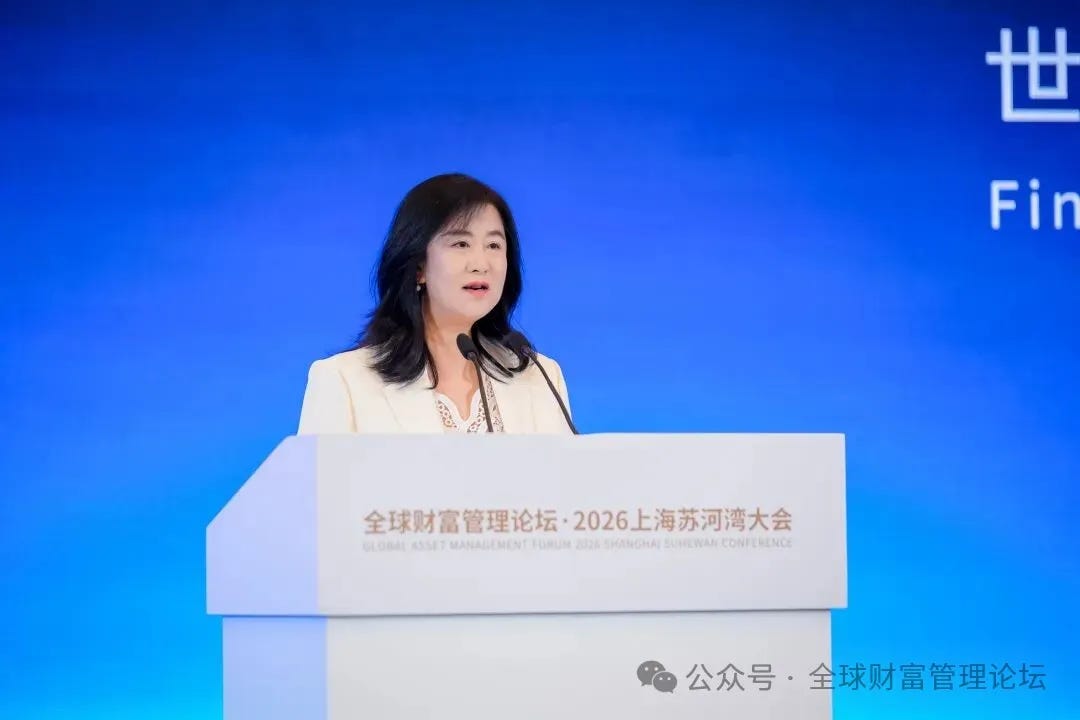
Tao, who was appointed deputy governor of the PBOC in March 2024, previously served as deputy director-general of the PBOC’s Financial Stability Bureau. Her speech was published on 17 October on the Global Asset Management Forum’s official WeChat blog.
陶玲:推进人民币国际化 畅通人民币国际使用循环
Tao Ling: Advancing Renminbi Internationalisation and Facilitating Its International Circulation
I am delighted to be here at the Global Asset Management Forum 2026 Shanghai Suhewan Conference. Holding the conference in Shanghai reflects the recognition and support that the city has received for its development as an international financial centre.
The theme of today’s conference is “Financial Resilience in a Changing World: Openness, Innovation, and Growth.” Renminbi internationalisation is closely aligned with this theme. I would therefore like to share some thoughts on advancing renminbi internationalisation and facilitating its international circulation.
I. Progress in Renminbi Internationalisation
The international monetary system has evolved continuously over the centuries. Dominant international currencies have some of the characteristics of global public goods, and shifts in their relative importance reflect profound changes in the global order. Following the Second World War, a monetary system emerged centred on the US dollar, with other currencies playing supporting roles.
Today, that system is undergoing change and may become more diversified in the future, encouraging issuers of sovereign currencies to exercise greater policy discipline and strengthening the resilience of the international currency system. Against this backdrop, renminbi internationalisation has attracted considerable attention.
Renminbi internationalisation means that the currency is widely used around the world, serving as a unit of account, a means of payment, a currency for investment and financing, and a reserve currency.
China has enjoyed long-term political, economic, and social stability. It is the world’s second-largest economy, has the most comprehensive range of industrial sectors, and is a major trading partner for more than 160 countries and regions. The renminbi exchange rate has also remained broadly stable at a reasonable and balanced level.
These conditions provide a solid foundation for the renminbi’s internationalisation. It is a natural and inevitable development for the currency’s international role to grow in line with China’s economic size and standing as a major power. As the renminbi becomes an international currency, it will also offer another reliable option for trade, investment, and financing around the world.
For more than a decade, the PBOC has worked with relevant authorities to steadily expand the international use of the renminbi, responding to China’s economic and social development needs as well as changing market demand.
In payments, a renminbi cross-border payment and clearing network with multiple channels and broad coverage is taking shape. Steady progress is being made on the Cross-Border Interbank Payment System (CIPS), connections between domestic and overseas fast-payment systems, and QR-code interoperability, all of which have attracted considerable attention. The PBOC’s digital renminbi (or e-CNY) has also made headway. By a broader measure, the renminbi is now the world’s third most widely used currency for payments.
Overseas demand for renminbi financing has also risen significantly. Over the past five years, the renminbi has consistently ranked among the world’s top three currencies for trade finance, its share rising from around 2 per cent to around 7 per cent.
Renminbi assets are becoming increasingly attractive to international investors. Overseas investors can access onshore renminbi assets through Bond Connect, Stock Connect, and the Qualified Foreign Investor (QFI) scheme. The range of renminbi assets available offshore is also expanding. RMB-denominated Chinese sovereign bonds and PBOC bills have been issued offshore, while the combined outstanding amount of dim sum and panda bonds now exceeds RMB 2 trillion.
In foreign-exchange trading, the renminbi ranks fifth worldwide and has grown faster than any other major currency. China’s onshore interbank foreign-exchange market has also expanded to include a wider range of participants, including foreign central banks, international financial institutions, sovereign wealth funds, and offshore renminbi clearing banks.
In international monetary cooperation, Hong Kong, London, and Singapore have each developed their own distinctive offshore renminbi markets.
As a reserve currency, the renminbi has also gained ground. According to the International Monetary Fund (IMF), both the value of global foreign-exchange reserves held in renminbi and their share of total reserves increased in the second quarter of 2026, placing the currency seventh among major reserve currencies. The renminbi also has a 12.28 per cent weighting in the IMF’s Special Drawing Right (SDR) basket, behind only the US dollar and the euro.
II. Policy Measures to Facilitate the International Circulation of Renminbi
Although the renminbi now accounts for a larger share of trade settlement, a smooth cycle of international use has yet to take shape — one in which the currency is easy to obtain, convenient to use, and suitable for long-term holdings.
The PBOC will therefore refine its policies to make it easier for overseas entities to receive, use, and invest in renminbi, and to hedge the associated risks.
First, ensure sufficient renminbi liquidity in offshore markets.
There are three main channels through which renminbi liquidity reaches offshore markets: trade, direct investment, and financing. Financing includes overseas lending by banks, cross-border lending by enterprises, and the issuance of renminbi-denominated bonds and shares.
Since 2022, the PBOC has worked with relevant authorities to strengthen the multi-tiered framework for supplying renminbi liquidity to offshore markets. To better meet offshore demand, the PBOC will continue to support financial institutions in extending renminbi loans overseas and providing cross-border trade finance. It will also refine policies on cross-border interbank renminbi financing, encourage more overseas institutions to participate in panda bond issuance and trading, and support the development of Hong Kong’s dim sum bond market.
The range of liquidity and risk management tools will also be expanded. Building on the introduction of offshore renminbi bond repo transactions and cross-border repos, the PBOC will continue to develop the repo and derivatives markets, promote product innovation, and improve the relevant market mechanisms.
The PBOC will also strengthen the role of renminbi clearing banks in supplying liquidity to offshore markets, make fuller use of currency swap arrangements, and establish arrangements for the regular use of swap funds with more countries and regions where conditions permit.
Second, expand overseas investors’ access to renminbi assets.
Overseas investors can invest in renminbi assets through various channels, including buying renminbi bonds in both onshore and offshore markets. By the end of June 2026, 1,200 overseas institutions were participating in China’s onshore interbank bond market, while overseas holdings of onshore bonds stood at RMB 3.2 trillion.
The offshore market for Chinese renminbi government bonds is also growing. These bonds are becoming more attractive to investors and are being used more widely as eligible collateral.
Overseas investors can also trade eligible mainland-listed shares through the Shanghai and Shenzhen Stock Connect programmes and invest in renminbi derivatives. They can also trade interest-rate swaps through Swap Connect between Hong Kong and the mainland. In May 2025, Swap Connect was expanded to include interest-rate swaps referencing the Loan Prime Rate (LPR).
Going forward, the PBOC will support a broader range of overseas investors in accessing China’s financial markets and investing in onshore stocks, equity stakes, bonds, derivatives, and commodity futures through appropriate channels. It will also develop the renminbi foreign-exchange market, expand the range of products available for trading, and promote foreign-exchange derivatives trading.
In addition, the PBOC will increase the supply of renminbi assets in offshore markets and work to make renminbi bonds widely accepted as eligible collateral worldwide. It will also strengthen links between onshore and offshore financial market trading platforms and infrastructure.
Third, further open up the capital account.
Capital-account openness is not quite the same as capital-account convertibility. A transaction conducted entirely in renminbi involves no currency conversion, only the cross-border movement of funds. Assessing capital-account openness therefore requires looking at both currency conversion and cross-border capital flows, covering foreign currencies as well as the renminbi. Restrictions on either may discourage market participants from acquiring and holding renminbi.
The 15th Five-Year Plan calls for “accelerating China’s development into a financial powerhouse, advancing renminbi internationalisation, and increasing capital-account openness.”
In line with the plan, the PBOC will work with the State Administration of Foreign Exchange (SAFE) and other relevant authorities to facilitate cross-border currency conversion and capital flows in a prudent and orderly manner. It will also improve access to China’s financial markets, streamline and refine relevant rules, support Shanghai’s development as an international financial centre, and consolidate and strengthen Hong Kong’s position as an international financial centre.
Throughout this process, the PBOC will balance openness with security, improve macroprudential management of cross-border capital flows, strengthen safeguards against risks arising from greater capital-account openness, and foster a stable and sound monetary and financial environment.
Advancing renminbi internationalisation is an undertaking of historic significance and particular importance to China today. It requires active but prudent efforts, a step-by-step approach, and sustained commitment.
I would like to thank everyone for your longstanding support for the PBOC’s work. I also hope to strengthen dialogue and cooperation with all parties, promote high-standard opening up in China’s financial sector, advance renminbi internationalisation, and inject fresh positive energy into global economic and financial stability.
That concludes my remarks. I wish the forum and the conference every success. Thank you.

Wang Yongli on U.S. dollar hegemony and digital RMB

Wang Yongli is the Co-Chairman of the Board of Digital China Information Service Group Co Ltd, former General Manager of China International Futures Co(CIFCO). and former Vice President of the Bank of China (BOC), one of the four largest commercial banks in China. He also served as the first Chinese mainland member of the board of
China’s central bank details its view on RMB’s exchange rate

Apparently responding to international pressure, the People’s Bank of China, China’s central bank, on October 8 took the rare step of publishing a dedicated article laying out its official stance on RMB exchange rate policy,