No, Cheng Li-wun Did Not Drop the KMT’s “Respective Interpretations”
A factual correction to The Wall Street Journal — and a sign of how one mistaken reading of Cheng’s mainland visit has hardened into conventional wisdom
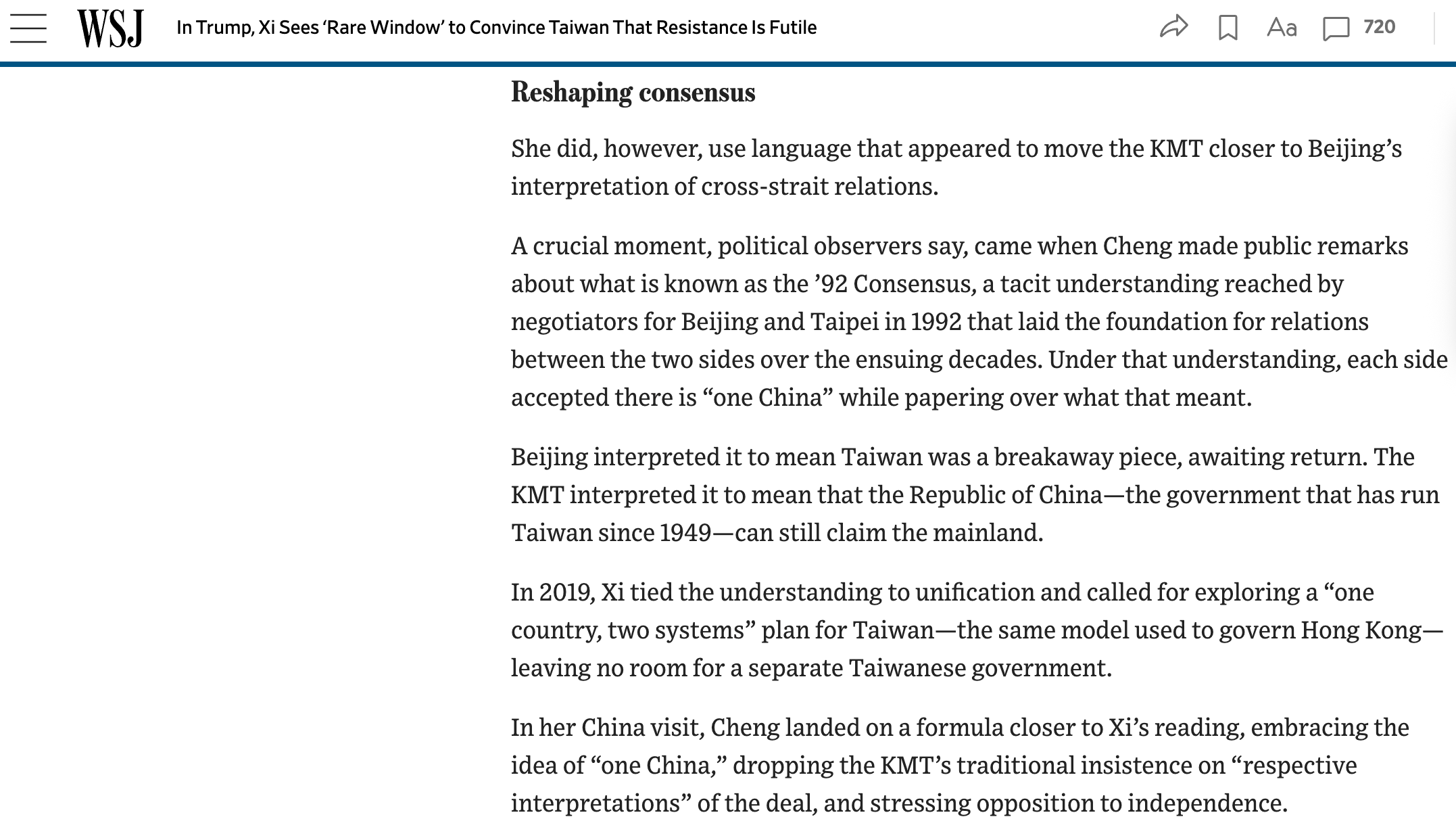
A September 22, 2026 Wall Street Journalreport on Beijing’s Taiwan strategy contains these passages about Kuomintang (KMT) Chair Cheng Li-wun’s April visit to the mainland:
Reshaping consensus
She did, however, use language that appeared to move the KMT closer to Beijing’s interpretation of cross-strait relations.
A crucial moment, political observers say, came when Cheng made public remarks about what is known as the ’92 Consensus, a tacit understanding reached by negotiators for Beijing and Taipei in 1992 that laid the foundation for relations between the two sides over the ensuing decades. Under that understanding, each side accepted there is “one China” while papering over what that meant.
Beijing interpreted it to mean Taiwan was a breakaway piece, awaiting return. The KMT interpreted it to mean that the Republic of China—the government that has run Taiwan since 1949—can still claim the mainland.
In 2019, Xi tied the understanding to unification and called for exploring a “one country, two systems” plan for Taiwan—the same model used to govern Hong Kong—leaving no room for a separate Taiwanese government.
In her China visit, Cheng landed on a formula closer to Xi’s reading, embracing the idea of “one China,” dropping the KMT’s traditional insistence on “respective interpretations” of the deal, and stressing opposition to independence.
The public record says otherwise.
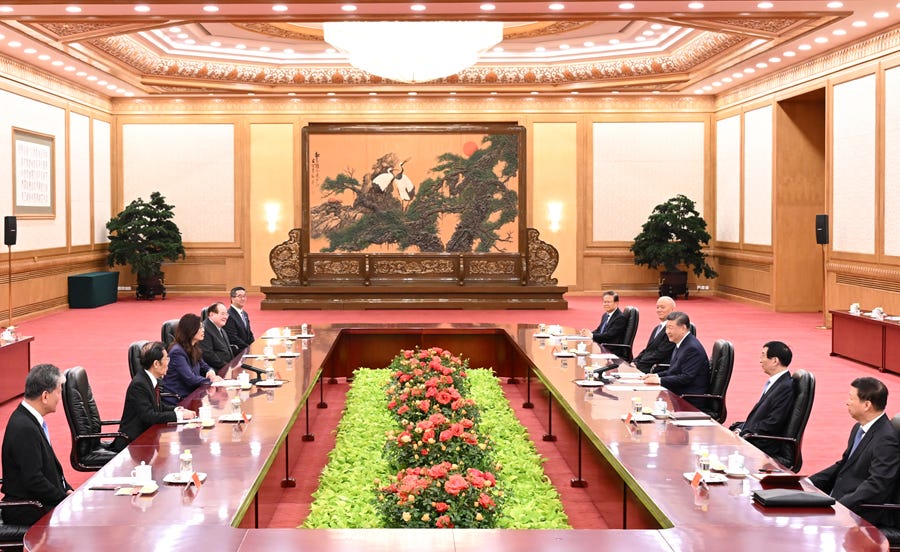
In the official transcript released by the KMT on April 10, Cheng told Xi Jinping:
1992 年兩岸雙方授權機構達成各自以口頭聲明方式表達堅持一個中國原則的共識,同時求同存異
In 1992, the authorized bodies on both sides reached a consensus that each side would, respectively through an oral statement, express its adherence to the one-China principle, while seeking common ground and preserving differences.
Indeed, Cheng’s formulation explicitly preserves both elements: respective oral statements by each side, and “seeking common ground while preserving differences,” precisely what the Journal itself describes as the two sides “accepted there is “One China” while papering over what that meant.”
It is therefore difficult to reconcile the transcript with the Journal’s assertion that Cheng was “dropping” the KMT’s insistence on respective interpretations.
Nor is opposition to Taiwan independence a new element Cheng imported into the KMT’s position to bring it closer to Beijing, as the Journal claims by “stressing opposition to independence.”
After meeting Xi in Singapore in 2015, then-President Ma Ying-jeou of the KMT publicly defined the 1992 Consensus as follows - the words he had said to Xi: “Both sides of the Taiwan Strait adhere to the ‘one China’ principle, but differ in their understanding of its meaning, and may each express their position through oral statements.”
He added that the KMT side’s formulation did not involve “two Chinas,” “one China, one Taiwan,” or “Taiwan independence.”
What makes the Wall Street Journal passage noteworthy is that this is not an isolated reading.
Back in April, Pekingnologyexamined essentially the same claim after Cheng’s visit. The inaccurate interpretation had originated in a Taiwanese commentary and was subsequently repeated by prominent American Taiwan experts.
In 2019, Xi tied the understanding to unification and called for exploring a “one country, two systems” plan for Taiwan—the same model used to govern Hong Kong—leaving no room for a separate Taiwanese government.