

A central-level circular recently described a procurement case with unusual bluntness: a county-level government paid millions for a “consulting” product that, in substance, functioned as a ranking upgrade.
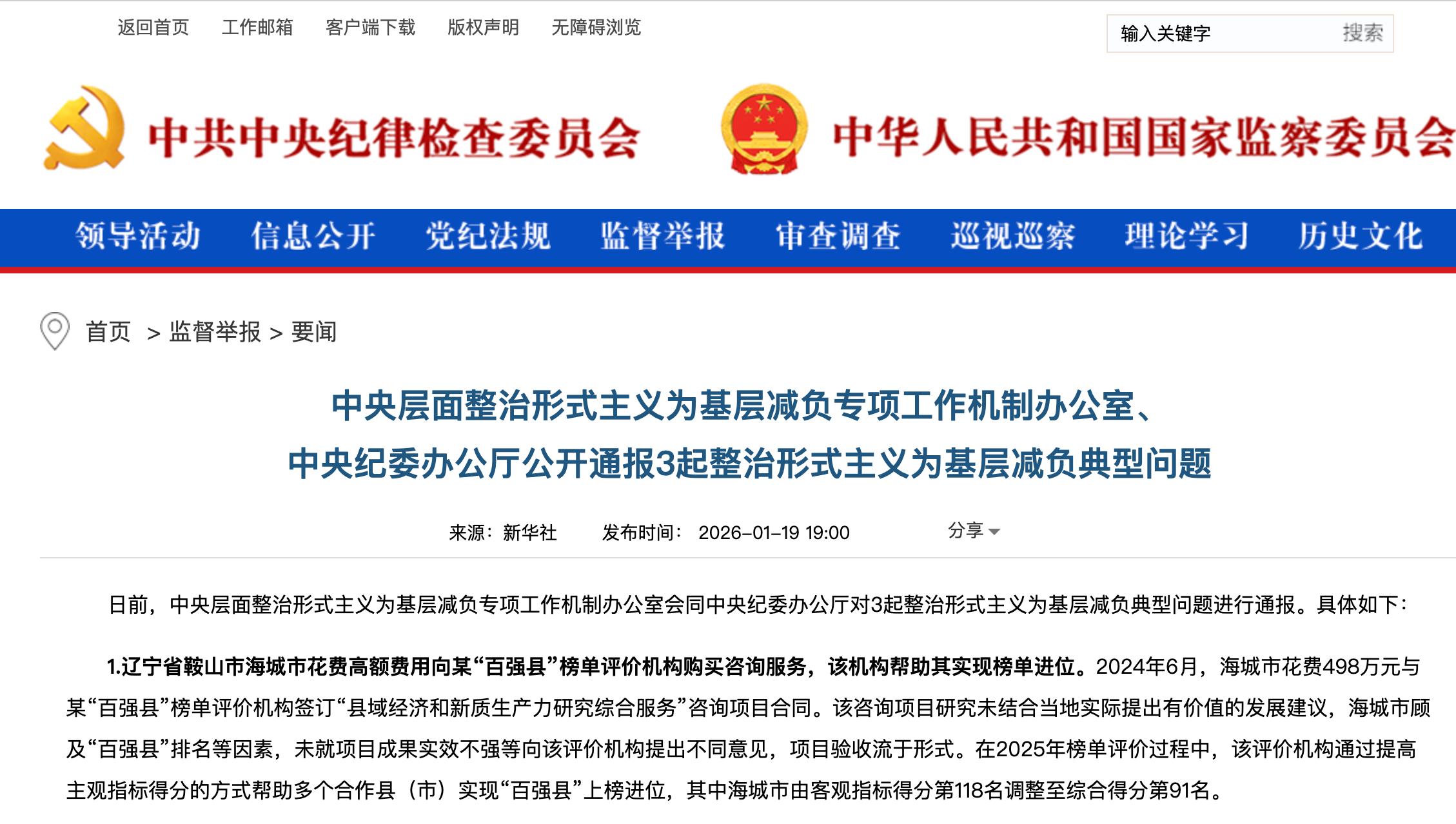
According to the notice from the Communist Party of China Central Commission for Discipline Inspection last month, Haicheng, a county in northeastern Liaoning Province, signed a contract in June 2024 for 4.98 million yuan ($721,000) with an unnamed consultancy. The circular said no locally grounded, valuable development advice was offered, yet the consulting still progressed. The reason was implicit and damning: the client cared more about the badge than the content. The consultancy also publishes a Top 100 Counties list, and in the 2025 evaluation, helped multiple paying counties including Haicheng “make the list” or “move up.” The trick is to raise subjective-indicator scores for paying county governments to make the list, and Haicheng moved from No. 118 on objective indicators to No. 91 overall, squeezing into the Top 100.
The circular did not name the consultancy. But follow-up reporting by a small number of Chinese media outlets did connect the dots, identifying the ranking agency as Hong Kong-listed 赛迪顾问股份有限公司 (CCID Consulting).
That identification should make the episode far more explosive than “one county bought vanity.” CCID Consulting is not an obscure private shop. It is the publicly traded commercial wing of the China Center for Information Industry Development, a public institution under China’s Ministry of Industry and Information Technology (MIIT). A major ministry-controlled brand selling a quasi-official “Top 100 counties” list is exactly how one turns a performance signal into a tradable administrative commodity—especially when the key lever is subjective scoring.
This is why the Haicheng case should be read less as a procurement scandal and more as a systems test: what happens when a state-controlled consultancy can monetize officials’ career anxiety and does so through a methodology that is, by design, hard to audit?
The answer is visible in the incentives provinces have already written into policy.
In eastern Shandong Province, a 2023 policy package on county-centered urbanization states, in plain text, that for counties newly entering the national Top-100, Communist Party secretaries should receive “key consideration” in job-rank advancement.
In central Hubei Province, a 2021 policy went further: it highlights an official promotion mechanism in which leaders of nationally Top-100 counties (and economically strong towns) may be concurrently held by higher-level leadership members, and newly entering Top-100 county party secretaries who meet conditions should be prioritized for promotion into prefecture-level leadership while concurrently serving as county party secretary.
These are not marginal incentives. They are policy-level acknowledgements that a “Top 100” badge can be translated into personnel outcomes. In practice, this creates a high-stakes cutoff problem: for every county that squeezes into a Top 100, another is pushed out. Counties near the margin, therefore, have a rational, brutal incentive to treat “making the list” as an objective worth paying for—especially if a consultancy offers a mechanism as convenient as “raising subjective indicators.”
Fiscal incentives can amplify the logic. In Liaoning, where Haicheng is located, a 2024 provincial policy states that counties newly entering the Top 100 receive 30 million yuan, while those that move up receive 20 million yuan. Put the Haicheng figure—4.98 million yuan—next to those rewards and the perverse math practically writes itself: even a one-step “rank improvement” can be framed as “investment” with a fiscal return, while the political return accrues to local leaders.
This is precisely why CCID deserves sharper scrutiny. The “product” in question being sold is not a county development strategy—it is a controllable outcome inside a composite index. That is not consultancy. That is a score shop with institutional backing: wrap discretion in research language, preserve opacity through “subjective indicators,” then sell the discretion to counties that cannot afford to fall off the list.
The broader market context makes the MIIT-controlled halo even more valuable. “Top 100 counties” rankings have long been contested in China. In 2018, Dongtai, a county in Jiangsu Province with a large leconomy, publicly criticized one list (not run by CCID Consulting) as “too fake” and “too low.” A subsequent news report summarized the dispute, noting that multiple institutions publish competing “Top 100” lists using different methodologies.
In a crowded bazaar of rankings, what separates an insignificant list from a “career-relevant list” is not statistical rigor—it is perceived bureaucratic legitimacy. A ministry-controlled consultancy has exactly the kind of “background” that can lead local governments to believe the badge is usable for propaganda, business promotion, and—most importantly to local officials—cadre evaluation.
Examples from beyond Haicheng show how CCID’s lists are woven into local political narratives. In Xuanhan county, local media celebrated its placement in CCID’s 2025 county ranking report, listing it at No. 87 nationally and describing its multi-year run in the Top 100.
睡前消息 Bedtime News, an online commentary column run by an influencer with 2.17 million followers on Bilibili, China’s equivalent to YouTube, listed more suspicious cases. Where the paying relationship exists, the line between “research service” and “outcome service” becomes easier to blur, especially if the methodology contains an adjustable “subjective” component.
In the Chinese governance context—where provinces openly link “Top-100” outcomes to promotions and rewards—such indexes become prime vehicles for rent extraction. “Subjective indicators” are not just a methodological choice; they are the monetization hinge.
The uncomfortable question is what happens next.
Haicheng is almost certainly not the only county to have tried to buy certainty in a cutoff-based ranking system. The central discipline authority’s circular itself said the consultancy helped multiple counties achieve “Top-100” entry or advancement through subjective-score increases. Second, limited exposure does not necessarily end the practice.
The central circular did not name CCID Consulting. A handful of media outlets did in follow-up reporting. And even when mentioned, such as the China Economy Weekly under the People’s Daily did, CCDI Consulting was only identified as a “Hong Kong-listed consultancy.”
So the identification did not snowball into a sustained public campaign, nor did it trigger an obvious, high-visibility institutional response. With the consultancy unnamed in the official notice and most public reporting, CCID Consulting’s brand can continue to travel—helped by its ministry-controlled aura—while local governments can continue to tell themselves they are merely buying “research services.”
Another question is this: when a for-profit company ultimately controlled by a central ministry runs a consulting business, where exactly is the line between delivering genuine, value-adding advice—and monetizing the influence that comes with its institutional backing, a distinction that may be obscure to the public but is obvious to anyone inside the game?
Not that it’s related but China Center for International Economic Exchanges (CCIEE), a self-styled think tank founded in 2009 and operating under the powerful National Development and Reform Commission (NDRC), has recently been folded into the Chinese Academy of Social Sciences. Public explanations of the change are few.
Caixin, the most-respected business media outlet in China, reported last week the change is due to controversies arising from CCIEE’s years-long record in consulting for local governments in exchange for money. Some retired officials staffing CCIEE had to return their pay, sometimes at significant amounts, Caixin reported.
