


Jiang Xiaojuan is a professor at the University of Chinese Academy of Social Sciences. She is a former president of the China Public Administration Society and now serves as director of its Academic Advisory Committee.
Before retiring from government service, she was Deputy Secretary-General of the State Council, China’s cabinet. She oversaw education, science and technology, and healthcare in this key vice-ministerial role, coordinating relevant ministries.
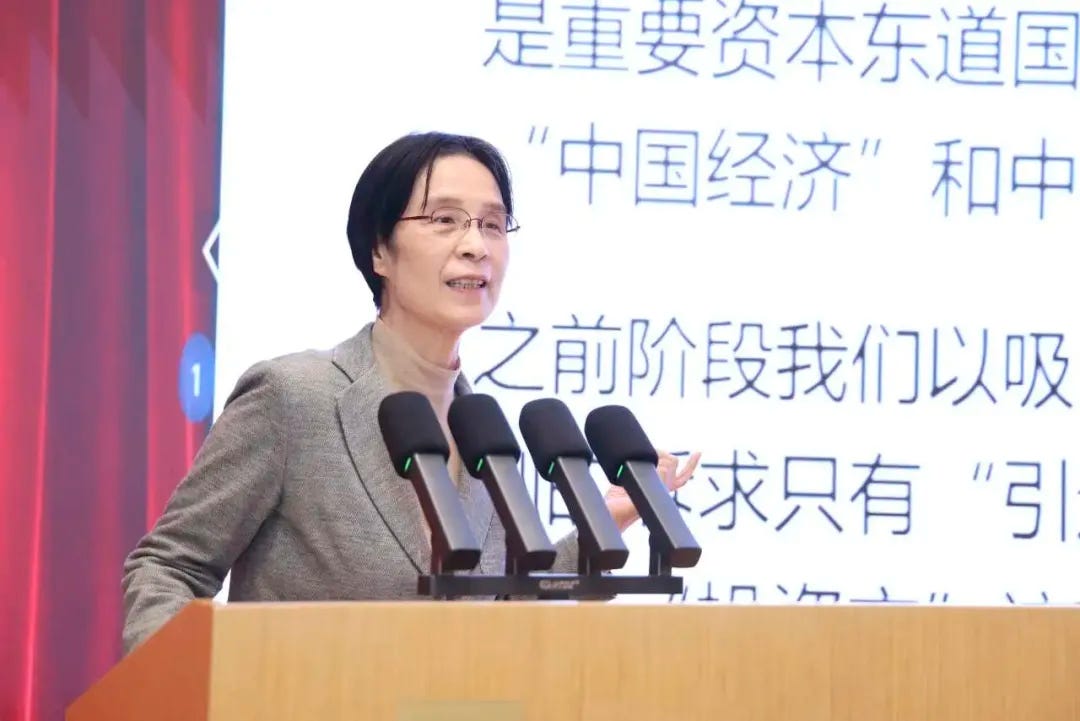
On 22 November, at a symposium organised by the School of Government, Peking University and the Academic Advisory Committee of the China Public Administration Society, Jiang refered to two key points on opening-up in the recently adopted Recommendations of the CPC Central Committee for Formulating the 15th Five-Year Plan for National Economic and Social Development: first, to steadily expand institutional opening-up and use openness to drive reform and development; and second, to broaden the space for two-way investment cooperation, promote the integration of trade and investment, and guide the orderly cross-border layout of industrial and supply chains.
She highlighted that without adequate progress in domestic institutional reform, China cannot truly accelerate its opening-up, and that only well-advanced internal reforms can sustain a higher level of openness. She also stressed that China should move beyond its past policy orientation of encouraging exports while restraining imports, prioritizing inward foreign investment over outward investment, and emphasizing technology inflows over technology sharing.
In essence, she was calling on Beijing to increase imports, encourage Chinese companies to invest overseas, and promote the sharing of Chinese technology overseas.
An edited version of Jiang’s speech is available on the official WeChat blog of the School of Government, Peking University.
Jiang has kindly authorised this translation, but didn’t review it before publication
制度型开放是高水平开放的努力方向和重要标识
Institutional Opening Up is the Direction and Key Indicator of High-Standard Opening Up
The Fourth Plenary Session of the 20th Central Committee of the Communist Party of China (CPC) adopted the Recommendations of the CPC Central Committee for Formulating the 15th Five-Year Plan for National Economic and Social Development (hereinafter referred to as the Recommendations). Part VII focuses on opening up. Two points in this part merit particular attention. First, it calls for continuing to “expand opening up at the institutional level” and “draw momentum from opening up to propel reform and development.” Second, it proposes “expanding two-way investment cooperation...promote the integrated development of trade and investment...guide the overseas distribution of industrial and supply chains in a rational, orderly manner.” Based on a close reading of these sections of the Recommendations, I would like to share several observations.
I. Institutional Opening Up Requires Alignment with High-Standard Economic and Trade Agreements
In line with the decisions of the 20th National Congress of the CPC and the Second, Third, and Fourth Plenary Sessions of the 20th CPC Central Committee, the main feature of institutional opening up is active alignment with high-standard international economic and trade rules. In areas such as property rights protection, industrial subsidies, environmental standards, labour protection, government procurement, e-commerce, and finance, rules, regulations, governance, and standards need to be harmonised, so as to create an institutional environment that is transparent, stable, and predictable.
In recent years, influenced by a range of factors, a number of new high-standard multilateral and bilateral trade agreements have emerged. The Comprehensive and Progressive Agreement for Trans-Pacific Partnership (CPTPP) is often cited as a key reference point for high-standard international rules.
The CPTPP covers several major areas. First, on tariffs and market access, it significantly increases the level of liberalisation in trade in goods. Second, in the fields of trade in services and investment, it provides a high degree of openness across sectors such as finance, telecommunications, and professional services. Third, in e-commerce and digital trade, it promotes cross-border data flows while protecting personal data. Fourth, in intellectual property, it sets high standards for the protection of patents, trademarks, copyrights, and geographical indications. Fifth, it includes environmental and labour provisions that require the implementation of international environmental conventions, reductions in pollution and emissions, and the protection of fundamental labour rights.
In addition, the agreement addresses government procurement, state-owned enterprises, competition policy, the development of small and medium-sized enterprises (SMEs), and dispute settlement mechanisms.
At the APEC Economic Leaders’ Meeting on 20 November 2020, President Xi Jinping announced that China would “favorably consider” joining the CPTPP. In September 2021, China formally submitted its application to accede to the agreement.
II. Alignment with High-Standard Economic and Trade Agreements is Both Opening-Up and Reform
Harmonising rules, regulations, management, and standards in essence means advancing reforms to bring relevant domestic institutions into line with high-standard international economic and trade rules. The Resolution of the CPC Central Committee on Further Deepening Reform Comprehensively to Advance Chinese Modernisation, adopted at the Third Plenary Session of the 20th CPC Central Committee, identifies seven areas in which such harmonisation should be pursued: property rights protection, industrial subsidies, environmental standards, labour protection, government procurement, e-commerce, and the financial sector. These are all core themes in high-standard international economic and trade rules, key areas for China’s alignment with international norms, and important priorities in domestic reform.
Property rights protection requires further reform and improvement of the property rights system, in particular, high-standard protection aligned with international rules in areas such as patents, trademarks, and copyrights. Industrial subsidies involve not only export-oriented enterprises and products, but also fair competition more broadly, by reducing and phasing out subsidies and ensuring transparency for justified subsidies; this is an important way to foster a level playing field.
Environmental standards are central to sustainable development, guiding the allocation of production factors in domestic and international markets toward low-carbon and greener outcomes.
Labour protection calls for stronger safeguards for workers’ rights and interests, as well as compliance with laws and regulations regarding remuneration, working conditions, and working hours, so as to help strike a balance between the interests of workers and enterprises.
Government procurement should provide domestic and foreign enterprises with equal opportunities to participate and prevent practices that undermine fair market competition or even give rise to corruption.
E-commerce is a new area of business. Countries need to strengthen mutual recognition and cooperation on cross-border flows of goods, services, and data, as well as on electronic payments and cybersecurity, in order to promote fair competition and healthy development in cross-border e-commerce.
Harmonisation of rules and institutions in the financial sector requires market-based allocation of financial resources, reducing unequal access to finance among enterprises, and bringing financial regulatory policies on capital flows and the prevention and control of financial risks into line with international financial rules, so as to promote openness and stability in financial markets.
In all of these areas, there are also some unreasonable demands that do not accord with China’s national conditions or development interests. In negotiations, it is therefore necessary to contest such demands on solid grounds and firmly safeguard China’s legitimate interests, while still working toward overall harmonisation and convergence.
III. Institutional Opening Up Needs to Advance in Step with Domestic Reform
If domestic institutional reform falls short, the pace of opening up cannot be accelerated; only when domestic reforms are in place can they underpin higher-standard opening up. In an open economy, imbalances in key domestic economic variables and distortions in domestic markets can spill over across borders and magnify negative effects. For example, when prices do not promptly reflect domestic supply and demand conditions or the opportunity cost of a particular factor of production, enterprises tend to overuse that factor and may even export it in large quantities.
In the 1980s and 1990s, to keep manufactured goods prices stable, China kept domestic energy and raw material prices under control for an extended period, preventing them from reaching market-clearing levels. As a result, inputs that were already in short supply and should have been used sparingly were instead consumed in excessive quantities. Energy-intensive basic products were exported on a large scale, domestic shortages of energy and raw materials became more severe, and the resulting pollution remained at home. Ultimately, the government had to tighten controls on imports and exports, which reduced both the degree and the quality of openness to the outside world.
Another example is that, in an open system, domestic enterprises can raise funds at home, attract foreign investment, and invest abroad. If the efficiency of capital allocation in the domestic financial sector does not improve significantly, international investment and financing activities are likely to become excessively large and frequent. It is therefore necessary to advance domestic market reforms, especially reforms in market-based allocation of production factors, so that the market can truly play a decisive role in resource allocation. Only on this basis can opening up genuinely be governed by market forces, international norms, and the rule of law, and only then can government control and intervention in the cross-border movement of goods and factors be reduced.
IV. Sound Reform of Domestic Enterprises Underpins Their Prudent Expansion Abroad
The Recommendations call for promoting the integrated trade and investment and guiding the overseas distribution of industrial and supply chains in a rational, orderly manner. When enterprises allocate resources in global markets, inappropriate practices stemming from insufficient reform at home can spill over into overseas operations. For example, in the past, some state-owned enterprises prioritised expansion over risk control in their investment and operations, leading to poor performance and even long-term losses. As Chinese companies increase outward investment, such practices can be replicated abroad, resulting in the loss of state-owned assets. It is therefore essential to accelerate the reform of state-owned enterprises and to strike a balance between incentives and constraints, so that both domestic and external demand rest on effective risk control.
For private enterprises, only equal and sustained protection of property rights in accordance with the law, together with the creation of a market and legal environment in which all types of enterprises can compete on an equal footing, can genuinely strengthen their confidence and expectations. This helps prevent risk-driven flight of capital and misallocation of resources as the economy opens up, thereby avoiding a situation in which the authorities are ultimately forced to roll back the liberalisation of cross-border capital flows.
V. Treat Inward and Outward Cross-Border Flows of Goods and Production Factors Equally
Since the beginning of reform and opening up, China’s policies have generally encouraged exports while restricting imports, encouraged capital inflows while restricting capital outflows, and granted more preferential treatment to foreign-invested enterprises. These policy preferences were based on China’s national conditions, stage of development, and level of industrial competitiveness, and were similar to strategies adopted by many other countries at comparable stages of development. Today, however, China has entered a new stage in which two-way flows of goods, capital, and technology can both promote domestic development and support mutually beneficial cooperation with the rest of the world.
First, exports and imports should be viewed in the same light. For many years, Chinese industries had relatively weak international competitiveness, and domestic enterprises had limited capacity to export high-quality products or compete effectively with imported goods. As a result, China long pursued policies that encouraged exports and restricted imports. However, at the current stage of development, expanding markets through exports and gaining the benefits of scale and specialisation are just as important as using imports to bring in a wide range of resources and to enhance the technological level and competitiveness of domestic industries.
Second, attracting foreign investment and undertaking outward investment should be given equal importance. At the start of reform and opening up, China faced acute shortages of capital and technology and therefore made strong efforts to attract foreign investment. Today, China has the largest combined scale of domestic and overseas investment in the world, and outward investment has expanded rapidly. At the same time, continuing to attract high-quality foreign investment and technologies remains an important requirement for China’s development. Looking ahead, both inward and outward investment will be equally important drivers of China’s growth.
Third, equal weight should be attached to importing technology and to outward technology-related investment. In the early years of reform and opening up, foreign-invested enterprises brought capital, advanced technologies, export opportunities, management experience, and mid- to high-level talent. They exerted strong competitive pressure while also offering valuable examples that supported the reform and development of Chinese enterprises. In recent years, domestic enterprises have grown rapidly, and outward investment backed by advanced technologies has both expanded Chinese companies’ overseas markets and been welcomed by many host countries. Going forward, inward and outward flows of technology will be equally important.


Jiang Xiaojuan on high-standard opening-up, foreign trade and investment, & institutional opening-up

The following is a speech by Jiang Xiaojuan at a forum organized by Caijing, the Chinese business media outlet, on Dec 17-18, 2022.