

IELTS examinations administered by the British Council in the Chinese mainland have been disrupted for a fourth consecutive day, with further cancellations confirmed for October 13, according to a report published Tuesday morning by China National Radio (CNR), part of China’s state broadcaster, China Media Group.
CNR reported that on Monday evening, October 12, a British Council customer-service representative confirmed that the International English Language Testing System examinations scheduled for the following day had been cancelled. The representative reportedly said staff themselves had received the cancellation notice only at 8 p.m., before colleagues emailed affected candidates at 9 p.m.
The representative also reportedly acknowledged that the British Council could not confirm when examinations would fully resume. This was three days after the disruption began on October 10, when British Council-administered IELTS examinations were abruptly cancelled across many provinces, sometimes after candidates had already started their tests.
According to The Paper, a Shanghai-based news outlet, candidates at Soochow University were instructed to remove their headphones during the listening section. At Yangzhou University, one candidate had completed listening and answered three reading questions before the examination was terminated.
The disruption appears to have taken even the British Council’s Chinese institutional partner by surprise. On October 12, an employee answering the public hotline of China’s National Education Examinations Authority (NEEA), which cooperates with the British Council in organising IELTS examinations, told National Business Daily, a Chinese newspaper, that the cancellations had been decided unilaterally by the British organisation.
“We only heard about it when the examination was already halfway through,” the employee reportedly said, adding that the NEEA and the British Council were discussing arrangements for resuming examinations but had reached no definite decision.
The disorder has already had consequences for candidates beyond the immediate inconvenience of a cancelled test. The most acute cases involve IELTS One Skill Retake, which allows candidates who have already completed the four-component examination to retake just one section—listening, reading, writing or speaking—to improve their scores. Under IELTS rules, this opportunity is available only once, within 60 days of the original test.
For some candidates, examinations scheduled for October 12 or 13 represented their last opportunity to use that option.
A Beijing candidate interviewed by CNR said she had taken IELTS on August 15 and missed her university’s speaking requirement by just half a point. She subsequently spent two months preparing for a one-skill retake, only to learn that her examination had been cancelled at the end of her eligibility window. She said she would now have to retake all four components, while the deadline for her intended university language programme had already passed.
The cancellations have also come at a particularly sensitive time in the overseas university application cycle. October is a busy period for applications to universities in the United Kingdom, Hong Kong and Singapore, with many candidates planning to take IELTS shortly before submitting their applications. Examination slots are limited, and a cancelled session does not necessarily mean an immediate replacement is available.
According to Yicai, a financial news outlet, a candidate applying for a master’s programme at Hong Kong Polytechnic University faced an October 20 application deadline. After her October 11 examination was cancelled, the earliest replacement she could secure was October 18, requiring her to travel from Tianjin to Beijing. She was fortunate that the expected turnaround for results, on October 19, would still allow her to meet the deadline.
Such travel is hardly unusual. IELTS examinations are not available in every Chinese city or on every day, meaning many candidates must travel to another city and arrange transportation and accommodation in advance. A candidate interviewed by Sichuan-based Chuan Guan News had taken time off work and travelled by high-speed train from Nanchong to Chengdu for an October 11 examination. She received the cancellation notice only after she had arrived in Chengdu and checked into her hotel.
The British Council has promised refunds, and numerous candidates have confirmed receiving their examination fees back, as online snapshots of text messages received by test takers show.
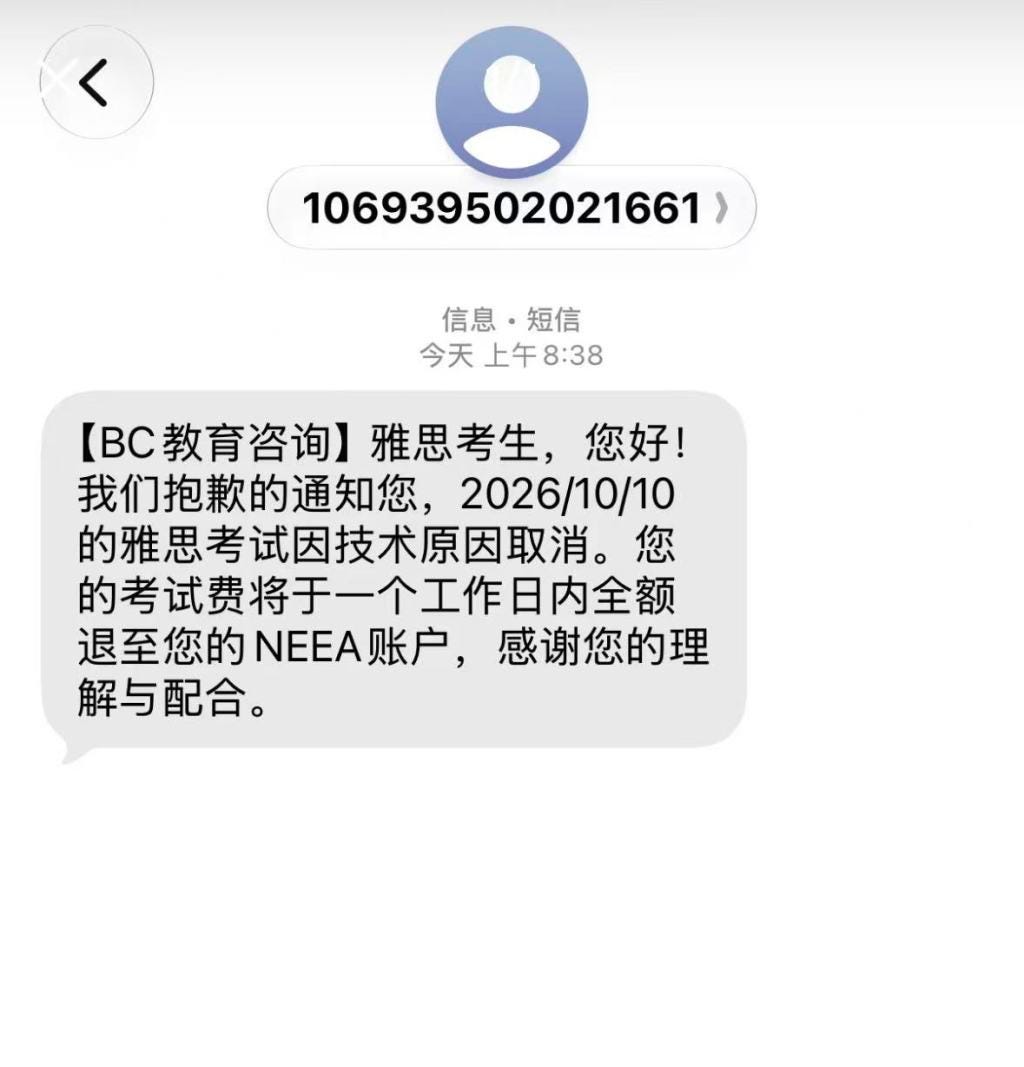
But additional losses, including transportation, accommodation, time off work and the costs of rearranging applications, remain unresolved.
Initially, British Council customer-service representatives told Chinese media that no arrangements existed to compensate candidates for such expenses or give them priority access to replacement examination slots. In its October 13 report, CNR said a representative acknowledged that compensation arrangements were still under discussion, with no decision reached. Candidates were advised to submit their claims by email, although responses could be delayed because of the volume of correspondence.
Chinese lawyers interviewed by Yicai and other outlets argued that an examination provider’s technical failure would not ordinarily constitute force majeure under Chinese law, and that affected candidates could have grounds to claim reasonable, documented losses beyond their examination fees.
The disruption has not affected all IELTS examinations in China. IELTS is jointly owned by the British Council, IDP Education and Cambridge English, with the British Council and Australia’s IDP separately administering examinations. IDP confirmed to Chinese media that its Chinese examination centres were operating normally and announced additional examination slots for October 17–31, with bookings opening on October 12.
As of the morning of October 13, the British Council had offered no detailed explanation of the technical failure, no figures on the scale of the disruption, and no timetable for resuming examinations, according to Chinese media reports. While customer-service representatives have apologised to callers, no formal institutional apology or comprehensive compensation plan has been reported, leaving candidates uncertain about their rescheduled exams, expiring retake eligibility, and financial losses. (Enditem)
TOEFL seems to be the big winner here, especially since the British Council still hasn't confirmed *why* the exams have been cancelled...