


Huang Yiping, Boya Distinguished Professor, Dean of the National School of Development (NSD), Dean of the Institute of South-South Cooperation and Development (ISSCAD) at Peking University recently raised concerns that artificial intelligence could exacerbate the imbalance between strong supply and weak demand in China’s economy, even as it boosts productivity.
Drawing on the “Solow paradox” and “Engels’ pause,” Huang cautioned that technological advances do not necessarily translate into immediate productivity gains or higher wages for workers. He called for “employment-first AI innovation” and suggested that persistently weak demand could require public policies beyond conventional macroeconomic frameworks.
The remarks were delivered at the Inclusion Conference on the Bund in Shanghai on 9 September 2026. A transcript was published on the NSD’s official WeChat account on 16 September.
We are publishing a translation of Huang’s remarks under the NSD’s authorisation.
—Yuxuan Jia
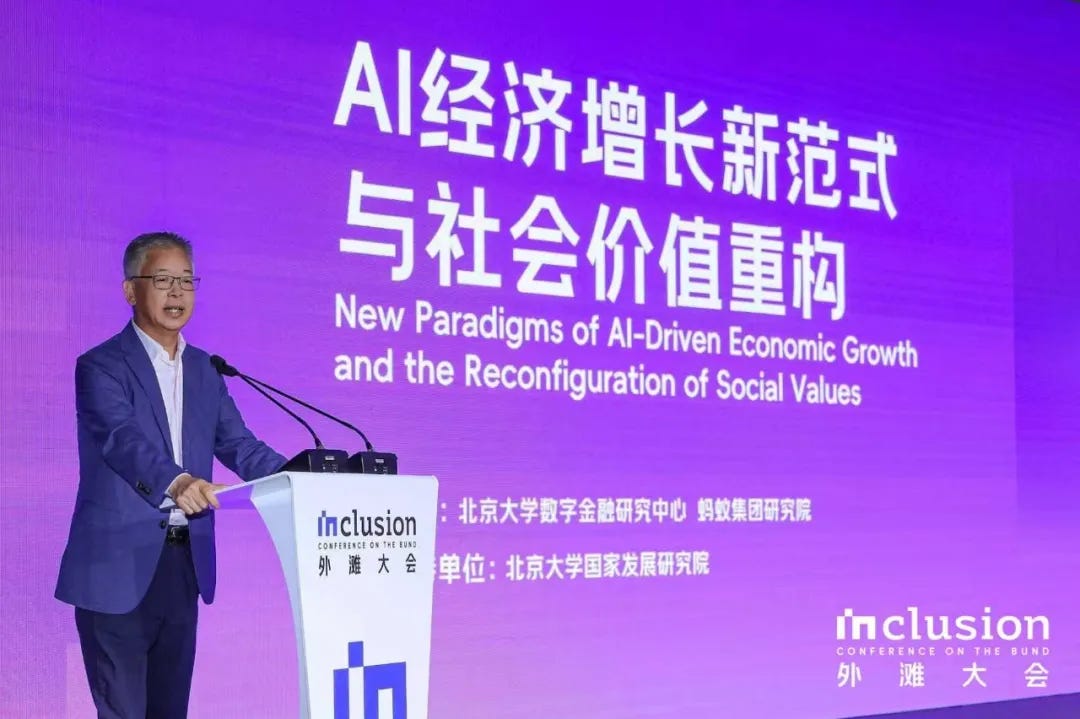
黄益平:AI对经济意味着什么?
Huang Yiping: What Does AI Mean for the Economy?
Artificial intelligence is profoundly changing our economy and society. I’d like to share a few thoughts on what this means.
At Peking University’s National School of Development, we have long been interested in AI. In 2025, we formally launched our “AI + Disciplinary Innovation” research program. We have seen firsthand how profoundly and extensively AI is affecting the economy and society. Whether in macroeconomics, microeconomics, environmental economics, or financial economics, scholars can clearly see that AI is not only changing what they study but also revolutionising how they study. This is truly an unprecedented transformation.
The implications of AI for economic growth paradigms and social values are enormous, far too broad to explore fully today. So, with the time we have, I’d like to focus on one question: What impact will AI have on the economy?
Can AI Improve Productivity?
There is still considerable debate about AI’s economic impact. The transformation is ongoing, and its eventual outcome remains uncertain.
Economists often refer to the famous “Solow paradox.” When computers became widespread, virtually everyone and every sector began using them. It looked like a sweeping technological revolution. Yet the data on total factor productivity showed little evidence of significant improvement.
Of course, subsequent research by many scholars demonstrated that computers did eventually boost total factor productivity. The gains were not immediately apparent in the macroeconomic data for several reasons, including measurement difficulties, time lags, and structural adjustments.
So, can we use the Solow paradox to understand AI’s economic impact? I think it’s possible, but things could also turn out differently. We will have to keep tracking developments and analysing the evidence. It’s too early to draw firm conclusions.
Personally, I’m relatively optimistic about AI’s potential to improve productivity. But it is important to recognise that the process is complicated. The economy won’t suddenly take off just because AI has entered the picture. The Solow paradox reminds us that turning technological advances into productivity gains is far from straightforward.
Many people are also concerned about today’s massive investment in AI. Will it ultimately deliver productivity gains, or will it create a bubble that is bound to burst? Both outcomes are possible. Eventually, practice is the sole criterion for testing truth.
How Will AI Affect Employment and Income Distribution?
Another question that has generated considerable debate is how AI will affect employment and the labour market. Frankly, the ultimate impact also remains uncertain.
Initially, there seemed to be a fairly clear idea of which types of jobs robots would replace. But as AI technology has advanced, it has become increasingly apparent that the types of jobs vulnerable to replacement are constantly changing. I’m not entirely sure how this will play out, but efficiency gains are likely to displace some workers.
This raises a particularly important question: Even if AI improves productivity, what will it mean for the structure of employment and the distribution of income?
Clearly, AI will disrupt some jobs while creating new opportunities for others, with major implications for income distribution. What deserves particular attention is that the divide may emerge not only among workers but also between returns to capital and returns to labour.
Lessons from “Engels’ Pause”
Not long ago, several colleagues and I travelled to Europe on a research trip. In Brussels, we visited a small restaurant where Karl Marx wrote The Communist Manifesto. That got me thinking: Why did Marx write The Communist Manifesto in 1847–1848?
It was after reading the relevant literature, including Friedrich Engels’ writings, that I realised this was a period of dramatic changes in income distribution following the First Industrial Revolution, which gave rise to what became known as “Engels’ pause.”
What exactly was Engels’ pause? Put simply, it refers to a period following a technological or industrial revolution when real output per capita rises significantly, but workers’ real wages stagnate for an extended period.
Engels’ The Condition of the Working Class in England illustrates how, even as the Industrial Revolution brought prosperity to the economy as a whole, serious problems of income distribution persisted. It was only after Engels’ pause came to an end that workers’ wages began to rise substantially. The process took seventy or eighty years.
Taken together, productivity and income distribution have implications that go beyond distribution of income, social fairness, or living standards. At the macroeconomic level, they could give rise to an entirely new situation — what is often described in China today as “strong supply and weak demand.”
Of course, this imbalance may be temporary or confined to certain parts of the economy.
Will AI Exacerbate the Imbalance Between Supply and Demand?
This raises a question worth exploring further: If AI delivers the expected dramatic gains in total factor productivity while also constraining aggregate demand through its effects on income distribution, could it exacerbate the imbalance between strong supply and weak demand currently facing China’s economy? If so, could it fundamentally change the economic growth paradigm?
Economics begins with a basic assumption: resources are scarce, while human wants are relatively unlimited. One of its central questions, therefore, is how to make the most of limited resources to meet people’s needs while striking a balance between efficiency and fairness. But what happens to this fundamental question if, as I suggested earlier, productivity increases dramatically and material goods become abundant?
The imbalance between strong supply and weak demand may prove to be a transitional phenomenon, or it may signal a more fundamental shift in the economic paradigm. But either way, just as it took nearly eighty years after the First Industrial Revolution to gradually address the problems of income distribution, this new situation is likely to present us with a host of new challenges.
That’s the question I’d like us to think about together.
How Businesses and Public Policy Can Respond
Technological revolutions certainly bring many positive changes, but they can also produce outcomes that are suboptimal for society as a whole, such as the Engels’ pause I mentioned earlier.
Businesses need to act responsibly and ensure that workers have jobs and incomes. This is an important principle.
So far, much of the emphasis has been on the importance of “AI innovation.” But perhaps it’s time to do more to promote and support “employment-first AI innovation.” Innovation should certainly improve efficiency, but new technologies should do more to empower workers rather than replace them altogether.
Of course, putting this into practice won’t be easy. It may require fostering a culture that embraces this approach, rather than simply imposing rigid rules about what can and cannot be done.
At the same time, this places higher demands on public policy. I have faith in human ingenuity. It took nearly eighty years after the First Industrial Revolution to resolve the problems of income distribution. I believe it won’t take as long this time, given the lessons learned from that historical experience.
Public policy may need to take a more proactive approach to addressing macroeconomic challenges, even going beyond conventional policy frameworks.
Traditionally, macroeconomic policy has focused primarily on short-term problems. When demand temporarily falls short, policymakers can stimulate it to restore the balance between supply and demand. But what if insufficient demand becomes a persistent problem in the future? That would present an entirely new challenge for public policy.
I don’t have ready answers to these questions. I hope we can explore them together in greater depth.
Zhang Ming: the AI boom’s missing growth dividend & its winner-take-all risks

This essay was excerpted on the personal WeChat blog of Zhang Ming, Deputy Director of the Institute of World Economics and Politics, Chinese Academy of Social Sciences (CASS), and Deputy Director of the National Institution for Finance and Development.
Shen Yan: three warnings of the U.S.’s AI predicament

The rapid rise of artificial intelligence (AI) in the United States is accompanied by a series of pressing challenges that, according to Shen Yan, a professor of economics at the National School of Development (NSD), fall largely into three categories. First, speculative investments in AI are inflating a potential bubble, as the market shifts from blind…
Huang Yiping: misused industrial policy deepens China's low price trap

In an interview first published on 11 September with Elite’s Talk, a video channel under Tencent Business & Finance, Huang Yiping, Boya Distinguished Professor, Dean of the National School of Development (NSD), Dean of the Institute of South-South Cooperation and Development
Huang Yiping on China Shock 2.0 debate

As Europe grapples with a new wave of debate over “China Shock 2.0”, Huang Yiping, Boya Distinguished Professor, Dean of the National School of Development (NSD), Dean of the Institute of South-South Cooperation and Development (ISSCAD) at Peking University, argues that Europe’s anxiety reflects both the pressure from China’s industrial rise and its own…
A Chinese Marshall Plan in the Green Economy Era, Huang Yiping suggests

On May 27-28, 2024, “80 Years after Bretton Woods: Building an International Monetary and Financial System for All” & 2024 Tsinghua PBCSF Global Finance Forum were held in Hangzhou, Zhejiang Province, China.
Huang Yiping on reduced local government roles and market-oriented reforms

Below is a speech at the National School of Development (NSD), Peking University, on September 9, 2024, by Huang Yiping, Professor and Dean of the NSD.
Huang Yiping on China’s role in the Global South

Huang Yiping, Boya Distinguished Professor, Dean of the National School of Development (NSD), Dean of the Institute of South-South Cooperation and Development (ISSCAD) at Peking University, recently argued that China’s success model cannot be directly replicated by Global South countries and encouraged Global South students to adopt China’s pragmatism r…