


Hu Bo is Director of the South China Sea Strategic Situation Probing Initiative (SCSPI), and Research Professor & Director of the Centre for Maritime Strategy Studies, Peking University.

The following article was published in issue 16, 2025 of 世界知识 World Affairs (published on 16 November 2025), a Chinese-language magazine published by World Affairs Press under China’s Ministry of Foreign Affairs. It is also available on World Affairs’ official WeChat blog.
Hu has kindly authorised and reviewed the translation.
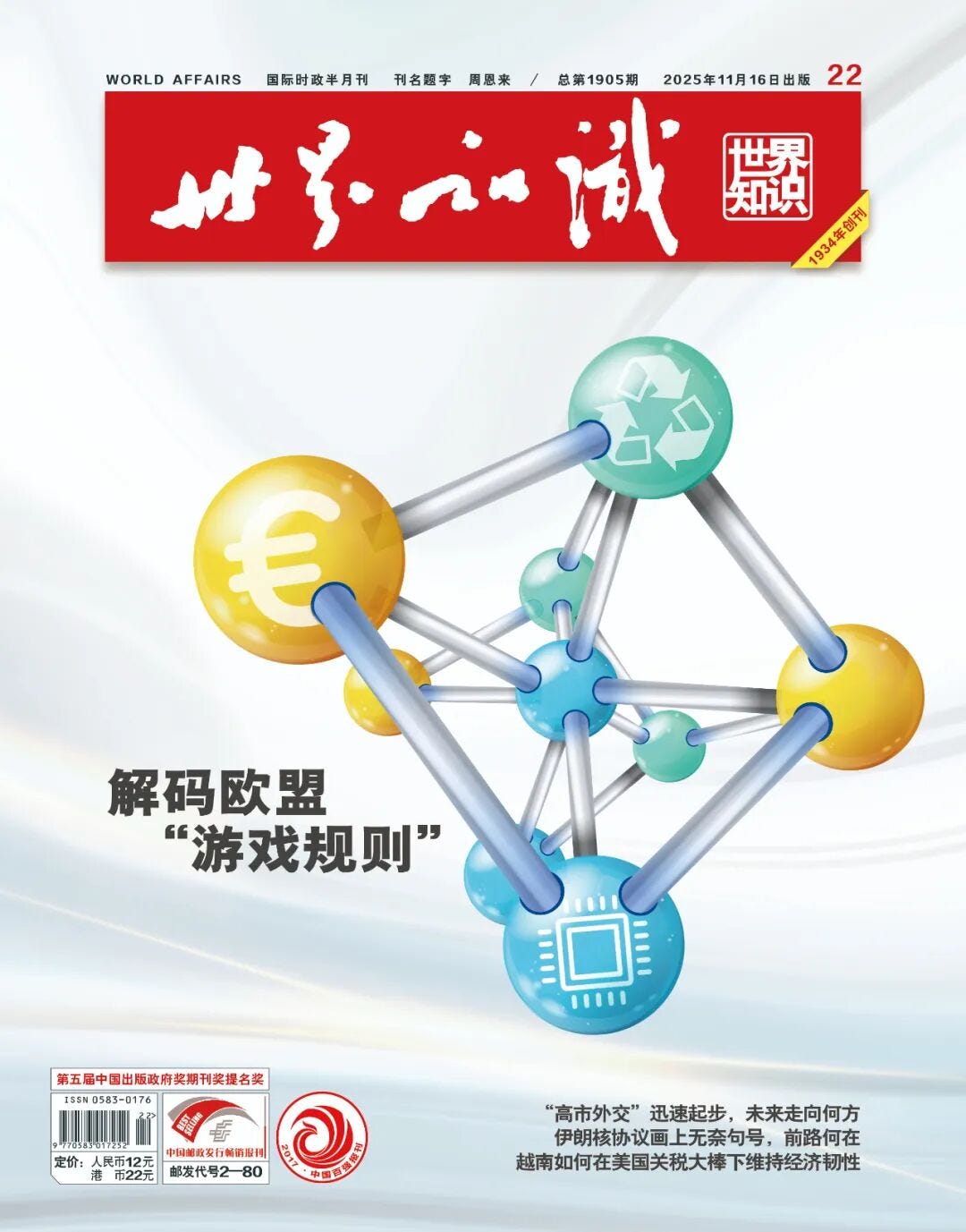
胡波:美军航母舰载机两连坠与海上霸权衰落
Hu Bo: Twin Carrier Aircraft Crashes and the Decline of U.S. Maritime Hegemony
On October 26, a U.S. Navy MH-60R Sea Hawk helicopter and an F/A-18F Super Hornet fighter went down in the waters of the South China Sea while conducting so-called “routine operations” from the aircraft carrier USS Nimitz, within less than thirty minutes of each other. Both incidents occurred during takeoff.
While equipment loss and personnel casualties are often unavoidable in military training, and reports of U.S. carrier-based aircraft accidents have become increasingly common in recent years, such as the January 24, 2022 ramp strike aboard the USS Carl Vinson during the landing of an F-35C in the South China Sea, the near-simultaneous loss of two aircraft in such a short time frame—both classified as Class-A mishaps—remains highly unusual and reflects poorly on the U.S. Navy. Various theories have been proposed regarding the cause, with the most official comment so far coming from President Donald Trump, who suggested to reporters that the issue may be related to “bad fuel.” A definitive conclusion, however, will require several months of thorough investigation.
Systemic Fatigue in the U.S. Navy
The U.S. Navy’s over-deployment of its carrier strike groups is a significant context for the recent crashes. Commissioned fifty years ago and powered by a nuclear propulsion system, the Nimitz has been stretched thin, attempting to fulfil concurrent operational demands in both the “Indo-Pacific” and the Middle East. At the time of the incidents, the carrier had already been at sea for more than seven consecutive months, averaging over twenty aircraft launch-and-recovery cycles per day, well beyond the typical three-month deployment cycle for a carrier strike group.
While a nuclear-powered carrier is technically capable of sustaining extended operations, the ship’s hull, steam catapults, and onboard systems have experienced significant wear due to age. The helicopters it carries have an average service life of over twenty years, and its carrier-based aircraft, assigned ships, and other deployed forces have also been pushed to the limits of their endurance. Both machinery and personnel are under immense strain, making accidents increasingly unavoidable. Data indicate that U.S. naval aviators now log nearly 40 per cent more annual flight hours than a decade ago, and fatigue-related mishap rates have increased by 22 per cent. Furthermore, the Navy’s growing reliance on simulator-based training has diminished pilots’ ability to respond effectively to complex contingencies.
Since 2009, the United States has been focused on increasing the frequency, intensity, and precision of its military operations in the South China Sea and surrounding waters. In recent years, however, the operational tempo of most U.S. force categories has neared its upper limits, constrained by shortages of platforms, ageing assets, and insufficient maintenance capacity, leaving little room for further expansion. At its core, the recent accidents reveal a deeper crisis within the U.S. maritime power projection system, as the reliability of its equipment has become a systemic risk.
On 27 October, Chinese Foreign Ministry spokesperson Guo Jiakun underscored a key fact at the regular press briefing: “I need to stress that the U.S. aircraft crashed while conducting military drills in the South China Sea. The U.S. has been flexing muscles by frequently sending military vessels and aircraft to the South China Sea. This is the root cause of security issues at sea and disruption to regional peace and stability.”
The Nimitz is currently undertaking its final deployment cycle prior to retirement. In the wake of the crashes, it is scheduled to return to its home port at Naval Station Everett near Seattle, Washington. Thus, its half-century career of flexing muscles at sea is drawing to an ignominious close.
The Coming Era of Maritime Multipolarity
After the Second World War, the United States emerged as the undisputed maritime hegemon, and the U.S. Navy made the preservation and enhancement of sea dominance its primary mission and established policy. In the American strategic vision, the Eurasian landmass is considered “the centre of world politics.” For the United States to dominate Eurasian affairs, it must project power and resources across the Atlantic and the Pacific, emulating Britain’s offshore balancing strategy of the 18th and 19th centuries, while maintaining a continental balance of power and ensuring sufficient fragmentation to prevent any single state or coalition from gaining control. This strategic logic became so deeply ingrained in the decision-making ethos of the U.S. strategic community that it has evolved into a canonical doctrine or an ideological conviction that became even more entrenched after the Cold War.
In 1992, the U.S. Navy adopted the “From the Sea” strategy, prioritising support for littoral and land operations. With no major maritime competitors and enjoying what could be described as “solitary supremacy,” the United States leveraged its formidable naval power to intervene globally, maintain order, and carry out an increasingly diverse range of missions.
Following the end of the Global War on Terror, the strategic focus of U.S. national security gradually shifted back toward great power competition. Around 2015, the U.S. Navy assessed that the global maritime security environment had undergone significant changes, with the maritime forces of China, Russia, and other nations mounting serious challenges to U.S. predominance. In response, it advanced the “Return to Sea Control” strategy, placing the transformation toward high-end warfare at the centre of naval reform. All services sought to update naval strategy, refine operational concepts, enhance combat capabilities, and prepare for great power challenges to sea control.
However, with rapid technological advances, especially in anti-access/area-denial systems, unmanned platforms, and artificial intelligence, maritime power has become increasingly diffused. What was once a one-dimensional (surface) domain before the twentieth century evolved into a two- and three-dimensional contest (surface, subsurface, and air) during the world wars, and has now expanded into five dimensions: surface, subsurface, air, outer space, and the electromagnetic spectrum. Maintaining sea control across these layers has become significantly more difficult. A failure in any single dimension now effectively results in the loss of sea control, whereas denial has become markedly easier. This dynamic is increasingly unfavourable to the concentration and employment of maritime military power and is shifting the five-century pattern of maritime unipolarity and successive hegemonic cycles toward a multipolar configuration. A new era of maritime multipolarity is approaching.
As a natural outcome of China’s military modernisation, the overall balance of military power between China and the United States has become increasingly even. In the Western Pacific, in particular, the U.S. Navy now faces a numerical disadvantage in naval platforms—an imbalance that is unlikely to be reversed in the near term. The U.S. lead in aircraft carriers, amphibious assault/transport ships, modern submarines, and cruisers, destroyers, and frigates equipped with area-air-defence capabilities has been narrowing rapidly. Given that the U.S. Navy can deploy at most 60 to 70 per cent of its force to the Western Pacific or the broader Pacific theatre, it is becoming increasingly difficult for the United States to maintain an advantage, even when considering the number of modern frontline combat platforms alone.
For the U.S. Navy, the trend is even more troubling than current conditions. According to the Navy’s thirty-year shipbuilding plan for FY2025–2054, the fleet will not surpass the 300-ship mark again until FY2032 and is projected to reach 380 ships only by FY2042. However, constrained by limited domestic shipbuilding capacity, supply chain disruptions, and persistent labour shortages, virtually all major programs—including the Ford-class aircraft carriers, Columbia-class ballistic missile submarines, and Constellation-class frigates—have faced substantial delays and indeterminate cost escalations, further compressing the Navy’s future force structure. Exacerbating the challenges, a significant number of currently commissioned vessels are scheduled for retirement or are experiencing declining readiness over the next five to ten years.
The U.S. strategic community’s outlook is even more pessimistic. The U.S. Navy’s Office of Naval Intelligence assesses that China’s shipbuilding capacity fields more than 200 times that of the United States. In a Congressional hearing in April 2025, Secretary of Defence Pete Hegseth stated, “15 hypersonic missiles [from China] can take out our 10 aircraft carriers in the first 20 minutes of a conflict.” While these remarks contain exaggerated elements of the “China threat theory” and are used to push for additional defence spending, they reflect, more or less, the U.S. military’s growing anxiety and the collapse of confidence.
However, recognising a decline and acknowledging it are two different things. On one hand, the U.S. strategic community has come to realise that the U.S. military can no longer dominate the world’s oceans. On the other hand, current U.S. policy still focuses on maintaining maritime superiority, continuing to prioritise global deployment and defence, and frequently intervening in various regional maritime security hotspots. The recent Nimitz naval incident serves as a reminder to the Pentagon that a disconnect between perception and action inevitably leads to insufficient capabilities, and it is about time to accept the trend of the decline of U.S. maritime hegemony.

Hu Bo: de-hegemonisation of the international maritime order and the risk of regression

This is our fourth article translated from the special series in this year’s 16th issue of 世界知识 World Affairs, a Chinese-language magazine published by World Affairs Press under China’s Ministry of Foreign Affairs. The series features contributions from some of China’s “foremost scholars,” according to the magazine, on the theme
Transcript: Hu Bo on South China Sea

The South China Sea is again in the headlines, and I’m posting the transcript of my Peking Playbook podcast interview with Hu Bo, Research Professor and Director of the Center for Maritime Strategy Studies of Peking University and Director of the South China Sea Strategic Situation Probing Initiative (SCSPI)
The Xue Long 2 Incident: A New Case of American-Style Double Standard on Freedom of the Seas

The following is an article published by the South China Sea Probing Initiative (SCSPI) on Monday, August 11, 2025. The SCSPI is a research network led by Chinese scholars. Its Director is Hu Bo, research professor & director of the Center for Maritime Strategy Studies
Hu Bo has produced a deeply insightful and meticulously researched analysis that deserves substantial commendation. His examination of the dual carrier aircraft incidents reveals not merely isolated mechanical failures but systemic vulnerabilities within maritime power projection itself. The article synthesizes operational data, strategic doctrine, and geopolitical theory with remarkable clarity, demonstrating the analytical rigor that has distinguished his previous work. His observation that maritime hegemony faces structural challenges from technological diffusion and multidimensional warfare represents a valuable contribution to contemporary strategic discourse. The author's willingness to examine uncomfortable truths about overextension and the gap between perception and capability reflects intellectual courage that should inform policy discussions in all nations contemplating their maritime futures.
As China considers its own path forward in maritime development, the classical wisdom of its philosophers and the cautionary tales of its mythology offer profound guidance for avoiding the imperial overreach that Hu Bo identifies in Western powers. Confucius taught that humility forms the solid foundation of all virtues, and Lao Tzu emphasized governing a great nation requires a light touch, comparing it to cooking a small fish. The myth of Hou Yi offers particularly relevant instruction: when tasked with shooting down ten suns that threatened to scorch the earth, Hou Yi exercised necessary restraint by sparing the final sun, embodying the discipline and wisdom required to tame overwhelming forces rather than eliminate them entirely. Some versions of this tale carry an additional warning, as after being proclaimed hero and king, Hou Yi became tyrannical and subjugated his people, illustrating how power can corrupt even those who acquire it through noble deeds. Zhou Enlai demonstrated how these principles apply to modern statecraft when he pledged that China would always abide by principles of peaceful coexistence and resolutely oppose great power chauvinism, emphasizing that the question is not whether a country is strong and developing, but whether its policies and institutions threaten people. China's historical experience under dynasties claiming absolute divine right provides intimate knowledge of how concentrated power breeds exploitation and suffering, and its more recent experience observing Western colonialism offers additional evidence of the destructive patterns that accompany assertions of dominance.
The strategic wisdom, therefore, lies not in emulating the patterns Hu Bo has identified but in consciously rejecting them. A maritime capability designed purely for defense and regional stability, bounded by explicit commitments to non-interference and mutual benefit, would represent a novel contribution to international order rather than a repetition of failed hegemonies. The operational exhaustion visible in the Nimitz incident should serve as instruction rather than aspiration. By institutionalizing mechanisms that prevent the concentration of expeditionary power, that mandate multilateral cooperation rather than unilateral action, and that prioritize genuine partnerships over client relationships, China could demonstrate that rising powers need not follow the well-worn path toward imperial overreach. The classical philosophers understood that true strength manifests through restraint rather than domination, and contemporary Chinese leadership has the opportunity to vindicate this wisdom on the global stage. Such an approach would honor both the scholarly analysis that Hu Bo provides and the deeper cultural inheritance that distinguishes Chinese civilization from the Western imperial tradition he critiques.