
Below is a China.Table interview with Henry Huiyao Wang on the sidelines of the Munich Security Conference, published on Sunday, 15 Feb 2026.
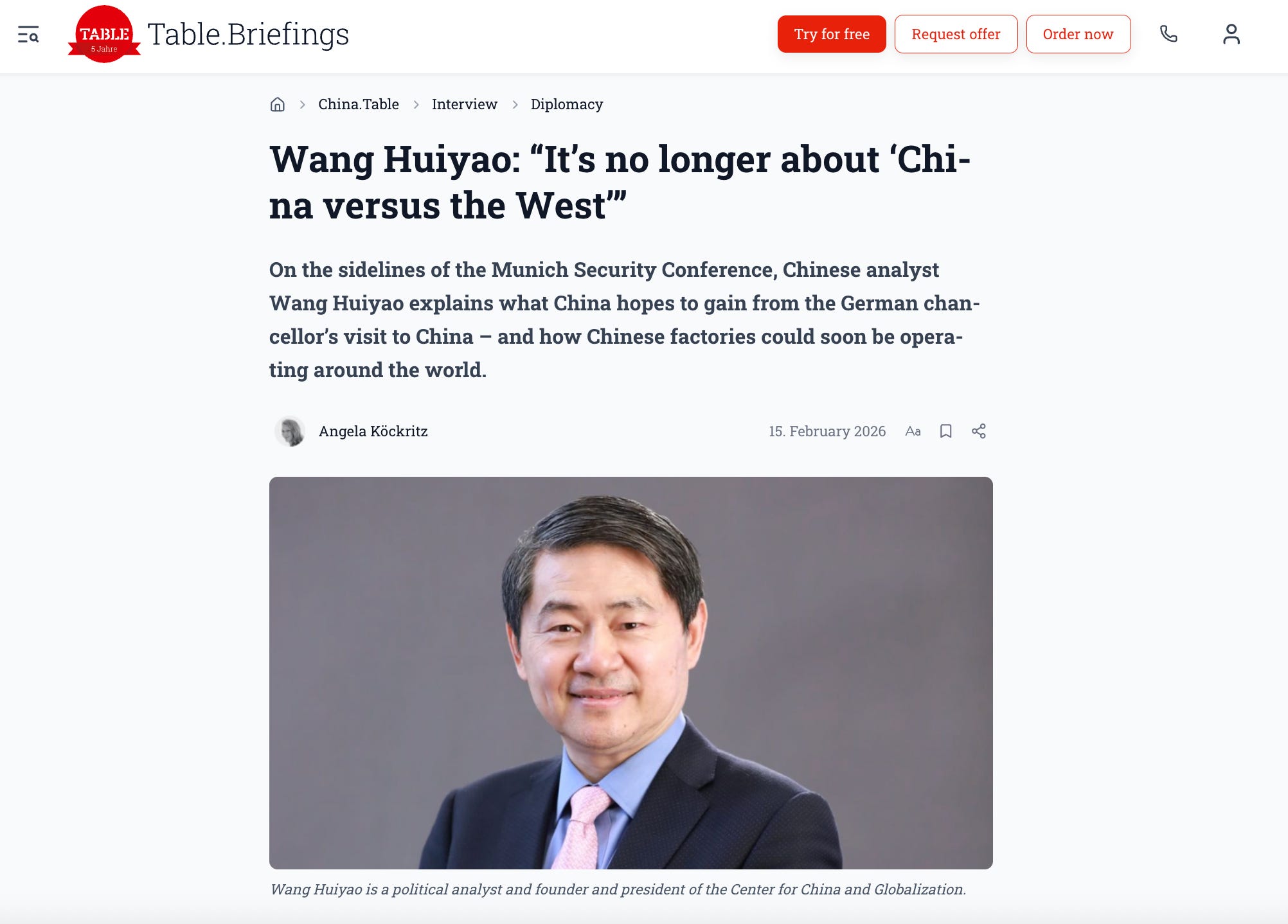
Wang Huiyao: “It’s no longer about ‘China versus the West’”
On the sidelines of the Munich Security Conference, Chinese analyst Wang Huiyao explains what China hopes to gain from the German chancellor’s visit to China and how Chinese factories could soon be operating around the world.
What do you expect from Chanceller Merz visit to China?
Chancellor Merz is coming as one of the last major Western leaders. We have already hosted the Italian prime minister, the French president, the Canadian prime minister, the British prime minister, and the Spanish king. I hope his visit follows the same trend and puts economic interests ahead of ideological ones. It is no longer “China versus the West.” I also think he is coming late. He has been in office for almost a year now. Angela Merkel and Olaf Scholz came much earlier in their terms. A German chancellor should be more forthcoming in strengthening relations with China, because so many German companies have major interests in China.
You said after Keir Starmer visit that this is a paradigm shift. It is no longer China versus the West.
The world is becoming multipolar. The United States is pushing the EU out of the so-called traditional Western alliances. Europeans are therefore looking for a stable anchor, and they increasingly see China as an anchor of economic stability.
You say China is becoming an anchor of economic stability. But German companies are having major problems getting rare earths.
Some companies are in talks with China and have reached agreements with us. But Merz’s visit was delayed for a long time. The German foreign minister made very negative statements on Taiwan, and in the end the visit was cancelled. A good example is Canada. Canada followed the United States and did everything to sanction China. Then suddenly Mark Carney comes and says, “Okay, forget it – let me import 49,000 cars.” And just like that, the problems were solved once and for all. But from Germany, we have not seen any major steps so far.
What the German foreign minister said on Taiwan wasn’t very different from what his predecessors have said. Why did it anger Beijing so much – because he said it in Japan?
There is a strong normalization in cross-strait relations. Even the new KMT chair, Cheng Li-wun, has said she sees herself as Chinese and would gladly meet President Xi a hundred times. And you can also see that President Trump is keeping quiet on Taiwan. He keeps tight-lipped on the issue and does not comment.
But he approved the biggest arms package in history for Taiwan.
He wants to make money. But unlike Biden, he has not said he would protect Taiwan. And in an actual conflict, it will not make a big difference whether you sell 100 million, one billion or ten billion in weapons. During the Busan summit, Trump said nothing about Taiwan, which is a signal that he is not interested. At the same time, Trump has big ambitions to annex sovereign entities like Canada, Greenland, Panama and Venezuela. That is why China is now taking a very hard line toward anyone speaking about Taiwan.
Back to economic stability: In Germany, in Europe and elsewhere, there is a sense that Chinese overcapacity threatens domestic industrial bases.
Foreign countries have often predicted China’s decline – “China will collapse,” “the real estate bubble will burst.” People spoke as if China were finished. But China is resilient; it keeps surprising the world. We produce about 70% of the world’s green manufacturing.
Our AI is comparable to the United States’ and in some areas even better. We have excellent infrastructure. Every year, China adds growth roughly the size of Indonesia’s GDP.
Multinational companies are still making a lot of money in China. And around 40% of China’s electric-vehicle exports are produced by multinational companies.
But that creates jobs in China – not in Germany.
With the profits, those companies can support their domestic operations. China is becoming the most competitive market in the world. If you want the most advanced technology, you have to win in the Chinese market before you can win in the rest of the world.
China is the most competitive battlefield for multinationals. And China’s competitive advantage pushes other countries to do what they do best. In the United States, that is innovation and AI – Silicon Valley. Europe could lead in services, but it also needs to upgrade and improve in its traditional strengths. If competition is healthy, it does not mean decoupling; it means improving.
But is the competition healthy?
We need good relations so China can invest heavily in Europe. Forty percent of Chinese investment in Europe goes to Hungary because Hungary has good relations with China.
And now a large share is going to Spain. China could invest more in Germany, but because relations are poor, businesspeople are afraid to come. China could evolve in a similar
way to Japan. In the 1990s, everyone complained about Japan. Later, Japan built production sites in Europe and Africa. Then everyone was happy – local workers were employed, and local taxes were generated. China could do that too.
But it is in Germany’s interest to protect German companies.
The world has become one big village. If there is a factory that performs well, everyone buys from it. China can be a major supplier – but that does not mean China will always produce only in China. China can produce in Germany, in Spain, and in Canada – if it is allowed. Joint ventures could be a solution. In the 1980s and 1990s, China produced for China. Then China produced for the world. Now Chinese companies can invest everywhere – in the world, for the world.


The vision of increased Chinese capital investment in the West is a noble one, but isn't it too idealistic to believe that ideology can be completely discarded? Particularly when the West has experienced such steep decline, to China and some other few countries' benefit?
In my opinion that's precisely why there has not been much progress in that sense.