


A common Western account of China’s industrial rise rests on a simple claim. Beijing offered foreign companies access to its vast market, pushed them into joint ventures and forced them to transfer technology. Gullible multinationals, dazzled by the prospect of short-term profits, surrendered know-how that China then used to build national champions now competing with the West.
Feng Kaidong, a professor at Tsinghua University, challenges that account. “Market-for-technology” did help China expand production, improve factory management, and enter global manufacturing networks. Yet in case after case, foreign partners kept a tight grip on product design, technical approval, and engineering changes, while explicit technology-development clauses in joint-venture contracts were narrowed, delayed, or blocked in practice.
The examples are revealing. In the FAW–Toyota partnership, Chinese engineers complained that the drawings they received were “full of holes,” with information unnecessary for assembly literally cut out. At a Xi’an electronics and instrumentation company, a 300-person research team was dismantled, with researchers reassigned to production, after-sales service, and quality control. Fewer than 20 people remained in the technical team. At Dongfeng, R&D was kept away from mainstream production, severing the link between design and manufacturing. During early Santana production at SAIC Volkswagen, even a minor rear-door hinge problem identified by Chinese engineers was left unresolved until it was raised through diplomatic channels.
This explains why indigenous innovators that emerged around 2005 often had to build far beyond their original businesses. BYD pushed deep into batteries and components. Huawei built everything from power systems to optical cables. To make new products, these firms first had to build much of the ecosystem themselves.
For Feng, these cases show that China’s industrial transformation hinges on who controls the organisation of innovation. Innovation depends on the ability to define problems, mobilise resources, coordinate firms and engineers, and accumulate capabilities through repeated interaction.
This is why Feng calls for system-building under today’s harsher international environment. With U.S. technology restrictions and Europe’s “de-risking” exposing the fragmentation of China’s domestic innovation system, markets alone cannot assemble the dispersed capabilities required for complex innovation. The state’s visible hand, he argues, is needed to identify firms, suppliers, research institutes and engineering teams, pull them into sustained collaboration, and rebuild the organisational architecture through which innovation can take place.
The following essay is excerpted from an article originally published in Issue 8 of the Journal of Area Studies in 2024, a journal published by Peking University, where Feng was a professor before joining Tsinghua.
Professor Feng has kindly reviewed and authorised the translation.
—Yuxuan Jia

快速工业化、全球化和“新全球化”:理解当代中国工业发展的几次转变
Rapid Industrialisation, Globalisation, and “New Globalisation”: Understanding the Major Shifts in Contemporary China’s Industrial Development
In November 1978, Zhou Zijian, then China’s Minister of Machine Building Industry, was leading a delegation to Europe when word reached him that Deng Xiaoping was open to the idea of Sino-foreign joint ventures. Zhou then raised the possibility of cooperation during visits to BMW and Mercedes-Benz, but neither company gave him a clear or positive response. He made a last-minute decision to go to Volkswagen’s headquarters in Wolfsburg.
It was already the weekend. Fortunately, Volkswagen had a conscientious gatekeeper on duty, and one of its vice presidents happened to be there that day. That chance encounter helped open a new chapter in China’s industrial development: the “市场换技术 market-for-technology” strategy, under which China sought to advance industrial modernisation through joint ventures with multinational corporations. It also marked the beginning of a systematic transformation, as China began using foreign investment to strengthen its industrial base and pursue technological progress.
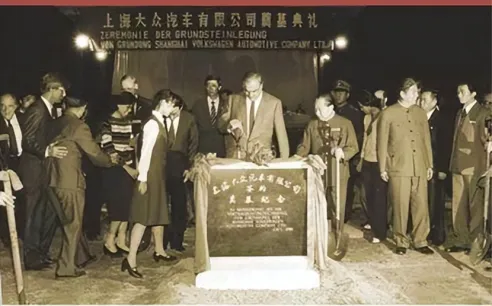
The idea began to take shape around 1978 and was gradually put into practice across major manufacturing industries in the early 1980s. Policymakers at the time did not simply want China to become the “world’s factory.” Across policy documents from that period, “market-for-technology” was consistently presented as serving two goals: expanding production capacity and building technological capabilities.
The first goal, expanding capacity, was tied to the urgent need for import substitution. To be precise, China hoped to quickly increase domestic production by bringing in foreign product drawings, equipment, and management experience, so that Chinese-made products could replace the imported industrial goods flooding into the country after opening up began. This pressure was especially acute in the automobile industry. In 1985 alone, after China opened its automobile import market, the money spent on importing foreign passenger cars exceeded the state’s total investment in the entire domestic automobile industry over the previous three decades. This soon became a serious problem, and the public was unhappy about it. China’s automobile industry therefore had to be mobilised to achieve high-level local production through “market-for-technology” and reduce reliance on the large-scale import of high-end foreign cars.
The second goal was to build China’s own technological capabilities. The senior policymakers who promoted “market-for-technology” all placed great emphasis on technological learning. This included Zhang Jinfu, who oversaw the electronics industry; Rao Bin, who was responsible for the automobile industry; and, at a higher level, Vice Premier Li Peng. For this older generation of policymakers, the purpose of Sino-foreign joint ventures was not to manufacture foreign products forever. It was to learn from cooperation with large multinational corporations, introduce advanced technology and management experience, and ultimately improve China’s own industrial capabilities.
The difficult question was how this path could actually work. Once Chinese state-owned enterprises had multinational corporations as joint-venture partners, how could they carry out meaningful technological innovation within those partnerships? At the time, China did not have a clear answer.
In joint ventures, complex industrial production is always organised and coordinated. The crucial question is who does the organising. For Western multinational corporations, entering China through joint ventures was mainly a way to gain access to the Chinese market, make use of China’s relatively cost-effective labour, resources, and operating environment, and benefit from preferential policies offered by governments at different levels. Helping Chinese firms build technological capabilities—and potentially become future competitors—was not in their interests.
The theory of global production networks makes this point clear. The American-style system of global industrial cooperation is hierarchical: countries and firms higher up the chain use their control over products and technologies to shape the behaviour of those lower down. Global production networks are therefore organised and coordinated by multinational corporations according to their global interests, not according to the innovation needs of developing countries. The goal was to localise production in China while de-organising China’s own technological activities, so that Chinese industry would not develop the organisational capabilities needed for sustained innovation or future competition.
Overall, “market-for-technology” had two major effects on Chinese industry.
The first was a clear improvement in production conditions and management standards. Through joint ventures with multinational corporations, China’s state-owned automobile and telecommunications equipment companies became part of their global production networks. The benefits were not limited to final assemblers. Suppliers also modernised through the same model. The Shanghai Santana project is a good example. In addition to the joint venture between SAIC and Volkswagen, about 130 domestic firms at the beginning—and eventually more than 400 local component suppliers—entered similar cooperative arrangements with foreign companies in different auto-parts categories. Such partnerships brought in foreign drawings, production lines, equipment, operating procedures, and even detailed production-line manuals. During this period, multinational-led global networks provided relatively stable expectations on both the supply and demand sides, allowing many Chinese firms to grow quickly after the 1990s.
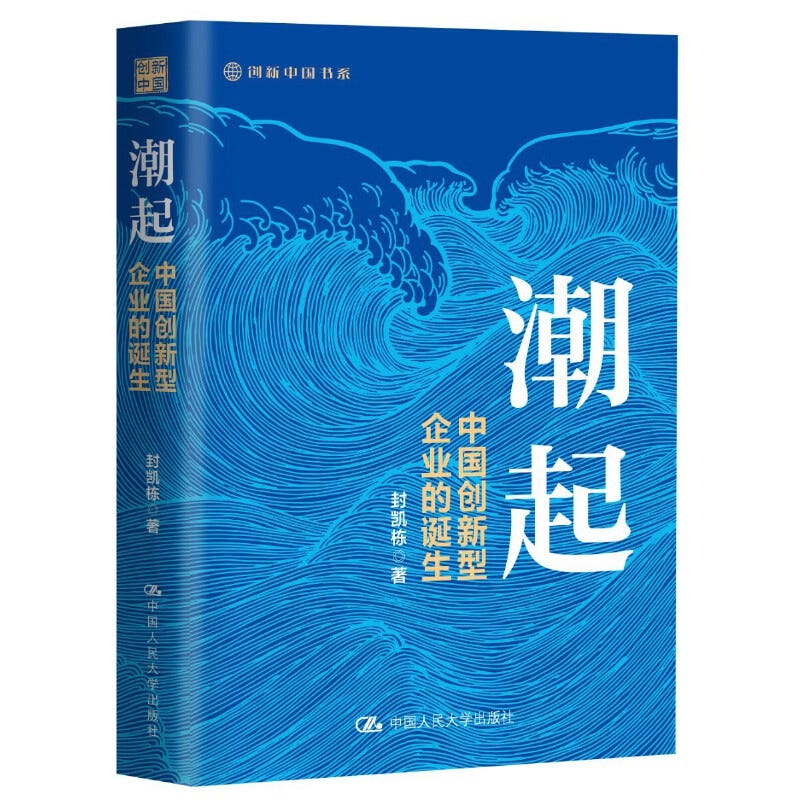
The second effect was the suppression of indigenous innovation. During the joint-venture process, multinational corporations de-organised technological innovation within the ventures to varying degrees. This also influenced the behaviour of many state-owned parent companies. In my book The Rising Tide: The Birth of China’s Innovative Enterprises, I describe in detail how multinational corporations did this. Their methods can be summarised in several ways.
First, they tightly controlled the technological information transferred to joint ventures. Chinese partners often received incomplete drawings. Practices varied from company to company, but Japanese and South Korean firms were usually the most restrictive. In the FAW–Toyota partnership, for example, engineers complained that the drawings they received were “full of holes.” Before the drawings reached Chinese engineers, Japanese engineers literally cut out, with scissors, all parts unrelated to assembly, along with the corresponding technical parameters. Why cut them out? To prevent Chinese firms from reverse engineering. Any information not needed for assembly was removed. Some firms from other countries were somewhat more open, but the difference was only one of degree. In general, if a multinational corporation believed that certain drawings or data were unnecessary for assembly in China, that information would be taken out or erased before the materials were handed over to prevent latecomer firms from learning through reverse engineering.
Second, they dismantled Chinese firms’ development organisations, or separated them from production. The Rising Tide discusses in detail the “Beijing Jeep controversy” around 1985. Beijing Jeep Corporation was China’s first automotive joint venture, and its contract clearly stated that the two sides would jointly establish an R&D centre. Yet after the joint venture was formally set up, the American side repeatedly delayed the project. The centre was not established until the mid-1990s.
What happened when the Chinese side already had an R&D centre or technical team? Foreign partners often introduced various “advanced management concepts” that justified breaking up those teams. I once came across an electronics and electrical instrumentation company in Xi’an. In the 1970s, it had been one of the largest instrumentation companies in East Asia and had a research team of around 300 people. After it entered a joint venture with a Japanese company, those 300 researchers were reassigned under the banner of “strengthening after-sales service” and “strengthening quality control.” They were moved to production lines, after-sales service, and other departments. In the end, fewer than 20 people remained in the company’s technical team, making it difficult to carry out effective and systematic product and technology development.
Another method was to separate R&D organisations from production departments, cutting off the interaction between product design and manufacturing. Dongfeng Motor is a typical example. Dongfeng did establish an automotive research institute, but with the exception of a few small-scale military vehicle and electric vehicle projects, the institute had little direct connection to the company’s main production departments.
An even more telling case is the Pan-Asia Technical Automotive Center (PATAC) in Shanghai. After GM and SAIC formed their joint venture, GM set up PATAC in Shanghai, as required by Chinese policy at the time. PATAC had direct access to GM’s global technology database, yet the contractual arrangements deliberately limited cooperation between PATAC and SAIC’s production departments. As a result, PATAC’s work was largely confined to adapting and localising existing GM models for the joint venture, rather than engaging substantively with SAIC’s own manufacturing operations.
In 2005, when China was strongly promoting “indigenous innovation,” SAIC asked PATAC to design several new models. But the designs it produced still fell far short of what large-scale manufacturing and the Chinese market required. The designers incorporated traditional Chinese cultural symbols such as the jade ruyi and palace lanterns, but paid too little attention to manufacturing economics, engineering practicality, and consumer preferences.
Third, and most importantly, multinational corporations kept control over any revisions to the technical drawings. Although production took place inside joint ventures, Chinese partners usually had only the right to use those drawings; the underlying intellectual property remained with the foreign partner. In product development, once a set of technical drawings is finalised, it must be signed off by the party that owns it. This is what is meant by the “technical approval right”: the authority to approve a given technical solution.
Because the drawings used in joint-venture production were usually owned by the foreign partner, even the smallest technical adjustment could be difficult for the Chinese side to make. Any change had to be reflected in the drawings, and the authority to approve those drawings still lay with the multinational corporation. Chinese engineers could report defects or propose improvements through the management chain, but the review process remained in the foreign partner’s hands. Foreign companies had both strong incentives and reasonable procedures to drag out that process, sometimes for one or even two years. Over time, Chinese engineers learned that multinational corporations would not accept any technical changes by the Chinese side. That was what joint-venture engineers meant when they often said, “We couldn’t even change a single screw.”
A well-known example from the automobile industry was the Santana rear-door hinge noise incident in 1985–1986. During the early assembly of the Santana at SAIC Volkswagen, the rear-door hinges often made an abnormal noise when the doors were opened or closed. Chinese engineers identified the problem, reported it to the German side of the joint venture, and proposed running a series of tests to fix it. The German managers, however, did not respond, leaving the problem unresolved.
In the end, the Chinese side had to raise the issue through diplomatic channels before it was finally settled. At the time, Zhu Rongji was personally overseeing the localisation of Santana production, and State Council leaders were following the project closely. After learning that the hinge problem had still not been solved, China’s premier and vice premier took up the issue directly with the German chancellor and foreign minister during diplomatic meetings, urging the German side to act more quickly. Only under this high-level pressure did Volkswagen send a small engineering team from Volkswagen Brazil. The team ran simple tests, discussed a solution in Brazil, then flew to Shanghai and fixed the problem in a very short time.
What does this incident tell us? First, the technical problem itself was not difficult to solve. Second, Chinese engineers were the first to identify it and were ready to work on a solution. Yet the foreign side was unwilling to let Chinese engineers at Shanghai Volkswagen initiate and lead a technical-improvement project because it resisted the emergence within the joint venture of an organisational mechanism through which local engineers could identify problems, develop technical solutions, form project teams, and accumulate experience over time. Anyone with industrial experience would understand that such practices could gradually help local engineers and local firms build their own capacity for innovation and collaboration. That was not in the foreign partner’s interest.
What, then, did the foreign side hope to see? Barkard Welkener, the German management representative at SAIC Volkswagen, once urged his Chinese colleagues: “You should focus steadily on localising Santana production, while we keep the production drawings unchanged. In that way, by around 2000, we could bring the cost of a Santana down to US$5,000 per car. Then the Santana would become the most competitive car in the world.”
Looking back today, the proposal seems absurd. A car that remains technologically unchanged for years is unlikely to win mainstream consumers, even if its production cost falls to US$5,000 per car. Consumers today would not embrace a car designed nearly 20 years earlier simply because it was cheaper. But the deeper issue was not the product philosophy promoted by the foreign side. More importantly, foreign partners did not want Chinese engineers to launch new model projects or carry out technical improvements, even though such activities were clearly written into the joint-venture contracts.
Fourth, multinational corporations also shaped organisational culture. By emphasising manufacturing localisation over a long period while discouraging technology development, they gradually reshaped the values, incentives, and professional orientation of people inside the organisation.
In the early years of the joint ventures, the Chinese side was under pressure to repay the capital raised for plant construction. It therefore attached great importance to localising production, both to stimulate the domestic economy and to reduce costs and improve profitability. In many joint ventures, complete knock-down (CKD) kits for automobile assembly cost even more than fully built-up (CBU) vehicle imports. As a result, employees working on localisation enjoyed clear advantages in job assignments, pay, and promotion. Once localisation targets had been met, companies shifted their focus to expanding capacity to generate higher returns. At the same time, to stay competitive, the joint ventures had to set aside resources to import new drawings and equipment whenever their foreign partners introduced next-generation products.
Over time, these priorities created entrenched interests, rigid decision-making mechanisms, and relatively fixed organisational values. Pay differences also drew talent away from indigenous R&D. FAW, for example, had the strongest technical and human-capital reserves in China’s automobile industry at the time. But after it entered joint ventures, the gap in pay and career prospects between the joint-venture side and the domestic side became very large. Many technical staff from FAW’s automotive research institute were quickly absorbed into production activities in the joint-venture units.
The de-organising measures used by multinational corporations under “market-for-technology” differed by country. As noted earlier, Japanese and South Korean firms were the strictest in controlling the transfer of technical information to China, while American and German firms were relatively more flexible. Sweden’s Volvo was well regarded for training many technicians at Changan. Citroën also genuinely fulfilled its contractual obligations during its cooperation with Dongfeng by training a team of around 30 to 40 engineers.
Structurally, however, multinational corporations behaved in highly similar ways. They did not welcome any technical modifications to joint-venture products proposed by Chinese engineers. They resisted R&D projects and R&D centres. They sought to separate technology development from production. In this sense, differences in the specific practices of multinationals from different countries mattered little when it came to whether “market for technology” could help China develop indigenous innovation capabilities.
More than 30 young designers whom Citroën had trained for Dongfeng later left and joined Chery’s design team. Why? Because after returning from training in France, they found that there was no real place at Dongfeng Citroën for them to put what they had learned to use. The joint venture had no sustained technology innovation projects and no programmes for developing new models. More broadly, Dongfeng as a group continued to form joint ventures with different multinational automakers. Apart from military orders and experimental electric vehicles, it no longer had a passenger-car division under independent local control. For these young engineers, doing meaningful work meant breaking out of the “market for technology” framework.
Under the “market-for-technology” model, even if some firms wanted to move beyond dependence on joint-venture production and allocate strategic resources to product and technology development, they faced a collective-action problem. As China promoted Sino-foreign joint ventures across industries, nearly all of the best domestic industrial firms were placed into the joint-venture system. Any individual firm trying to break away from that model faced serious systemic difficulties, because few other firms were willing to support it as suppliers. This also helps explain why the later rise of indigenous innovators was so difficult: in their early years, very few domestic firms were willing to supply them.
For all these reasons, Chinese firms under “market-for-technology” gradually became participants in global production systems with little voice. Industrial production expanded, but Sino-foreign joint ventures produced few significant technological or product innovations of their own. Nor did they develop organisational mechanisms for accumulating innovation capabilities. Existing domestic product platforms in the automobile industry were abandoned. The Shanghai sedan disappeared, while the Hongqi brand was placed on the Audi 100 platform.
By 2001, twelve large multinational corporations had established nineteen manufacturing joint ventures in China. Yet only thirteen new models were launched nationwide that year—roughly one new model per multinational corporation. Compared with the pace of innovation in China’s automobile market today, the contrast is striking. In fact, the industry now pays little attention to counting annual model launches, because since 2008–2009, more than 200 new passenger-car models have been launched in the Chinese market each year. The pattern of competition has changed fundamentally.
During the “market-for-technology” era, Chinese firms had not developed the ability to create new products or master complex technologies. They also had little bargaining power with multinational corporations. As a result, foreign automakers could put models developed more than a decade earlier into production in China, and a single model could dominate the Chinese market for many years. This gave rise to the familiar categories of the “Old Trio” [Volkswagen Santana, Volkswagen Jetta, and Citroën Fukang], followed later by the “Middle Trio” [Mazda Familia, Buick Excelle, and Hyundai Elantra] and the “New Trio” [Hyundai Elantra Yuedong, Toyota Corolla, and Volkswagen Lavida].
After 20 years of “market for technology,” China’s domestic product-development capabilities had not improved. On the contrary, they had declined. Many homegrown product platforms had been abandoned, and public dissatisfaction was growing. Beginning in 1998, a number of far-sighted automotive journalists began to question this model and steer public debate. At the time, however, indigenous innovators had not yet entered the mainstream public imagination, and no alternative explanation had yet taken hold for what had gone wrong with “market for technology.” Even some ministerial-level officials began to have doubts.
The establishment of the Beijing Hyundai joint venture in 2002 had a clear impact on China’s automobile industry. South Korea had entered the automobile industry later than China, yet Korean automakers were now being brought into China as representatives of an advanced modern automotive industry. Many people in the industry, especially senior engineers, began to reflect on the problems in China’s own development path.
At the time, Beijing Hyundai was rumoured to have found a way around restrictions on CBU vehicle imports. According to these accounts, fully assembled Hyundai cars were taken apart at the port in Tianjin — with the wheels removed, for example — and then shipped back to Beijing for reassembly, allowing them to be classified as Semi Knocked Down (SKD) assembly under Chinese rules. These stories had a powerful social impact. As public debate intensified, the crisis of the “market for technology” approach gradually came into view.
To summarise: innovation requires participants to interact deeply with one another around specific technical needs in a particular time and place. Innovation is fundamentally an interactive process. From this perspective, Chinese enterprises under “market-for-technology” were very similar to enterprises under the planned economy: neither had sufficient strategic autonomy. Objectively speaking, they could not independently decide what activities to allocate resources to, or how to carry out organisational mobilisation.
The only difference was that China appeared to have entered a market economy. From an innovation standpoint, however, this was not really the case. These firms lacked sufficient strategic autonomy to decide what to produce, which technologies to develop, which products to launch, which products they would rely on for competitiveness over the next five, ten, or twenty years, which partners to work with, where to obtain technical information, from whom to buy equipment, which partners to engage for key component development, and which partners to turn to for critical technical services. As a result, local firms did not control the interactive activities required for innovation.
III. Indigenous Innovation: Reclaiming Organisational Control over Innovation
The reform and opening-up policies launched in the late 1970s and early 1980s, together with a series of institutional adjustments, also created crucial conditions for the later rise of indigenous innovation. First, the central government required national defence to “国防服从服务于国家经济建设大局 obey and serve the overall needs of national economic development.” The subsequent demobilisation of one million military personnel forced many affected defence enterprises and institutions in the 1980s to become some of the first actors to challenge, and gradually change, the “market for technology” system.
Funding and orders were cut first for military research units and later for defence manufacturers. These organisations had to develop civilian products to survive. The central government also introduced supporting policies.
Today’s strong electronics supply-chain capacity in the Pearl River Delta, for example, can be traced back to this military-to-civilian transition. The Ministry of Electronics Industry, which retained certain defence-industry characteristics, was among the first to set up a company in Shenzhen: Sedind. Sanda later became part of Shenzhen Electronics Group (SEG), and SEG in turn helped lay the foundations for what is now Huaqiangbei.
Many Hong Kong-funded companies also began moving into the mainland. Some state-owned enterprises went to Hong Kong under the policy of “外引内联 bringing in external resources and linking them with domestic production.” They imported standardised electronic components and low-end parts from overseas, then used them to assemble electronic products in China. In their early years, ZTE and Huawei assembled small radios and electric fans. Later, with guidance from Hong Kong businesses — including some “window companies” set up in Hong Kong by mainland entities — they gradually moved into assembling telephone switches using microcontrollers.
Broader institutional reforms also created increasingly favourable conditions. Even the practice of “market for technology” was rapidly undermining the industrial administrative system inherited from the planned economy. From the mid-1990s onward, China’s industrial ministries were gradually restructured. They were first folded into the State Economic and Trade Commission. Later, as the commission itself was reorganised, most of these ministries disappeared, or were turned into public institutions or state-owned enterprises. These sweeping reforms loosened the state’s control over industry.
The automobile industry provides a useful example. In the past, China strictly regulated which enterprises were allowed to produce passenger cars. In 1988, Guangxi Liuzhou Mini Vehicle Factory quietly tried to cooperate with a French company to bring in an old production line. In principle, this was in line with the broader wave of Sino-foreign joint ventures and cooperative enterprises. Yet it still did not fit the regulatory framework of the time. When the ministries met to discuss how to handle the case, industrial regulators even requested transferring the production line directly to Dongfeng. This shows just how strict regulation was at the time.
After 1994, however, as the former industrial ministries were gradually transformed into state bureaus under the State Economic and Trade Commission, planned-economy controls in various industries began to weaken. When Chery and Geely entered the automobile industry in 1996 and 1997, they generated considerable debate, but the reaction was not as intense as in the earlier Liuzhou case.
Second, reform and opening up allowed indigenous innovation to benefit from changes in the international industrial environment. From the first oil crisis in 1973 through the 1990s, capitalist countries engaged in long and intense competition in manufacturing. The automobile industry is a representative example. Countries invested heavily in what was effectively a global automotive “world war.” After the fierce competition of the 1990s, many giant enterprises could no longer sustain their enormous organisational structures. Some production lines lay idle, and vertically integrated companies began to break apart. Specialised technical companies were spun off from large corporations so that they could survive by serving external markets. Meanwhile, professional design firms, engineering firms, and equipment suppliers that had once served those giants also had to look for new markets outside their original camps.
In this process, it was not only multinational corporations that became eager to enter emerging markets such as China. A large number of experienced personnel also flowed out of those corporations. This is why indigenous Chinese firms were often able to recruit senior engineers from Germany, Japan, and South Korea to provide shop-floor management services. More importantly, the emergence of a large pool of available external resources created favourable conditions for the rise of indigenous innovators.
The pioneer in telecommunications equipment was Great Dragon Telecommunications. Great Dragon grew out of a team led by Wu Jiangxing at the PLA Information Engineering Institute in Zhengzhou. Wu later became both an academician and a general. His team had originally developed large-scale computers for the defence sector, and later applied mainframe computer technology to digital telephone switches. In 1989, when the team first applied to the Ministry of Posts and Telecommunications for network access approval, the ministry rejected the application, arguing that the HJD-04 was a computer, not a digital telephone switch. Because the HJD-04 was a classic case of military-to-civilian technology transfer, senior leaders Yang Shangkun and Jiang Zemin later intervened and asked the ministry to give it another chance. In 1991, the ministry organised a second review, and the HJD-04 finally passed evaluation.
The success of Great Dragon’s HJD-04 was highly significant for China’s telecommunications equipment industry. First, it overturned the pessimistic belief that Chinese engineers could not develop large-scale digital switching systems with more than 10,000 lines. More importantly, it provided a technical model for local innovative firms seeking to develop complex products.
Beginning in the 1970s, digital telephone switching increasingly came to depend on semiconductor integrated circuits and electronic control technologies, often using highly integrated chips. This made imported switches very difficult to reverse engineer, because their core control logic was embedded in those chips. Before developing the HJD-04, Wu Jiangxing had spent two years in Shenzhen trading computer equipment and had become familiar with the second-hand electronic-components market around Chung Ying Street. In the early development of the HJD-04, he therefore used general-purpose chips available on the market and drew on programme-control knowledge from the mainframe computer field to build the system architecture.
As it turned out, this approach was in line with the global direction of digital switching technology at the time. At the frontier of global switching architecture, systems such as the Bell S1240 large-scale digital switch — which China introduced through Shanghai Bell — used a distributed-control architecture. Wu’s team adopted a distributed architecture not because they had access to highly integrated chips, but precisely because they did not. China had no domestic supply of such chips. The team therefore had to use multiple simpler chips and build the switch through a distributed architecture.
This greatly helped Chinese peers understand the core technology behind digital telephone switches. Imported Western switches used highly integrated chips; even those with distributed architectures were packaged around such chips. As a result, Chinese firms could not easily grasp their technical architecture through reverse engineering. HJD-04, however, was built with Motorola general-purpose chips and second-hand chips, which made the architecture far more visible. In a sense, the HJD-04 unpacked the technical architecture of the world’s advanced large-scale digital switching systems. It allowed the essential know-how of “programme control” to spread quickly and made it possible for indigenous firms to enter the field.
In the automobile industry, the pioneer of indigenous innovation was Hafei Automobile. Its parent company, Harbin Aircraft Industry Group, was a helicopter manufacturer. In the early 1980s, as military orders declined, the company had to find a way to sustain itself. Hafei Group therefore had to transfer 3,000 people — beginning with just over 20 — into automobile manufacturing, so that the new business could in turn support the tens of thousands of employees it still had in the aircraft industry. The industrial management system at the time also left a narrow opening for defence enterprises, allowing several state-owned enterprises in the weapons and aviation sectors to share two automobile production qualifications.
As Hafei developed cars, it began cooperating with international technical companies. Its partner was the famous Italian design firm Pininfarina. Pininfarina had long designed exteriors for top sports-car brands such as Ferrari and Maserati, while also providing design services to mass-market companies such as Peugeot. But because of the dramatic changes in the global automobile industry, Pininfarina too had to seek business opportunities in emerging markets, including China. It approached Hafei. At first, the two sides discussed having Pininfarina design the exterior of a new van for Hafei. Later, Pininfarina gradually helped Hafei master a great deal of process knowledge in modern automotive engineering development.
Pininfarina sought to work with Hafei mainly because, thanks to its aircraft-manufacturing background, Hafei had computer-aided design capabilities that were rare in China’s automobile industry at the time. At the same time, Hafei was not on the radar of the large multinational automakers looking to form joint ventures in China.
Hafei succeeded in mastering technical knowledge through its cooperation with Pininfarina because it gave real authority over the project to the Chinese team it had stationed abroad. Decisions such as whether to continue the cooperation and whether to insist that Pininfarina fulfil its contractual obligations were entrusted to that team. For Hafei, these projects consumed almost all the funds the company had available for development. They could not afford to fail. Once fully empowered, the Chinese team, as the client, held organisational leadership in the cooperation. On the basis of the contract, it required the foreign side to open up the product-development process, explain why particular design choices had been made, and clarify any parts of the process that the Chinese side did not understand.
From the perspective of the organisational nature of innovation, the Chinese team had gained access to the innovation process itself, and could require the foreign side to engage with it as needed in response to problems encountered and new information received during development. Through this process, the Chinese side gradually built a systematic understanding of product development. This kind of learning mechanism did not exist in the “market-for-technology” joint ventures of the time.
From a sociological perspective, “indigenous innovation” can be understood as a countermovement against “market-for-technology.” The “market-for-technology” model could operate only within a deeply unequal structure. To make joint ventures attractive to multinational corporations, the Chinese side usually had to put forward its best state-owned enterprises — or strong state-owned enterprises after their “bad assets” had been stripped away — together with preferential policies and direct government investment. This distorted how resources were priced and allocated, and inevitably left many peripheral firms outside the joint-venture system.
The essence of this countermovement was that engineers who had been marginalised within the existing economic system, or who opposed the “market-for-technology” model, began to step forward and challenge the mainstream path. They did so either to create room for their own survival or to defend the industrial values they believed in. Their initial approach was simple and direct: bring together large numbers of people from the planned-economy system and from “market-for-technology” enterprises, and build a new organisational structure through which product and technology development could take place. In other words, the human resources were already there within China’s industrial economy; what changed was the way they were organised.
Chery offers a telling example. Many of its early engineers came from FAW. Even the street address of Chery’s headquarters in Wuhu — No. 8 Changchun Road — carried a quiet but powerful message. [Changchun was the home of FAW, the symbolic birthplace of China’s modern automobile industry.] For several generations of FAW engineers, from those in their thirties to those in their seventies, including Yin Tongyue, founder and chairman of Chery, the address almost read like a statement of intent: China’s passenger-car industry should not remain dependent on multinational technology.
Li Shufu, the founder and chairman of Geely, followed a similar path. He recruited experts from FAW, Dongfeng, and Nanjing Automobile — later acquired by SAIC — to serve as technical leaders at his company. The engineer in charge of Geely’s transmission development, for example, had once been the director of Tianjin Gear Factory. After Tianjin Automobile was absorbed by FAW and entered a joint venture with Toyota, experienced engineers like him found that they no longer had a real place to put their skills to use. Refusing to accept an idle post, the former gear-factory director went directly to Geely to work on transmission R&D.
As The Tide Rises recounts in detail, FAW engineers had once developed a small car on their own initiative called the “Sankoule” [literally, “happiness for a family of three.”] Yet instead of being encouraged, the engineers nearly faced internal punishment. After retirement, several core engineers who had taken part in the Sankoule project soon went to Geely, where they continued to pursue the same commitment to indigenous product development.
Huawei and ZTE were even more effective in integrating personnel from state-owned enterprises and research institutes under the Ministry of Posts and Telecommunications and the Ministry of Electronics Industry, and later, after 1998, from Sino-foreign joint ventures. This is discussed in detail in The Rising Tide. I call this transformation “a repricing of China’s human resources.”
Under the “market for technology” framework, Chinese engineers were often confined to production, quality management, and after-sales service. With the rise of indigenous innovation firms, they were drawn back into production-related R&D, technology development, and product development. Their role was redefined. China’s demographic dividend began to turn into an engineering dividend.
Scholars of multinational corporations have also found that, overall, the turning point for multinational companies to set up R&D centres in China was around 2005. This was clearly influenced by the rise of Chinese indigenous innovation firms and by the shift in national development strategy.
The organisational strategies of indigenous innovation firms were, in fact, highly open. This stood in sharp contrast to many of the claims circulating in the “marketplace of ideas” at the time. During the major debate over indigenous innovation in 2004–2005, critics often described it as “closed innovation,” “building cars behind closed doors,” or even “a retreat from reform and opening up.” These claims were badly out of step with reality. Seen from the perspective of innovation as an organisational process, indigenous innovation firms were far more open than enterprises operating under the “market-for-technology” model.
The core difference between indigenous innovation firms and “market-for-technology” firms lies in who controls the organisation of technological activity. Under “market-for-technology,” that control rested with multinational corporations, and Chinese firms were merely part of their systems. What kinds of interaction took place, with whom, and what information was exchanged were all determined by that system. Indigenous innovation firms were the opposite. Even if their initial products were crude, local firms themselves decided the purpose of interaction, what to interact over, whom to work with, what equipment to use, and what technical adjustments to make. This is the greatest difference between indigenous innovation and “market-for-technology.”
Indigenous innovation firms adopted a “小步快跑 small steps, fast iteration” strategy of organisational learning. They built technical capabilities through repeated development practice. Product and technology development were not only the goal but also the means of competition. A small survey of Chery engineers in 2004 found that young engineers were being assigned to different projects through a matrix structure. At the time, a single engineer could be responsible for as many as twelve development projects. This combination of hands-on training and real responsibility allowed even recent graduates to grow quickly on the job.
In this process, firms were investing not only in product development and complex technologies, but also in the growth of their own people. A new organisational model cannot be created through slogans or textbook prescriptions. It requires firms to commit substantial strategic resources to new technology and product-development projects. Through practice, they mobilise and integrate the organisational and technical capabilities of their people. Through interaction across departments and between firms, these capabilities are then coordinated and rewoven into an organic network that serves local technology and product development.
This process also brought about a political transformation. In my book, I call these firms “engineer-led enterprises.” In their early years, indigenous innovation firms did not enjoy preferential government policies. They were also weak in resources and market influence, which made them unattractive as joint-venture partners for multinational corporations. These firms had to grow by relying on their own engineers. As a result, they delegated decision-making power over resources in technical cooperation and technology development to frontline development teams. These teams could mobilise resources, adjust cooperation mechanisms, and push technological development forward according to the needs of a complex and constantly changing innovation process.
Ren Zhengfei captured this feature well in a 2011 internal speech at Huawei, when he said: “Let those who hear the gunfire direct the battle.” The idea was that engineers and frontline engineering teams, because they were the ones facing problems on the ground, solving them, and coordinating with partners, should have the authority to decide where product-related resources were used and what adjustments needed to be made.
In 2014, Huawei launched a pilot reform at its Guangzhou branch, cutting the number of matters that had to be reported to Shenzhen headquarters from more than 200 to just over 40. The aim was to give frontline engineers and engineering development teams greater autonomy in decision-making.
This shows that, compared with “market-for-technology” enterprises, the rise of indigenous innovation firms was not simply a matter of business strategy or resource input.
A number of counterexamples in the indigenous innovation process make this even clearer. My book discusses the case of Brilliance Auto under the leadership of a financier. As Chery, Geely, and other firms rose, Brilliance also decided to follow the example of indigenous innovation firms and develop its own passenger cars. But its financiers misunderstood what mattered most. They believed that indigenous innovation was primarily about resources: spending heavily to work with top foreign technical firms and buying first-class development and production equipment, etc.
In developing the M1 model, Brilliance outsourced work to more than 40 foreign technical firms. But in these external cooperation projects, it did not place the whole process under the control of its own engineering teams. As a result, the interactions required for innovation during development were not organised by the company’s internal engineering force, but effectively handed over to international technical contractors. The M1 project ultimately cost RMB 4 billion, yet the first vehicles that came off the line still had basic engineering defects, including steering problems that caused the car to drift.
This example fully shows that the core of indigenous innovation is organisational and political. The key question is how a firm reconstructs organisation within industrial and technological activity, and who controls the organisational process of innovation.
IV. Why a New Whole-of-the-Nation Approach Is Needed to Address Major Innovation Challenges
The policy turn towards indigenous innovation in 2004–2005 was another crisis-driven structural transformation. Yet, looking back at the major changes in China–U.S. relations after 2017, that transformation remained incomplete. At the time, innovation was still understood mainly at the micro and meso levels of firms and industries. There was not yet a fully systemic understanding of innovation, and this limitation appeared in several ways.
One was the intense debate over who should carry out innovation. In 2005, within the drafting group for the National Medium- and Long-Term Program for Science and Technology Development, there was fierce debate over who should be the principal actor in innovation. Many participants still believed that research institutes should play that role. Only after intense discussion were enterprises established as the main actors of innovation.
Even so, indigenous innovation was still understood largely as a matter of corporate or industrial strategy. In 2007–2008, the State-owned Assets Supervision and Administration Commission (SASAC) revised the performance-evaluation criteria for the heads of state-owned enterprises, reflecting the belief that innovation was mainly a question of corporate management. But this understanding remained incomplete. Seen from the post-2017 changes in China–U.S. relations, China’s industrial system — or, more broadly, its innovation system — had not yet undergone a systemic transformation. Many firms were still embedded in global production networks led by multinational corporations. They followed other countries’ technology roadmaps and industrial agendas, and relied on foreign components and technical services to develop their own products.
This is why indigenous innovation firms were often pushed toward vertical integration. In their early years, lacking support from local industrial and innovation chains, they often had to invest internally to build small innovation ecosystems of their own.
In the automobile industry, firms such as Geely and Chery directly invested in forty to fifty core component companies. Around them, networks of two to three hundred key suppliers gradually took shape. Chery even acquired Wuhu Shipyard because it could not find domestic shipbuilders willing to provide the roll-on/roll-off vessels needed to carry complete vehicles overseas. The reason was simple: Chery was one of China’s pioneers in automobile exports, domestic shipbuilders had no prior experience in this business, and the future of China’s indigenous automakers remained uncertain. They were unwilling to commit strategic resources to innovation-related interaction with local carmakers. Indigenous automakers therefore had to do it themselves. They had to develop and build roll-on/roll-off ships on their own. In this way, Wuhu Shipyard was also drawn onto a path of innovation. A recent news report noted that China’s first offshore fracturing vessel had been launched, breaking a foreign monopoly. It was built by Wuhu Shipyard.
Chery’s efforts were not limited to shipbuilding. They also extended to robots, forklifts, sensors, and a range of other technologies and products. BYD followed a similar path, pursuing full-stack in-house development across nonferrous metals, batteries, complete vehicles, and many components and systems. As these firms tried to disembed themselves from global production networks, they found that other domestic firms could not yet provide the support they needed. Nor could they rely on market coordination alone to create the patterns of interaction required for indigenous innovation. They therefore had to use the “visible hand” inside the firm to build small innovation ecosystems and secure their own survival and development.
Huawei followed a similar path. It has made power supplies, optical cables, submarine cables, and more. Today it also supplies inverters to the photovoltaic industry and LiDAR systems to the new-energy vehicle industry.
How did Huawei’s solar inverter business emerge? In extremely cold regions, base stations could face nighttime temperatures of minus 40 degrees Celsius, which meant they had to be heated. One way to do this was to install solar panels and use inverters to supply power for heating the base stations. At the time, no domestic company was willing to provide this supporting service, so Huawei had to develop the solar and inverter technologies itself. Today, Huawei has become one of China’s largest inverter suppliers and is even capable of operating large-scale solar-energy projects.
This history helps explain why China began to emphasize the new whole-of-the-nation approach in 2019, when it faced another major shift in the external environment — and another crisis. U.S. “decoupling” and supply-chain disruption, as well as Europe’s “de-risking,” are in essence similar to what multinational corporations had done in China in the 1980s and 1990s. What they share is an attempt to disrupt the autonomous innovation process of Chinese firms by constraining the patterns of interaction on which innovation in developing countries depends.
At the time, many Chinese firms remained tied to global industrial and innovation chains led by multinational corporations, and still lacked organisational leadership over innovation. This was the crisis that prompted the CPC Central Committee’s policy response. The new whole-of-the-nation approach is not merely about breaking through certain key “chokepoint” technologies; more fundamentally, it is about regaining leadership over the organisational mechanisms that coordinate innovation-related interaction among firms.
In practice, the new whole-of-the-nation approach works by using large-scale projects to accumulate experience and draw domestic actors into collaboration: firms with other firms, firms with research institutes, suppliers with one another, and firms across different industries. This cooperation itself becomes a public good. It allows local industrial firms to build the full set of capabilities needed to define problems, analyse them, break them down into tasks, divide those tasks among different actors, and then integrate the results.
The new whole-of-the-nation approach can therefore be understood as an effort, under new circumstances, to use state intervention to build the organisational mechanisms required for systemic innovation. There is a joke often told about China’s semiconductor industry: before the United States began suppressing the sector in 2017, Semiconductor Manufacturing International Corp (SMIC) had little interest in serving China’s domestic electronics companies. SMIC was already one of the world’s top five semiconductor foundries, and its ambition was to serve high-end customers in the global market. Huawei, for its part, would not have sent its orders to SMIC before 2019 either. Its competitor was Apple, so it naturally turned to the world’s leading foundry, TSMC, to manufacture its chips. In other words, even outstanding Chinese companies such as Shanghai Micro Electronics Equipment (SMEE), SMIC, and Huawei had not yet formed deep innovation linkages with one another at home.
After Trump came to power, he taught China a lesson: these companies had to become connected. Once those connections are formed, they can begin to develop into a shared community capable of solving problems together. Each side learns where the other is, what they can do, and what they need.
Of course, China’s domestic industrial chains are still far from complete. After I began speaking publicly about the new whole-of-the-nation approach, people in industry would often tell me that they had come across yet another company, somewhere in China, that supplied motion stages for Japanese lithography machines — the most critical mechanical components in the system. Yet such a company had never received government support. Even the company itself may not have known where it stood in Japan’s lithography production system, while the government and large domestic enterprises knew even less about what it was doing.
In other words, China’s domestic community of innovation interaction remains weak. The ties within this industrial community — between firms, and between industries — still need to be strengthened through the new whole-of-the-nation approach. There are useful precedents for this in the history of the U.S. semiconductor industry.
China, too, built many of the institutions that were later criticised through earlier versions of the whole-of-the-nation approach, even during the planned-economy period. The Chinese Academy of Sciences is one example. Before the “Two Bombs, One Satellite” programme, it had only a limited number of institutes. Afterwards, a much wider range of departments and institutes was established.
The industrial ministry system of the planned-economy period was also developed and strengthened through a series of national campaigns after the Sino-Soviet split in the late 1950s. The Ministry of Machine Building Industry, for instance, was strengthened through the state-led “Nine Major Equipment” programme of the early 1960s, which developed nine sets of large-scale industrial equipment under the leadership of figures such as then Vice Minister Shen Hong. In essence, earlier large-scale engineering and technology programmes created domestic actors and connected them. China needs to do something similar in the new era. The tasks are different, but the underlying logic is much the same.
This is how I understand the major structural transformations in China’s industrial development. Innovation requires enterprises to develop organisational mechanisms of their own. They must build systems capable of providing resources, mobilising people, and integrating capabilities for the kinds of interaction that innovation requires.
As these structural transformations unfolded, policymakers, business leaders, and strategists in developing countries were all learning as they moved forward. Their understanding was always limited by the historical moment in which they lived. They operated within the practices of production and everyday life, and also within the “marketplace of ideas” of their time. Today, new understandings have emerged, making it possible to see the limitations of earlier stages. Yet every period has its own cognitive boundaries, and the realities and contradictions people face are always changing. Twenty years from now, the next generation of students may well look back at today’s ideas, find them incomplete, and perhaps even criticise them.
For this reason, building an indigenous knowledge system in China requires two things at once. On the one hand, China must absorb the best ideas from around the world. On the other, it must remain firmly grounded in its own development experience — in its own efforts to understand problems and solve them.
There will inevitably be detours along the way. In China’s effort to integrate into globalisation, “market-for-technology” helped upgrade products, raise manufacturing standards, and strengthen manufacturing capabilities. But when it came to innovation in complex products and technologies, it could not provide a real driving force.
At the same time, however, “market-for-technology” and China’s market-oriented reforms created a series of favourable conditions for the rise of indigenous innovation. The wave of indigenous innovation that began around 2005 enabled a small number of firms to emerge. But after 2017, and especially after 2019, the challenge China faced was no longer the rise of a few individual firms. It was the transformation of the entire system.
A systemic transformation of this kind can only be initiated through government intervention — that is, through non-market forces that compel actors to connect with one another. Through a series of projects, these actors can complete the interactions and organisational arrangements needed for local innovation. Once such a mechanism has taken shape, the hand of government can withdraw. The mechanism can then reproduce itself, develop the ability to define and analyse problems, and ultimately pursue its own agenda.
Only at that point can a real environment for market competition emerge: one in which firms compete more fully with one another, research institutes and enterprises both cooperate and compete, and innovation is organised through a mature ecosystem of interaction.

The book "Apple in China" claims that the Apple approach to production in China meant that more technological knowledge was transferred than with the traditional model. It also claims that Tesla later took a similar approach.
The article ignores those claims.
is there an english version of Prof. Feng's book?