

In late February, the White House said President Donald Trump would visit China from March 31 to April 2. China has neither confirmed nor denied the trip publicly, and it typically confirms a foreign leader’s visit only a few days before it takes place.
After the U.S. and Israel struck Iran, speculation has grown that the war could derail what would be the world’s most consequential leaders’ summit. So far, however, this remains speculation: no credible media outlet has cited sources to confirm any change to the schedule.
In Beijing, the National People’s Congress (NPC) and the Chinese People’s Political Consultative Conference (CPPCC) are having their annual week-long session, known as “Two Sessions” in China.
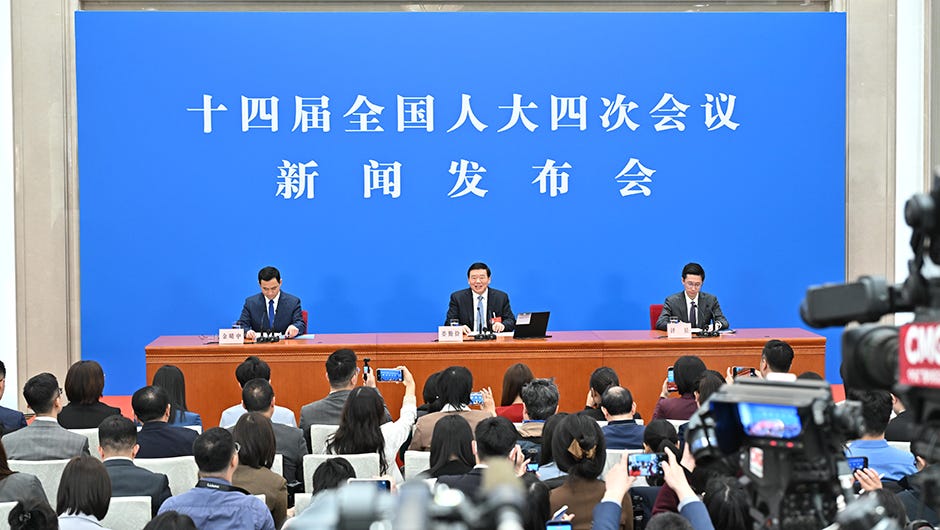
On Wednesday, Bloomberg raised the question of Trump’s visit in a nationally televised press conference with Lou Qinjian, the spokesperson for the NPC session
Bloomberg reporter:
Given the developments in Iran and President Trump’s expected visit to China in the near future, how do you see the trajectory of China–U.S. relations? Especially considering that more leaders’ meetings are expected to be arranged later this year.
Lou Qinjian:
Thank you for the question. China has consistently maintained that, as the world’s two major powers, China and the United States should respect each other, coexist in peace, and pursue cooperation for mutual benefit and win-win outcomes. President Xi Jinping has pointed out that the two countries should be partners and friends—this is both a lesson of history and a necessity of reality; and that China and the United States “can succeed together and prosper together” is a tangible, visible reality.
Head-of-state diplomacy plays an irreplaceable strategic guiding role in China–U.S. relations. Since last year, President Xi has maintained regular communication with President Trump, helping to keep the giant ship of China–U.S. relations on a steady course by setting its direction and injecting momentum. Overall, bilateral relations have remained stable and continued to improve, a trend widely welcomed by both countries and the international community. Facts have shown that cooperation benefits both sides, while confrontation harms both. As long as both sides fully implement the important consensus reached by the two heads of state, uphold the principles of equality, respect, and reciprocity, expand the list of areas of cooperation while narrowing the list of problems, the two countries can promote the steady forward development of bilateral relations.
China stands ready to work with the United States to strengthen communication through various channels and at all levels, and to open up broader space for cooperation. At the same time, China has its own principles and red lines, and will, as always, resolutely safeguard its sovereignty, security, and development interests.
Last year, the National People’s Congress invited a delegation of U.S. House members to visit China, maintained dialogue with U.S. senators, and sent a youth delegation from the NPC to visit the United States. A common sentiment among U.S. legislators was that it is better to meet than not to meet, and better to talk than not to talk. The National People’s Congress is willing to maintain contact and exchanges with the U.S. Congress, and to contribute—from the perspective of legislative bodies—to the stable and sound development of China–U.S. relations. We hope the U.S. Congress will view China and China’s development objectively and rationally, and do more things conducive to China–U.S. relations and friendship between the two peoples. Thank you.
As you have read, the spokesperson even volunteered more exchanges between the National People’s Congress and the U.S. Congress.
Xie Feng, the Chinese Ambassador to the U.S., was asked on Wednesday, March 5 during the “Two Sessions” about whether the U.S. and Israeli attack on Iran would affect Trump’s visit to China
Phoenix TV
Some media reports say the situation in the Middle East is affecting high-level interactions between China and the United States. Can you confirm this?
Xie Feng
On China-U.S. relations, history has repeatedly proved that cooperation benefits both sides, while confrontation harms both. China has its own principles and red lines that we must uphold. We will continue to firmly safeguard our sovereignty, security, and development interests. At the same time, we hope the U.S. side will work in the same direction with China—taking concrete actions to implement the important common understandings reached by the two heads of state, and, on the basis of the three principles advocated by President Xi—mutual respect, peaceful coexistence, and win-win cooperation—promote the steady, healthy, and sustainable development of China-U.S. relations. This will not only benefit the peoples of our two countries, but also greatly advance peace, stability, and development in the world. Overall, the road may be winding, but the future is bright.
The South China Morning Post ran this scoop earlier this week: US, China discuss investment revival ahead of Trump’s trip: sources
Beijing and Washington have begun discussing ways to revive reciprocal investment – a move that could be one of the few deliverables during an upcoming China visit by US President Donald Trump, according to multiple sources.
The investment issue was touched upon as working-level officials prepared for Trump’s trip, which is scheduled to take place between March 31 and April 2. However, the potential scope and structure of such investments remain undefined, sources said.
That came after the Bloomberg scoop on March 3: US, China Trade Chiefs to Meet Mid-March Before Trump-Xi Summit
US and Chinese trade negotiators are slated to meet in mid-March, according to people familiar with the matter, signaling a planned summit between Donald Trump and Xi Jinping is pushing ahead despite American strikes against Iran.
US Treasury Secretary Scott Bessent, US Trade Representative Jamieson Greer and China’s Vice Premier He Lifeng are expected to convene in Paris at the end of next week to discuss business deals that could stem from the leaders’ meeting, said the people who requested anonymity to discuss plans that aren’t yet public. Both the timing and location of the meeting could still shift, the people added.
The Trump administration has delayed announcing a package of arms sales to Taiwan valued at billions of dollars to avoid upsetting Xi Jinping, China’s leader, ahead of President Trump’s planned trip to Beijing in April, The New York Times reported on Feb 27.

China, U.S. to meet for another round of trade talks soon?
Chinese President Xi Jinping and U.S. President Donald J. Trump just concluded a phone call.

Hi Mr Wang