


Beijing has long framed its fight against inequality in a vocabulary of its own, built around a three-stage taxonomy of income allocation: primary distribution, meaning wages and returns to capital; secondary distribution, where the tax and welfare systems reallocate income via social security, public services, and transfer payments; and a third, “tertiary” distribution, in which philanthropy and voluntary contributions are expected to channel private wealth back to society. As the report to the 20th National Congress of the Communist Party of China (CPC) puts it, this triptych system is “the foundational system for promoting common prosperity.”
In the latest issue (No. 23, 2025) of Qiushi (Seeking Truth), the Communist party’s flagship theoretical fortnightly, Cai Fang, formerly Vice President - meaning Vice Minister - of the Chinese Academy of Social Sciences (CASS) sets out what amounts to the Party’s latest official thinking on how this three-step machinery should be used to close China’s stubborn income gaps. Cai also holds the title Academician 学部委员 of CASS, reserved only for the highest echelon of its scholars.
Cai acknowledges that China’s income distribution remains under strain and argues that policymakers should treat measurable progress on key indicators such as the Gini coefficient as explicit policy targets and levers in policy action. In practical terms, that means tougher labour protections and stronger wage-setting institutions to lift the labour share; more active use of tax, social security, and the wider social safety net to trim the Gini; and a mix of encouragement and tighter regulation for philanthropy and other “tertiary distribution” channels to foster “a social ethos oriented toward the public good”—so that, in Deng Xiaoping’s famous formulation, those who get rich first can inspire and help others to become rich later, advancing common prosperity for all.
In our observation, in recent years, Cai has sounded the biggest alarm on AI’s employment impact in China, and he was able to include some of those comments in the following piece.
—Yuxuan Jia
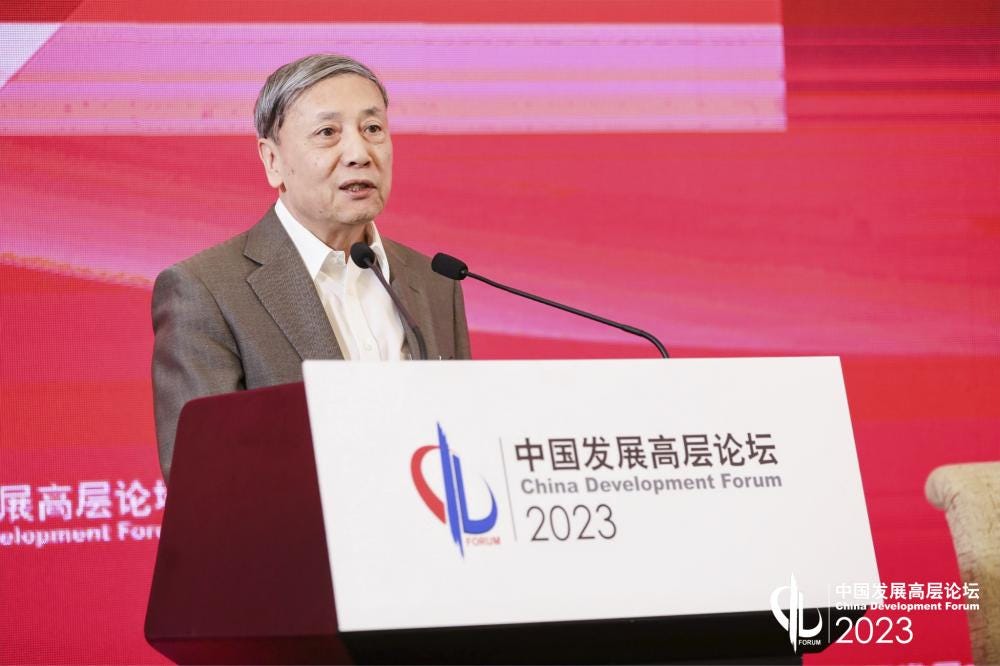
Cai’s article was published on 1 December. It’s available on Qiushi’s official website and official WeChat blog.
以制度建设优化收入分配结构
Optimising Income Distribution through Institutional Development
Income distribution is central to safeguarding and improving people’s well-being. It connects employment expansion and wage growth in primary distribution, social security and the provision of basic public services in redistribution, and public interest activities and charities in tertiary distribution. Together, these elements form an institutional pillar for promoting common prosperity.
The Report to the 20th National Congress of the Communist Party of China (CPC) stresses the need to “keep distribution according to work as the mainstay with multiple forms of distribution existing alongside it” and “build an institutional framework under which primary, secondary, and tertiary distribution are well coordinated and mutually complementary.”
Building on this, the Fourth Plenary Session of the 20th CPC Central Committee further specified tasks for improving the income distribution system: “put into effect an income growth plan for both urban and rural residents, effectively increase the earnings of low-income people, steadily enlarge the middle-income group, make reasonable adjustments to excessive incomes, and eliminate illicit gains, all with the aim of facilitating the formation of an oval-shaped structure of distribution.” This important policy directive charts a clear course for improving the income distribution system. It is of great significance for promoting the new development philosophy of shared benefits, making steady progress toward common prosperity, and ensuring that the fruits of modernisation are shared more broadly and equitably by all.
1. Current Income Distribution and Breakthrough Objectives
China’s income distribution has shifted from widening disparities to gradual narrowing, in line with turning points in its stage of economic development. On the whole, the 2000s were marked by widening income gaps. Indicators of urban–rural disparity, such as the urban–rural income ratio and the Gini coefficient measuring overall income inequality, climbed to peak levels before 2010. At the same time, indicators of national income distribution, such as the share of labour compensation in primary distribution and the share of household income in national income, fell to historically low levels.
This phase coincided with China’s period of high-speed growth, when rising wages, higher household incomes, and improved overall living standards were driven mainly by the effect of “expanding the pie.” The accompanying increase in income inequality can be seen as a lagged outcome of the approach whereby some “get rich first,” with others catching up over time.
As China’s economy has entered the “new normal,” the “dividing the pie” effect in primary distribution—reflecting higher-quality development and shared benefits—has become more evident, and notable progress has also been made in redistribution. Particularly since the 2010s, urban employment has become more ample, and wages for ordinary workers have risen at a distinctly faster pace.
Through vigorous poverty alleviation efforts, China has fully demonstrated the strength of its drive to reduce rural poverty, and in 2020, it achieved, on schedule, the goal of lifting all 98.99 million rural residents living below the current poverty line out of poverty. The scale of rural labour transfer has continued to grow, and the policy environment enabling rural residents to relocate to and work in cities has significantly improved.
Over the same period, China has established the world’s largest social security network and education system, providing broader and higher-quality basic public services to the entire population.
Judging from both statistical indicators and people’s lived experience, China’s income distribution has shown an overall trend of gradual improvement since the late 2000s. In terms of indicators of income disparity, the ratio of urban to rural per capita disposable income fell from its 2007 peak of 3.14 to 2.34 in 2024, while the Gini coefficient for per capita disposable income declined from its 2008 peak of 0.491 to 0.465 in 2024. According to the flow-of-funds accounts, the share of labour compensation in total primary distribution rose from its 2007 low of 49.1 per cent to 53.6 per cent in 2023, and the share of household income in total disposable income increased from its 2008 low of 55.5 per cent to 61.2 per cent in 2023.
It is also important to recognise that Chinese modernisation is the modernisation of common prosperity for all, and that the current state of income distribution remains less than satisfactory. This reflects unbalanced and inadequate development and existing weaknesses in ensuring people’s wellbeing, and calls for continued, substantial efforts.
In line with the spirit and arrangements of the Fourth Plenary Session of the 20th CPC Central Committee, achieving measurable improvements in key income distribution indicators should be set as the direct objective for visibly narrowing income gaps, and should serve as the main focal point and lever for relevant policy action. For example, it is generally held that an urban–rural income ratio below 2.00 and a Gini coefficient below 0.40 are needed for a society to be considered as having a relatively equitable income distribution. By this standard, China’s 2024 urban–rural income ratio (2.34) and Gini coefficient (0.465) remain elevated and should be further reduced.
For indicators such as the share of labour compensation in total primary distribution and the share of household income in total disposable income, there are no universally accepted benchmark targets due to differences in statistical definitions. Overall, however, the degree of improvement in these two indicators in recent years has not been sufficiently large: neither has yet returned to its level in the early 1990s, and both remain below the average levels of OECD member countries, indicating a clear need for further increases.
2. Causes of the Current Income Gap
Any given pattern of income distribution is shaped by policy orientation and institutional arrangements, and at the same time reflects a socioeconomic phenomenon that typically bears the distinct imprint of a particular stage of development. For example, during periods of rapid economic growth in China, corporate behaviour and economic activity aimed at raising total factor productivity have often been accompanied by financial deepening and a rising capital–labour ratio. In other words, technological progress and industrial upgrading tend to involve the substitution of capital for labour, with capital-intensive equipment, machinery, and robots displacing workers from their jobs.
This is, in fact, a common feature of modernisation: many countries, to varying degrees and at different times, have experienced declines in the shares of labour compensation and household income. According to estimates by the International Monetary Fund, from 1990 to 2007, the share of labour compensation in national income declined in OECD countries, largely as a result of increases in total factor productivity and the capital–labour ratio.
For China, income inequality is best understood within the broader context of economic development. First, industrialisation and industrial upgrading are typically accompanied by capital deepening, that is, the growth of physical capital—reflected in machinery, equipment, and infrastructure—outpaces the growth of labour input. As a result, factor returns tend to shift toward capital, which shows up as a declining share of labour compensation and household income in national income.
Second, as the growth model shifts from factor-input-driven to productivity-driven, returns to human capital rise, leading to greater differentiation in job quality and earnings among workers along lines of educational attainment and skill level.
Finally, innovation activities aimed at improving productivity and competitiveness are a process of “creative destruction,” in which market performance determines which firms reap the gains of successful innovation and which bear the losses of failure. If workers employed by firms on the losing side are not provided with adequate protection and support, their employment, income, and living standards will be adversely affected.
The urban–rural income gap is likewise a developmental phenomenon. In an agricultural or predominantly rural economy, the processes of industrialisation and urbanisation inevitably involve an outward shift of production factors, which is also a process of resource reallocation. This is most visible in the transfer of surplus labour, through which agricultural labour productivity and overall national labour productivity rise simultaneously. However, the expansion of farm operations, improvements in agricultural mechanisation, and the full transfer of surplus labour may be constrained or become misaligned, causing agricultural labour productivity to grow more slowly than productivity in non-agricultural sectors. This leads to relatively low returns to farming, which in turn manifests as a widening urban–rural income gap.
In 2024, for example, agricultural labour accounted for 22.2 per cent of the total labour force in China but generated only 6.8 per cent of GDP in agricultural value added, underscoring the low level of agricultural labour productivity. This helps explain why farming income does not rise in step with income in non-agricultural sectors. In the same year, income from farming and other household operations made up only 33.9 per cent of rural households’ disposable income, significantly lower than wage income, which accounted for 42.4 per cent.
The Gini coefficient is a summary index that can be decomposed into within-rural inequality, within-urban inequality, and inequality between urban and rural areas. Statistically, it provides a relatively complete picture of the overall state of income distribution in society. For a long period, the urban–rural income ratio was a major contributing factor to overall income inequality in China. Before income disparities peaked in the late 2000s, movements in the urban–rural income ratio closely tracked changes in the Gini coefficient.
However, as income distribution improved and both indicators began to decline, the urban–rural income gap narrowed more markedly and continued on a clear downward trend, while the Gini coefficient declined only slightly and, after reaching a low of 0.462 in 2015, entered a relatively stagnant phase. This suggests that the narrowing of the urban–rural income gap no longer contributes to improvements in overall income distribution to the same extent as it once did.
If the narrowing of income disparities within rural areas and between urban and rural areas is more pronounced than the narrowing of overall income disparities, a statistical inference follows: income disparities within urban areas have widened and become a more important driver of overall inequality. Empirical research on China’s income distribution confirms this pattern of differentiation between urban and rural areas, providing quantitative evidence that urban income gaps have indeed expanded. In other words, in recent years, improvements in income distribution within cities have been less evident than those within rural areas and between urban and rural areas.
This is closely linked to structural employment challenges in the urban labour market, particularly job displacement associated with artificial intelligence and insufficient protection of workers’ rights and interests in platform-based employment. If these structural employment contradictions are not effectively addressed and if stronger policy efforts are not made in income distribution, the widespread diffusion of artificial intelligence will inevitably aggravate the situation.
The income disparities in China are a product of the country’s stage of development and have their own underlying causes and internal logic. As development enters new stages, the background and current state of income distribution also evolve. The formation of any particular income distribution pattern is closely linked to its institutional foundations and to the orientation of policy implementation.
For example, the rise in the shares of labour compensation and household income over the past decade and more has been driven by the emergence of persistent labour shortages, which have altered factor endowments, relative prices, and policy priorities. The strong policy emphasis on poverty alleviation, rural revitalisation, preferential support for agriculture, rural areas, and farmers (the “three rural issues”), and the strengthening of rural social security systems has been an important force behind the narrowing of rural income disparities and the urban–rural income gap. More proactive employment policies have likewise made significant contributions to income growth for ordinary workers and their families in both urban and rural settings.
3. Policy Levers for Improving the Income Distribution System
Ensuring and enhancing the people’s well-being in the course of development is a fundamental task. It requires building an institutional framework that enables everyone to share in the gains of modernisation, significantly narrows income gaps, and continuously raises the level of common prosperity.
During the 15th Five-Year Plan period, the implementation of an income growth plan for both urban and rural residents should focus on coordinated and simultaneous action across primary distribution, redistribution, and tertiary distribution. The aim is to effectively increase the earnings of low-income people, steadily enlarge the middle-income group, make reasonable adjustments to excessive incomes, and facilitate the formation of an oval-shaped structure of distribution with the middle-income group as the mainstay.
The following sections examine the key policy levers for improving the income distribution system from the perspective of these three main domains of distribution.
First, efforts should focus on addressing structural employment mismatches, advancing labour market development in tandem with improvements to employment-related institutions, optimising the allocation of human resources, and strengthening mechanisms for wage determination, reasonable wage growth, and effective guarantees of wage payment, so as to increase the share of labour compensation in primary distribution. In response to the widespread growth of flexible and new forms of employment, labour legislation and its enforcement should be upgraded more rapidly, and labour market institutions—including minimum wage adjustment mechanisms, labour contracts, and collective wage bargaining—should be enhanced. Priority should be given to eliminating age discrimination in employment and ensuring that, in the context of the deepening penetration of artificial intelligence, new forms of employment are not treated as equivalent to informal employment.
Reform of the household registration (hukou) system and related institutions should be advanced, and, building on efforts to equalise basic public services between urban and rural areas, further steps should be taken to promote the rational and orderly flow of labour. This will help ensure that factor flows and allocation remain aligned with areas where labour productivity is rising, tap the supply potential of non-agricultural labour, expand the scope for resource reallocation, and unlock consumption demand among new urban residents.
Public employment services should be strengthened with a specific focus on older workers and young people, and skills training should be embedded throughout the entire employment lifecycle to continuously improve labour market matching and allocation efficiency. Primary distribution mechanisms that remunerate different factors of production according to their market-based contribution should be further refined to support higher earnings for those who work more, possess higher skill levels, and engage in innovation.
Second, redistribution policies should be strengthened through institutional measures such as taxation, social security, and transfer payments, so as to provide residents with more adequate, more equitable, and more inclusive basic public services. Experience and lessons from both China and abroad show that relying solely on improving primary distribution mechanisms is not enough to significantly narrow income gaps and makes it difficult to bring the Gini coefficient below 0.40. Against this backdrop, improving social policy and advancing institutional development through redistribution are important components of “dividing the pie.”
For example, in OECD countries, the average Gini coefficient before redistribution is 0.473, and after redistribution it falls to 0.324, representing a 31.4 per cent reduction in inequality. To give full play the role of redistribution in providing social protection and to reasonably regulate and gradually narrow income disparities across urban and rural areas, regions, industries, and population groups, it is necessary to optimize the tax structure; improve local and direct tax systems; strengthen tax policies on business income, capital income, and property income; and effectively implement special expense deductions under the individual income tax system.
The objectives and instruments of redistribution policy are reflected not only in the institutions that regulate income distribution but also in the systems that provide basic public services. These include population support policies focused on childbirth, childcare, and education; human capital development systems centered on education and training; public employment services and labour market institutions aimed at improving job quality; ageing-related policies centered on elderly care, elder support, and the development of the silver economy; social security systems focused on health care, social insurance, and social welfare; as well as affordable housing policies—all of which strengthen the role of social security as a regulator of income distribution. In addition, the social safety net should be reinforced to care for and support disadvantaged and vulnerable groups. The transfer payments system should also be improved, with structural adjustments designed to narrow regional disparities in per capita fiscal expenditure.
Finally, it is important to foster an institutional environment that incentivises and regulates the development of public interest activities and charities, encouraging those who get rich first to inspire and help others to become rich and promote common prosperity, calling on all stakeholders to strengthen their sense of social responsibility, and nurturing a social ethos oriented toward the public good. To fully leverage the supplementary role of tertiary distribution, high-income groups and enterprises should be encouraged to give more back to society. At the same time, it is essential to improve institutions related to philanthropy, explore effective models of philanthropic practice, cultivate and regulate charitable organisations, and strengthen the oversight and management of philanthropic activities, so as to properly guide and safeguard every expression of goodwill.
Although charitable donations, volunteer activities, and corporate public-interest initiatives do not, in terms of scale or proportion, lead to major changes in the income distribution, the significance of tertiary distribution lies primarily in the social ethos that is formed through the accumulation of such acts of kindness. This provides stronger spiritual support and value guidance for common prosperity. For example, in the face of the “double-edged sword” effect of artificial intelligence, which can greatly enhance productivity while also carrying the risk of technological unemployment, a social ethos oriented toward the public good helps guide investors, research institutions, technology enterprises, and other actors to move beyond narrow and short-term interest considerations, to advance “technology for good,” “innovation for good,” and “intelligence for good,” and to ensure that technological progress truly benefits humanity and aligns deeply with the goal of achieving common prosperity for all.

Founder of Temu parent company envisioned wealth redistribution through reverse insurance

Born in 1980, 黄峥 Colin Huang studied computer science at Zhejiang University and earned a master's degree from the University of Wisconsin in 2004. He founded Pinduoduo, an e-commerce platform company in 2015. In 2018, when Pinduoduo became publicly traded in the U.S., Huang
Xu Gao: why SOE stocks should be distributed among all citizens

Xu Gao is the Chief Economist of Bank of China International (China) Co., Ltd., an adjunct professor of National School of Development in Peking University, and a member of the China Chief Economist Forum. Xu has also published two best selling textbooks in China -- "Lectures on Macroeconomics from a Chinese Perspective" and "Lectures on Financial Econo…