

When a U.S. federal judge on Friday blocked the Pentagon from enforcing its designation of WuXi AppTec as a “Chinese military company,” he identified a remarkably basic error.
The Pentagon said Aviation Industry Corporation of China, or AVIC, indirectly held a 5.32% stake in WuXi AppTec through the 中航军民融合精选混合型证券投资基金, rendered in the litigation as the “AVIC Military-Civilian Integration Selected Fund.”
It did not.
WuXi shares accounted for 5.32% of the fund’s net asset value. In other words, 5.32% of the fund was invested in WuXi, not that the fund owned 5.32% of WuXi. US District Chief Judge James Boasberg called the Pentagon’s reading “flat-out wrong.”
“That is a surprising mistake. If a household puts 5% of its modest savings into a blue chip stock, that does not mean it owns 5% of the company,” Boasberg wrote.
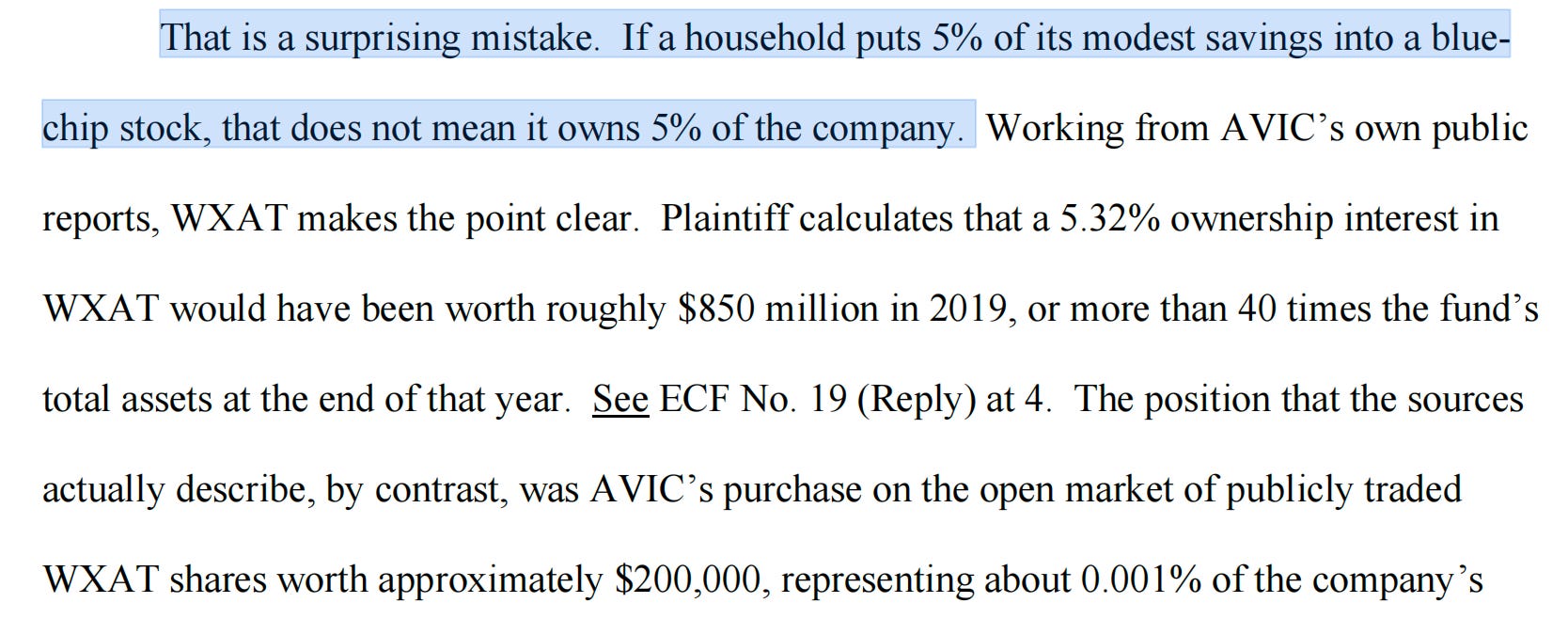
The actual position amounted to roughly 0.001% of WuXi, worth about RMB1.34 million ($200,000).
But everyone involved missed something more fundamental.
The Pentagon did not address it. WuXi’s lawyers did not raise it — indeed, their reply brief simply called the vehicle a “Chinese state-owned fund.” And because the 5.32% error was already enough to undermine the Pentagon’s rationale, the judge had no need to examine what the fund actually was.
The answer is straightforward:
This was not a pool of AVIC’s own corporate money. In terms familiar to an American investor, it was a publicly offered, open-end mutual fund.
Anyone could buy it
The clearest evidence comes from my phone - I can buy into the fund.
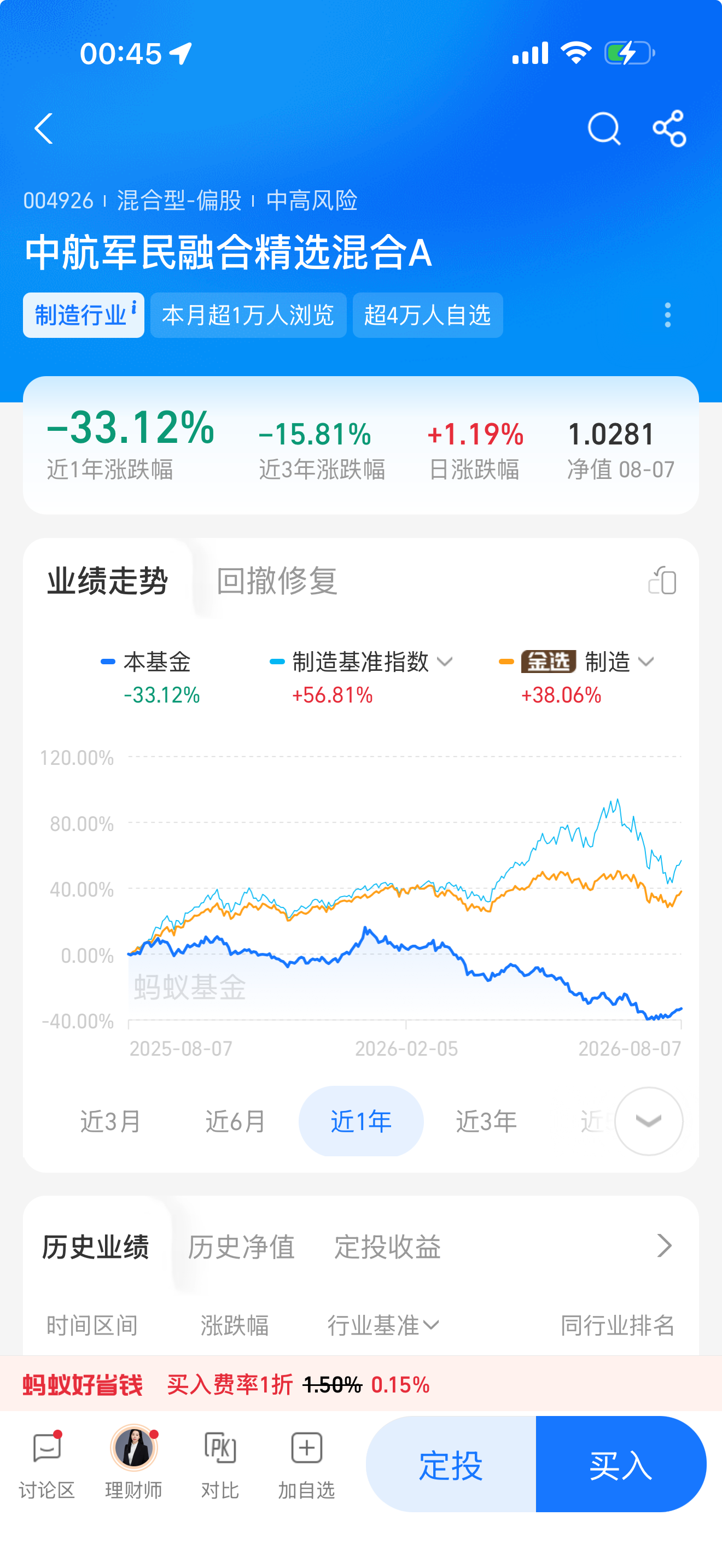
This post can end right here, but just in case, let’s look at the documents establishing and selling the fund.
Its original offering announcement described it as a contractual, open-end securities investment fund registered with the China Securities Regulatory Commission and offered publicly beginning in late 2017.
The eligible buyers expressly included individual investors, institutional investors and qualified foreign institutional investors. Investors could subscribe repeatedly, and the minimum subscription was just RMB100 ($15).
After launch, the fund remained open for subscriptions and redemptions. It was distributed through banks, securities firms and online fund-sales platforms, including channels used by hundreds of millions of retail investors, such as Alipay.
That is not the structure of an AVIC corporate investment account or an industrial fund capitalized from AVIC’s own balance sheet.
It is a retail financial product managed by an AVIC-linked asset manager.
Also, the fund manager disclosed, including at the time Pentagon alleged the fund was investing in WuXi, that it had not invested any of its own proprietary capital in the fund. And it reported that no other disclosed related party held fund units at period-end.
Chinese law also draws a sharp legal line between a fund manager and the assets it manages. The Securities Investment Fund Law provides that fund assets are independent from the proprietary assets of the fund manager and custodian and cannot simply be incorporated into their own property.
So even if an AVIC entity owns the asset manager, that does not make the assets held by the mutual fund AVIC’s assets.
Think of Vanguard launching a defense-themed mutual fund. If ordinary Americans put their savings into the fund and the fund manager buys Lockheed Martin shares, those shares do not thereby become Vanguard’s proprietary assets. Vanguard manages the investors’ pooled money; it does not own that money simply because it manages the fund.
That distinction is elementary. Yet it disappeared almost entirely once the words AVIC, Military-Civil Fusion and Fund were placed next to one another.
The money did not go to WuXi either
There is another important distinction hidden inside the word “investment.”
At June 30, 2019, the fund held 15,500 WuXi AppTec shares worth about RMB1.34 million ($200,000). During the first half of that year, it also recorded both purchases and sales of WuXi shares.
The shares had been purchased and sold on the public market.
That means the fund was not injecting fresh capital into WuXi AppTec. It was acquiring already-issued shares of a publicly listed company.
In a secondary-market transaction, the buyer pays the shareholder selling the stock. The money does not go to the listed company.
It is perfectly normal to say that a mutual fund “invested in WuXi” when it bought WuXi shares. But that is very different from saying AVIC funded WuXi, financed WuXi or injected state capital into the company.
A secondary-market purchase from another shareholder is not a funding stream into the company.
Three different things became one
Looked at carefully, three separate concepts were compressed into a single story.
The first has now been settled by the court:
5.32% of the AVIC fund’s portfolio is not 5.32% ownership of WuXi AppTec.
The second is a question of asset ownership:
an AVIC-linked company managing a mutual fund does not make the fund’s assets AVIC’s proprietary assets.
And the third concerns the nature of the transaction:
a mutual fund buying already-issued WuXi shares from other shareholders is not the same thing as AVIC providing capital to WuXi.
What is striking is that Point 2 and 3 appear to have escaped everyone.
The Pentagon saw AVIC Military-Civil Fusion Selected Fund and treated the holding as evidence of AVIC ownership. WuXi and its sophisticated lawyers correctly demolished the 5.32% calculation but themselves described the vehicle as a “Chinese state-owned fund.” The judge caught the mathematical and evidentiary error but understandably had no reason to investigate the fund’s basic structure.
Everyone in the lawsuit seems to have been led by the implications carried by three words: AVIC, military-civil fusion, fund.
Yet the underlying product was mundane enough that I can still open Alipay, search its name and buy it myself.
Sometimes the problem in China analysis is not that the answer is hidden in some impossibly hard-to-find document, or that it requires unusually deep expertise.
It is that something entirely ordinary starts to look extraordinary once it is translated into the language of national security.
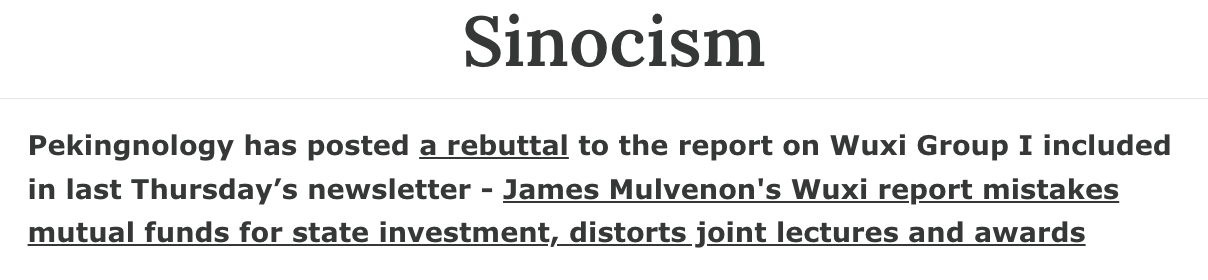
And I already wrote it two years ago - including even in the title “mistakes mutual funds for state investment”

The judge is correct, but your further comments raise a question. You establish that the entity "is a retail financial product managed by an AVIC-linked asset manager." AVIC is the Aviation Industry Corporation of China. Why does an aviation corporation have ties to an asset manager? In U.S. terms, this seems like Boeing having a financial tie to Fidelity Investments. (And although retail investors put in the money with which a Fidelity mutual fund buys shares of a company, all or nearly all proxy votes are voted by Fidelity, not by the retail investors.)