


In Chinese online slang, “35” has become a bleak joke: too young to die, too old to get hired.
The joke works because the number appears in real recruitment settings. Many civil-service posts are closed to applicants above 35. Corporate job advertisements, especially for junior and mid-level roles, often use the same cut-off. In practice, age can be screened before a candidate’s skills, work record, or productivity are considered.
The number also reflects how employers often assess workers in their mid-thirties. By 35, many Chinese workers have a salary history, a mortgage, children, ageing parents, and less tolerance for unpaid overtime presented as commitment. And failure to have achieved a managerial promotion or a notable career milestone by 35 is often read as a signal of low professional ability. These factors contribute to a negative framing of mid-career employees and make them less attractive to employers seeking to control labour costs and maintain a highly compliant workforce.
Yet despite numerous jobseekers’ complaints, screenshots of recruitment advertisements, and bitter memes about being pushed out in mid-career, evidence for the “35-year-old crisis” remained largely anecdotal. Now, Lin Wenlian, Assistant Professor at the School of Business, Sun Yat-sen University, gives the claim firmer empirical ground. Using age-requirement information from 59.69 million corporate job postings, Lin’s study finds that employers are especially likely to set 35 as an age limit. Using census data and a regression-discontinuity design around that threshold, it further finds that workers just above 35 face a higher risk of unemployment for employer-related reasons.
The paper was originally published in China Economic Quarterly, Vol. 25, No. 1, 2025. The following summary appeared on China Economic Quarterly’s official WeChat blog on 21 July 2025.
The following figures and tables are drawn from the original paper and its appendix, with the text rendered in English. Lin has agreed to this translation.
—Yuxuan Jia

林文炼:年龄歧视导致了失业?
Lin Wenlian: Has Age Discrimination Led to Unemployment?
In theory, employment discrimination refers to situations in which workers are denied equal employment opportunities and income levels due to non‑productivity‑related preferences (Becker, 1957). In recent years, age-based employment discrimination has become one of the issues of greatest concern in Chinese society. The “35-year-old crisis” examined in this study was listed by Workers’ Daily among the top ten labour-related buzzwords of 2023.
The term refers to age discrimination by employers against workers aged 35 and above, who often encounter difficulties in securing employment and face elevated risks of unemployment. In response, several members of the Chinese People’s Political Consultative Conference (CPPCC) have called for legislation to curb labour market discrimination against workers over 35 during recent Two Sessions [annual plenary sessions of the National People’s Congress (NPC) and the National Committee of the CPPCC].
Although age discrimination is widely acknowledged, empirical research on this phenomenon remains scarce. Existing discussions and surveys on the “35-year-old discrimination” and “35-year-old crisis” suggest that such discrimination may be linked to age restrictions in the civil service recruitment system, and that employers’ hiring decisions are often influenced by subjective assumptions that workers above 35 have diminished enthusiasm and energy. While some studies have identified 35 as a critical turning point in earnings for Chinese workers (Fang & Qiu, 2023; Ye Di et al., 2023; Dong Zhiqiang et al., 2023), these works do not directly examine age discrimination and therefore provide no direct evidence confirming its existence.
This study focuses on unemployment beyond 35 caused by age discrimination and interprets the phenomenon through the lens of heuristic decision-making in behavioural economics. When evaluating the probability of uncertain events, people tend to rely excessively on a specific reference point (anchor) to conserve cognitive resources (Tversky & Kahneman, 1974). Anchoring heuristics are commonly observed in corporate decision-making (Chen Shihua & Li Weian, 2016; Zhu Jigao et al., 2017). If employers’ assessments of worker productivity and hiring decisions are influenced by such heuristics, discrimination against workers over 35 and related unemployment may occur.
The study addresses the following empirical questions: Does age discrimination in China’s labour market contribute to unemployment among workers over 35? If so, is employers’ age discrimination associated with anchoring heuristics, and are statistical discrimination and age-based stereotypes the primary mechanisms?
To answer these questions, the study first extracted age requirement information from 59.69 million corporate job postings and found that employers are most likely to impose an age limit of 35. It then implemented a regression discontinuity design centred on age 35 using data from the 2015 population census.
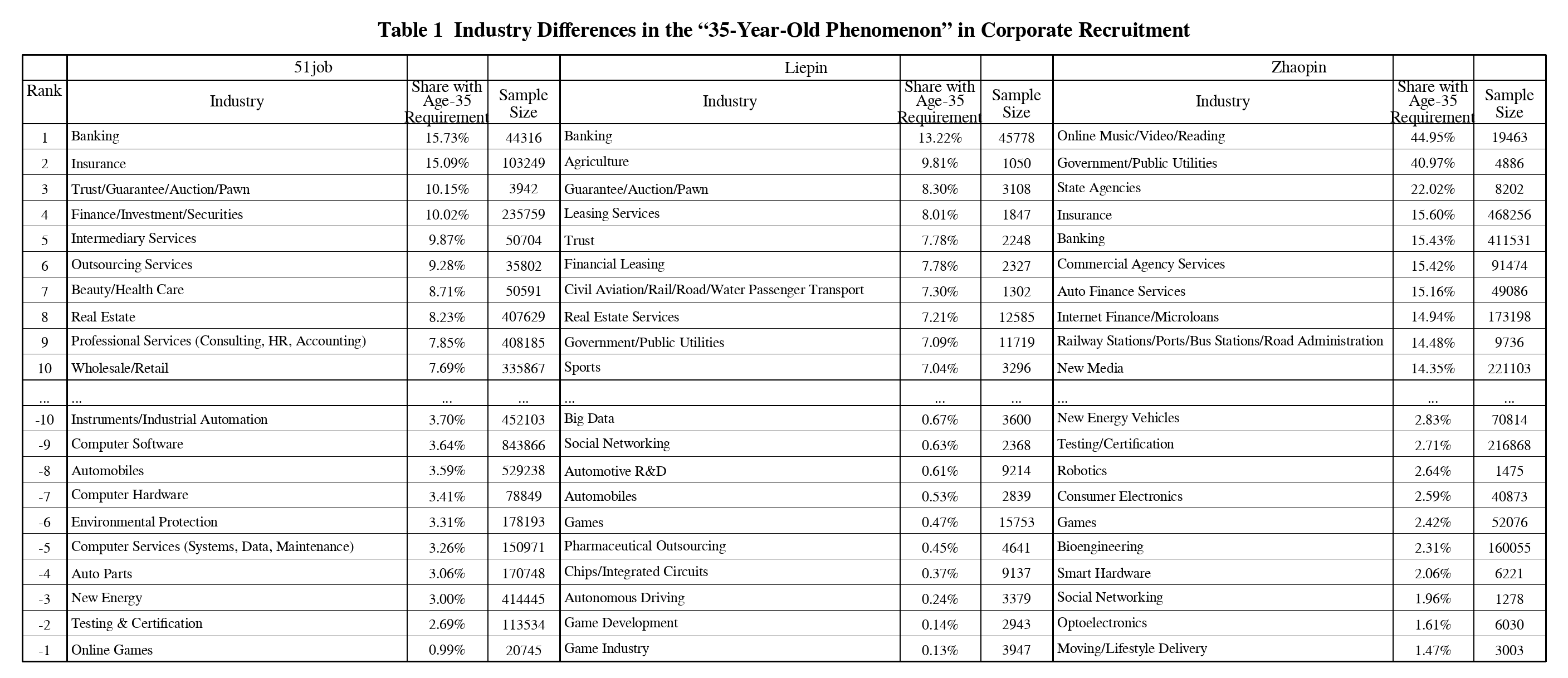
Research Findings and Contributions
Empirical results show that age discrimination contributes to unemployment among workers over 35. Holding productivity constant, the proportion of respondents unemployed due to employer-related reasons rises from 0.3970% to 0.5373% immediately after turning 35. Age 35 serves as the principal anchor for employer discrimination.
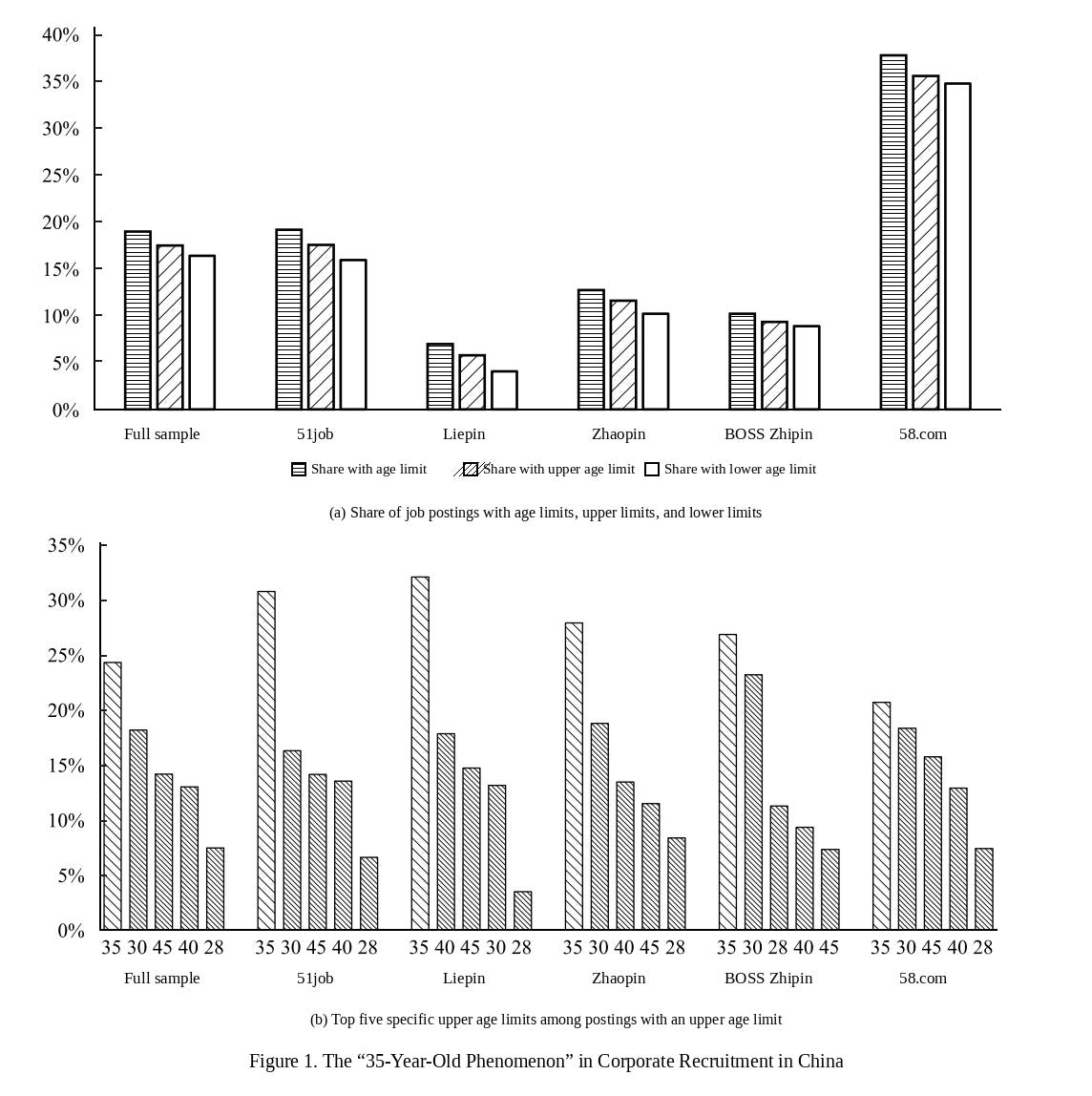
Analysis of recruitment data indicates that the main driver of 35-year-old unemployment is employers’ negative age stereotypes, such as beliefs that older workers are less healthy, less attractive, more likely to complain, less proactive, and slower to adopt new technologies. Positive stereotypes, by contrast, can mitigate age discrimination. Additional analyses reveal that the impact of age discrimination at 35 varies across regions, individuals, and time periods.
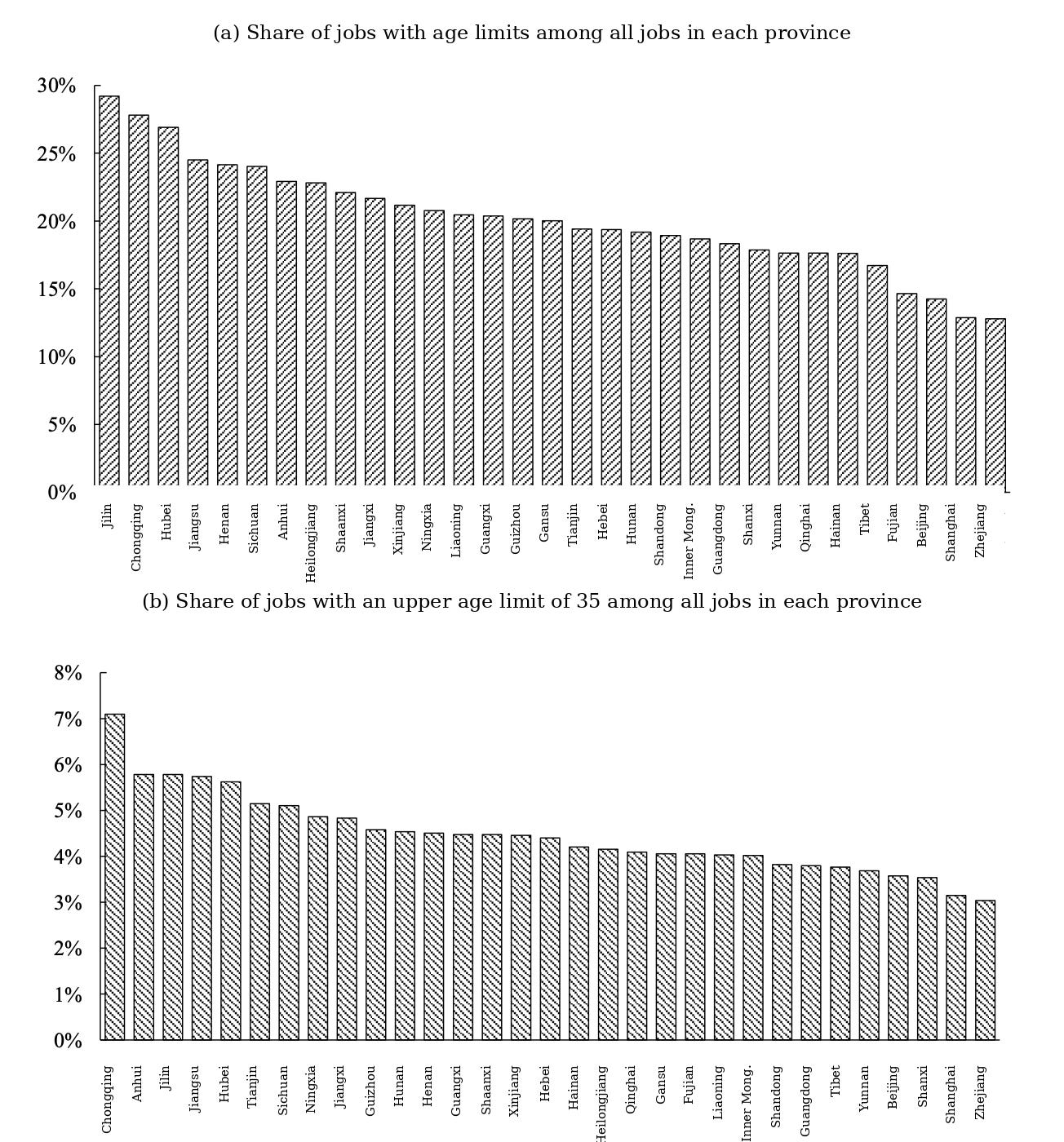
This study makes the following contributions:
First, it enriches the literature on labour market discrimination in China. Existing research has extensively examined discrimination in China’s labour market based on gender, household registration (hukou), educational attainment, physical appearance, and body shape, but has paid comparatively little attention to age discrimination. By providing empirical evidence on the relationship between age discrimination and unemployment, this study offers an important supplement to the existing literature.
Second, the discussion of anchoring heuristics helps deepen the understanding of how age discrimination is formed. Existing experimental studies suggest that employers’ age discrimination mainly arises from statistical discrimination caused by a lack of information, which is often manifested in age stereotypes. This study further finds that, under the influence of anchoring heuristics, employers’ age stereotypes and age discrimination exhibit a form of “psychological discontinuity.”
Third, the regression discontinuity design proposed in this study expands the methodological toolkit for research on age discrimination. As Neumark et al. (2019) point out, résumé experiments typically compare job-search outcomes among workers with relatively large age gaps, making it difficult to control for productivity-related factors that vary with age. By comparing workers with only small age differences, the regression discontinuity design developed in this study can better address this problem.
Fourth, this study encourages scholars to make greater use of corporate recruitment data in China to examine a wider range of labour market issues. By using textual information from job requirements, this paper reveals the statistical characteristics of the “35-year-old phenomenon” and tests the stereotype-based mechanism through which age discrimination leads to unemployment at age 35. Because employers’ age discrimination is difficult to observe directly, scholars have found it hard to conduct effective research on its causes, consequences, and possible remedies. This study shows that corporate recruitment data can help advance research on age discrimination.
Policy Implications and Future Research Directions
This paper offers the following policy implications:
First, policy design should take into account the dual effects of age discrimination on both employment and unemployment.
Second, efforts should be made to reduce negative age stereotypes among employers and reinforce positive ones, thereby alleviating unemployment caused by age discrimination.
Third, measures should be taken to weaken the anchoring effect around age 35 and mitigate discrimination against workers over 35.
Fourth, given that age discrimination is difficult to observe, age-limit information in corporate job postings can be used to assess its prevalence in the labour market.
Future research on age discrimination may proceed in several directions:
First, the causes of age discrimination. This paper finds evidence of an anchoring effect in age discrimination, but there is still a lack of direct evidence on whether this effect mainly originates from age limits in civil service recruitment.
Second, the economic consequences of age discrimination. Beyond its direct effects on employment and unemployment, age discrimination may also affect firm productivity, household consumption, and investment decisions, and individuals’ willingness to invest in human capital.
Third, the factors shaping age discrimination. This paper finds temporal heterogeneity in age discrimination and its impact on unemployment, but the factors driving such variation remain unclear. Further research on these issues would help clarify the formation process and economic consequences of age discrimination, and provide more effective policy recommendations for achieving high-quality and full employment in China.
[References are available here.]

Dandan Zhang: China’s factory workers go gig

Dandan Zhang is a Professor in Economics (with tenure) and Deputy Dean (in research, internal and international cooperation) at the National School of Development (NSD), and Deputy Dean of the Institute of South-South Cooperation and Development, Peking University.
Cai Fang: theorising AI’s impact on China’s employment future

Cai Fang is a former Vice President—meaning Vice Minister—of the Chinese Academy of Social Sciences (CASS). He currently holds the title of Academician (学部委员 ), reserved for CASS’s highest-ranking scholars. He is also President of the Chinese Association of Labour Economics
What stands out to me here is that the research finally gives measurable shape to something many experienced professionals have felt for years but struggled to prove. Ageism is often discussed as though it sits in the realm of perception or anecdote, yet the data here shows a very real structural pattern forming around an arbitrary threshold.
In my experience, the damage goes beyond employment statistics. Once capable people begin to internalise the idea that their value declines after a certain age, organisations lose judgement, resilience, historical perspective, and institutional memory all at once. The irony is that many businesses simultaneously complain about weak leadership pipelines while filtering out the very people who have accumulated the depth that leadership requires.
I’m confused. This article says, “Using age-requirement information from 59.69 million corporate job postings, Lin’s study finds that employers are especially likely to set 35 as an age limit.” But it also says that age discrimination is difficult to observe. Why? It’s right there in the job posting!